Units of Measure Continued
Power - depends on the total amount of time you have to complete the work
everyone can produce huge amounts of work if given enough time
Power = work / time
Power (W) = Work (J)/Time (s)
Why is power important?
It provides the rate at which exercise is performed, tell us the intensity
Common terms to use for Power
Watt - 1 W = 6.12 kpm
Horsepower - 1 hp = 745.7 W or 10.69 kcal
Kilopond-meter - 1kmp = 0.163 W
Find power if performing 20,000 J of work in 60 sec

What’s required to calculate how much work and power we produce?
Work
we need a force produced
Need a distance, how much distanced we produced
Power
Need to know the work produced and how long it took us to do the work
Measurement of work and power
Ergometry
Measures work output
Ergometer
Device used to measure work
Bench step ergometer
Cycle ergometer
Arm ergometer
Treadmill
Bench step-calculation of work and power example:
70 kg subject, 0.3 m step, 30 steps/min for 10 min
Calculate the force produced by the subject
Determine distance traveled
Calculate total work produced
Convert this to proper units
Calculate the amount of power this subject produced
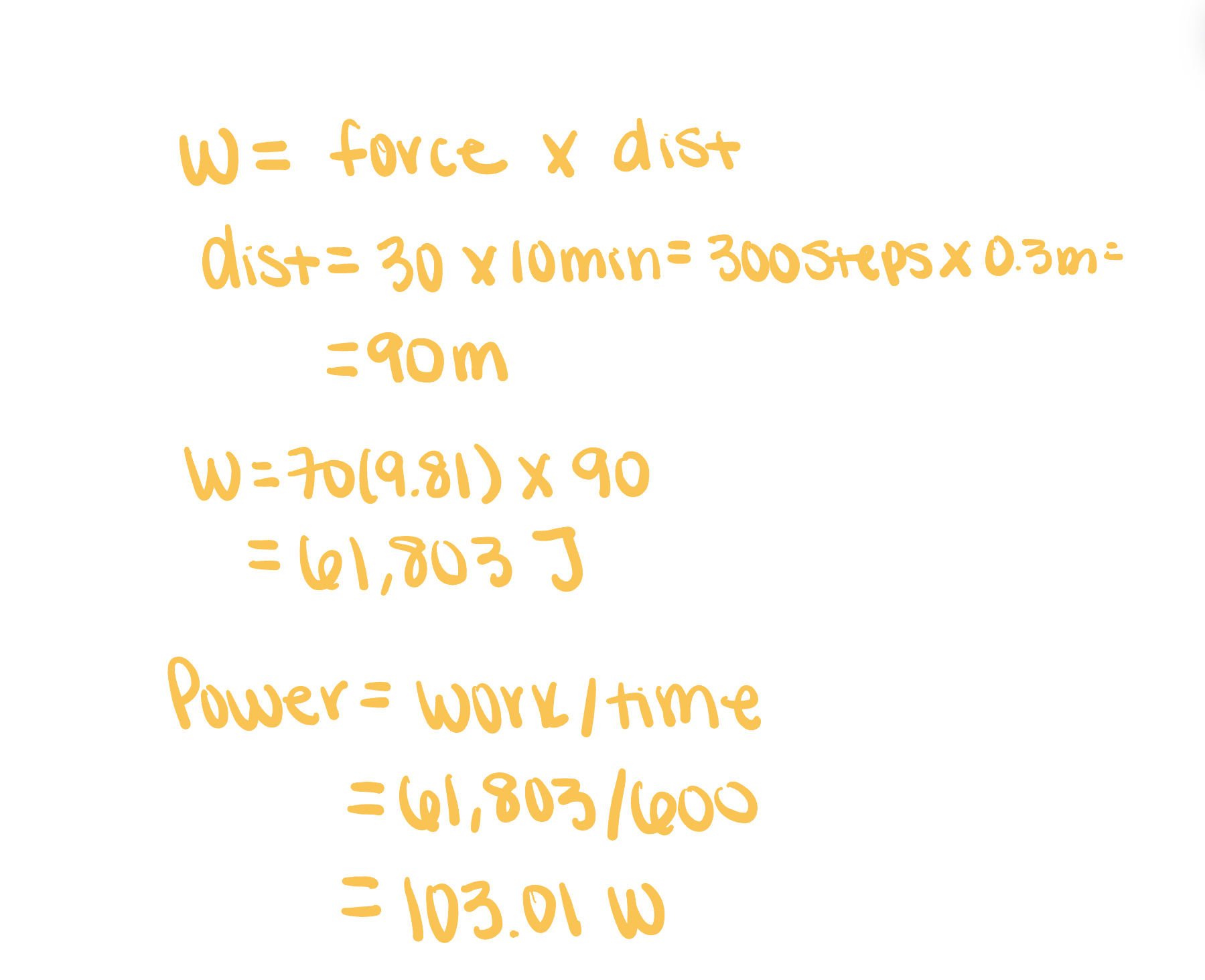
How many kcals per hour was this activity? - 1 watt =-0.0569 BTUs per minute 0.86kcal per hour

Cycle Ergometer-calculation of work and power - stationary cycle that allows accurate measurement of work performed
1.5 kp resistance, 6 m(rev^-1), 60 rev(min) for 10 min
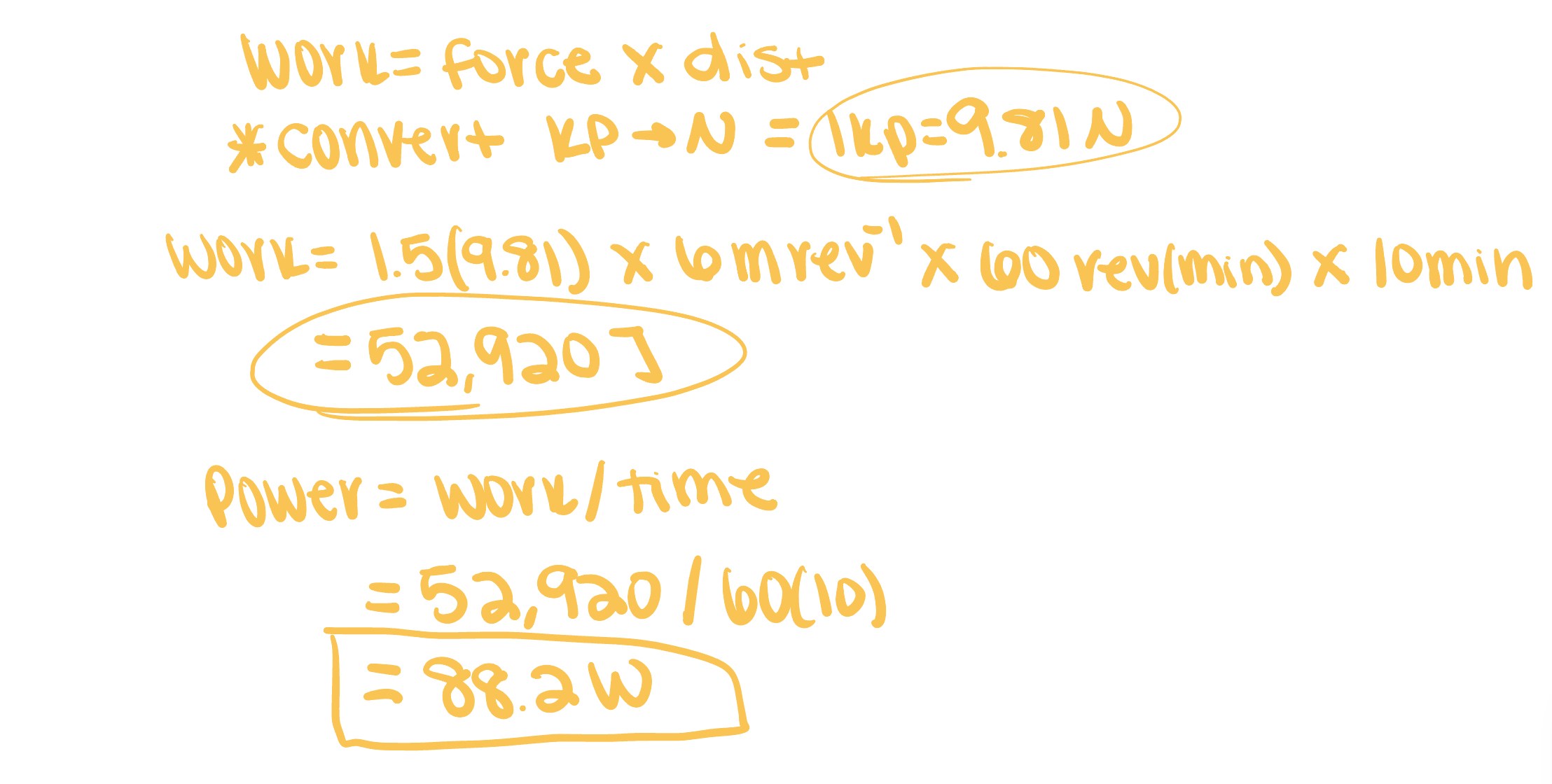 Convert to kcal? - 4186 J/kcal

MET:
resting metabolic rate
Taken as 3.5 mL kg min^-1
Energy expenditure of physical activities expressed in terms of multiple of MET unit
you need 500 MET minutes per week for optimal cardiovascular health
That is about 150 minutes of moderate intensity exercise per week
Biking 3 times a week at 13mph for 15 minutes & walking at an incline for 15 minutes 2 times a week will get you to 500 MET per week requirement
Estimation of Energy Expenditure:
VO2 = 0.1 mL(kg)(min) x speed + 3.5 mL(kg)(min) *WALKING
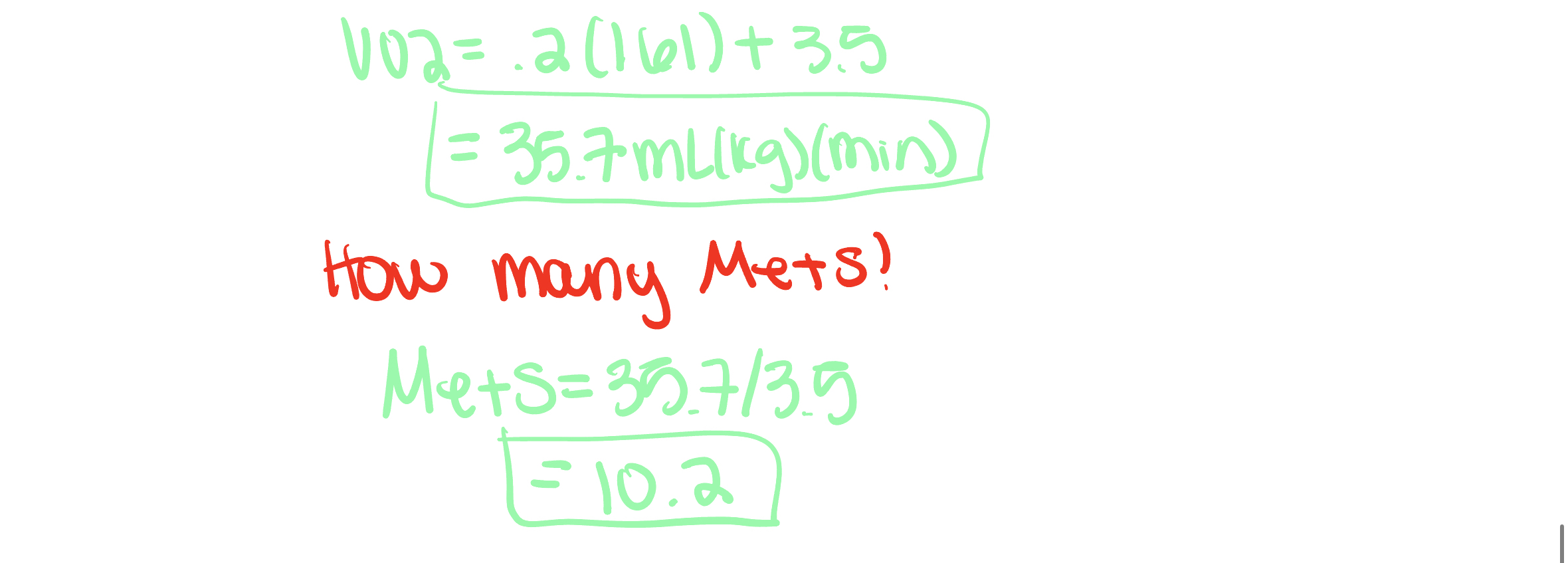
VO2 = 0.2 mL(kg)(min) x speed + 3.5 mL(kg)(min) *RUNNING
What is the O2 cost of walking at 80 m/min:
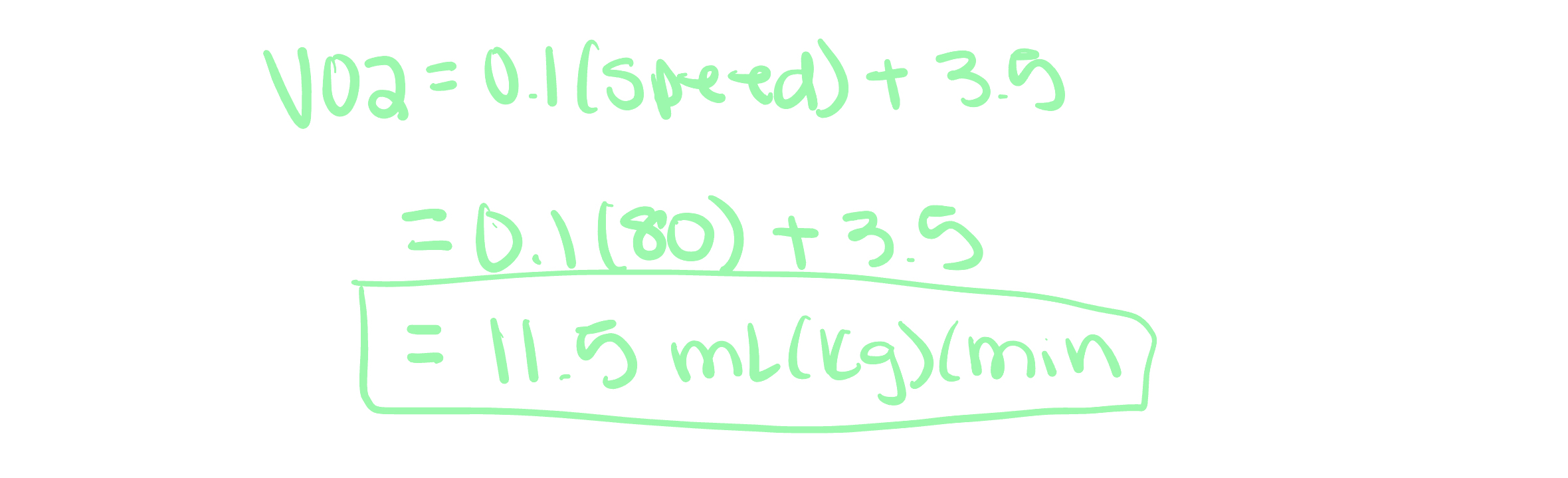
how many kcals per minute will they be burning with a 60kg person
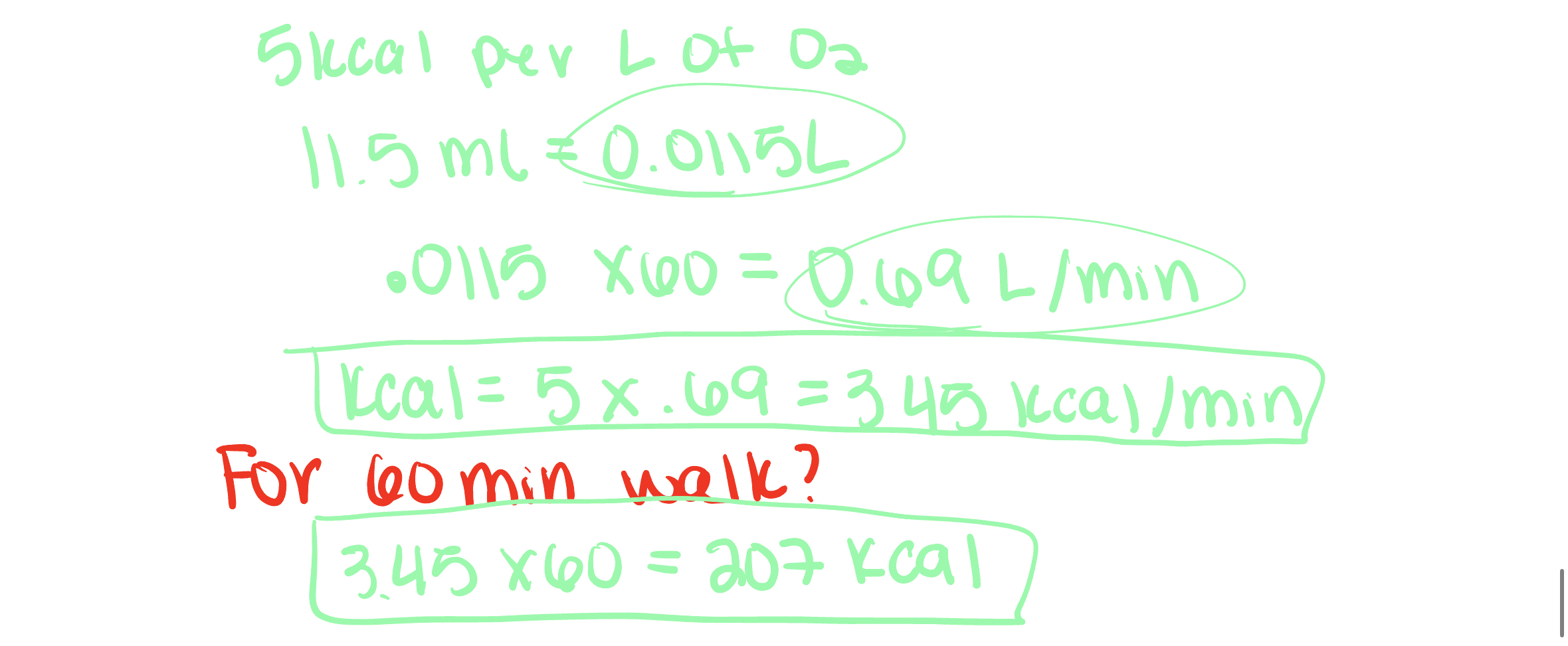
How many MET of activity is walking at this speed

What is the oxygen cost (O2) of a person running at 6mph (161 m/min):
Running Economy:
oxygen cost (energy expenditure) of running at a specific speed
Lower VO2 at the same speed indicates better running economy
Muscle Fiber Type:
slow muscle fibers are more efficient in using ATP compared to fast (type eight fibers)
Individual differences in running economy:
elite runners are more efficient to non-runners