med trauma 2
Injury | Is it a life threat? (need to be managed immediately (during head-to-toe) or during transport) | Treatment |
Abdominal Evisceration | It depends on the amount - may need to cover prior to rolling patient | Apply moist, sterile dressing---don't push contents back in. Cover with foil or plastic wrap to prevent heat loss. |
Abrasions | During transport | Cover with a dry, sterile dressing |
Avulsion | During transport | Fold the tissue to its normal position and apply a dressing |
Amputation | Only life threatening if associated with profuse bleeding | Control bleeding. Apply tourniquet if needed. Wrap amputated part in gauze; find amputated part, place it in a bag that is in another bag of ice; don't delay transport in an attempt to find the amputated part |
Burn | During transport | Dry, sterile dressing |
Flail Chest | If assosicated with inadequate ventilations it is a life threat and you need to assist ventilations with a BVM | Assist ventilations with a BVM. |
Impaled Object | Not a life threat unless it impedes the airway or performing CPR. You should not stop your assessment to treat it, but if you have an extra partner, they can stabilize it before rolling the patient. | Manually stabilize the impaled object with bulky dressings, and do not remove. Only remove if the object is life threatening (i.e. preventing the patient from breathing) |
Laceration | depends on size of lacertation; if profuse bleeding it is a life threat and needs immediate attention, otherwise it is a secondary wound to be managed in the ambulance as time permits. | direct pressure. If bleeding not controlled, apply a tourniquet (if on an extremity). If in chest/abdomen, use hemostatic agent and/or pack the wound. An occlusive dressing is only required if it is a neck injury and we are concerned with an air embolism. |
Long-Bone Deformity | Not a life threat. If patient is high-priority, placing him on LSB will stabilize the long-bone. If not a high priority, or it is an isolated injury, you can treat it on-scene. | Appropriate splints/casts (again, only if not a high-priority patient); femur fracture = hare traction splint; |
Pneumothorax (sucking chest wound) | Life threatening | Immediately cover with gloved hand, place an occlussive dressing on it and allow to "burp" every so often. Assist ventilations with BVM if ventilations are not adequate. If a tension pneumothorax develops, "burp" the dressing to relieve pressure but pulling back on one corner of the dressing. Reapply as the patient exhales. |
Joint Injury | Non a life-threat | shoulder = sling and swathe; ankle or knee = pillow splint; vacuum splint, air splint, or possible padded board splint. |
Pelvic Fracture | Possible life-threat due to blood loss. | Do not roll the patient. Apply pelvic splint or or stabilize with a sheet or blanket. Treat for shock if indicated. 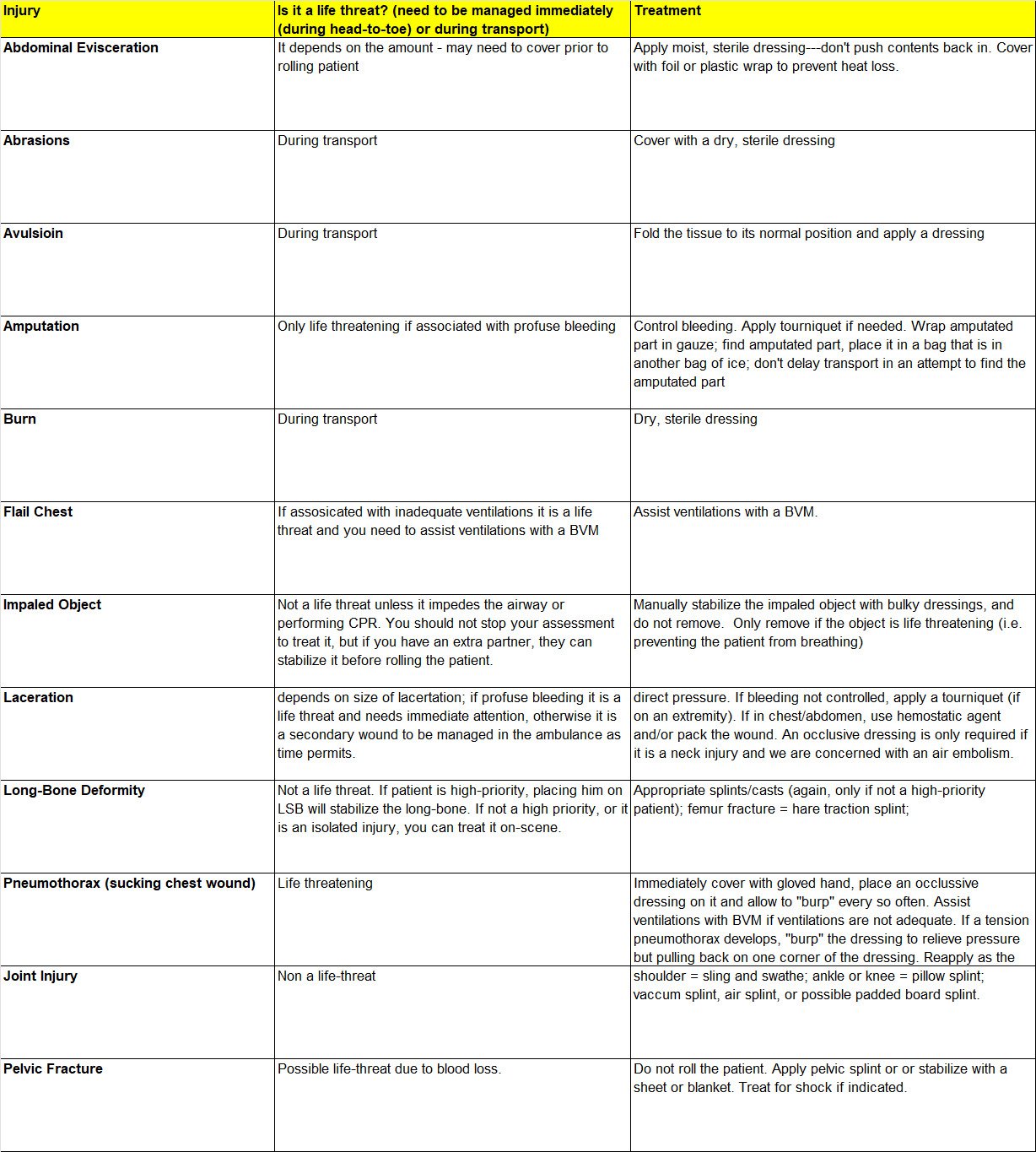 |