ENTREP Q2
ENTREP Q2
LESSON 1: BUSINESS PLAN
What Is a Business Plan?
A business plan is a document that defines in detail a company's objectives and how it plans to achieve its goals. A business plan lays out a written road map for the firm from marketing, financial, and operational standpoints. Both startups and established companies use business plans.
The Importance of the Business Plan
1. Well prepared business plan is a good instrument to use when you want to borrow money from the bank for your business.
2. The business plan can minimize the cost of production.
3.The business plan can also identify the defects/risks of the business operations and also help make decisions regarding expanding his business.
4. Well prepared business plan is a good guide to the entrepreneur when he starts operating the business.
TABLE OF CONTENTS
Business Logo
I. Executive summary
II. Business Description
Mission Statement
Vision Statement
Business Goals
Legal Structure
III. Product Description
IV. Market Analysis
V. Marketing Plan
VI. 4M’s of the business
VII. Financial forecast and the expected returns, risks and contingencies
Appendices
BUSINESS LOGO
Explain or describe your logo.
A logo is a symbol or design used to identify a company or organization, as well as its products, services, employees, etc. In its simplest definition, a logo identifies. It's how your company is recognized and remembered among others. It also functions as the face of your business.
I. Executive summary
The executive summary is part of the business plan and it is the most important. It highlights the business name, location, product or service to be sell, purpose and the projected sales and profits. This section tells your readers where your business plan is and where you want to take it. It is also your way to grab their interest and keep them reading or make them bored. More than anything else, it shows the success of your business idea. The executive summary should be the last section to do with not more than four pages in length. The purpose of the executive summary of the business plan is to provide your readers with an overview of the business plan.
II. Business Description
Mission Statement is used by a company to explain, in simple and concise terms, its purpose(s) for being. The statement is generally short, either a single sentence or a short paragraph.
VISION STATEMENT describes what a company desires to achieve in the long-run, generally in a time frame of five to ten years, or sometimes even longer. It depicts a vision of what the company will look like in the future and sets a defined direction for the planning and execution of corporate-level strategies.
III. PRODUCT DESCRIPTION
1. Business offerings = description of what your business is selling.
2.Industry = to which industry your product or business belong.
INDUSTRY refers to is a group of companies that are related based on their primary business activities
examples of industry:
- Real Estate industry
- Food industry
- Tourism industry
- IT/BPO industry
- health services
- transport
- Product ( Picture of your product/ service offering)
IV. MARKET ANALYSIS
A market analysis studies the attractiveness and the dynamics of a special market within a special industry. It is part of the industry analysis and thus in turn of the global environmental analysis. Through all of these analyses the strengths, weaknesses, opportunities and threats (SWOT) of a company can be identified.
V. MARKETING PLAN
A marketing plan may be part of an overall business plan. Solid marketing strategy is the foundation of a well-written marketing plan so that goals may be achieved. While a marketing plan contains a list of actions, without a sound strategic foundation, it is of little use to a business.
Writing a marketing plan will help you think of each campaign's mission, buyer personas, budget, tactics, and deliverables. With all of this information in one place, you'll have an easier time staying on track with a campaign. You’ll also discover what works and what doesn't. Thus, measuring the success of your strategy.
VI. 4M’s of the business = the four critical domains, usually attributed to manufacturing
a. Materials = raw materials or ingredients needed to produce the product
b. Methods = refers to the process or technique of converting raw materials to finished goods.The raw material undergoes several stages before it is completed and becomes ready for delivery to the target consumers.
c. Manpower = personnel needed to operate the business
d. Machineries = refers to the manufacturing equipment used in the production of goods or delivery of services
VII. FINANCIAL FORECAST and the Expected returns, risk and contingencies
Your business requires capital to manage the day-to-day expenses, this can be challenging in this economy. When you have access to working capital, you have more choices. First, you must understand the type of small business funding you can qualify for and who you can rely on and an important part of the decision making process. Some banks and institutions build their whole reputation on the financial needs of businesses–large and small.
FINANCIAL FORECAST
financial projections performed to facilitate any decision-making relevant for determining future business performance.
Importance of financial forecasting
Hypothetically speaking, failure to conduct regular financial forecasting leaves you flying blind.
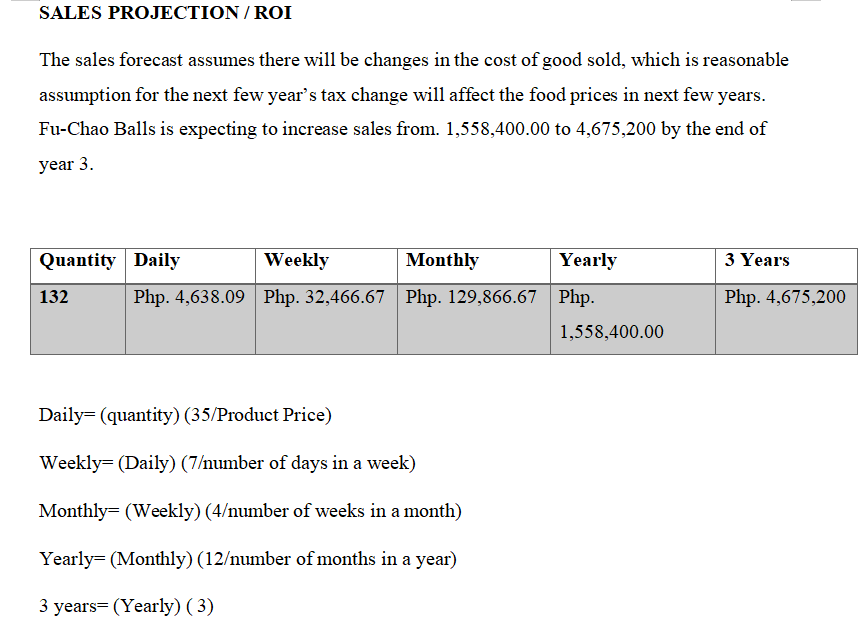
Sales projection estimates future sales revenue by analyzing historical sales data and using it to predict future sales patterns.