RT prelim
CHAPTER 1:
HEALTHCARE ENVIRONMENT
- creation of a helpful atmosphere and milieu at a healthcare setting in which a patient is undergoing
treatment.
- The creation and maintenance of a proper healthcare environment is indeed the responsibility of everyone
involved, right from government policy makers and stakeholders down to minutest level of the individual
healthcare worker.
- Coordination ensures that the right healthcare environment is created and maintained at all times.
- A number of factors go into ensuring a good healthcare environment.
- Ensuring the putting in place of a sound healthcare environment requires implementing the following:
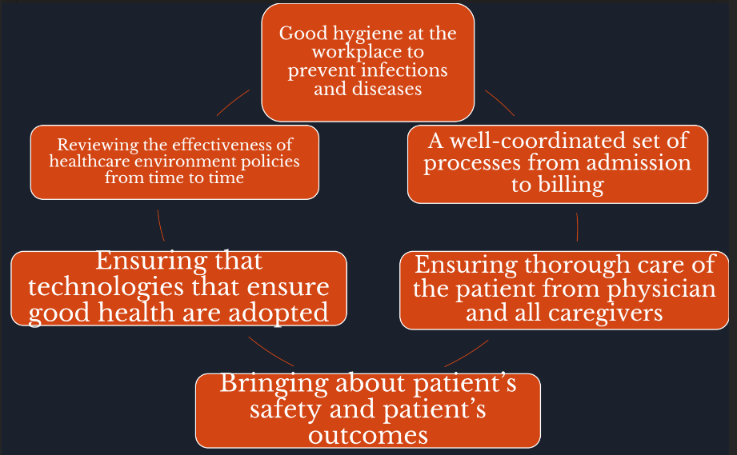
HEALTHCARE SETTINGS
- Other important factors ○Supplementary factors affecting more on human aspect and less with physical factors
- Making sure the healthcare professionals work in a congenital and motivating work atmosphere
- Attrition in industry affects in ensuring healthcare environment
- Promoting positive human interaction at the healthcare setting
- Go a long way in ensuring a very vibrant and happy healthcare environment
HOSPITAL
- An institution built, staffed and equipped for diagnosis of disease; for treatment, both medical and surgical,
of sick and injured; and for their housing during process.
- Modern hospital often developed outpatient facilities, as well as emergency, psychiatric and
rehabilitation services.
- “bed less hospitals” provide strictly ambulatory (outpatient) care and day surgery.
- Developing countries containing large proportion of world’s population, generally do not have enough hospitals, equipments and trained staff to handle volume of persons who need care.
- Developed countries’ hospital is complex, and is made more so as modern technology increases the range of diagnostic capabilities and expands the possibilities for treatment.
HISTORY OF HOSPITAL
- Early 4000 BCE, temples of Saturn, Asclepius in Asia Minor were recognized as healing centers.
- 431 BCE – hospitals established in Sri Lanka
- 230 – hospitals established in Hindustan by King Ashoka
- 100 BCE – Romans established hospitals called “Valetudinaria”
- 331 CE – modern concept of hospitals developed
- 370 CE – St. Basil the Great established religious foundation including hospital
- St. Benedict of Nursia at Montecassino, founded early in the 6th century
- One of the first medical schools in Europe ultimately grew at Salerno and was of high repute by the 11th century
- 542 – Hotel-Dieu of Lyon opened giving more attention to the patient’s well-being
- Infirmatorium – place where their sick were taken for treatment ○Pharmacy – managed by monasteries, frequently a garden with medicinal plants
- Middle ages - Religion affects the influence in establishment of hospitals
- 11th century – growth of hospitals accelerated
- 1099 – Order of St. John established in Holy Land a hospital that could care for some 2,000 patients specialized with eye disease
- The first of specialized hospital
- 12th century – number of hospitals grew rapidly in Europe
- Hospital of Holy Ghost – founded in 1145 at Montpellier France, is one of the most important center in Europe for training doctors
- 1718- first voluntary hospital in England established – Hugeunots from France
- 1719- Westminster Hospital in London founded
- 1724- Guy’s Hospital founded
- 1740- London Hospital founded
- 1736-1787 – hospitals established outside London in at least 18 cities
- 1729 – Little Hospital, the first voluntary hospital, opened in England
THE MODERN HOSPITAL CLASSIFICATIONS:
- By ownership and control
- By type of service rendered
- By length of stay
- By size
- By facilities and administration provided
Examples: (1) General Hospital (2) Specialized Hospital (3) Short-Stay Hospital (4) Long-term-care facility
BED NUMBER AND LENGTH OF STAY
○Modern hospitals tend to rarely exceed 800 beds
○In early 21st century, 800 beds was the largest unit that a facility could be governed
○Average bed-occupancy rate – percentage of available beds occupied per day or per month
○Bed-occupancy rate may be higher in cold winter months
○ALOS- average length of stay
● In acute-care hospital, ALOS will be relatively short
● In hospitals catering to chronically ill, ALOS will be higher
OWNERSHIP AND CONTROL
- Hospitals mostly owned and operated by government
- In Canada, hospitals are owned by religious orders and are contracted to deliver publicly funded services
- Other hospitals may be owned by municipalities or provincial or territorial governments.
- Many hospitals are associated with universities; others were founded by religious groups or by public-spirited individuals.
FINANCING
- In some countries, operating costs may be supplemented in part by public or private sources that Pay charges on uninsured or inaduequately insured patients or by out-of-pocket payment by these individuals.
- countries like europe, the financial support of services in hospitals tends to be collectivized, with funding provided through public revenues, social insurance or a combination of the two private insurance funds offer an alternative mechanism of hospital financing
THE GENERAL HOSPITAL
- may be academic health facilities or community-based entities.
- they admit all types of medical and surgical cases
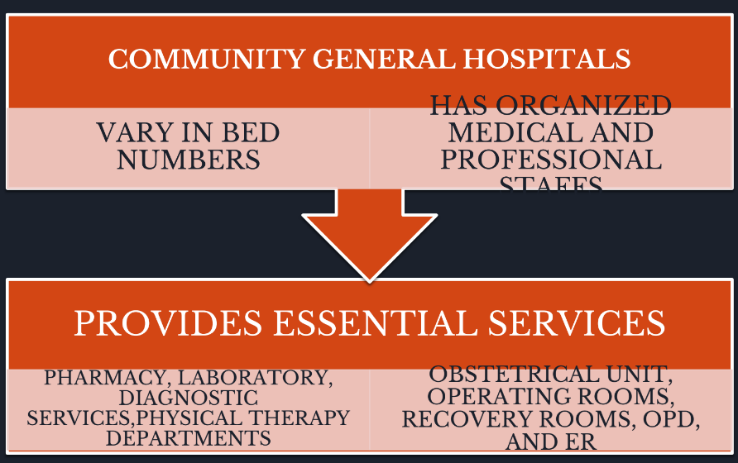
LARGER HOSPITALS MAY HAVE ADDITIONAL FACILITIES:
- Dental Services
- Nursery For Premature Infants
- Organ Bank
- Dialysis Department
- Equipment For Inhalation Therapy
- ICU
HOSPITAL BOARD
– Establishes policy and on the advice of medical advisory Board, appoints a medical staff and administrator.
ADMINISTRATOR
- Chief executive officer of the hospital
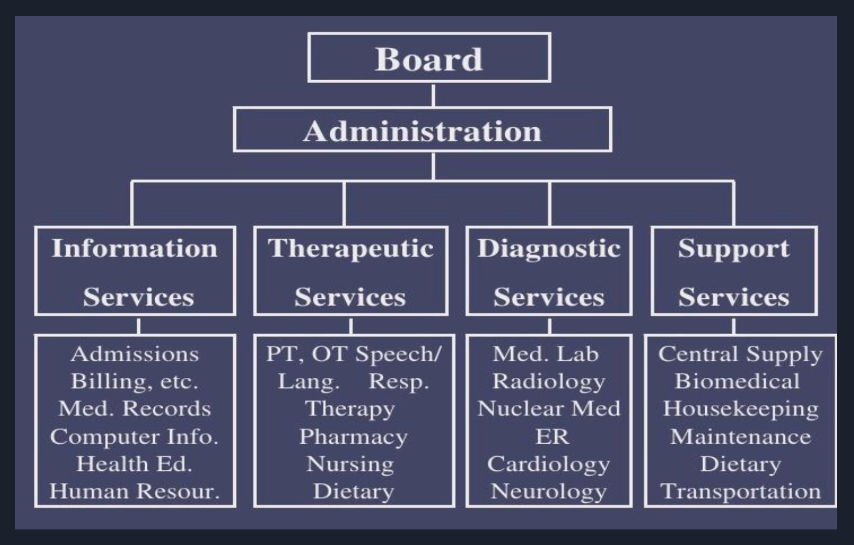
● Teaching hospitals are affiliated with undergraduate and post graduate education of health professionals.
SPECIALIZED HEALTH AND MEDICAL CARE FACILITIES
- Generally found in the developed world
- specialized health services often are a department of general hospital or a satellite operation of the hospital
● Tuberculosis and Leprosy hospitals
- 1880- 1940 – tuberculosis hospitals provided rest, relaxation, special diets and fresh air.
- A stay of more than 2 years was thought necessary to effect a healing of the disease
- Permanent cure was not considered entirely feasible
● Today, the use of antibiotics along with advances in chest surgery and routine x-rays, made the treatment of TB need
not to be carried out in specialized facility.
○ Leprosy – known to be contagious
○ Lazar houses – hospitals for infectious disease patients
- Established throughout Europe in Middle Ages
Chronic Leprosy
- Treated by surgical correction of deformities, occupational therapy
- Rehabilitation and sheltered living in associated villages
Acute Leprosy
- Treated in general hospitals, clinics and dispensaries
MENTAL HEALTH FACILITIES
- Formerly called asylums or mental hospital
- Patients are encouraged to participate in facility-based activities and programs.
- Through the use of appropriate medication and support services, patients have integrated into the community.
- The strong correlation between mental illness and addiction has been noted and has given rise to numerous programs incorporating the simultaneous treatment of both conditions.
LONG-TERM-CARE FACILITIES
- Homes for the elderly, the infirm and those with chronic irreversible and disabling disorders
- Often staffed with health professionals and equipped to care for patients with extensive needs for daily living
- Represents extension of hospital health care system
PRIVATE HOSPITALS
- Private facilities may be designed specifically for example, cataract or joint surgery.
- Small hospitals are called nursing homes in Britain
- Medical practice in developing countries is characterized by proliferation of many small private hospitals, usually owned by doctors.
THE HOSPICE
- A guesthouse intended for pilgrims, often closely connected with monastery and supervised by monks.
- 1905 – St. James Hospice developed in Modern Britain
- 1967 – St. Christopher Hospice founded
- 1974 – New Haven Hospice, first hospice in United States, was established currently called Connecticut Hospice
- Hospice care addresses the patient’s physical, emotional, social and spiritual needs
- also helps the patient’s family caregivers
- takes place in the patient’s home or in a home-like setting
- concentrates on managing a patient’s pain & other symptoms so that the patient may live as comfortable as possible and make the most of the time that remains
- believes the quality of life to be as important as length of life
MISSION HOSPITALS
- Christian missionaries had a great influence on the creation of centers of Western medicine (Conventional medicine) and in promulgating the concept of hospital
- Medical missionaries promoted the idea and ideals of nursing as a profession for native men and women
- A Mission hospital functions as a general hospital in the sense that it admits all who need hospital care
EXTENDED HEALTH CARE
- Progressive care divided into 5 categories
- Intensive care
- Intermediate care
- Self-care
- Long-term care
- Organized home care
SELF-CARE – are organized into separate units in which ambulatory patients who require only diagnostic/ convalescent care
- Patients can be considered ready for home care when:
- Diagnosis and a plan for treatment have been established
- Inpatient hospital facilities are no longer required for proper care
- Nursing service has found that physical environment of the home is such that the patient receives adequate care
- Patient is too ill to visit an outpatient clinic but does not need hospital care
- Family environment would have therapeutic effect and family members can be taught to provide necessary care
- Family and patient prefer care be provided at home
REGIONAL PLANNING
- Early 21st century, regional planning of hospital services in Sweden was highly organized
Three different levels of health care:
• Primary - General practitioner
• Secondary - Small hospitals that offered most medical specialties
• Tertiary - University hospital
- General hospitals were called “UCHASTOK” in Soviet Unions served populations 2,000 to 15,000 persons
- District hospitals had 250-500 beds usually for surgical, medical, obstetric and pediatric services.
- Regional hospitals – served a population of 1,000,000 – 5,000,000 people contained up to 1,250 beds.
- Metropolitan planning council – term used to denote an advisory planning group that coordinates services between member hospitals and decides where specialized services are to be delivered
TELEMEDICINE
- Refers to the provision of remote clinical services, via real-time two-way communication between patient and healthcare provider using electronic and visual means.
- provides convenience to patients and practitioners by obviating the necessity for physical visit to get medical advice or treatment
Important terms in telemedicine
- Practiced from a site where the distant practitioners deliver service through telecommunications
- Telemedicine usually employs a desktop computer with special video card.
- Uses services such as store-and-forward, where camera images are stored and forwarded
- Remote monitoring is another aspect of telemedicine
Benefits of Telemedicine
- Requires no significant outlay other than two things:
- A web camera and secure patient portal that connects the doctors
- Ensures safety
- Convenience and lower waiting time for consultation
- Lesser cost of most consultations
- Produces improved health outcomes
CHAPTER 2:
HOSPITAL ORGANIZATION
ORGANIZATION
- collection of persons, materials, procedures, ideas or facts arranged and Ordered that the combination of parts makes a meaningful whole that works towards achieving organizational objectives.
MISSION STATEMENT
- defines the hospital’s business, its objectives and its approach to reach those objectives
VISION STATEMENT
- describes the desired future position of the hospital
Sample of hospital vission
A community in which all people achieve their full potential for health and well-being across the lifespan. We work to be trusted by patients, a valued partner in community, and creators of positive change
HOSPITAL PHILOSOPHY
- Strive to maintain balance in our pursuit of excellence in clinical care, quality improvement, research and education
- Seek out well-trained physicians with excellent clinical skills as well as academic interests.
- Support those interests through hands-on mentorship, and tailored opportunities for professional development
- The result is a diverse and exceptional group of faculty that will enjoy successful academic careers in hospital medicine
- Describes the desired future position of the hospital
HOSPITAL ORGANIZATION
- Board of Trustees
- “governing board”
- Protect the assets of hospital
- Establishes hospital’s mission, bylaws and strategic policies
- Selects administrative leader
- Delegates hospital’s daily operations
- Executive Administration
- CEO reports to governing board
- Provides leadership on implementing strategic goals and decision set by the Board
- Represents the hospital to external environment and community
- CEO coordinates collective effort of the hospital’s personnel
- The Medical Staff
- Formally organized self-governing unit within the hospital
- Composed of – Physician, doctoral level health care professionals (Dentist or Psychologists)
- Physician
- leader of clinical team
- Diagnose patient’s condition accurately
- Prescribe the best and most cost-effective treatment plan
- Nursing Services
- Responsible for carrying out the treatment plan developed by the physician
- Also called patient care services
- Largest component of the hospital
- Allied Health Care Services
- Number of departments perform support functions that help with diagnosis and treatment
- Clinical laboratory – performs variety of Functions including:
- Autopsy
- Clinical Cytology
- Clinical Pathology
- Medical Technologists
- Radiology Department
- Rehabilitation Services
- Clinical support services
- Pharmacy – purchases and dispenses all medications used to treat patients in hospital
- Works directly with medical staff in establishing formulary
- Administrative support Services
- non-medical services
- ceo
- business services
- finance department
- accounting
- admitting services
- information services
- human resources Department
- marketing and planning, Public relations, plant and Materials management, Fund-raising, House-keeping and security
- Radiology / medical imaging Department
- Sub-departments of radiology
- radiography
- ultrasound
- nuclear medicine
- positron emission tomography
- computed tomography
- vascular ultrasound
- interventional radiology
- radiation therapy
- Administrative Director
- reports to senior Hospital administration and has direct Responsibility and Authority for operation And organization of Department
- planning, organizing, Directing, coordinating Communication, educating, Staffing, maintaining Safety and minimizing Hazards in workplace
- Radiologists
- interpret x-ray imaging film That may be needed to answer a Doctor’s question about a Symptom, disease, injury or
- Treatment
- discuss the reports verbally w/ The doctors
- part of clinical team for taking Care of patients so they can Participate actively in decision Making about imaging tests the Doctor is considering.
- Radiographers
- responsible for Producing high Quality medical Images that Assist medical Specialists and Doctors to diagnose or Monitor a Patient’s injury or illness
- Operate technologically Advanced equipment such as ct, Mri and mobile x-ray machines
- they are not responsible for Interpreting images they Produce.
PRINCIPLES OF MANAGEMENT
- management – activity consisting Of distinct process which is Primarily concerned with the Important task of goal
- Achievement
- “ management is the process by Which managers create, direct, maintain and operate purposive Organizations through systemic, Coordinated and cooperative Human effort” – mcfarland
PROCESS OF MANAGEMENT
- planning
- organizing
- direction
- controlling
MANAGERIAL FUNCTIONS
- planning
- organizing
- staffing
- directing
- motivating
- controlling
- co-coordinating
- communicating
CHAPTER 3:
MEDICAL RADIATION SCIENCES
RADIATION
- Energy that is transmitted by waves through space or through a medium (matter)
ENERGY
- Capacity to operate or work
IONIZATION
- When a neutral atom gains or loses an electron, thus acquiring its net charge
SOUND
- Form of mechanical energy
ELECTROCARDIOGRAPHY
- Imaging of electrical activities of the heart
ELECTROENCEPHALOGRAPHY
- Imaging of electrical activities of the brain
THERMOGRAMS
- Body’s natural emitted heat energy
NUCLEAR ENERGY
- emitted by the nucleus of an atom
- used by nuclear medicine
FORMS OF ELECTROMAGNETIC ENERGY
- Gamma radiation
- X-rays
- Radiowaves
- Microwaves
- Visible light/sunlight
X-RAYS / ROENTGEN RAYS
- Discovered by Wilhelm Conrad Roentgen
RADIOGRAPHY
- Making of records (radiographs) of internal structures of the body
MEDICAL RADIATION SCIENCE
- Study of the use of radiation throughout medicine
HISTORY OF MEDICINE
- Prehistoric and Primitive Medicine
- Shamans held multiple roles as healers, magicians, rulers, or priests.
- Trephination was done by using stone instruments to bore or grind holes in the skull.
- Magic
- spells
- prayers
- charms
- drinking warrior’s blood
- eating leaves
- digitalis, morphine, quinine, and ephedrine are all modern medicines that have been passed down to us from prehistoric signature practice.
- Egyptian Medicine
- Imhotep – most famous Egyptian physician and architect of the great step pyramid of Saqqarah.
- Medical Papyrus – paper used in ancient time
- Developed direct used of compression to stop bleeding
- Eye of Horus – origin of the modern day Rx pharmacy symbol
- Classical Medicine
- Aesculapius – ancient people believed that the art of healing was originally taught to him by the gods Apollo and Chiron.
- Rest, exercise, diet, magic
- Hippocrates – “Father of Medicine”, most famous ancient physician
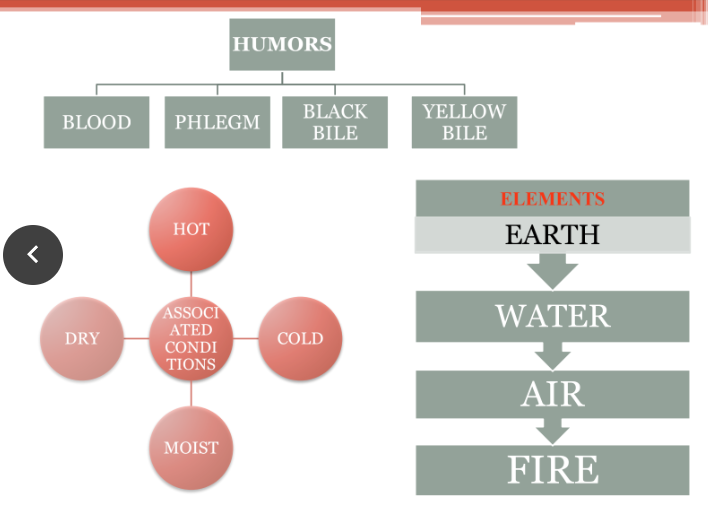
- Romans developed specialized instruments to remove arrows and they can suture wounds or blood vessels as well as treat bladder stones, hernias and cataracts.
- Galen – most influential physician of the Roman era, learned about trauma care, wrote over 500 books on medicine
- Arabic medicine
- 15th century – Islamic world was the center of medical knowledge
- Herbs and spices like nutmeg, cloves, mace are medicines
- Ocular techniques
- Developed 1st class civilian hospitals
- Medical and surgical ward
- Surgical room
- Pharmacy
- Clinic
- Library
- Lecture room
- Chapel
- Mosque
- Medieval Medicine
- Curing the soul than the body
- Disease and injury is a result of supernatural power
- Cures were possible through prayer
- Physicians – treats problems inside the body
- Surgeons – wounds, fractures, dislocation, urinary problems, amputations, skin disease, syphilis
- Renaissance Medicine
- Scientifically study of medicine began
- Andreas Vesalius – premier anatomist
- Laudanum – medicine that stops or reduce pain
- Amboise Pare – used ligatures to stop bleeding
- 17th and 18th Century Medicine
- William Harvey – determined how blood circulated through the body
- Anton Van Leeuwenhoek – used a microscope and discovered red blood cells, bacteria, and protozoa
- Edward Jenner – invented vaccination
- Thomas Sydenham – revolutionized clinical practice
- Giovanni B. Margagni – founded pathologic anatomy
- Marie Francois Bichat – created the field of histology
- 19th Century Medicine
- Jakob Henle – linked the study of anatomy with the study of bilogical functions and created physiology
- Robert Virchow – created cellular pathology
- Louis Pasteur – studied hydrophobia-rabies, created the field of microbiology
- Robert Koch – discovered bacteria that created anthrax, tuberculosis and cholera, created field of bacteriology
- Joseph Lister – disinfection of surgical equipment for safer surgery
- William Morton – developed anesthesia
- 20th Century Medicine
- Paul Ehrlich – invented antibiotic for syphilis
- Alexander Fleming and Selman Waksman – developed penicillin and streptomycin
- Radiotheraphy – discovered by Marie Curie and Poerre Curie
- Chemotherapy
- Radiography
- Specialization in Medicine:
- Cardiology
- Gastroenterology
- Hematology
- Oncology
- Genetics
- Obstetrics
- Gynecology
- Pediatrics
- Neurology
- Opthalmology
- Orthopedics
- Medical Team – group of doctors/ medical personnel in a surgery of procedure
- 21st Century Medicine
- The human aspect of patient care and quality service must be ever present in a practice
- Advance knowledge of DNA
- Alzheimers and parkinsons disease
- HIV and AIDS – prevention and treatment increased globally
- Biotechnology – increased number of surgery and other interventional procedures
- Robotic Surgery – permits precise incisions and excisions
- Improved outcomes of Laparoscopic surgery
- Electrical Conduction system – benefited by patients with tachycardia or artrial fibrillation
- International Space Station – conducts research in fields of human physiology and pharmacology
HISTORY OF RADIOLOGIC TECHNOLOGY
WILHELM CONRAD ROENTGEN
- Discovered x-rays on November 08, 1895
- Born on March 27, 1845 at Lennep, Germany
- Married to Anna Bertha Ludwig
- Died on February 10, 1923 because of colon cancer
DIAGNOSTIC MEDICAL SONOGRAPHY
- Uses high-frequency sound waves
MRI
- Uses magnetic fields and radio waves create images of internal anatomy of the body
RADIOGRAPHY
- Specializes in the use of x-ray to create images of the body
- Myelography visualize spinal cord
- Arthography visualize joint spaces
CARDIOVASCULAR INTERVENTIONAL TECHOLOGY
- Radiologic examinations of cardiovascular system
MAMMOGRAPHY
- Radiologic examination of the breast
NUCLEAR MEDICINE
- Use of radioactive materials for diagnostic or therapeutic purposes
RADIATION THERAPHY
- Cancer treatment
BONCE DENSITOMETRY
- Often used to diagnose osteoporosis
COMPUTED TOMORAPHY
- Recording of predetermined plane in the body using an x-ray beam that is measured, recorded and then processed by a computer for display on a monitor
CHAPTER 4
ARCHIMEDES
- Explained the reaction of solids when they are placed in liquids
DEMOCRITUS
- Described materials as being composed of ultimate particles.
- Formulated the first atomic theory.
- Considered to be the father of modern science
- Claimed that everything is made up of atoms.
THALES
- Discovered some of the effects of electricity
Three specific aspects of physical science helped pave the way for the discovery of x-rays
1. Electricity
2. Vacuums
3. Image-recording materials
EVANGELISTA TORRICELLI
- Produced the first-recognized vacuum when he invented a barometer in 1643.
OTTO VAN GUERICKE
- Invented an air pump that was capable of removing air from a vessel or tube in 1646. This experiment was repeated in 1659 by Robert Boyle and in 1865 by Herman Sprengel. Their techniques considerably improved the amount of evacuation, thus making better vacuum tubes available for further experimentation by other scientists.
WILLIAM GILBERT OF ENGLAND
- Studied electricity and magnetism. He was also noted for inventing a primitive electroscope.
ROBERT BOYLE
- His experiments with electricity earned him a place among the serious investigators.
ISAAC NEWTON
- Built and improved the static generator
CHARLES DU FAY
- Working with glass, silk and paper and distinguished two different kinds of electricity
ABBE JEAN-ANTOINE NOLLET
- Made a significant improvement in the electroscope, a vessel for discharging electricity under vacuum conditions.
BENJAMIN FRANKLIN
- Conducted many electrical experiments and should be mentioned in any discussion of the pioneers in electricity
WILLIAM WATSON
- Demonstrated a current of electricity by transmitting electricity from a Leyden jar through wires and a vacuum tube.
WILLIAM MORGAN
- Noticed the difference in color of partially evacuated tubes. He noted that when a tube cracked and some air leaked in, the amount of air in the tube determined the coloration.
MICHAEL FARADAY
- Induced an electric current by moving a magnet in and out of a coil in 1831. From this experiment evolved the concept of electromagnetic induction, which led to the production of better generators and transformers and high voltages for use in evacuated tubes.
HEINRICH DANIEL RUHMKORFF OF PARIS
- Made the most significant improvement on induction coils.
JOHANN WILHELM HITTORF
- Conducted several experiments with cathode rays, which are streams of electrons emitted from the surface of a cathode.
WILLIAM CROOKES
- Furthered study the cathode rays and demonstrated that matter was emitted from the cathode with enough energy to rotate a wheel placed within a tube
- Hittorf's works were repeated and further developed by Crookes.
PHILIPP LENARD
- Furthered the investigation of the cathode rays.
- He found that cathode rays could penetrate thin metal and would project a few centimeters into air. Lenard did a tremendous amount of research with cathode rays and determined their energies by measuring the amount of penetration.
- He also studied the deflection of rays as a result of magnetic fields.
WILLIAM GOODSPEED
- Produced a radiograph in 1890.
- His achievement was recognized only in retrospect and after the discovery of x-rays by Wilhelm Conrad Roentgen.
- Goodspeed was not credited with the discovery of x-rays.
JOHANN HEINRICH SCHULZE
- Produced the first photographic copy of written material in 1727.
RICHARD LEACH MADDOX
- Produced a film with a gelatin silver bromide emulsion that has remained the basic component for film.
GEORGE EASTMAN
- Produced and patented roll-paper film
- With this significant improvement of image-recording material and the improvement in the cathode ray tube, the basis for modern-day radiography was established.
THOMAS ALVA EDISON
- Patented a system for electricity distribution in 1880, which was essential to capitalize on the invention of the electric lamp. On December 17, 1880, Edison founded the Edison Illuminating Company.
- The company established the first investor-owned electric utility in 1882 on Pearl Street Station, New York City.
- It was on September 4, 1882, that Edison switched on his Pearl Street generating station's electrical power distribution system, which provided 110 volts direct current (DC) to 59 customers in lower Manhattan.
- Earlier in the year, in January 1882 he had switched on the first steam generating power station at Holborn Viaduct in London.
- The DC supply system provided electricity supplies to street lamps and several private dwellings within a short distance of the station.
- On January 19, 1883, the first standardized incandescent electric lighting system employing overhead wires began service in Roselle, New Jersey.
WILHELM CONRAD ROENTGEN
- Born on March 27, 1845 in Lennep, Germany
- Only child of Friedrich Conrad Roentgen, a textile merchant whose ancestors had lived in or near Lennep for several generations
- Married with Bertha Ludwig in 1872 1888 he was offered employment at the University of Wurzburg.
- He discovered x-rays on November 8, 1895
MICHAEL IDVORSKY PUPIN
- Produced radiograph 2 weeks after Roentgen discovered x-rays.
PIERRE CURIE
- Noticed that the radium killed diseased cells, which was the first suggestion of the medical utility of radioactivity.
- In 1880. Pierre and his older brother Jacques (1856-1941) demonstrated that an electric potential was generated when crystals were compressed, Le piezoelectricity. Shortly afterwards, in 1881, they demonstrated the reverse effect: that crystals could be made to deform when subject to an electric field. Almost all digital electronic circuits now rely on this phenomenon in the form of crystal oscillators.
HENRI BECQUEREL
- In 1896 Henri Becquerel discovered that uranium salts emitted rays that resembled X-rays in their penetrating power. He demonstrated that this radiation, unlike phosphorescence, did not depend on an external source of energy, but seemed to arise spontaneously from uranium itself. Becquerel had, in fact, discovered radioactivity.
MARIE CURIE
- Refined the knowledge of radioactivity and purified the radium metal. In 1911, she received Nobel Prize for her work in chemistry.
- She continued to study radioactivity until she became acquainted with Albert
- Einstein and resumed her experiments with radium.
- She was the first person honored with two Nobel Prizes in Physics and Chemistry
- She was the first female professor at the University of Paris, and in 1995 became the first woman to be entombed on her own merits in the Panthéon in Paris.
- Her achievements included a theory of radioactivity, techniques for isolating radioactive isotopes, and the discovery of two elements, polonium and radium. Under her direction, the world's first studies were conducted into the treatment of neoplasms, using radioactive isotopes. She founded the Curie Institutes in Paris and Warsaw, which remain major centers of medical research today.
ERNEST LAWRENCE
- Invented cyclotron in 1932.
- The cyclotron is a chamber that made it possible to accelerate particles to high speeds for use as projectiles. The cyclotron first made radioisotopes available in large quantities.
ENRICO FERMI
- Made a significant breakthrough when he induced a successful chain reaction in a uranium pile at the University of Chicago in 1942
- The results breakthrough was first demonstrated when atomic devices were detonated experimentally in 1945 at White Sands, New Mexico.
- Shortly thereafter, these devices were introduced as weapons when atomic bombs were dropped on Hiroshima and Nagasaki, Japan.