BIOL 1011
Lecture 1
Plants and the Colonization of Land
Agriculture
(incented 10,000 years ago)
Consequences:
-permanent villages, towns, cities
-larger family → larger population
-diverse economy
-less cooperation
-socioeconomic classes
-separation of humans from rest of nature
-large scale war
Plants create many things:
rubber → rubber tree
cotton
Drugs: plant Secondary Compounds
-not necessary for metabolism, growth of development
-e.x. quinine
-plant: bark of cinchona tree
-natural range: south america, now introduced worldwide
-treat: malaria (from 1650s in europe) / anemia/ muscle spasms/ cancer/ tonic water
e.x caffeine (coffee tree)
aspirin (willow species) contains acetylsalicylic acid
THC tetrahydrocannabinol (hashish, marijuana - cannabis sativa)
Nicotine (tabacco)
opium, heroine, morphine, codine (opium poppy, papaver)
Taxol (from yew: taxus) → chemotherapy
Importance of Plants:
- energy: food (agriculture)
- energy: fossil fuels
- clothes
- drugs, medicines
- ecosystems functioning
- biodiversity
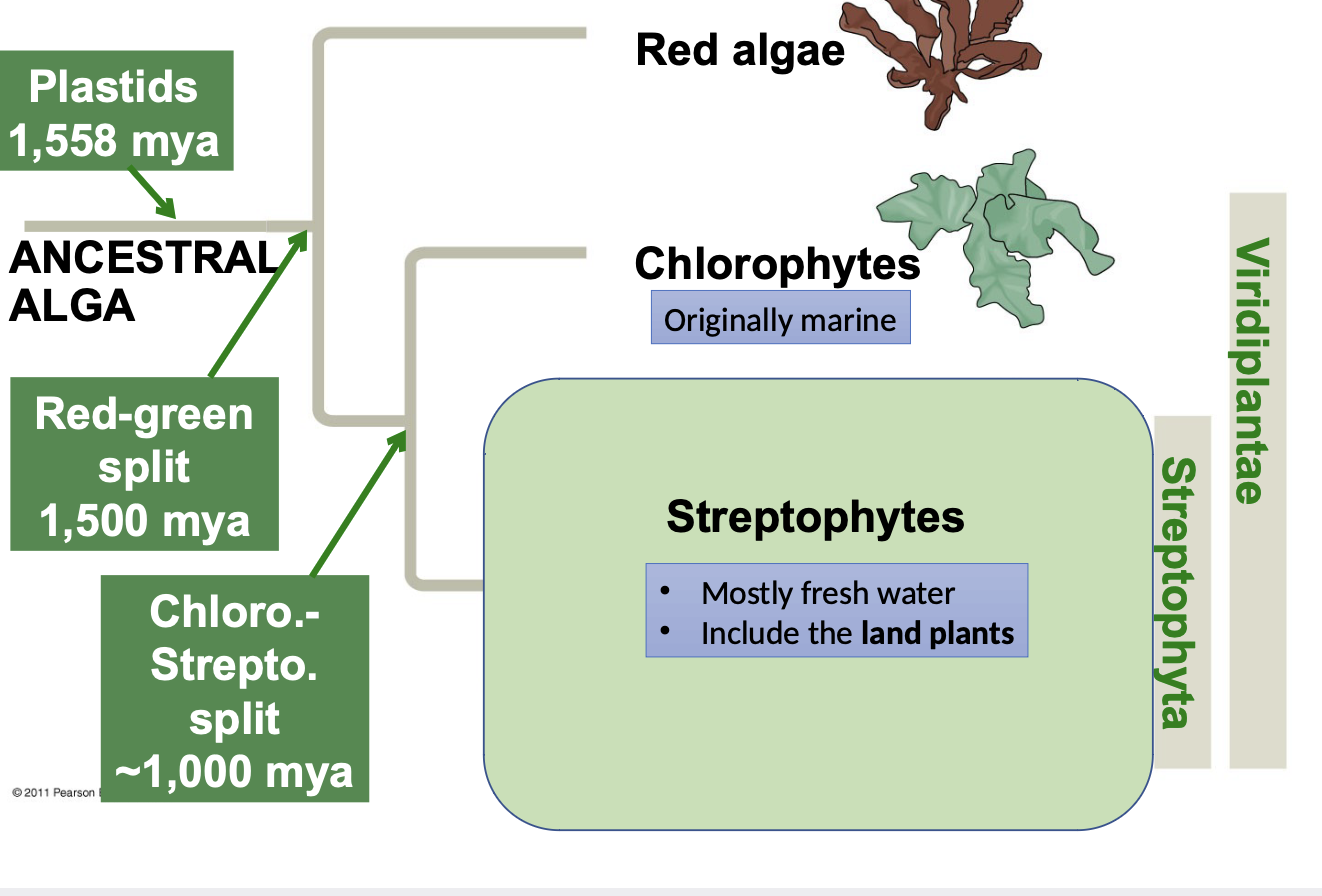
What is a Plant
Photosynthetic Eukaryotes
Plants and red algae
→ from primary endosymbiosis: prokaryote + eukaryote = eukaryote
non photosynthetic eukaryote engulfed a photosynthetic cyanobacterium (now a plastid)
Other Eukaryotes
→ from secondary endosymbiosis: eukaryote + eukaryote = eukaryote; non photosynthetic eukaryote engulfed a photosynthetic eukaryote (green or red alga)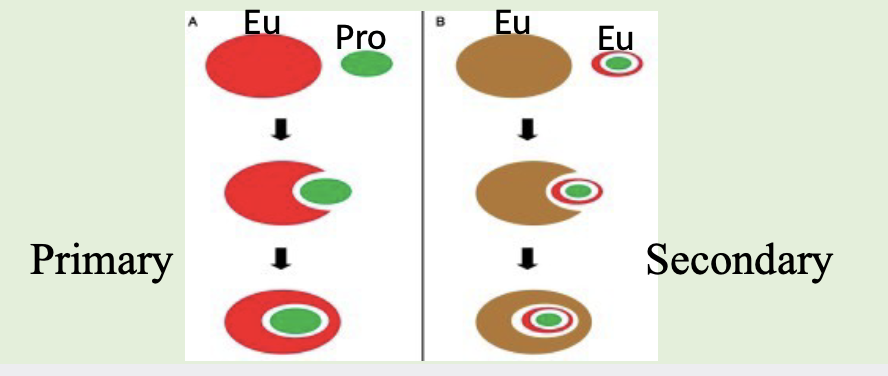
Plants in History of Life:
-Plants split from red algae -1500 mya
-both single cell and multicellular forms
-only marine
-moist environments near oceans
500mys: colonization of drier environments
adaptations:
-cuticle
-vascular tissue: roots and shoots
-relationship with fungi
-seeds and pollen
since colonizing land: 290,000 species 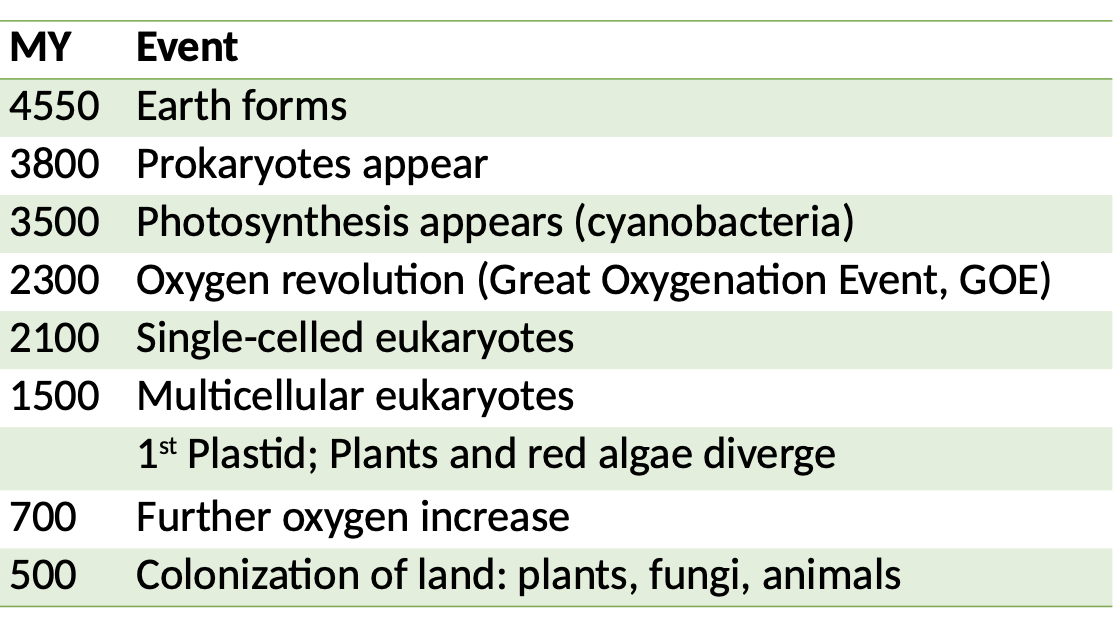
important: 4550/3500/1st plastid/500
Features of ALL Plants:
- starch as main energy-storage molecule
- polysaccharide (carbohydrate) of glucose residues
→sugar as an energy storage:
-not very reactive
-easily metabolized
-absorbs and holds water - scratch is solution
- Chlorophyll b
- chl a: all photosynthetic eukaryotes
- chl b: accessory pigment; passes energy to chl a
- chl b: absorbs slightly different wavelengths
- Cellulose is major component of cell wall
- polysaccharide: unbranched glucose residues (different bonds from starch)
- most common organic polymer on earth
- cotton 90%
- Thylakoids in stacks (grana)
- rather than as simple bands
- thylakoids are membranes inside chloroplasts - contain chlorophyll
Ancestors of Land Plants
-charophytes are the closest relatives of land plants
evidence: 1. both nuclear and chloroplasts genes 2. structure
-type of ‘green alga’
-land plants are not descendants from modern charophytes but share a common ancestor with modern charophytes
Features of Charophytes and Land Plants
- cell plate and phragmoplast (short microtubules)
- plasmodesmata → extensions of cell membrane through pores in cell wall
- sperm structure
- peroxisome enzymes
- rose-shaped cellulose synthesizing complexes
- sporopollenin: durable polymer
Sporopollenin:
-durable polymer
-found in walls of plant spores and pollen
-chemically inert
-stable
-persists in environment
-protects from desiccation, decay, etc
Advantages: The Move to Land
-air filters less sunlight than water → there is more light for photosynthesis
-air has more CO2 than water → there is more fuel for photosynthesis
-early terrestrial habitats lacked pathogens or predators/herbivores
-terrestrial soil is richer in nutrients than aquatic
Challenges/Adaptations: Move to Land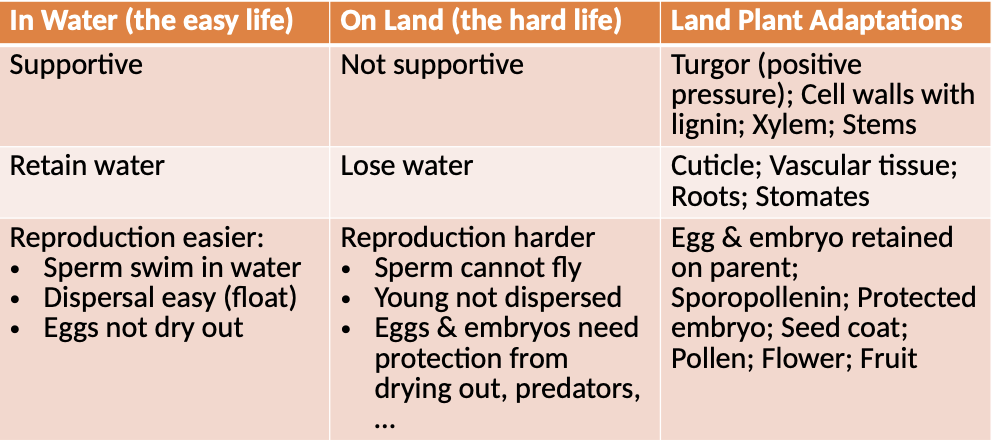
Features of LAND Plants:
- cuticle-waxy covering
- multicellular, jacketed (set of sterile cells around them) sex organs = ‘gametangia’
male sex organ: antheridium → produces sperm (haploid)
female sex organ: archegonium → produces egg (haploid)
- embryophyte condition → zygote retained in maternal tissue
zygote: land plants are also called embryophytes
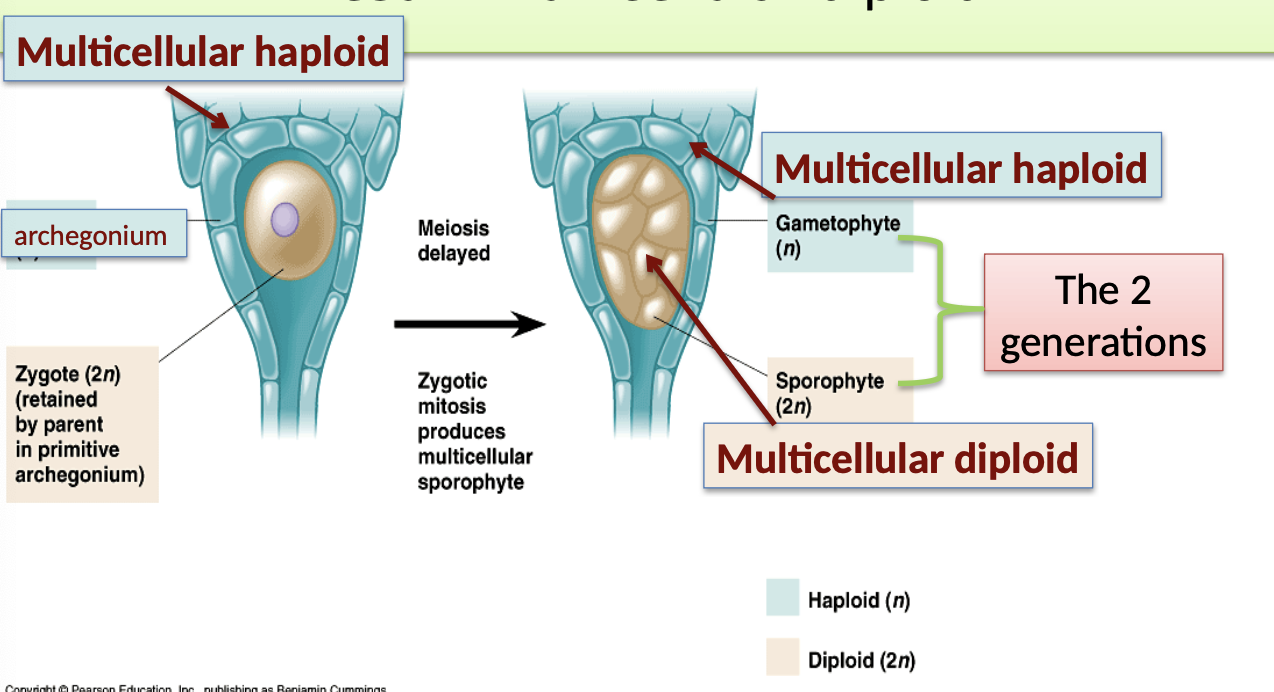
- alternation of generations
both haploid and diploid phase are multicellular
2 Generations: Sporophyte & Gametophyte
-Arose independently in evolution several times
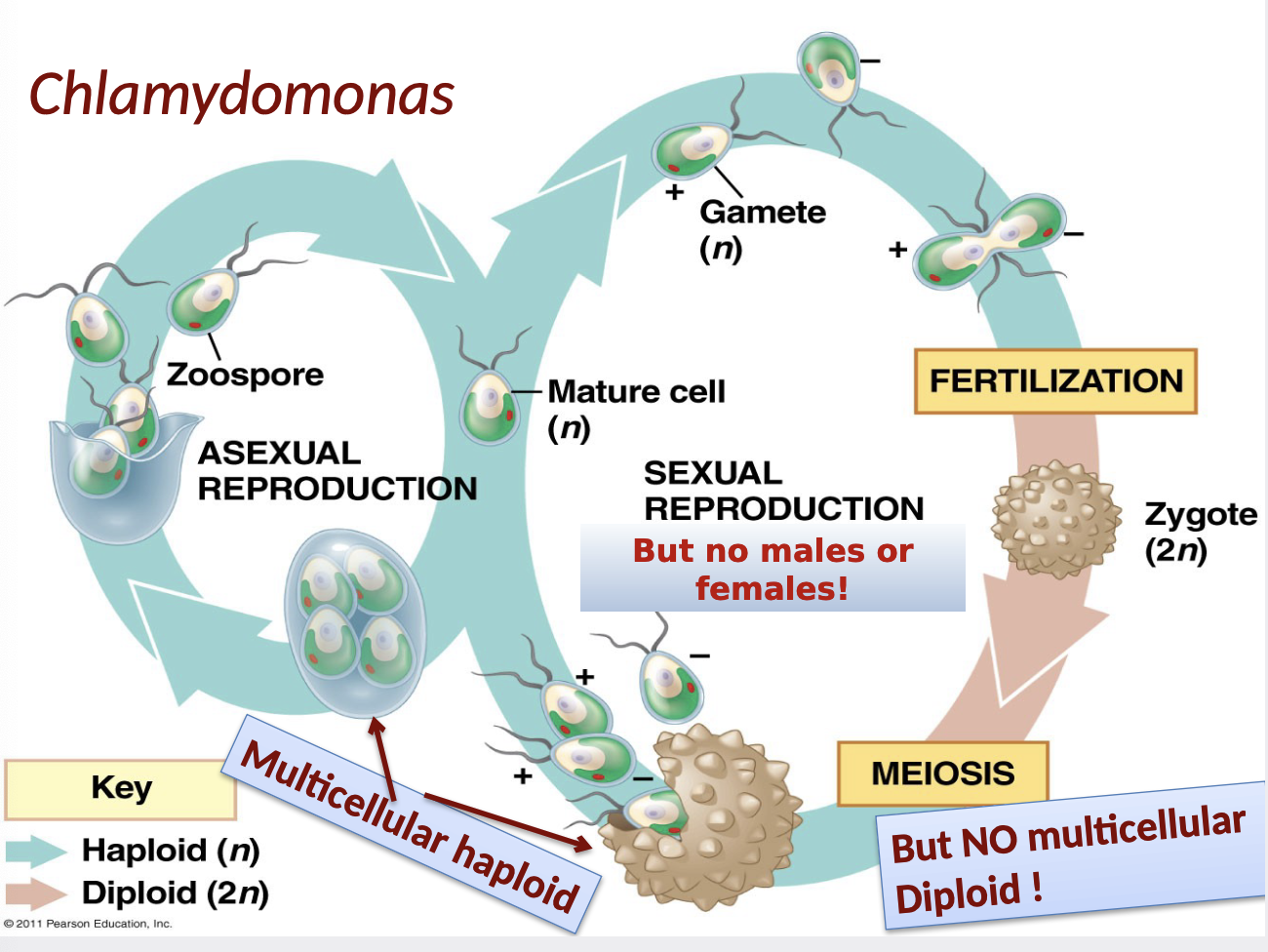
Alternation generations are: →does not occur in charophytes
- gametophyte (haploid; 1n) → makes gametes by mitosis
- Sporophyte (diploid; 2n) → makes spores by meiosis
[Green alga without alternation of generations]
most of life: single cell/haploid
origin of alternation of generation:
Zygote delays meiosis and divides and grows = multicellular diploid
Lecture 2
Major Groups of Land and their Reproduction
In Land Plants:
Meiosis produces Spores
Spore:
Single cell that can divide to produce a multicellular organism (often with protective coat)
Gamete:
Single cell that can unite with another gamete to produce a diploid zygote
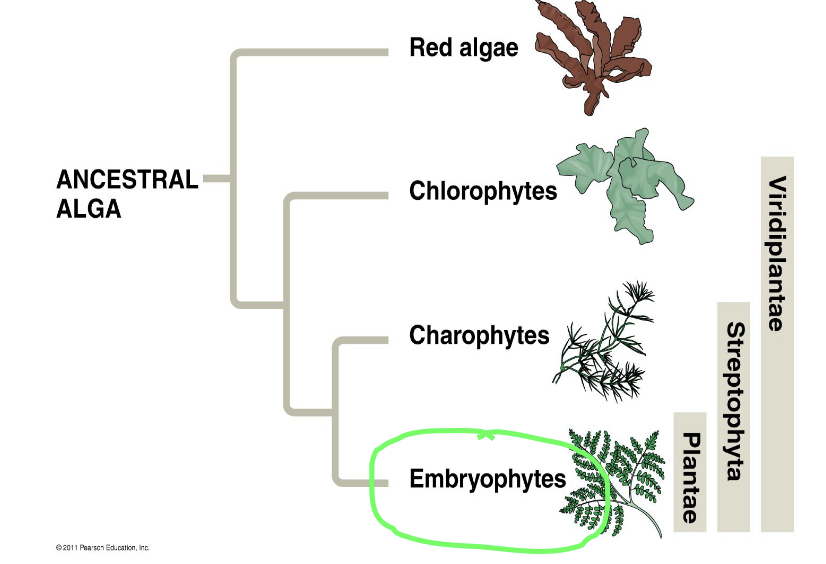
→ There are 10 divisions (phyla) of land plants (the embryophytes)
→ 4 major divisions of land plants:
- mosses
- ferns
- conifers
- angiosperms
Moss:
-15,000 species
-Low growing
-confined to damp areas
→ swimming sperm
→no true vascular tissue (rudimentary vascular system)
-no true leaves
-Gametophyte dominant 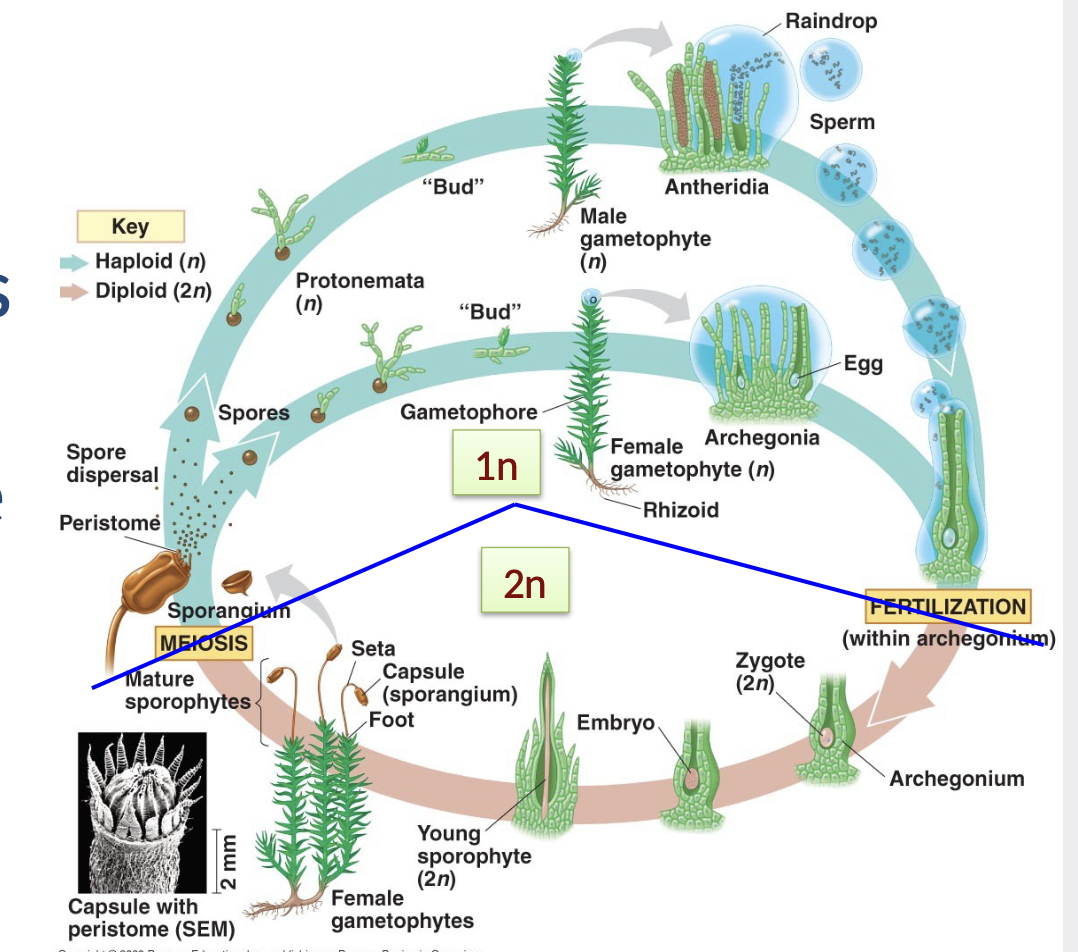
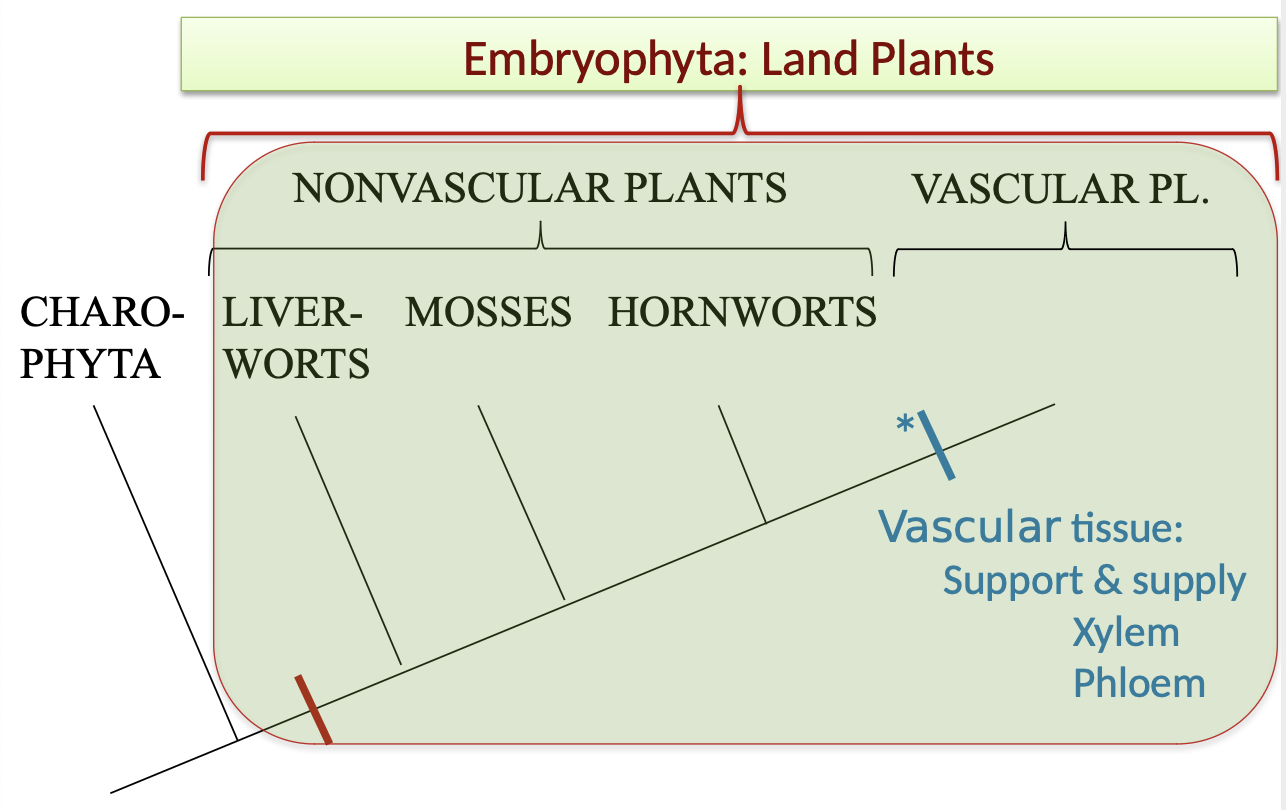
→ Major step in evolution: Vascular Tissue
Pterophyta: Ferns (horsetails, etc.)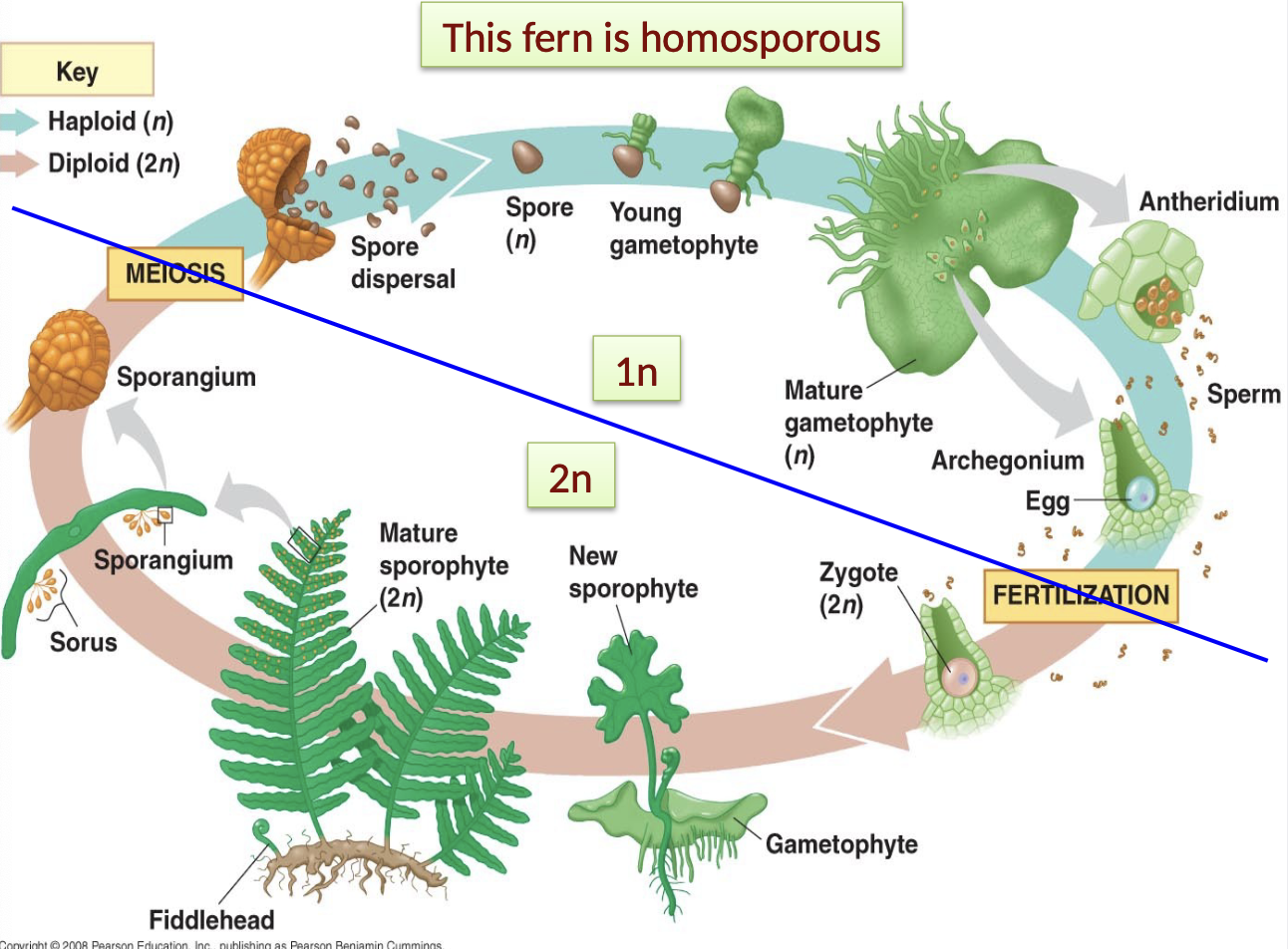
-20,000 species
-mainly tropical
-appeared 400 mya
-Vascular tissue
-Xylem and phloem
-support and supply
-swimming sperm
-sporophyte dominant
(fern sporangia)→ 2 kinds of leaves:
- cinnamon fern
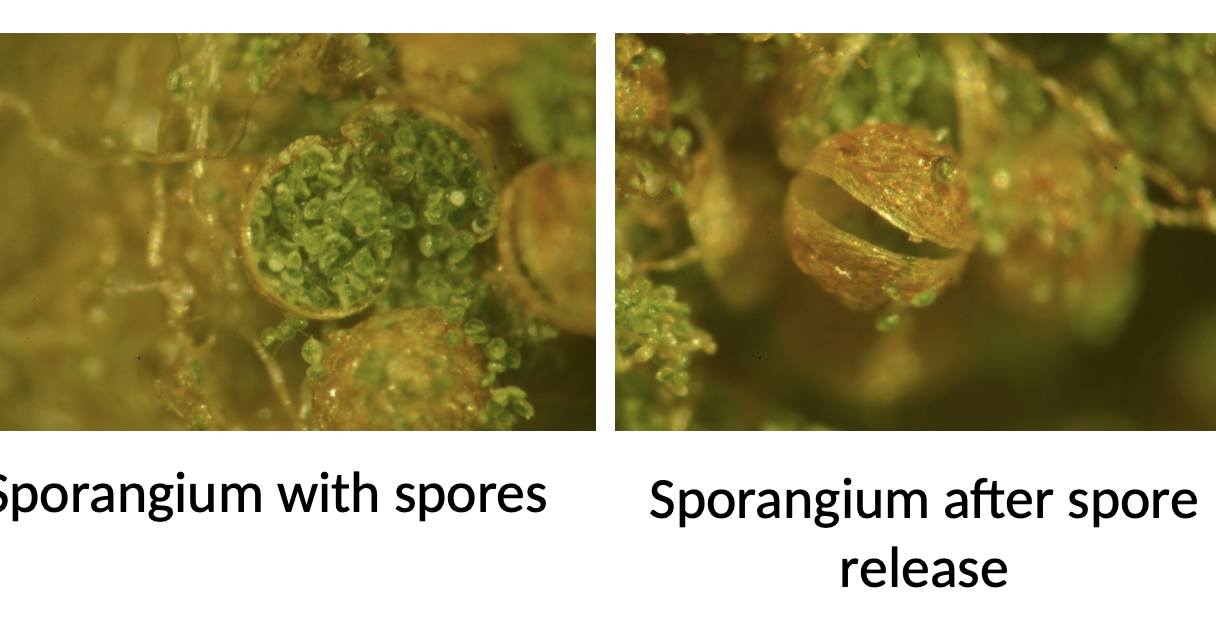
- group of sporangia
Fern spore release:
cinnamon fern:
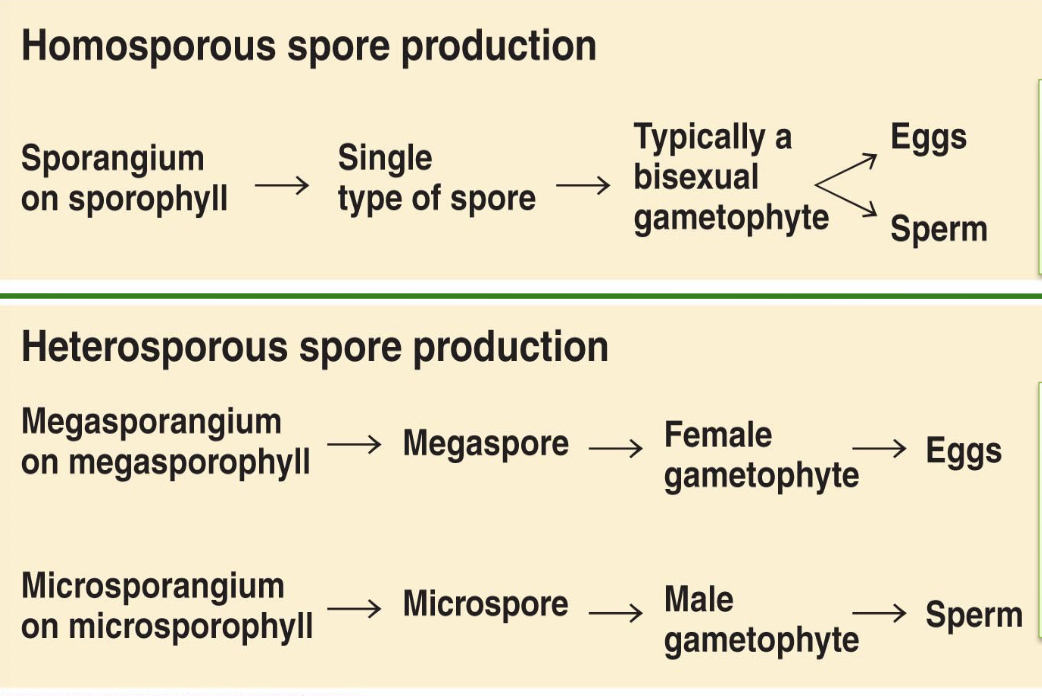
Spore Size:
- Homoespory
- 1 size of spore from meiosis
- mosses and most ferns
- Heterospory
- 2 sizes of spore from meiosis
- some ferns and all seed plants
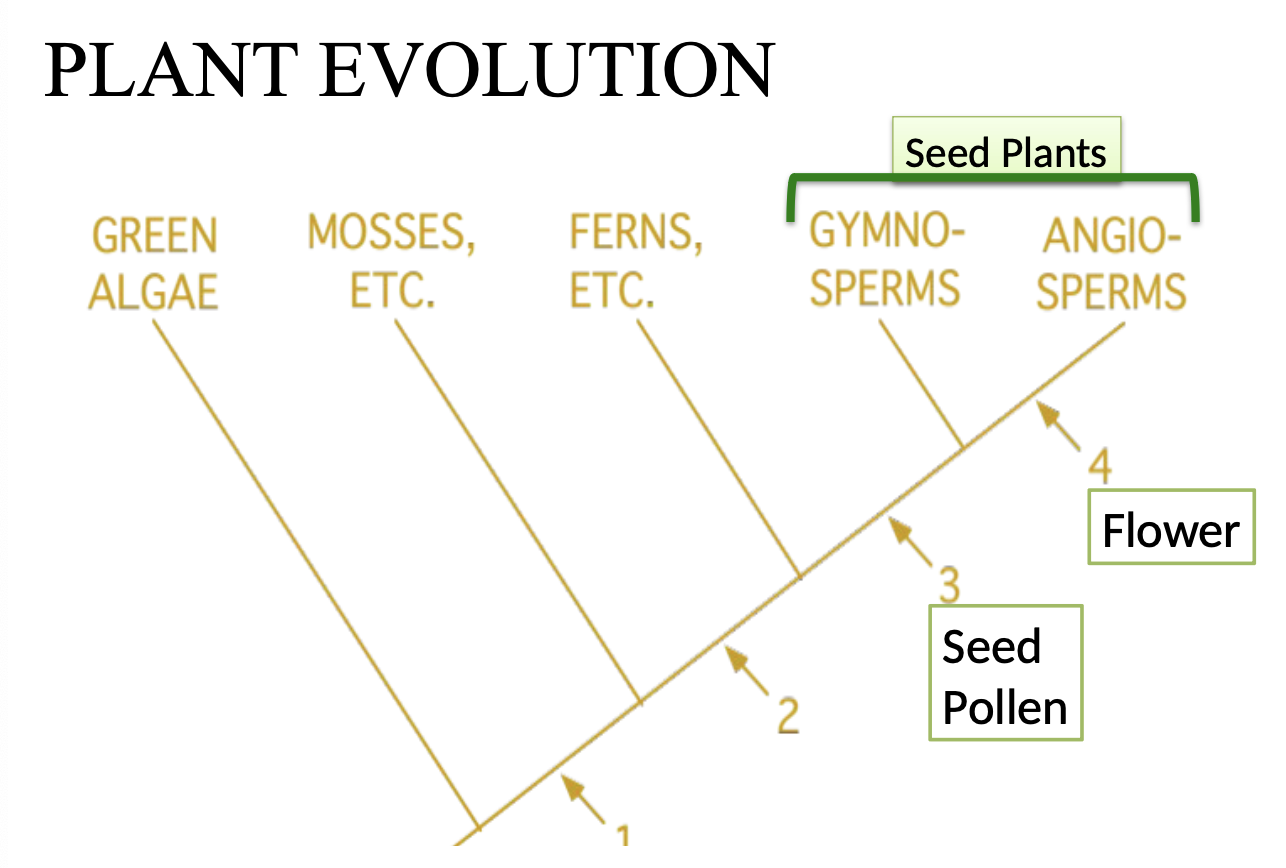
Seed Plants:
5 divisions (phyla) of seed plants
- cycadophyta
- ginkgophyta
- coniferophyta
- gnetophyta
- anthophyta
→ have both seeds and pollen
Seed:
-embryo + nutrition + seed coat
-develops from ovule
-novel structure appearing in seed plants
-site of (female) meiosis
-contains female gametophyte, female sex organs, egg and embryo
Ovule (conifer) at early stage (BEFORE meiosis in megasporangium) 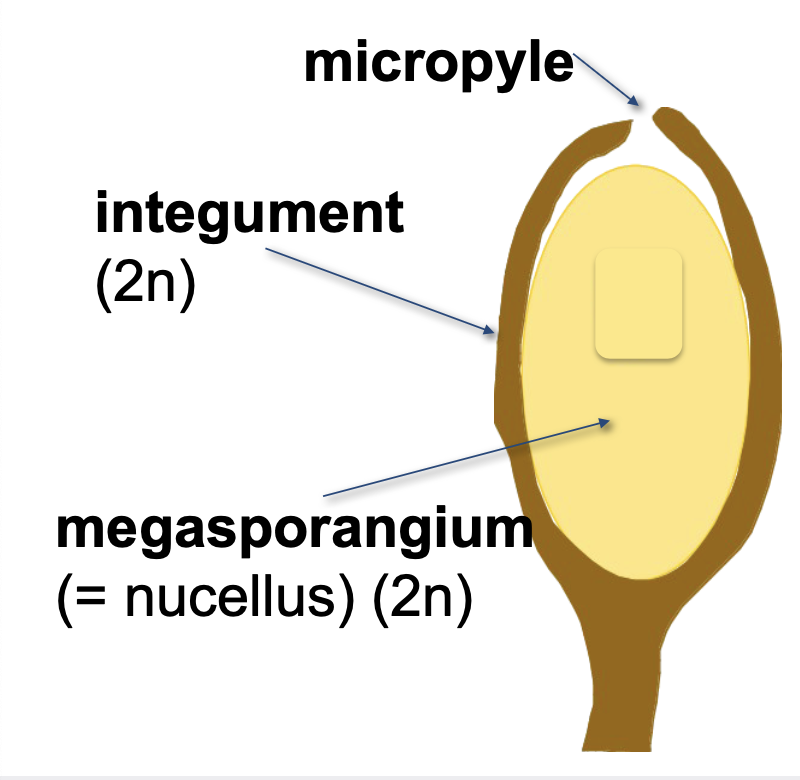
Ovule (conifer) at early stage (AFTER meiosis in megasporangium)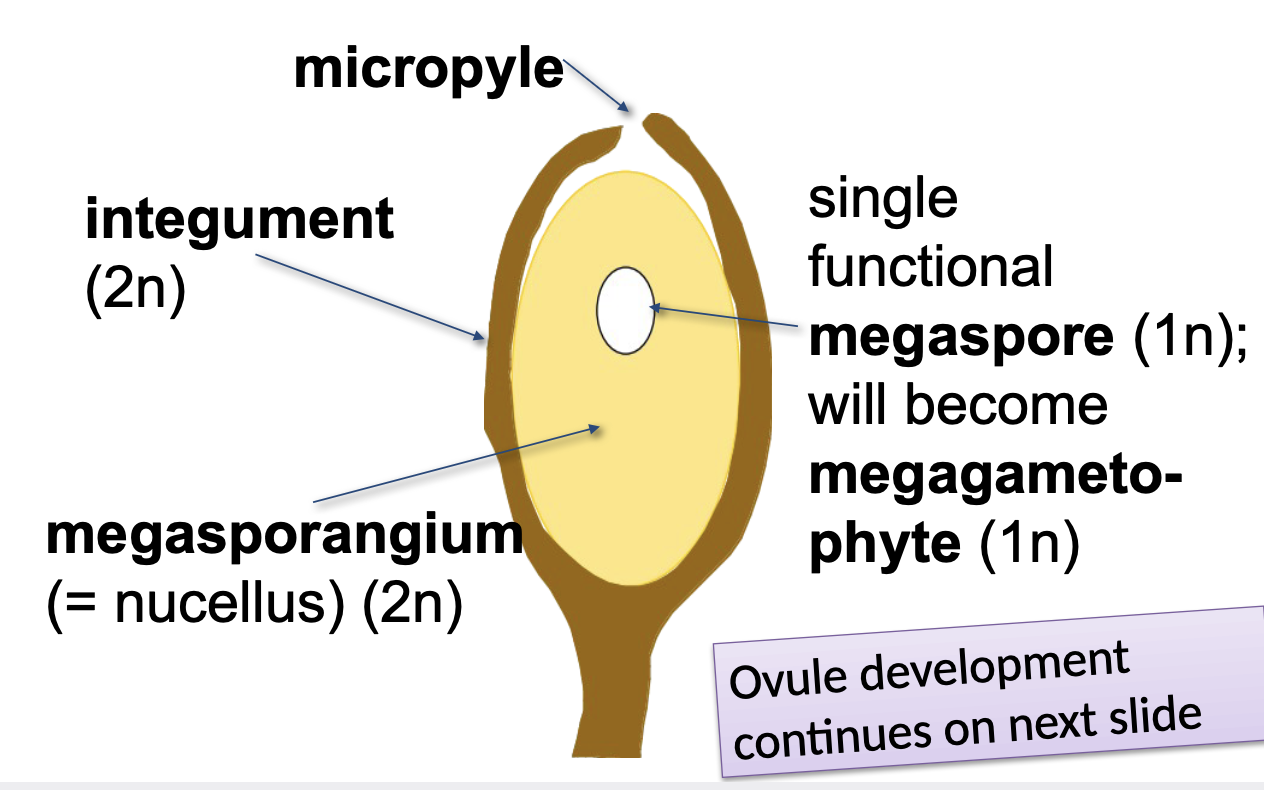
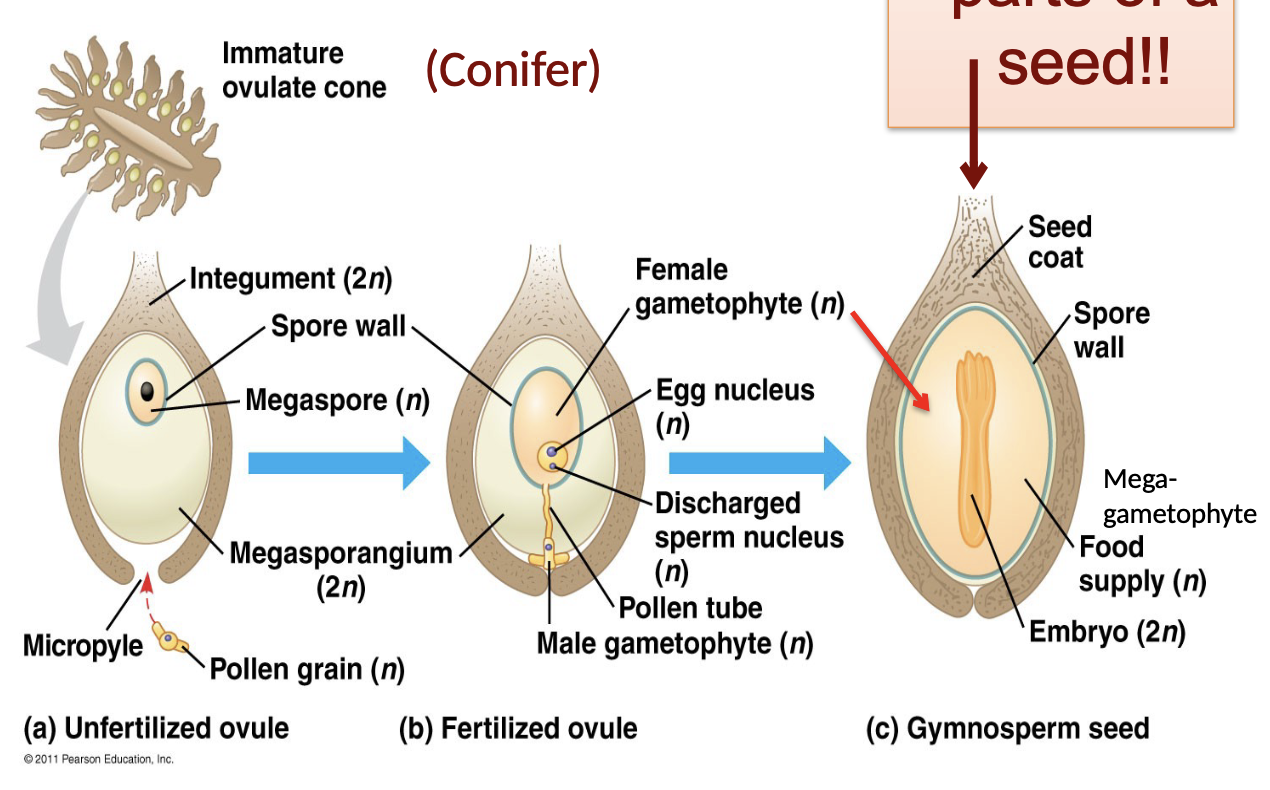
Ovule becomes seed
→Both seeds and pollen cont.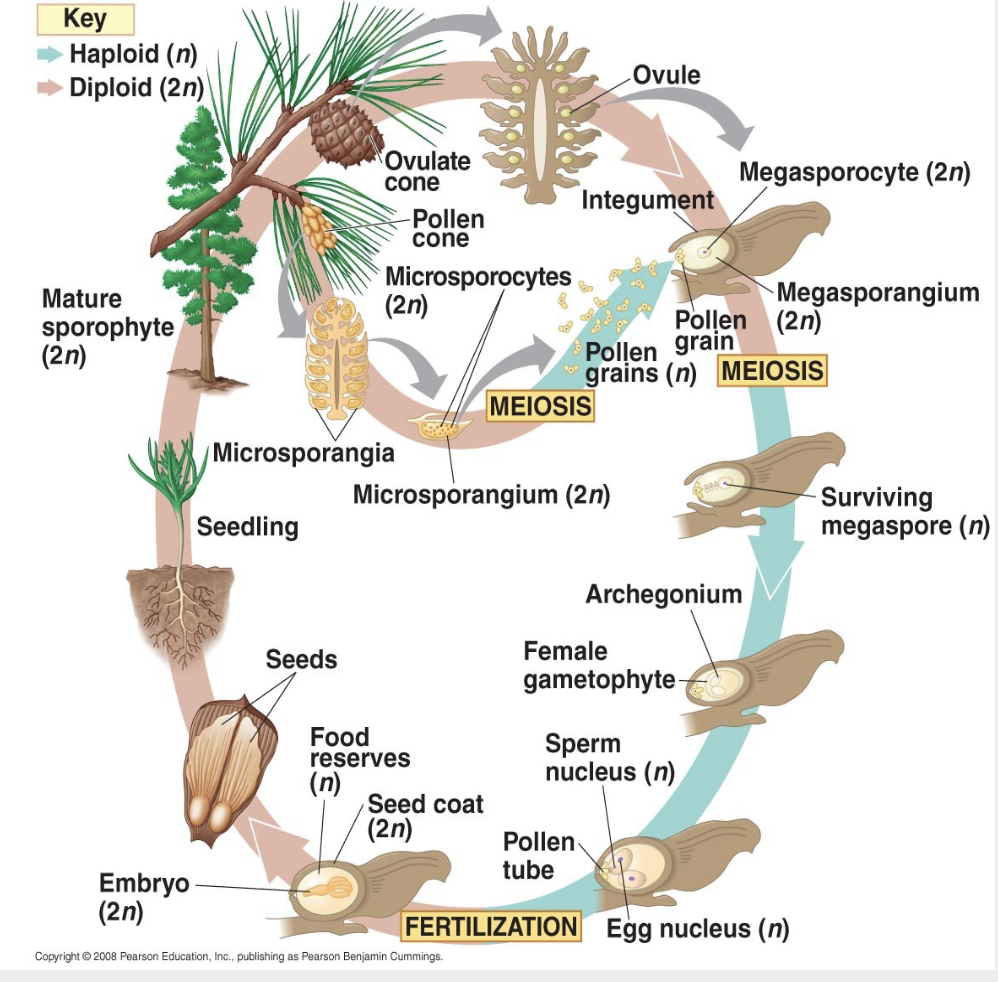
Pollen:
-Mature male gametophyte
-Few cells in size
Coniferophyta - the conifers
-550 species
-reproductive organs in cones
-sporophyte dominant
-Heterosporous
-Microgametophyte = pollen
-Megagametophyte
→ within ovule
→ makes egg and then nourishes
e.x. white pine / larch,tamarack /Bald cypress
→ in conifers:
seed:
-embryo + megagametophyte + seed coat
(rest is the same)
Conifer Gametophytes:
Mega Gametophyte
-makes egg in archegonium
-nourishes embryo
Micro Gametophyte
-pollen grain (makes sperm)
Life Cycles:
- Heterosporous 2. Seed-Plant
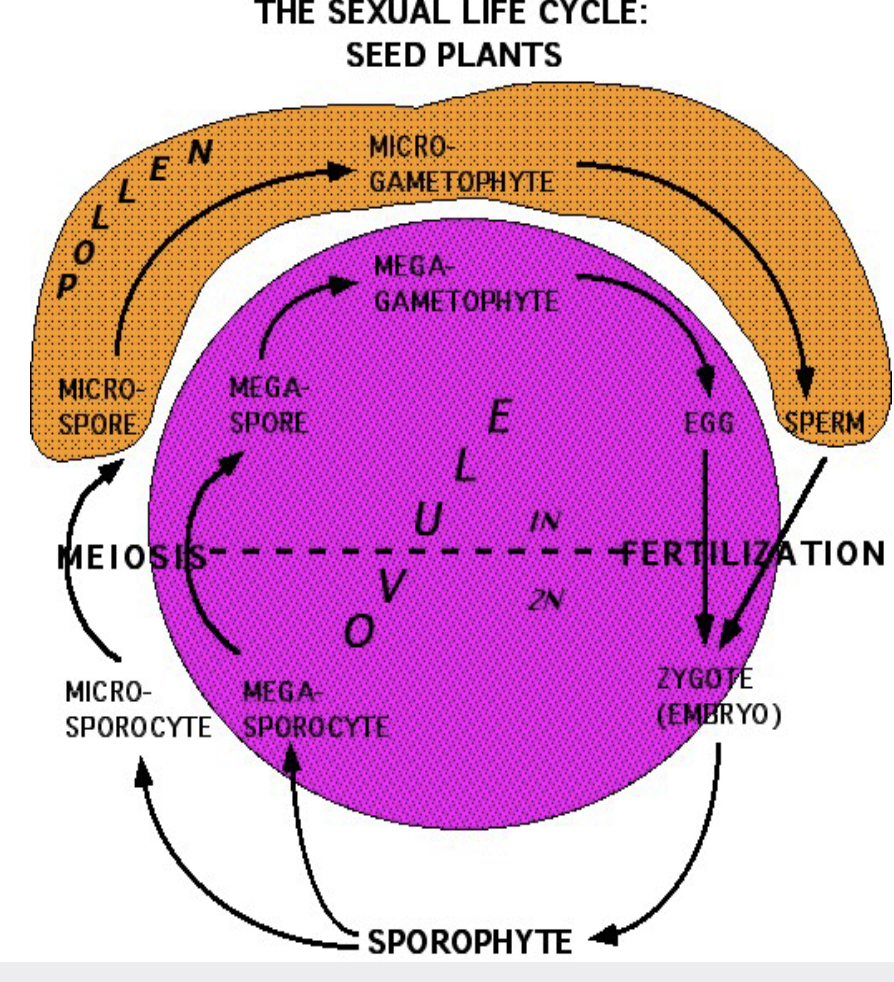
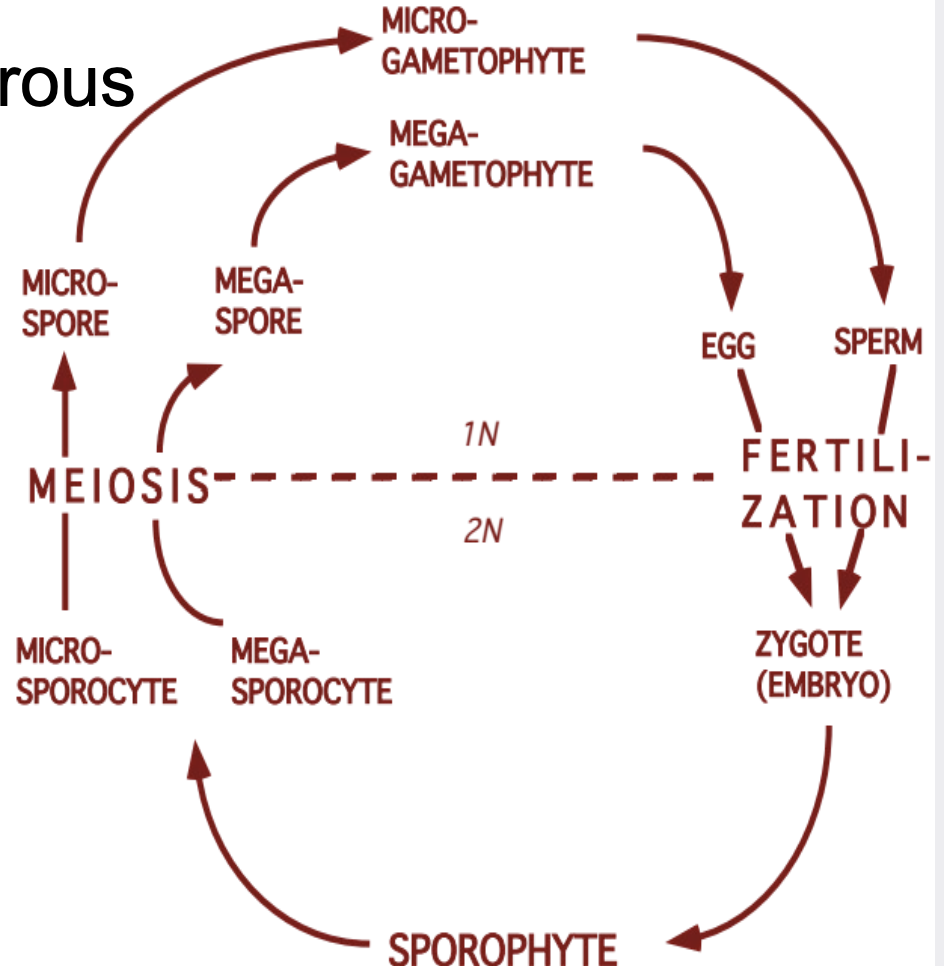
Phylum Coniferophyta - summary
-seeds and pollen
-cones: separate male and female
-naked seeds: “gymnosperms”
-seed: embryo nourished by megagametophyte
-slow reproduction
E.X. slow reproduction: Jack Pine
Male cones:
-development started 1yr ago
-this year they will pollinate female cones (started 1 year ago)
Female cone:
-initiated 2 yrs ago
-pollinated 1 year ago (female meiosis after pollination)
-will mature into woody cone this year with mature seeds
Summer Year 1:
-initiate male and female cones
Summer year 2:
-male meiosis: pollen
-pollination
-female meiosis after pollination
Summer Year 3:
-Fertilization (summer)
-Mature seeds (late summer/fall)
Lecture 3
Flowering Plants and Structure of Growth of Land Plants
→Anthophyta appeared around 150 mya then exploded into many species
Angiosperm Terrestrial Revolution
Fact: The diversification of the angiosperm coincided with a dramatic diversification of other organisms
Hypothesis: “Many of the most diverse organisms today, including angiosperms, spiders, insects and vertebrates showed their major diversifications fueled by the angiosperm terrestrial revolution”
- the origins of modern biodiversity
-today 85% of plant, animal, and fungal species live on land rather than in the sea
→ half live in tropical rainforests
-an explosive boost to terrestrial diversity occurred from c. 100-50 million years ago
→ biosphere expanded to a new level of productivity
→ coincided with innovations in flowering plant biology and evolutionary ecology,
including: flowers and efficiencies in reproduction
coevolution with animals, especially in pollinators and herbivores
photosynthetic capacities
adaptability; ability to modify habitats
→rise of angiosperms triggered a macroecological revolution on land and drove modern biodiversity to new high level, a series process we name the Angiosperm Terrestrial Revolution
Expanding Angiosperm Diversity and Species Number
- insect pollination
- flexibility in seed production and dispersal
- greater genetic and phenotypic flexibility in cell and shoot elongation
- more complex mechanisms for activating and repressing
- the genes
- greater complexity of the flower
Div.Anthophyta - Flowering Plants
- 300,000 (named)
- 400,000 (estimated) species
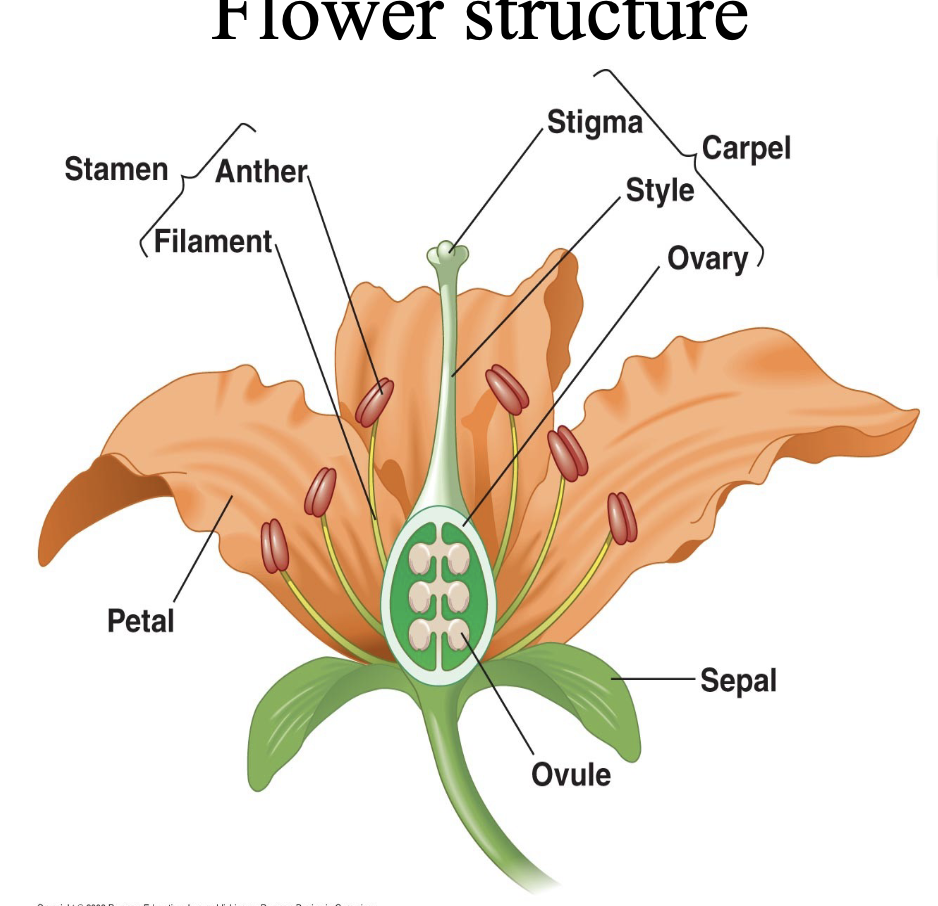
- reproductive organs in flowers
- sporophyte dominant
- heterosporous
- microgametophyte = pollen
- megagametophyte: 8 nuclei
Flower Structure
→ 4 whorls of modified leaves
Monocots
Grasses:
- maize
- wheat
- rice
- bamboo
Orchids:
- irises
- lilies
- palms
Eudicots
- oaks
- maples
- dandelions
- sunflowers
- legumes
- melons
- potato
- poppies
- roses
Male and Female Sex Organs within a Flower: Hermaphroditic
→ 85% of angiosperm species have cosexual = hermaphroditic flowers
→ Monoecy: separate male and female flowers on the same individual (e.x. paper birch)
→ Dioecy: Male and female sex organs on different individuals (e.x. willow)
Pollination:
→ arrival of pollen on stigma (flowering plant) or on a receptive female cone (conifers)
- occurs only in seed plants
- conifers: wind
- flowering plants: 1. insects 2. birds 3. bats 4. wind
Pollination in Angiosperms:
reward for pollinator:
- nectar (sugar water)
- pollen
Advertisements by plant:
- showy flower
- possibly odor
→ BOTH reward and advertisement are costly
Pollination Syndromes:
-Integrated sets if floral traits (e.g. morphology, colour, odour, size, rewards) associated with particular pollinator groups
e.x. of convergent evolution
- traits have evolved separately many times, can thus occur in unrelated plant species
Pollination by Bees:
syndrome:
- shape: various; can be highly specialized or not
- Colour: various; including yellow, blue, orange (not red)
- Odour: none or highly specialized
Pollination by Bats or Moths:
Syndrome:
- shape: tubular, open at night
- Colour: yellow or white
- Odour: strong and sweet
- Nectar: large quantity
Pollination by Birds:
Syndrome:
- Shape: tubular
- Colour: red most common, also yellow
- Odour: none
- Nectar: large quantity, often weak (20% sugar)
Pollination by Wind:
- Shape: not showy (reduced petals)
- Odour: none
- Nectar: none
- Pollen: very large quantity
Pollination cont.
-there is great variation among plant species
some plants:
- pollinated by many animal species
- pollinated by one animal species
- provide no reward: deceit pollination (e.x. pink lady slipper orchid)
Pollination by Deceit: (in some orchids)
Orchids:
- pollen in 2 packets (pollinia)
Reward:
- nectar
- none: deceit pollination
→ pollination syndromes are not perfect
Angiosperm Life Cycle:
note: double fertilization → 2 sperm nuclei in pollen
- 1 fertilizes egg → embryo (2n, diploid)
-1 fertilizes central cell → endosperm (3n, triploid)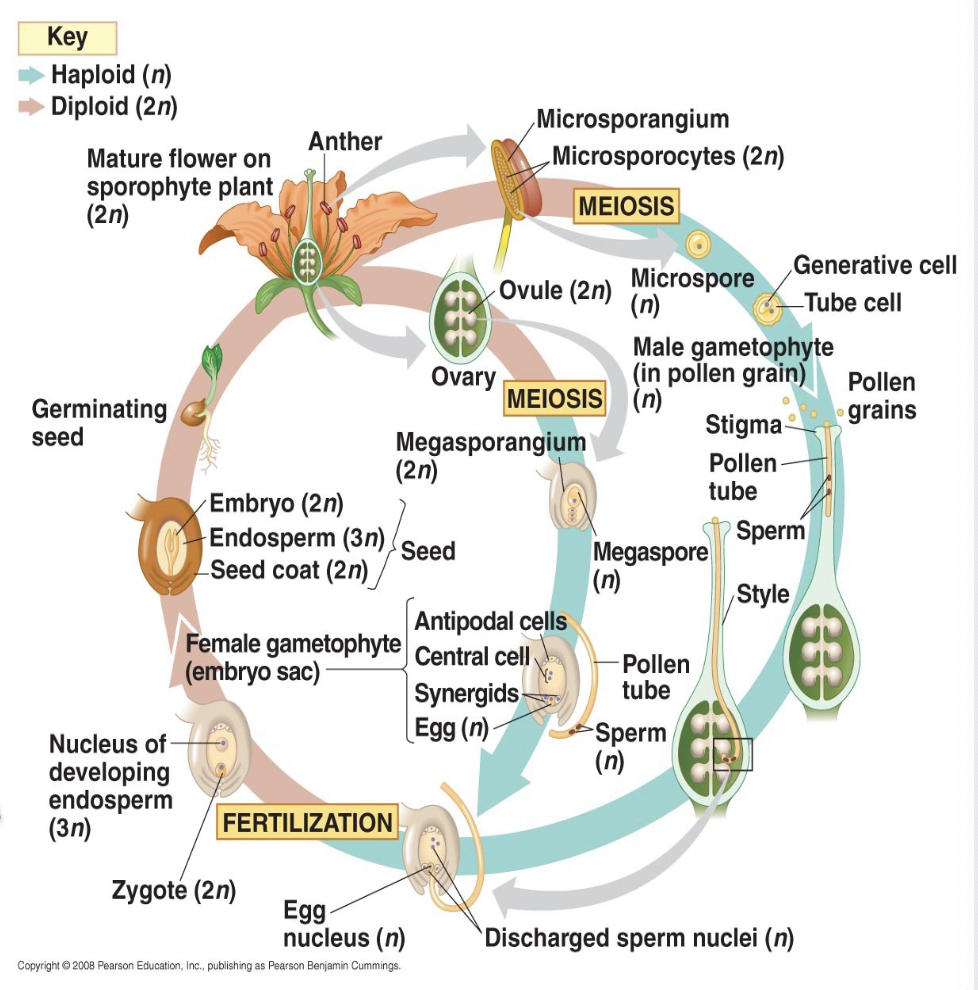
Pollen growth:
- pollen lands on stigma: pollination
- pollen tubes grow towards ovules
Angiosperm Ovules and Ovaries:
-ovules become seeds
-ovaries becomes fruit
Dispersal of Seeds and Fruits:
Winds:
- maple
- cottonwood
Water:
- coconut
- water lily
Animals:
- blueberry
- cocklerburr
Nourishing the Embryo
Conifers:
- megagametophyte (1n)
Angiosperms:
- endosperm (3n) (2 haploid from mom 1 haploid from dad)
Endosperm is the principal foodstuff of civilization:
- more than half of (direct) daily calories worldwide
- especially 3 cereal grasses: rice, wheat, corn (maize)
- domesticated around 10,000 years ago
Conquest of the Land:
- cuticle
- sporopollenin
- jacketed sex organs (antheridia, archegonia)
- embryo retention
- stomates (stomata)
- vascular tissue (xylem, phloem)
- seed and pollen
- flower
- fruit
Conifers and Flowering Plants: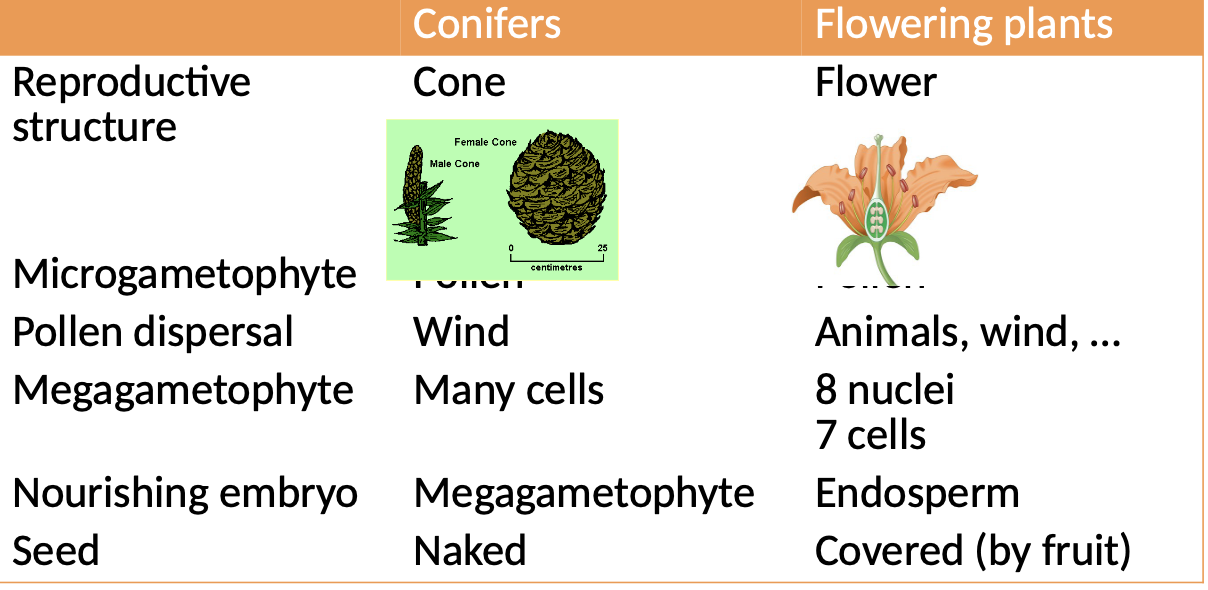
3 Variations of Alternation of Generations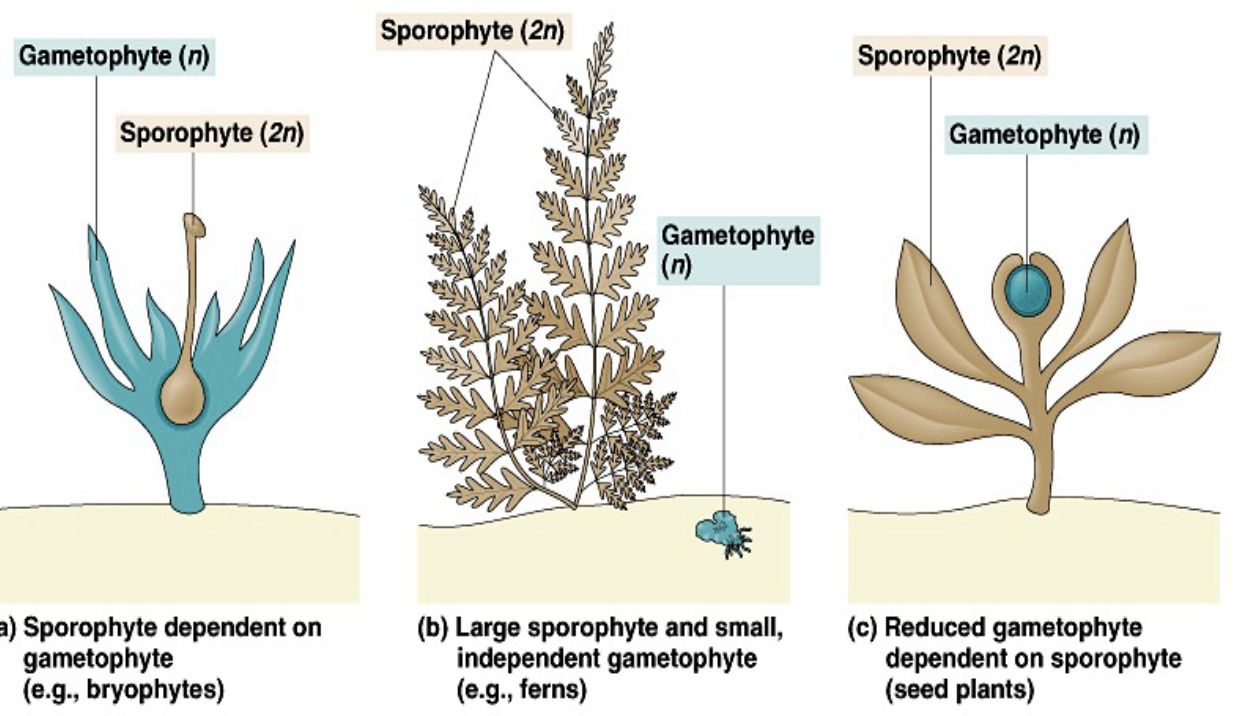
Land Plant Structure and Growth
Two Systems in Vascular Plants:
- shoots
- roots
Evolutionary Adaptations of Stems:
- Iris Rhizome
- rhizomes grow underground
- vertical shoots emerge from axillary buds at nodes
- Strawberry Stolon
- stolons grow along surface
- plantlets from nodes: asexual reproduction
- Potato Tuber (stolon or rhizome)
- storage
- ‘eyes’ are axillary buds at nodes
Plant Cell Walls:
→ cellulose microfibrils: adjacent, parallel cellulose molecules
- extracellular: outside of membrane
- composed mostly of cellulose (polysaccharide of glucose units)
- 2 kinds: 1. primary wall (thin, in all cells)
2. Secondary wall: thicker (in some cells) strength
Function of Plant Cell Wall:
- determines and maintains cell shape
- provides support and mechanical strength (allows plants to get tall, hold out thin leaves to obtain light)
- prevents the cell membrane from bursting (i.e. resists water pressure)
- Controls the rate and direction of cell growth and regulates cell volume
- responsible for the plant architectural design
- Physical Barrier to:
- pathogens
- water in suberized (waxy) cells
- note: wall is very porous and allows the free passage of small molecules
- hh
Plant Cell Wall Composition:
3 kinds of polysaccharides:
- cellulose
- polymer (chain) up to 25,000 glucose molecules
- around 36 chains bond to make microfibril
- cross-linking glycans (hemicellulose) - bond with cellulose
- Pectin - jellylike glue
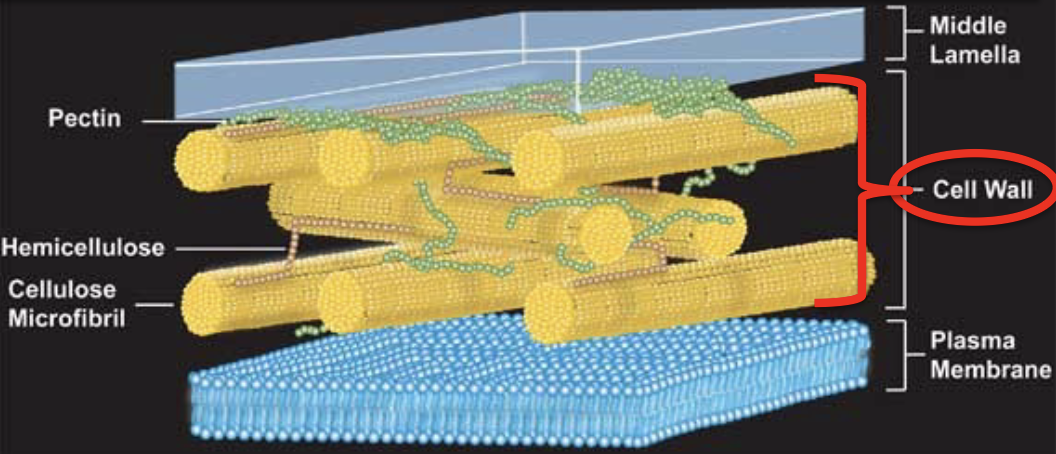
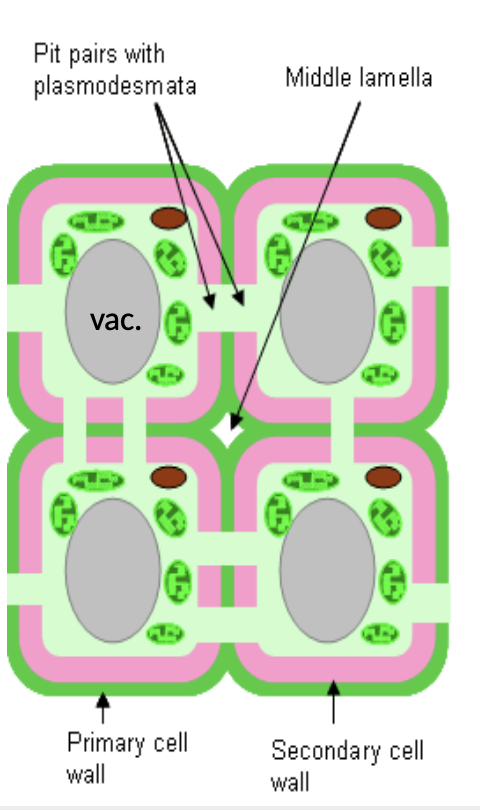
Cells Sticking Together:
Middle Lamella
- material between cells
- made of pectin substances
3 Tissue System in Vascular Plants
- Dermal Tissue
- single layer; secrets cuticle (waxy)
- Vascular Tissue
- Xylem and phloem: support and supply
- Ground Tissue
- Bulk of young plant; fills space between dermal and vascular tissues; mostly parenchyma; storage, photosynthesis, support
Plant Cell Types:
Dermal Tissue:
- Epidermis
Ground Tissue:
- Parenchyma
- Collenchyma
- Sclerenchyma
Vascular Tissue:
- Tracheids and vessel elements
- sieve elements
Epidermal Cells:
-Outermost cells
-single layer (single sheet) covering leaves, stems and roots of non woody plants or plant parts
-Functions:
- waterproofing
- protection from pathogens: viruses, bacteria, fungi
- (other specialized roles): hairs (trichomes) / nectary/ guard cells: gas exchange
Cuticle:
→ formed by the epidermal cells outermost part is wax
protection against;
- water loss
- pathogens
- ultraviolet (UV) radiation
→Secretory Trichomes
3 Kinds of Trichomes on 1 leaf
- Trichomes
- Secret oils (defense)
- Hinder crawling insects (defense)
Lecture 4
Cell Types and Primary Growth
Parenchyma Cells
- Functions
- Many; often specialized
- Most metabolic processes (photosynthesis, storage, secretion, food stroage)
- Features
- A type of ground tissue (when in stems and roots)
- Lack secondary wall
- Often divide and differentiate at maturity
- E.X.
- Fruit flesh
- Endosperm
- Pith and cortex of stems and roots
- Chloroplasts-laden cells inside leaves
Collenchyma Cells
- Functions
- Support (esp. Of young and growing organs)
- Features
- Type of ground tissue
- Thick, uneven primary wall
- No secondary wall
- ALWAYS occur just below epidermis
- Often occur in strands
- Alive at maturity; can elongate
- E.X.
- Celery leaf midrib and petiole
Sclerenchyma Cells
- Function
- Support
- Protection (of tissues no longer elongating)
- Features
- Type of ground tissue
- Thick secondary cell wall with lignin (rigid polymer)
- Cannot elongate at maturity (may be dead)
- 2 forms: fibers and sclereids
- E.X.
- Burlap bags (jute fibers)
- Fibers in a bundle (cross section)
- FIBER: Hemp (cannabis sativa)
- SCLEREIDS: Nutshell (pak acorn) →note: thick wall
Water-Conducting Cells of the Xylem:
Tracheids and Vessel Elements
- Functions
- Support and supply of water and minerals
- Features
- Dead at maturity
- Secondary wall lignified; often spiral
- 2 kinds: tracheids and vessel elements
- Type of vascular tissue
Lignin
- Class of complex organic polymers (NOT polysaccharide)
- 2nd most abundant natural polymer (after cellulose)
- Deposits in cell walls; fills spaces and bind cellulose, hemicellulose and pectin
- Gives strength to wood and bark
- Can occur in cell walls of non-woody plants (palm trees, bamboo, wheat)
- Human uses:
- Wood: 20-33% lignin by dry weight
- Rope, clothing, rugs (sclerenchyma fibers)
- Paper: lignin removed to leave cellulose
- Artificial Vanillin (real vanillin is from vanilla orchid)
Sugar-Conducting Cells of the Phloem: Sieve-Tube Elements
- Functions
- Transports sugars (esp. sucrose), other organic compounds, some minerals
- Features
- Type of vascular tissue
- Alive at maturity
- With companion cell (parenchyma)
Plants Grow from Meristems
Meristems: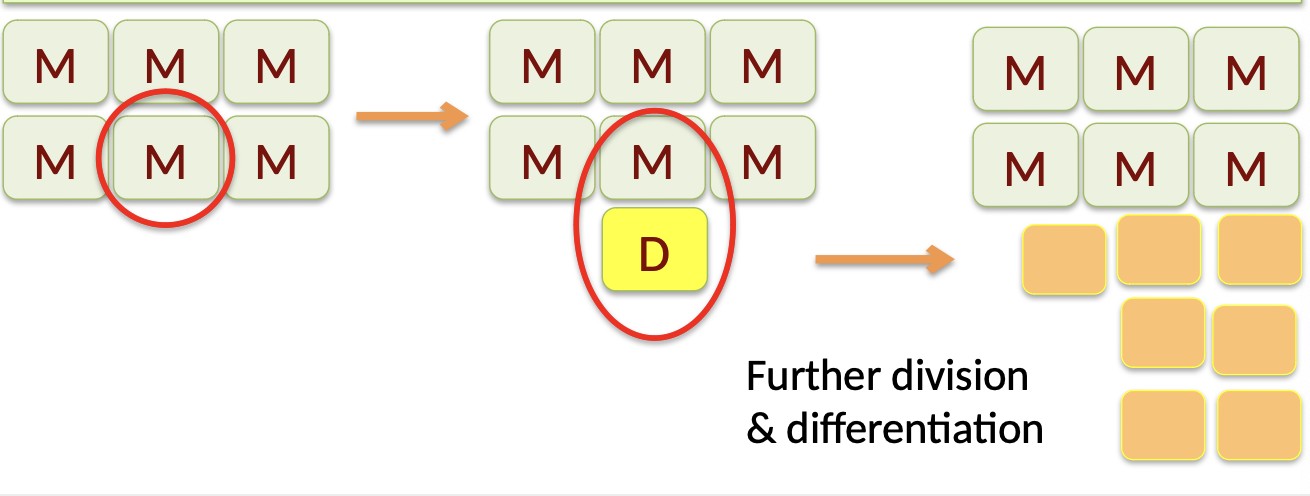
- Ultimate source of all parts of the mature sporophyte
- Undifferentiated
- Retain “forever” the ability to divide
Types of Location of Meristems
- Apical Meristems (AM)
- Root AM and shoot AM
- Primary growth
- Lateral Meristems
- Vascular cambium and cork cambium
- Secondary growth
Apical Meristem (AM): Shoot
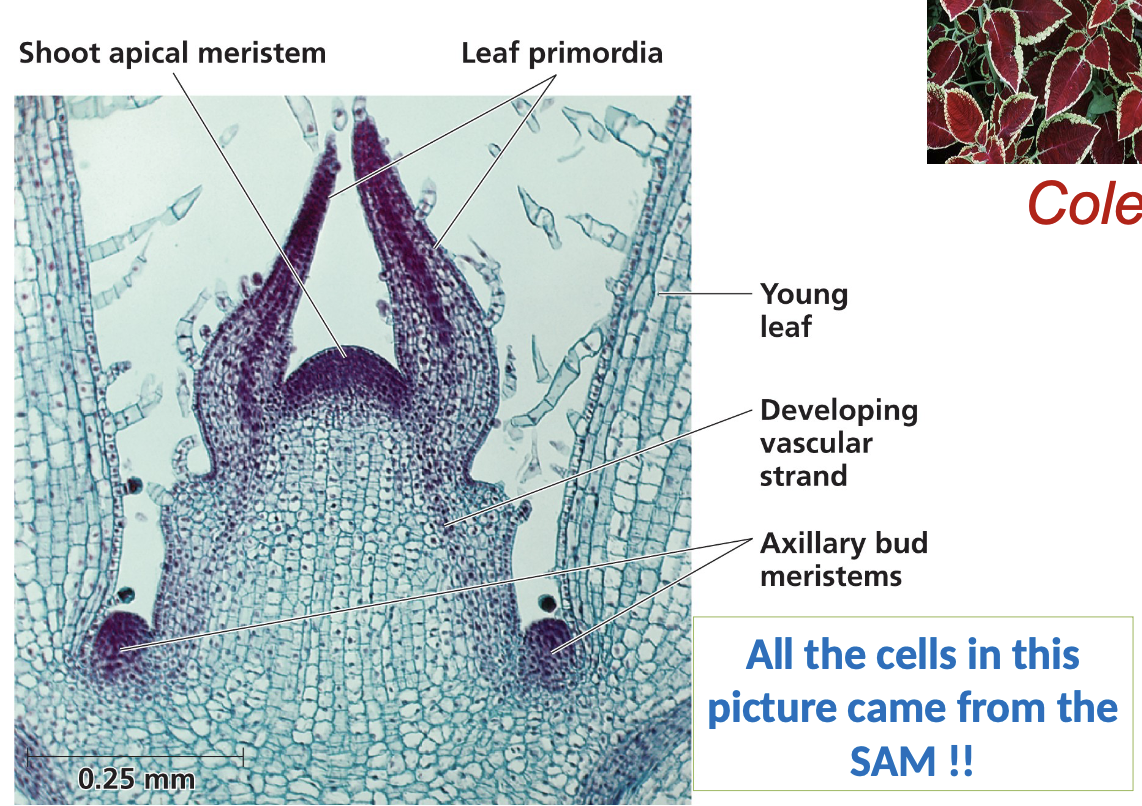
- Source of primary growth of both root and shoot
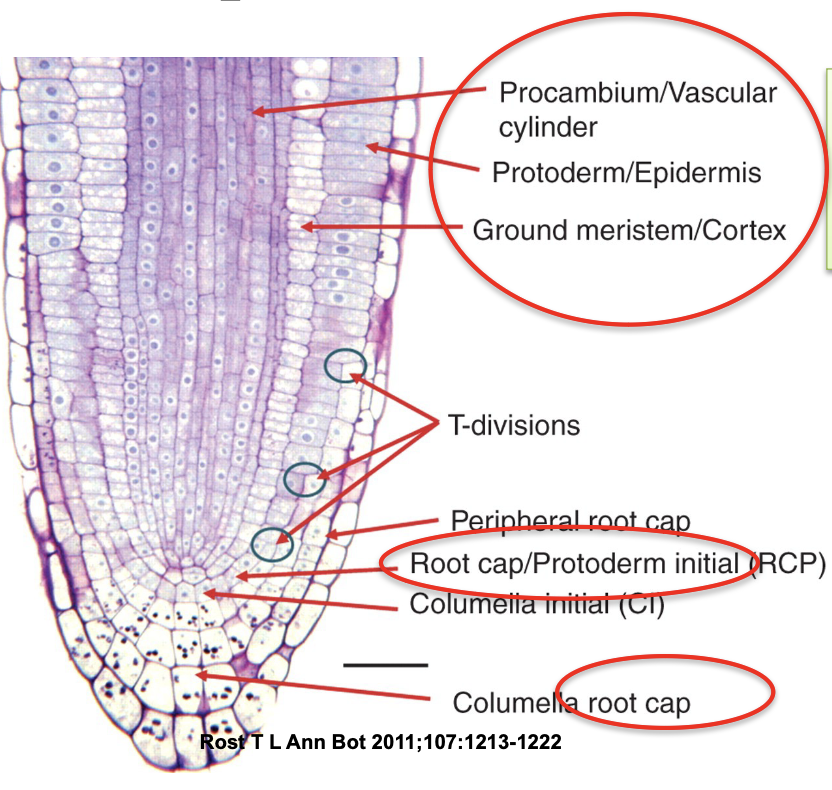
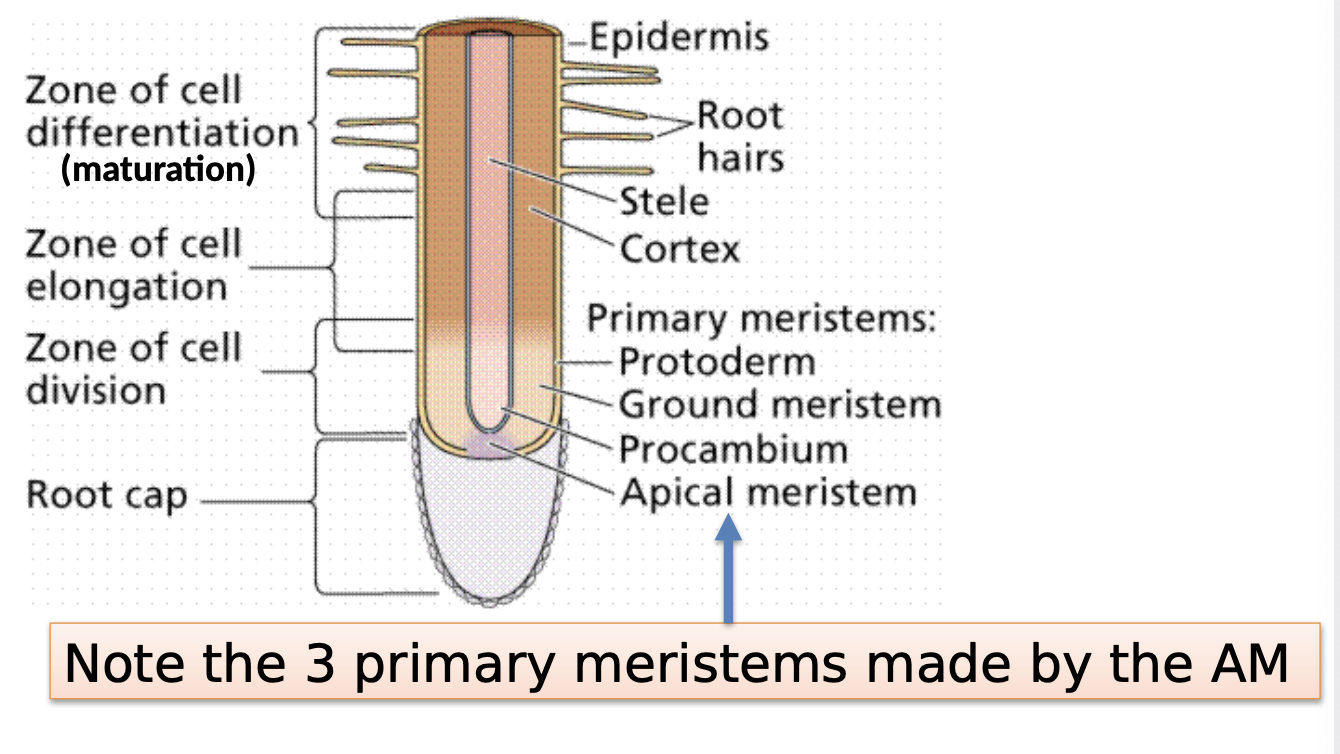
- Makes 3 meristems:
- Protoderm (epidermis) → dermal tissue
- Procambium → vascular tissue
- Ground meristem → ground tissue
Shoot Apical Meristem and Differentiation
Youngest tissue at shoot tip 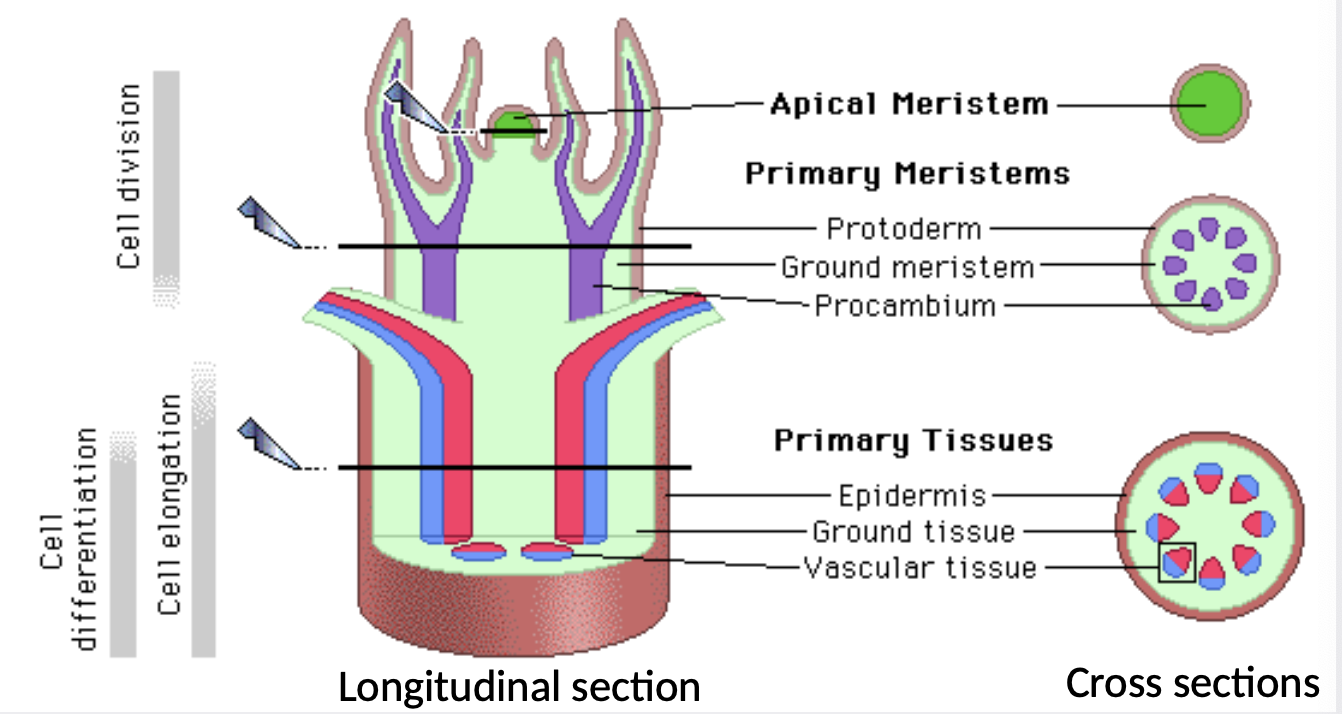
Young Stems (shoots)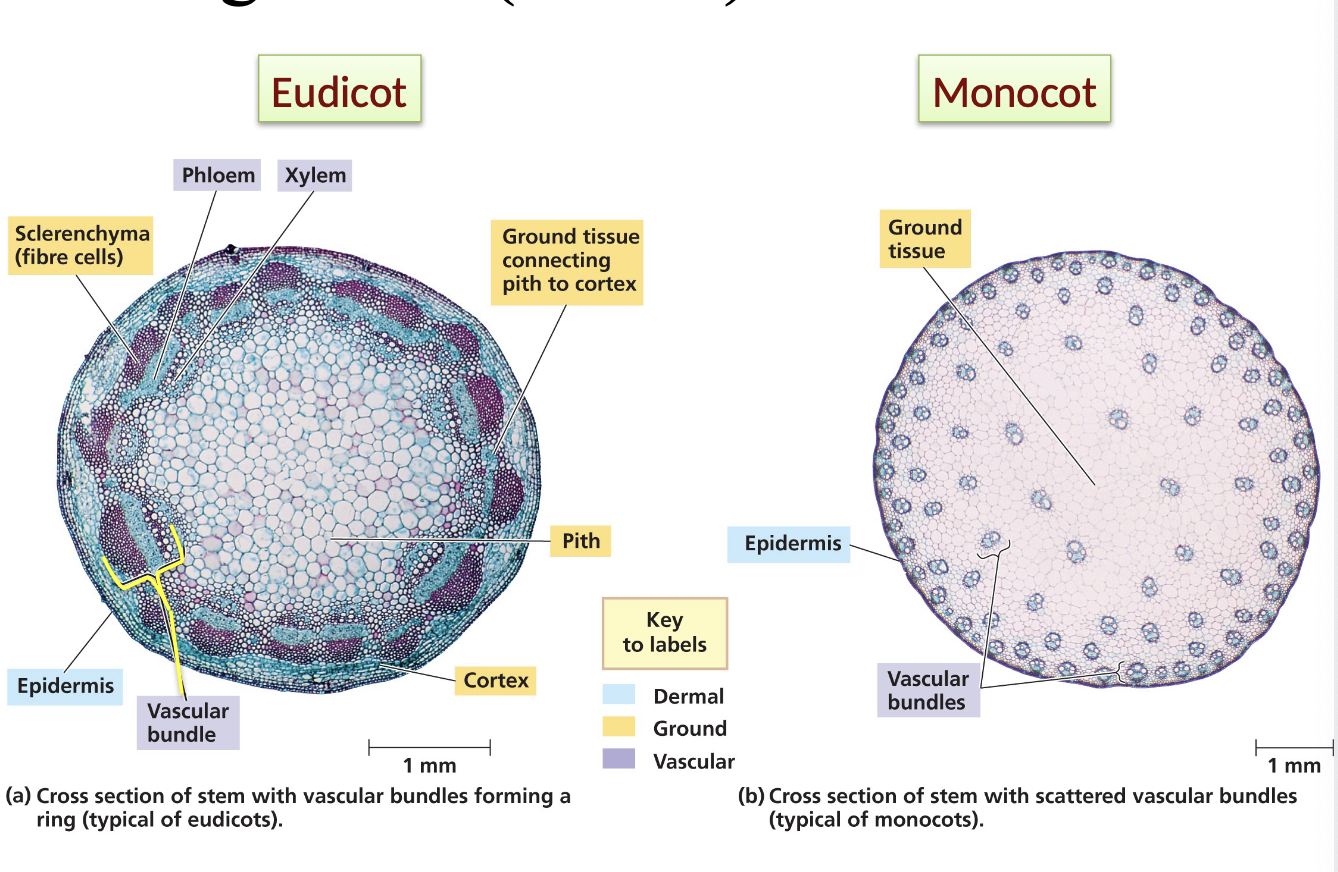
Root Apical Meristem and Development Root Primary Growth: 3 Zones
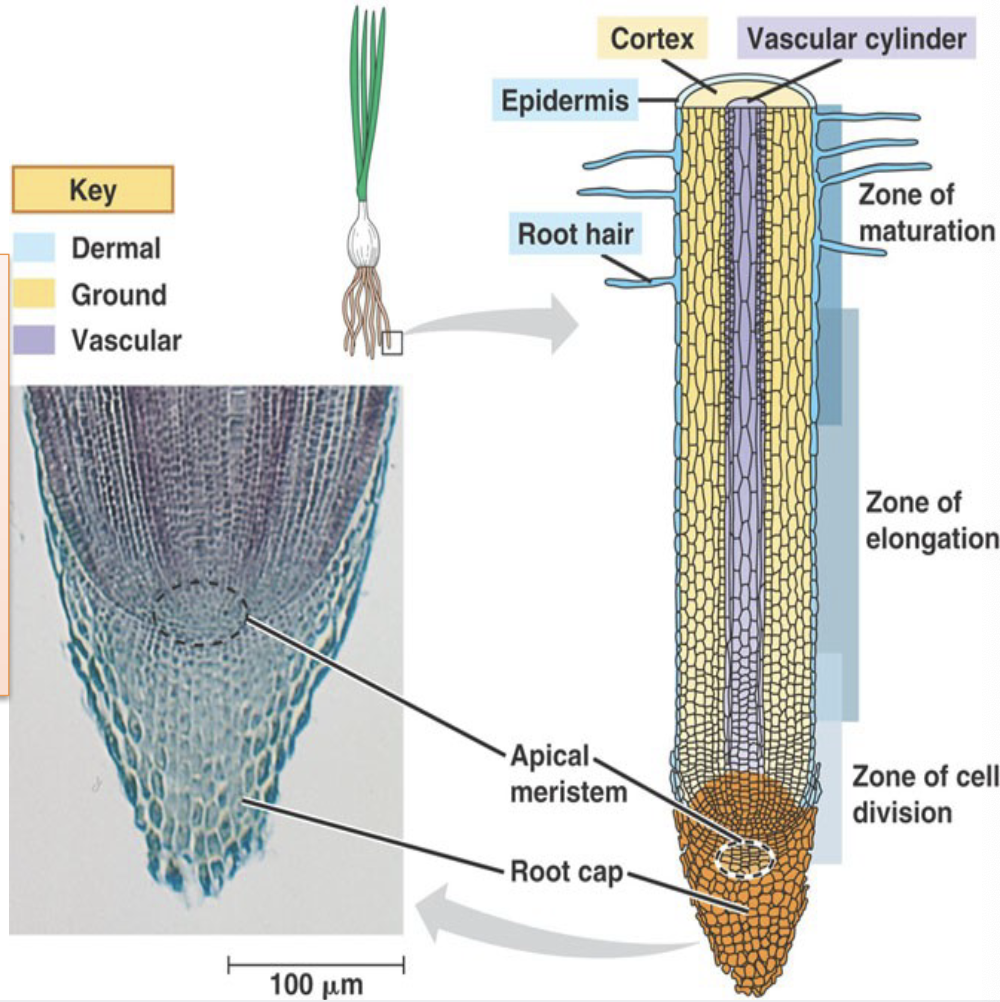
Root Primary Growth: (another view)
Root Hairs Increase Surface Area
4-month old rye plant
- 14 billion root hairs
- Surface area 400 sq. meters
- Placed end to end >10,000km
Young Roots
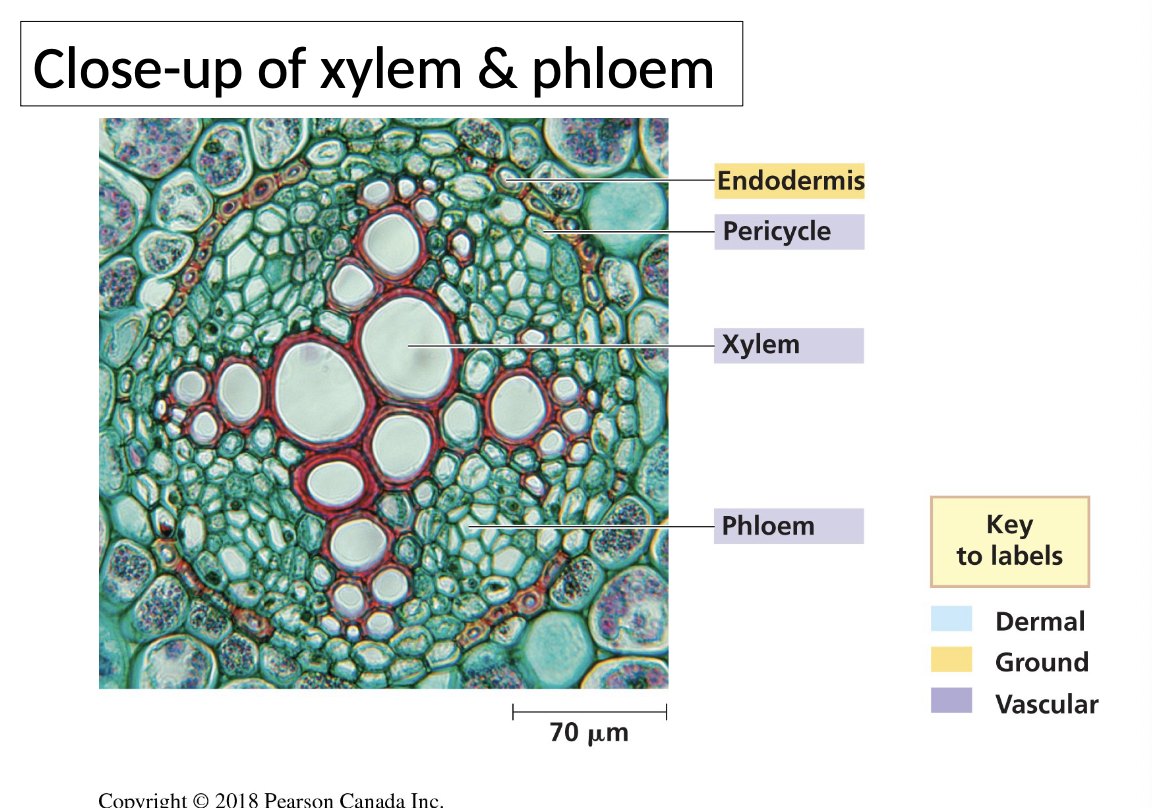
- Endodermis: innermost layer of cortex
- Stele or Vascular Tissue: all cells inside endodermis; arise from procambium
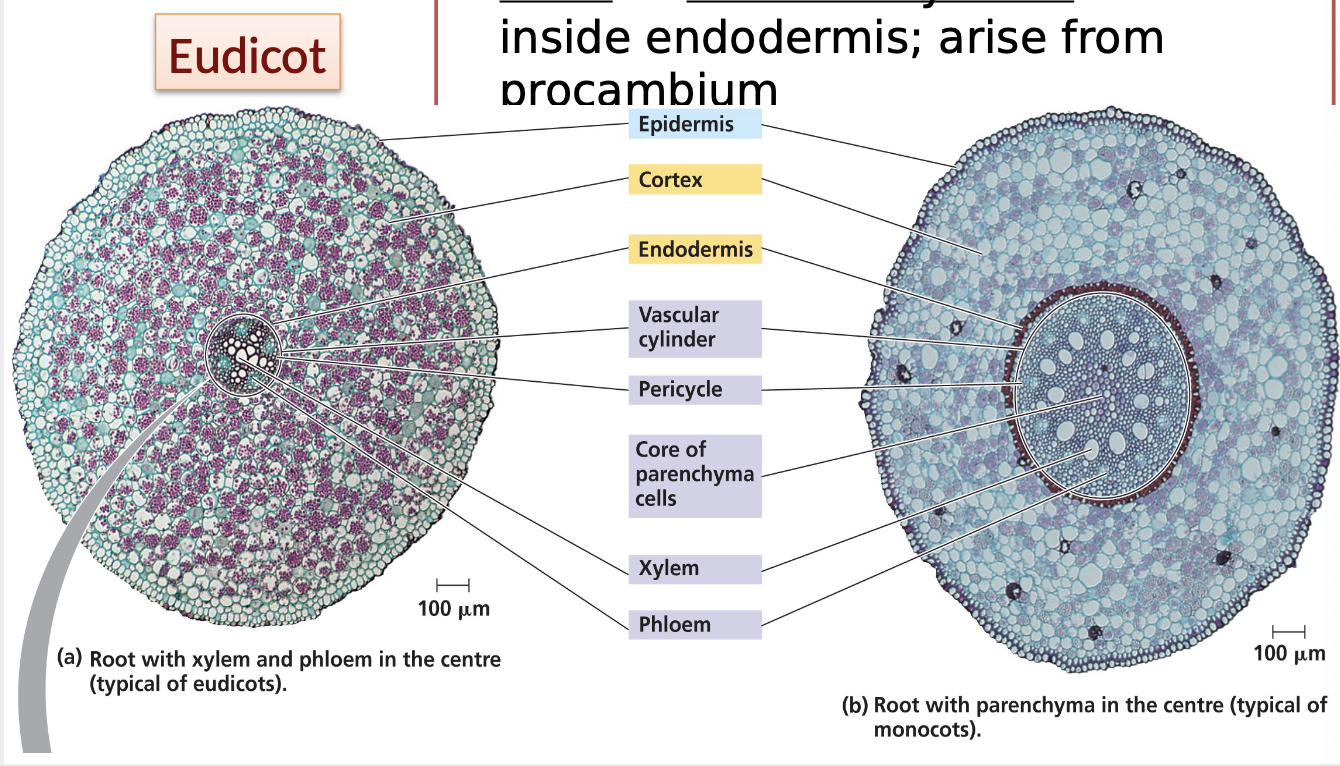
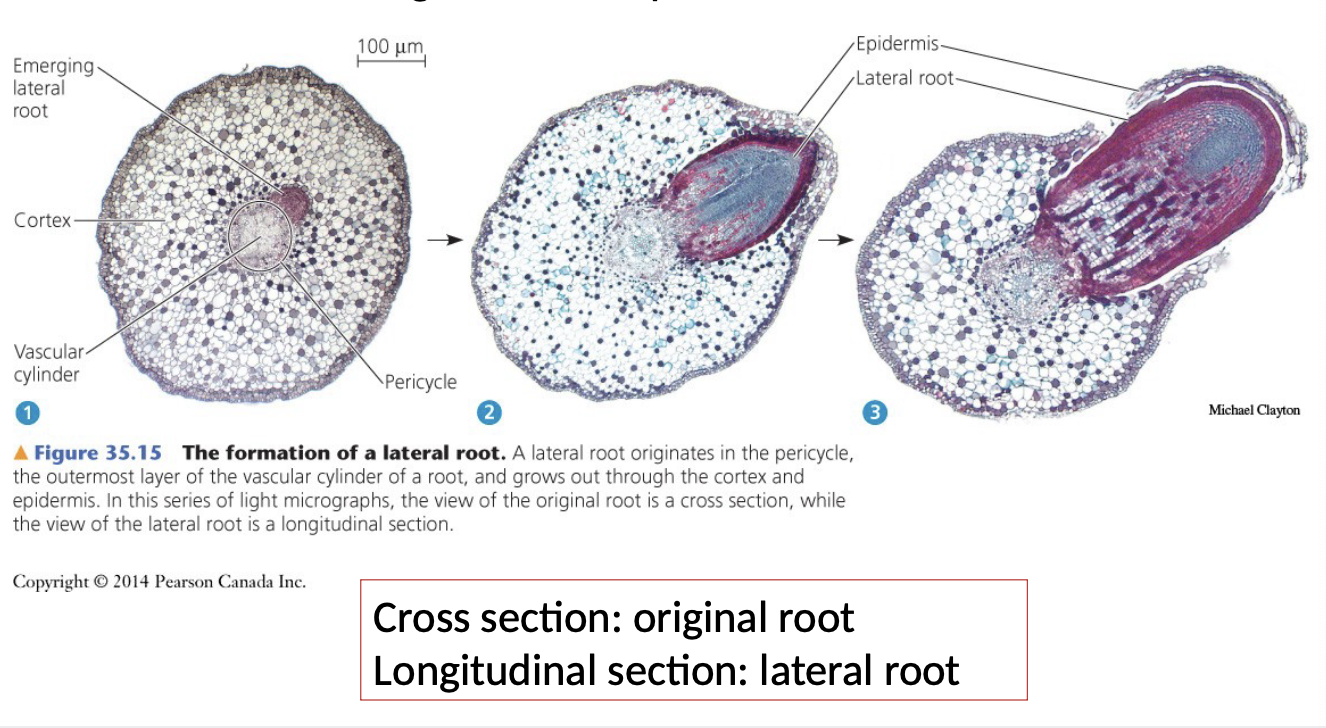
Lateral Root
- Originates in pericycle (outermost layer of vascular cylinder)
- Grows out through cortex and epidermis
Structure of Primary (non-woody) Roots: SUMMARY
- Root cap: protects
- Root Hairs: epidermal cells, increase absorption area
- Endodermis: innermost layer of cortex; surrounds vascular cylinder
- Vascular cylinder (stele): center of root; contains vascular tissue (xylem and phloem) and some ground tissue
- Pericycle: between vascular cylinder and endodermis; origin of lateral roots
Lecture 5
Secondary Growth, Transport
Types and location of Meristems
Apical Meristems
- Root AM and shoot AM
- Primary Growth
- All vascular plants
Lateral Meristems
- Vascular cambium and cork cambium
- Secondary growth
- Only in conifers and woody eudicots
- Make wood and bark
Secondary Growth
Produces: → wood and bark
Occurs in: → conifers and woody eudicots
Secondary Growth in Stems: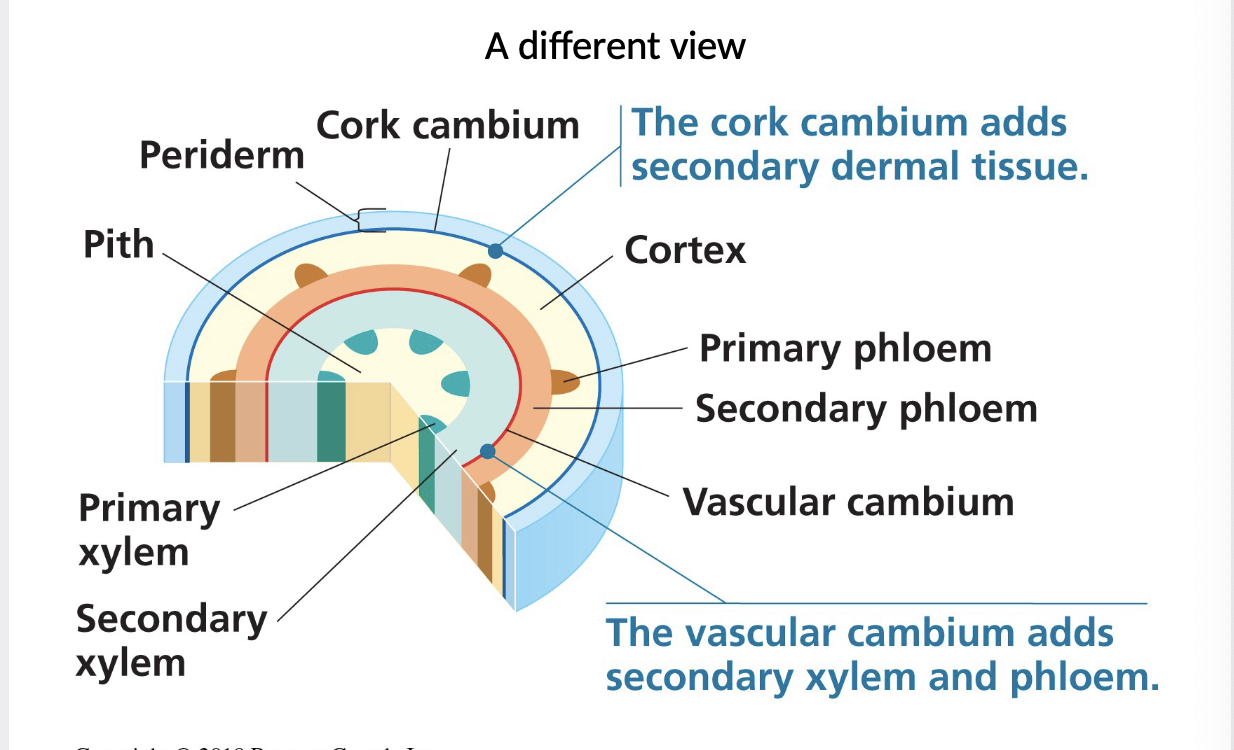
Vascular Cambium is a Meristem:
VC Produces:
- Secondary xylem to inside (wood)
- Secondary phloem to outside
- More VC (to increase circumference)
- Rays - parenchyma for lateral transport
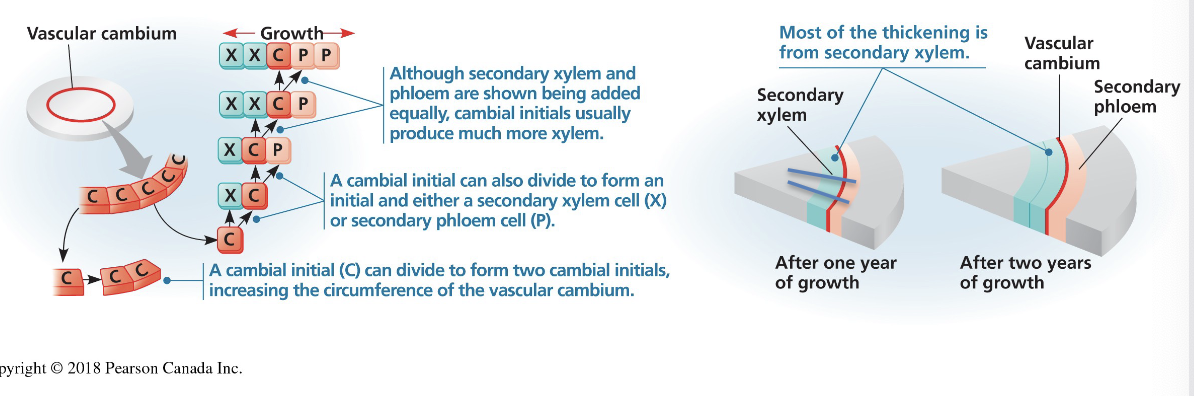
Vascular Cambium:
Fusiform initials make:
- Tracheids and vessel elements (xylem)
- Sieve elements (phloem)
Ray Initials make:
- Rays (in both xylem and phloem)
Wood: Oak
- Secondary xylem
- Lignin (polymer) in secondary walls of tracheids and vessel elements
- Heartwood vs. sapwood
Protection in Woody Plants:
Cord Cambium (Phellogen)
- New lateral meristem
- Arises from cylinder of cortex cells outside the vascular cambium and secondary phloem
- Produces periderm: 3 layers
- Phelloderm to inside (some woody species)
- Thin layer of living parenchymal cells
- Cork cambium itself
- Cork to outside
- Suberized, dead cells
- Protects woody plant (there is no more epidermis)
Anatomy of Tree Trunk: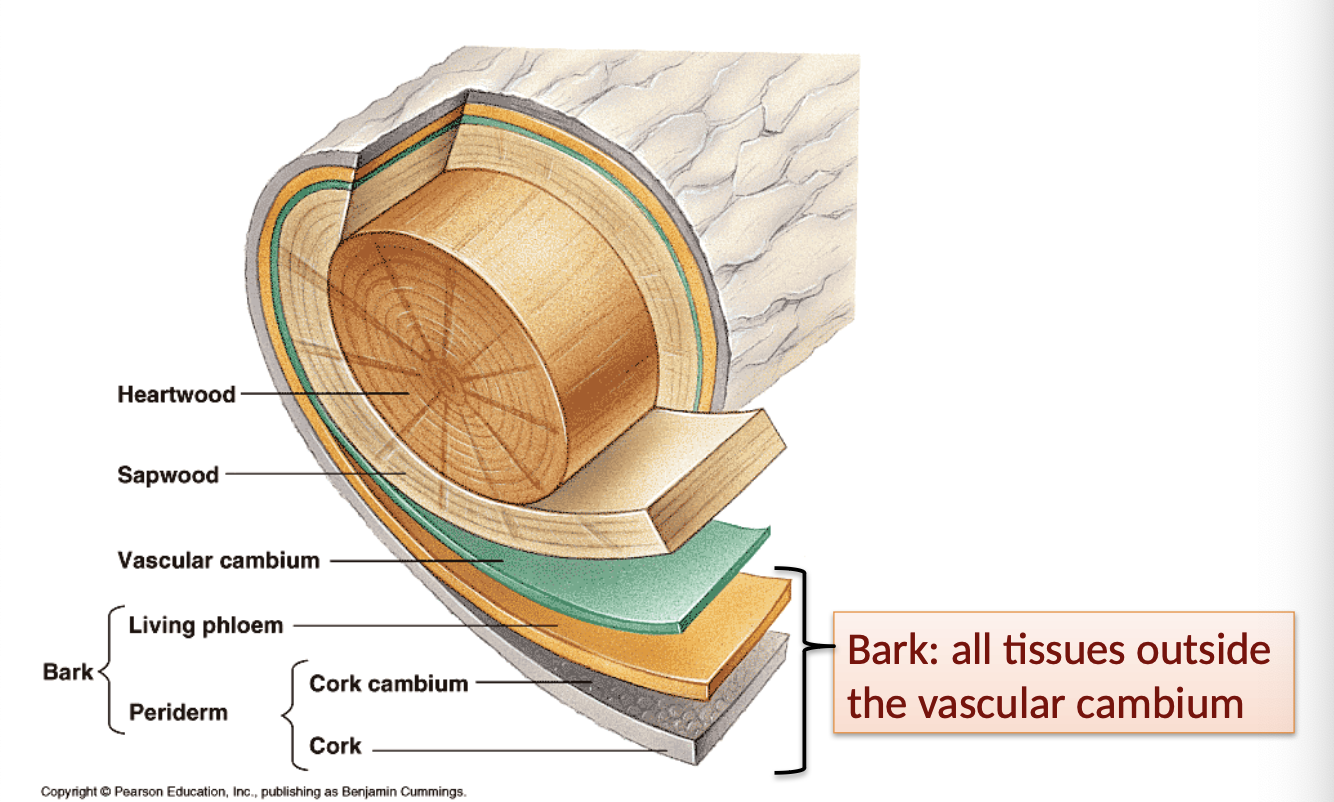
Tissues of Woody Stem: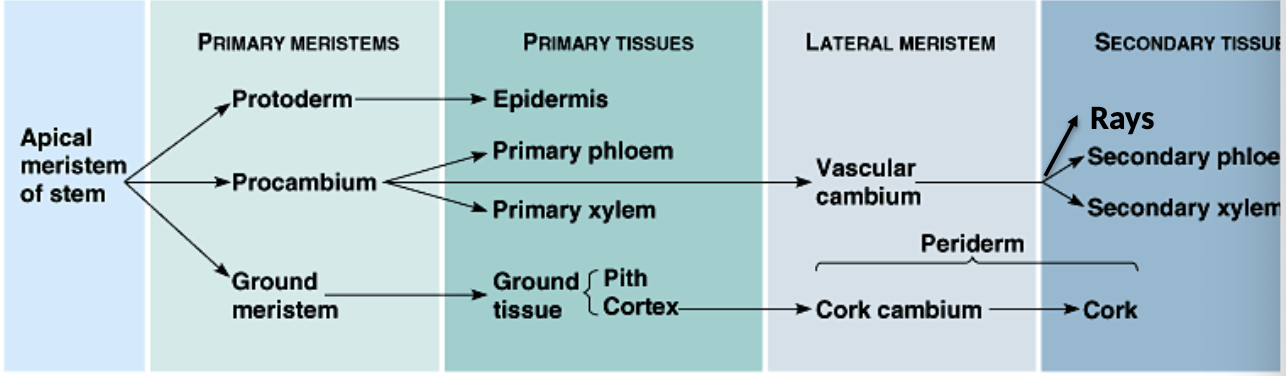
Transport:
1st Law of Thermodynamics
→ cannot create or destroy energy, can only change from one form to another
2nd Law of Thermodynamics
→Energy spontaneously tends to flow only from being concentrated in one place to becoming spread out, or for a combined system and surroundings, entropy never decreases
2nd Law in Life
- Movement of fluid in plants follows the 2nd law of thermodynamics
- The most equitable distribution of energy corresponds to maximum entropy
E.x. -osmosis
-diffusion
-fluid movement because of differences in hydrostatic pressure
Routes of Water Movement within a Plant:
3 cell compartments
Cytoplasm:
- All material inside cell membrane
Cytosol:
- Part of cytoplasm excluding organelles
3 transport Routes
Cellulose:
- Main component of cell walls
- Highly absorbent (hydrophilic)
- Polysaccharide (polymer)
- Most abundant organic compound on earth
Water Potential: Psi
- Water potential energy
- Unit: megapascal (MPa)
- 1 MPa = about 10 atm (bars)
- Potential refers to water’s capacity to perform work
- Energy and entropy are intimately linked (outside our discussion)
- Determine DIRECTION of movement water
- Water flows from regions of higher to lower water potential
- Combines effects of solute concentration and pressure
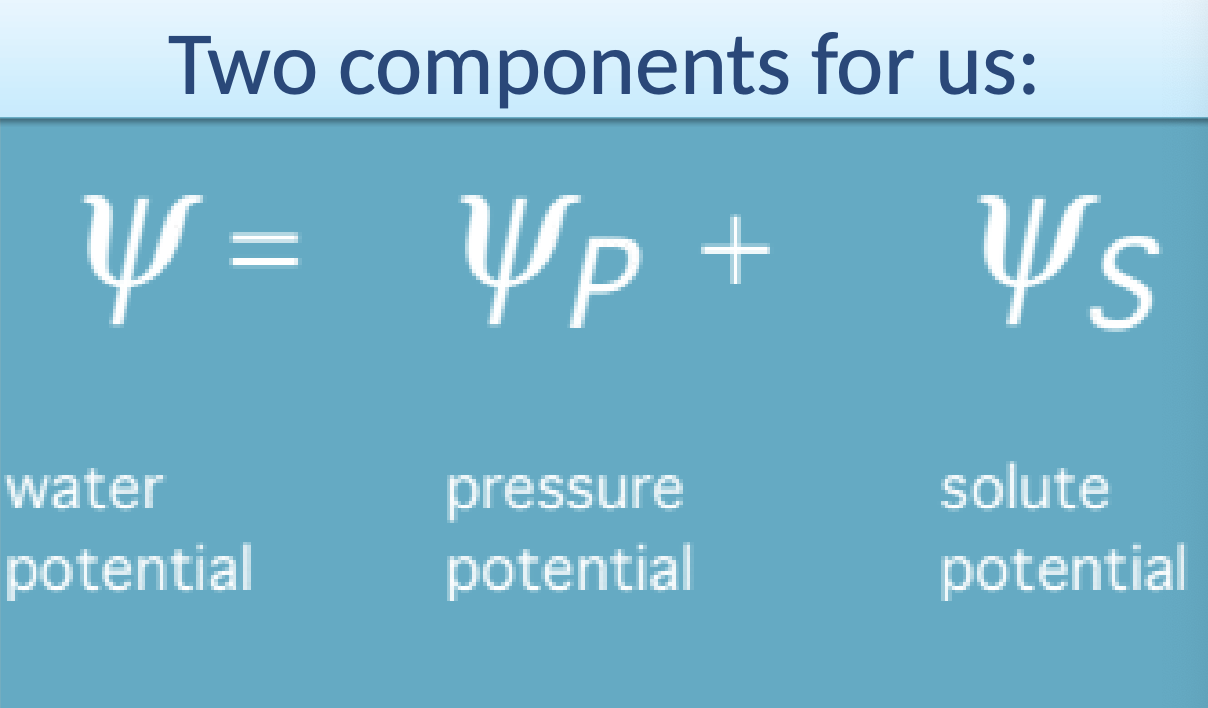
Water Potential: 2 Components 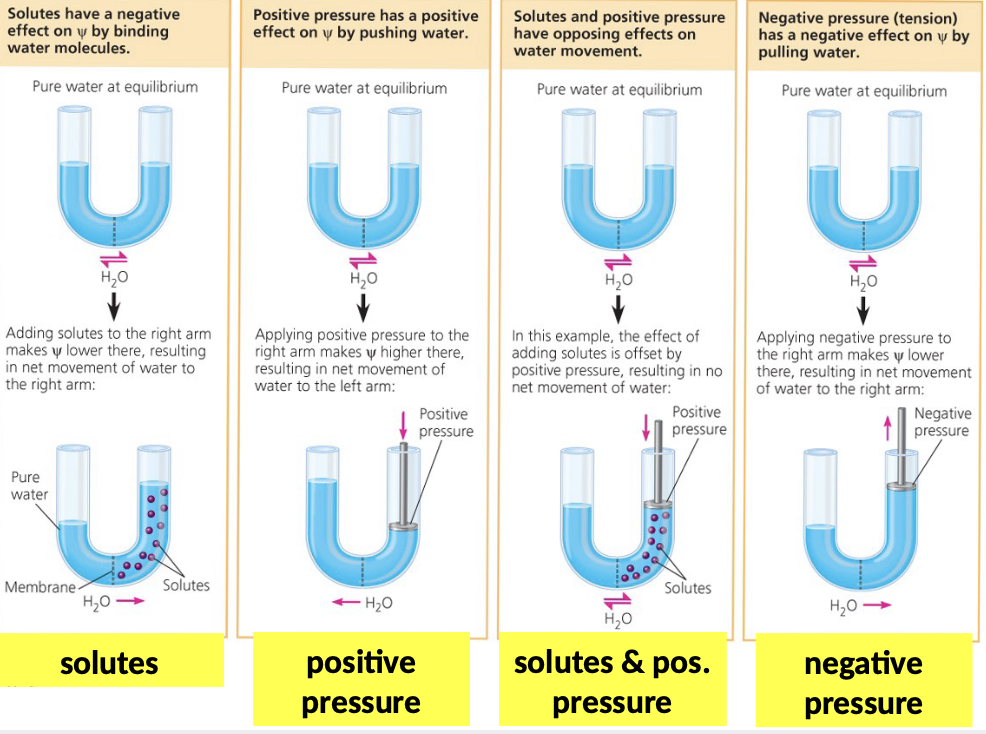
- Solute potential
- Pressure potential
Water Potential in Plant Cells:
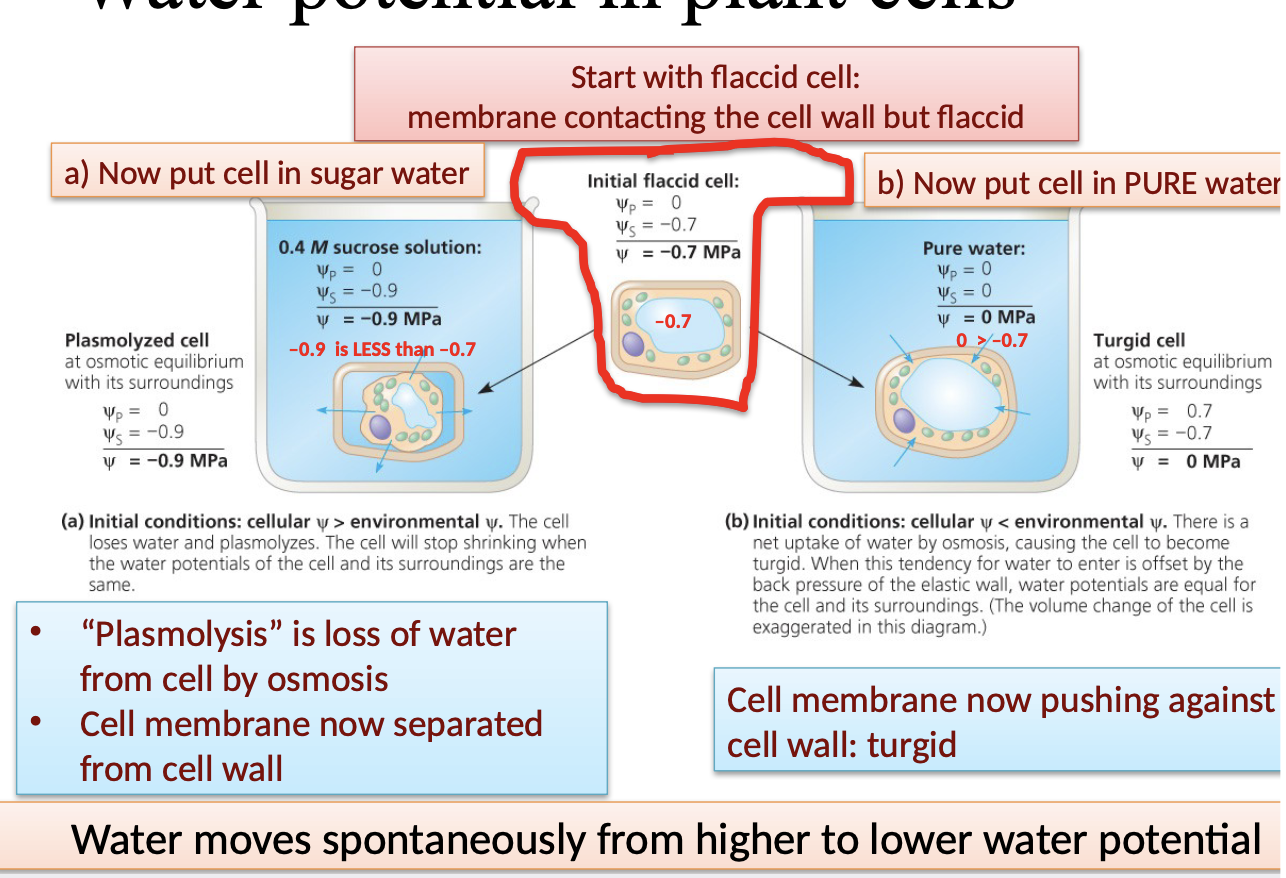
Water and Minerals Travel Upward in Xylem:
- Tracheids (all vascular plants)
- Vessel Elements (flowering plants)
Water Enters Roots: lateral transport H20 and Minerals:
Apoplast:
Non living continuum outside cytosol, including
- Cell walls
- Xylem cells
- Extracellular spaces
Symplast:
Continuum of cytosol connected by plasmodesmata
Endodermis:
- Cylinder 1-cell thick
- Stele: all material inside endodermis
- Xylem and phloem
- Pith
- Pericycle (origin of lateral roots)
- Casparian strip
- Where primary wall and middle lamella were
- Waterproof and impermeable to ions: suberin
- All water and ions entering xylem must pass through endodermal cells; must cross
cell membrane
Mycorrhizae - A Mutualism between Plants and Fungi
- Increase surface area
- Aid absorption of minerals
Pathway of Water and Minerals: (in herbaceous plant)
- Soil
- Root and hair mycorrhizae
- Cortex
- Endodermis
- Xylem
- Atmosphere
How Water and Minerals move up a Plant:
- Capillary action
- Pumps
- From above
- From below
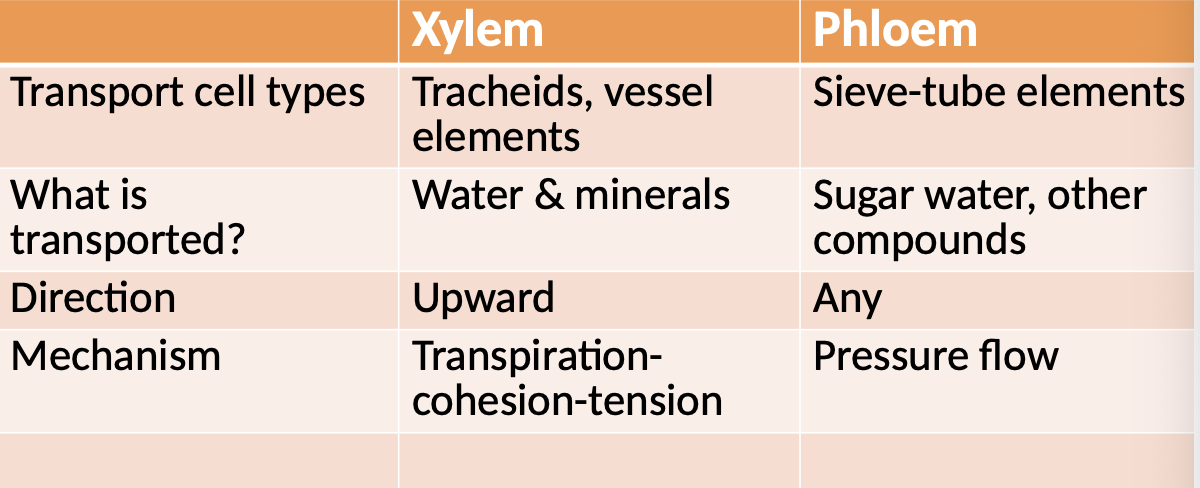
- Transpiration-cohesion-tension mechanism
Generation of Transpirational Pull:
Negative pressure (tension) at the air-water interface in the leaf is the basis of transpirational pull, which draws water out of xylem
Water Flow in Xylem: Ascent of Sap:
Steps:
- Water evaporates from moist cells in leafs stomates (transpiration)
- Water potential is lowered at air-water interface, causing negative pressure (tension) in xylem
- Hydrogen bonds hold water molecules together (cohesion)
- Xylem under tension gradient: pressure potential - lowest (most negative) at top
- Water is pulled up by pressure gradient
- Water and minerals enter root by osmosis
Facts:
- Total path in xylem from highest (lest neg.) to lowest (most neg.) water potential
- Passive process
- Tracheids and vessel elements are dead cells
- Upward only
Control of Transpiration by Stomates
Cues to open at dawn:
- Light
- CO2 deletion
- Circadian rhythm
Dry conditions:
Abscisic acid: hormone 
- Causes k+ to leave guard cells
- Stimulates stomatal closure
Phloem Transport:
What: sugar in solution and other compounds
Where: sieve-tube elements
How: pressure-flow hypothesis
Transport within plants: keys to understanding
- Water spontaneously moves from regions of higher to regions of lower potential energy
- In any regions, water potential energy is the SUM of
- Solute (osmotic) potential energy (0 to negative)
- Pressure potential energy (any value)
- 2 Main tissues for transport
Two Vascular Tissues: SUMMARY
Lecture 6
Transport, Photosynthesis and Control System
Photosynthesis
Importance:
- Source of oxygen in atmosphere
- 50% terrestrial plants
- 50% marine phytoplankton and macroalgae
- First step in moving energy into the living world; source of all energy in ecosystems
Photosynthesis
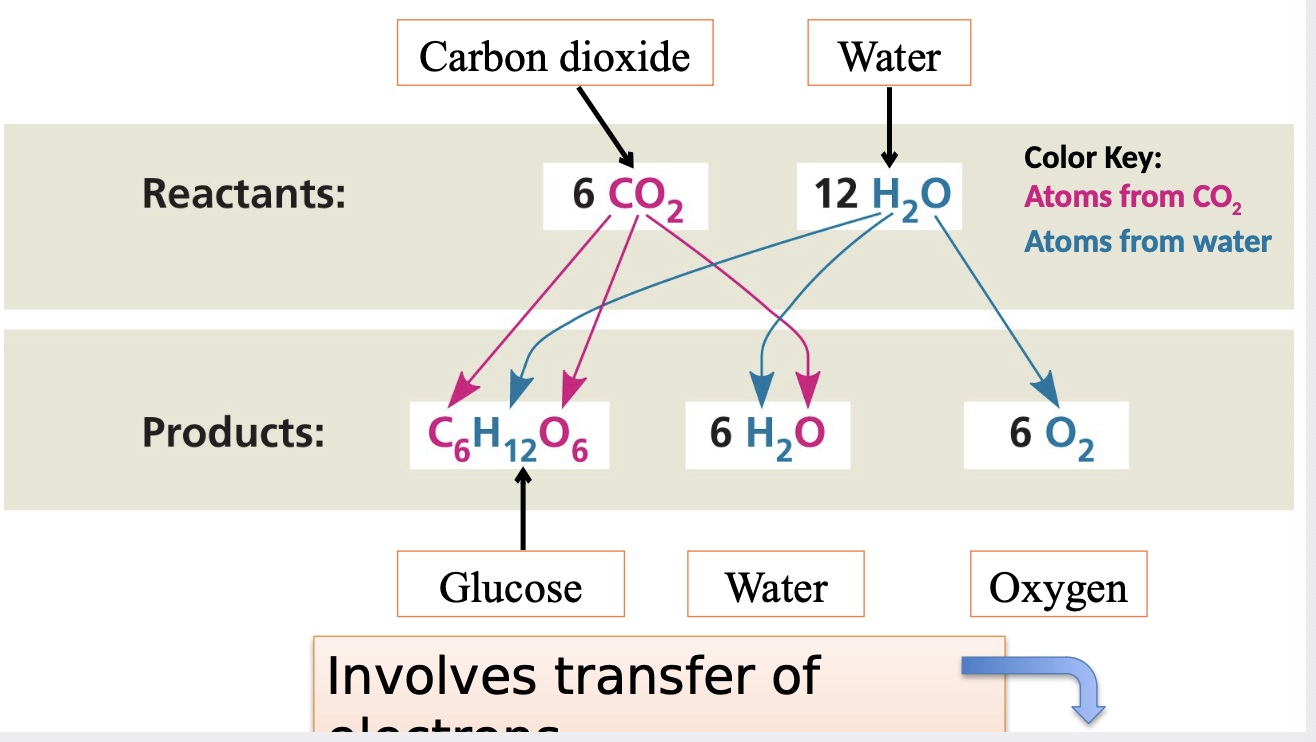
Electron Transfer: REDOX
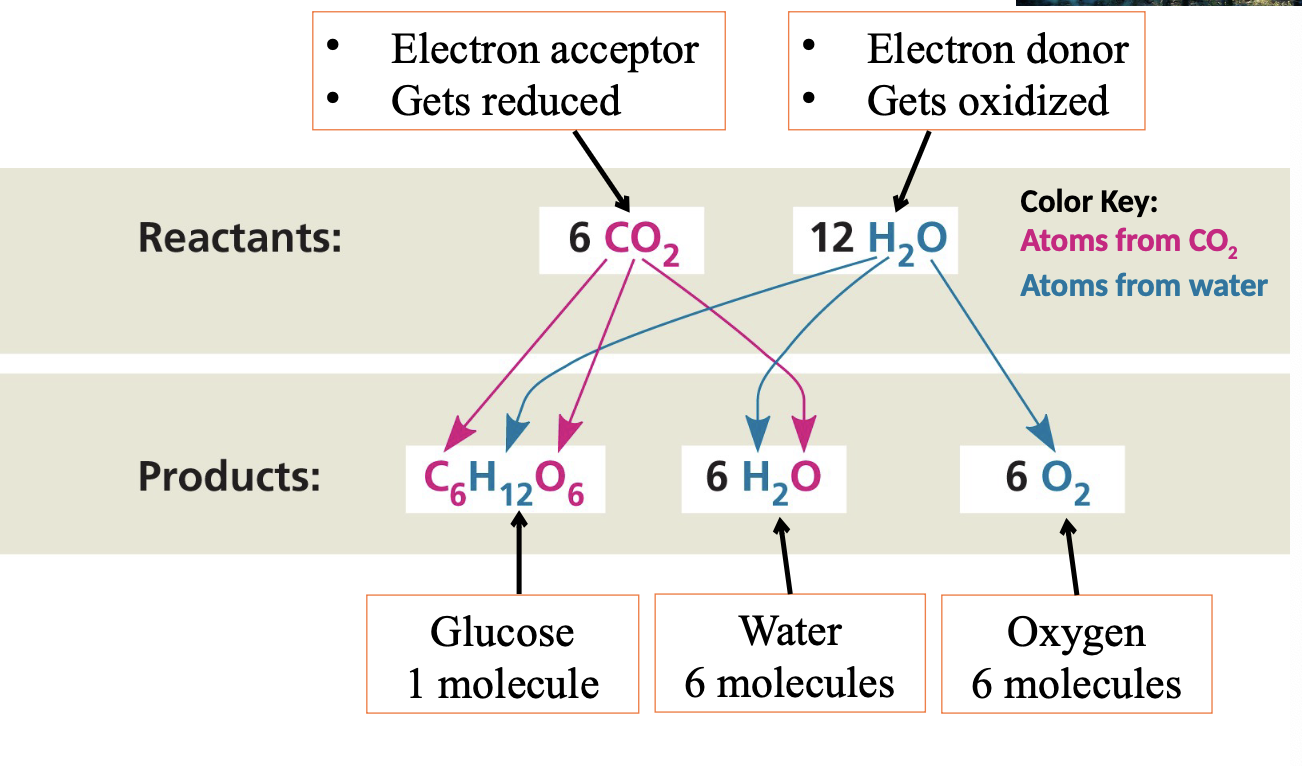
Electron Transfer
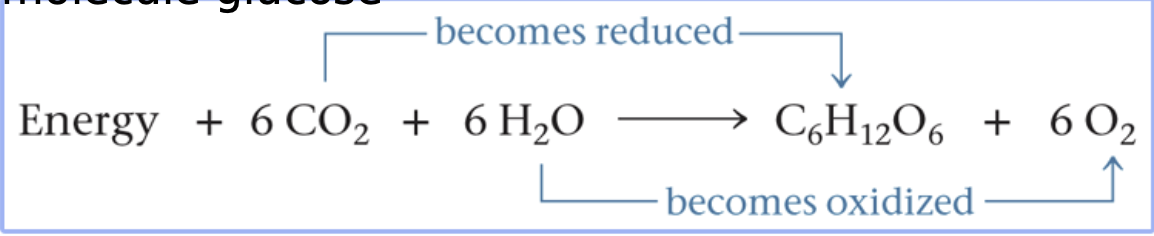
- Here, 6 water molecules have been subtracted from each side to give the net reaction to produce 1 molecule glucose
- Water is split, loses electrons (get oxidized), and electrons are transferred along with hydrogen ions from water to carbon dioxide, reducing it to sugar
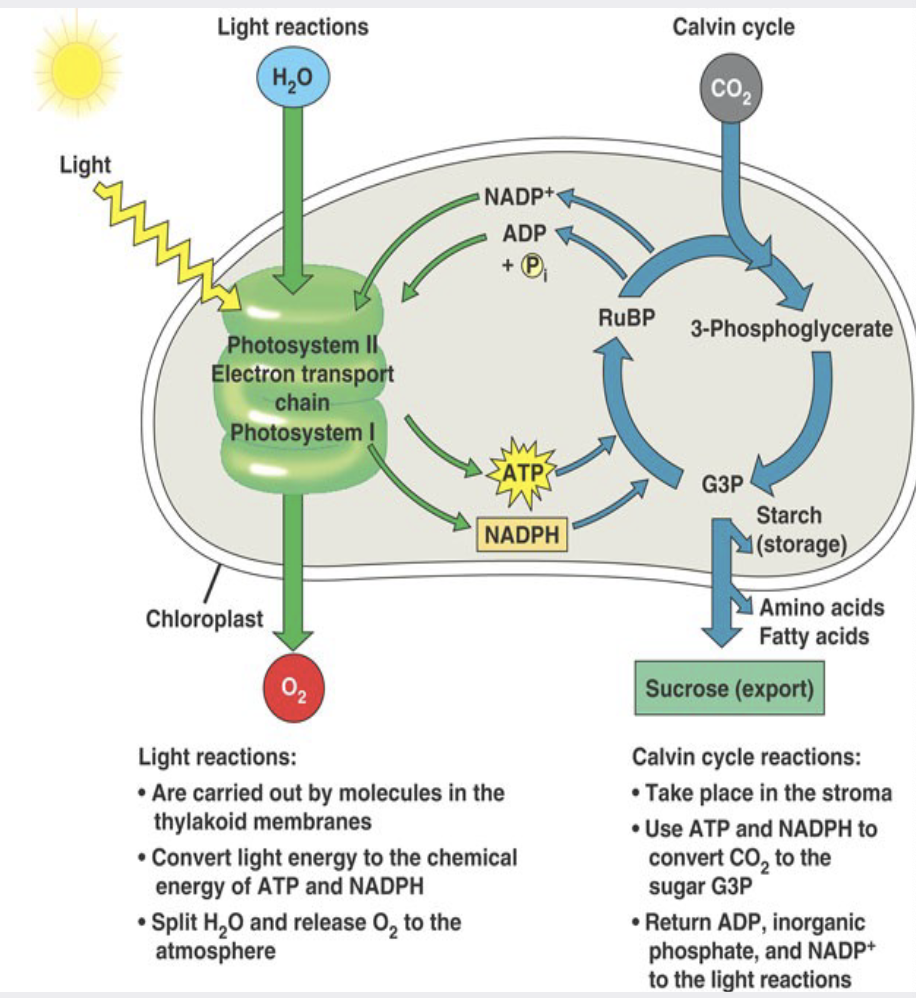
Photosynthesis: 2 stages
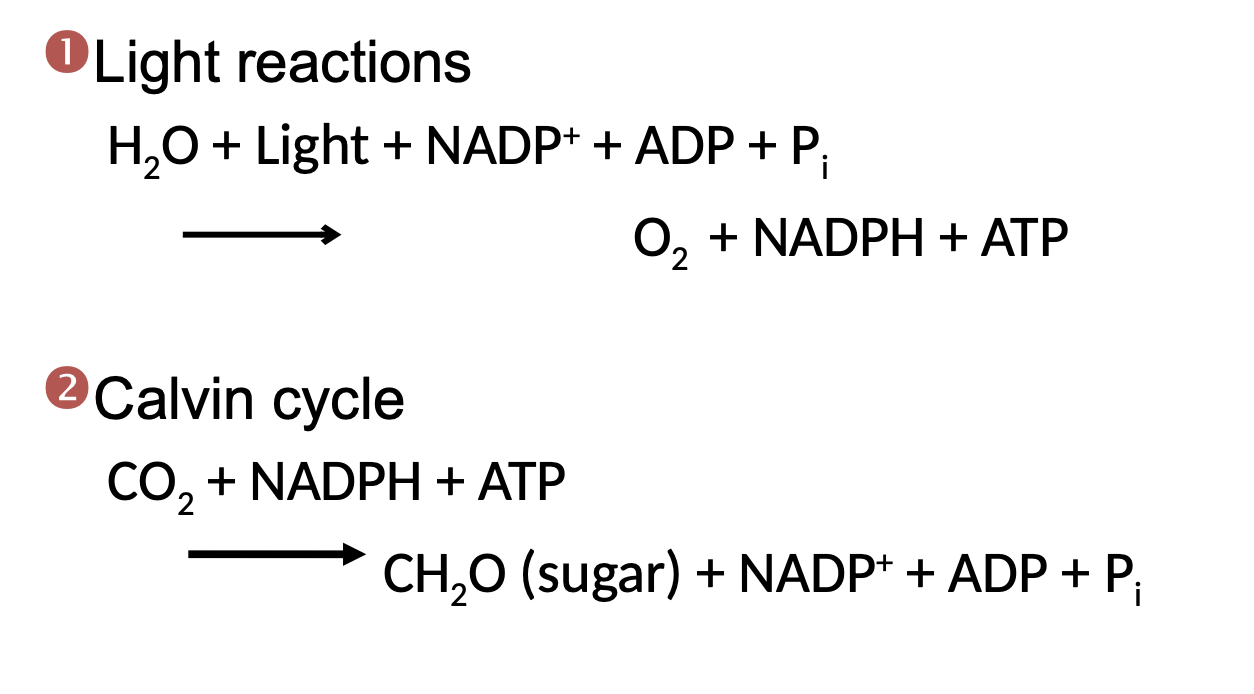
- Light reactions
- Calvin cycle (dark reactions)
Chloroplast structure and Function:
- Light reactions: thylakoid membrane
- Calvin Cycle: Stroma
Light Reaction: STEPS
- Light hits chlorophyll molecule
- Electrons bounced to higher energy level and OFF chlorophyll molecule
- Chlorophyll steals electrons from H2O (Oxidized)
- Causes water molecule to fall apart: photosynthesis → oxygen
- H2O → 2H+ + 2e + O
- Electrons and Hydrogens from H2O transferred to NADP+ (gets reduced)
- NADP+ + 2e- + h+ → NADPH (greater reducing power than H2O)
- ADP + Pi yields ATP (chemical energy): photophosphorylation
OVERVIEW:
- Light energy is converted first to chemical energy of NADPH and ATP
- Oxygen gas O2 is released (comes from water)
Chemical Bonds from Electrons:
NADP+ and NAD+
- Oxidizing agents
- Remove (accept) electrons from other molecules, including H2O (2 e- and 1 proton - nucleus of H atom)
- NADP+ in photosynthesis, NAD+ in respiration
NADPH and NADH
- Reducing agents
- Place electrons on other molecules
- NADPH in photosynthesis, NADH in respiration
Chlorophyll Absorption Spectra
→ why plants are green!
Chlorophyll A:
- Absorbs mostly violet-blue and red
- Reflects or transmits green light
- Accessory pigments broaden absorption
Photosynthesis Action Spectrum
- Matches the combined absorption spectrum of chl a and accessory pigments including chl b carotenoids
→ photosynthesis is driven by visible wavelengths
Dark Reactions (Calvin Cycle)
- Make sugar (precursor)
- Occur in stroma of chloroplast
- Use NADPH and ATP from light reactions
- Supply light reactions with NADP+ and ADP
Photosynthesis: Reaction
Rubisco
- Most abundant protein
- Most important protein
- Dual nature
Rubisco attaches O2 to RuBP Metabolic Pathway that:
- Consumes O2
- Releases CO2
- Makes NO ATP
- Wastes energy
- Decreases photosynthetic output
- SOLUTION: a new enzyme: PEP carboxylase (PEPC)
C4 Photosynthesis
Mesophyll Cells:
- O2 exits (light reactions)
- CO2 enters
- NO rubisco
Rubisco
- Is only in bundle-sheath cells
- Thus kept away from potentially low [CO2]
C4 vs CAM (Crassulacean acid metabolism)
C4: Spatial separation of steps
CAM: Temporal separation of steps
- 10% of species (e.x. cactus/pineapple/blue agave)
Control Systems
Plants Respond to Herbivores
Physical Defense
- Thorns
- Trichomes
Chemical Defense
- Distasteful compounds
- Toxic compounds
Some plants even recruit predatory animals that help defend against specific herbivores
8 Hormones
- Abscisic Acid
- Ethylene
- Auxins
- Cytokinins
- Gibberellins
- Brassinosteroids
- Jasmonates
- Strigolactones
Hormone:
- Organic substance made in one place and transported to another place where it affects growth and other processes
Hormone Action
- A hormone binds to a specific protein receptor, either embedded in the plasma membrane or in the cytoplasm
- Receptor protein’s confirmation thus changes
- Stimulates the production of ‘relay molecules’ in the cytoplasm
- Relay molecules trigger various responses to the original signal
Abscisic Acid: ABA
Stomate Regulation
Dry Conditions:
-ABA stimulates stomatal closure → causes K+ to leave guard cells
Ethylene - A Gas
Where: most plant parts
Functions:
- Leaf abscission (shedding)
- Triple response in seedlings
- Fruit ripening
- Root hair production
Discovered around 1901 by Nelijubov in Russia
1910: Emanations from oranges caused premature ripening of bananas
Now the most commercially produced organic compound in world - many uses
Abscission and Ethylene: Maple Leaf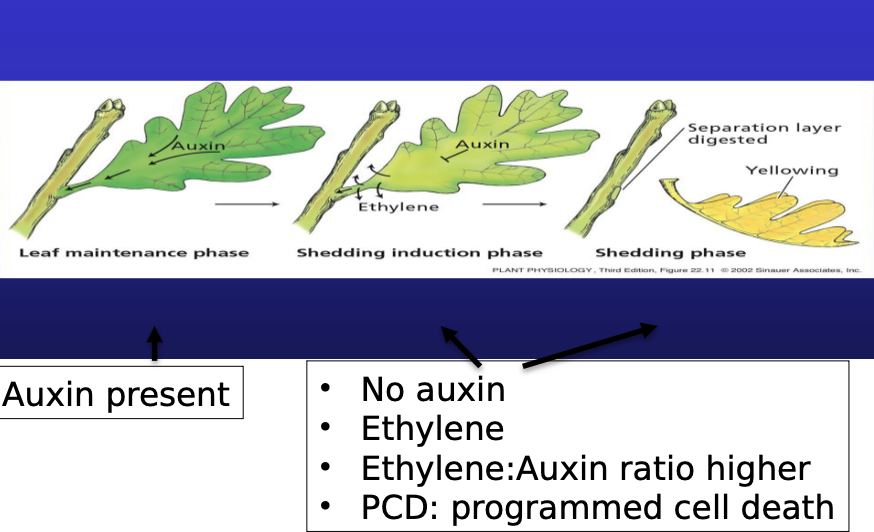
→ Caused by a change (increase) in ratio of ethylene.auxin
Ethylene and the Triple Response:
Germinating pea seedlings grown in dark
- Slowing stem elongation
- Stem thickening
- Horizontal stem growth
Effect of ethylene on Fruit Ripening
- Promotes fruit ripening and is produced during fruit ripening
- Autocatalytic: promotes its own production
- Increase respiration
Lecture 7
Introduction to Fungi
Characteristics of Fungi
- Heterotrophs
- Eukaryotic
- Main body is haploid
- Multicellular or unicellular
- Yeast: unicellular without flagella
- Cell wall made of chitin
- Polysaccharide
- Arthropod shells, cephalopod beaks, fish scales
- External digestion of food
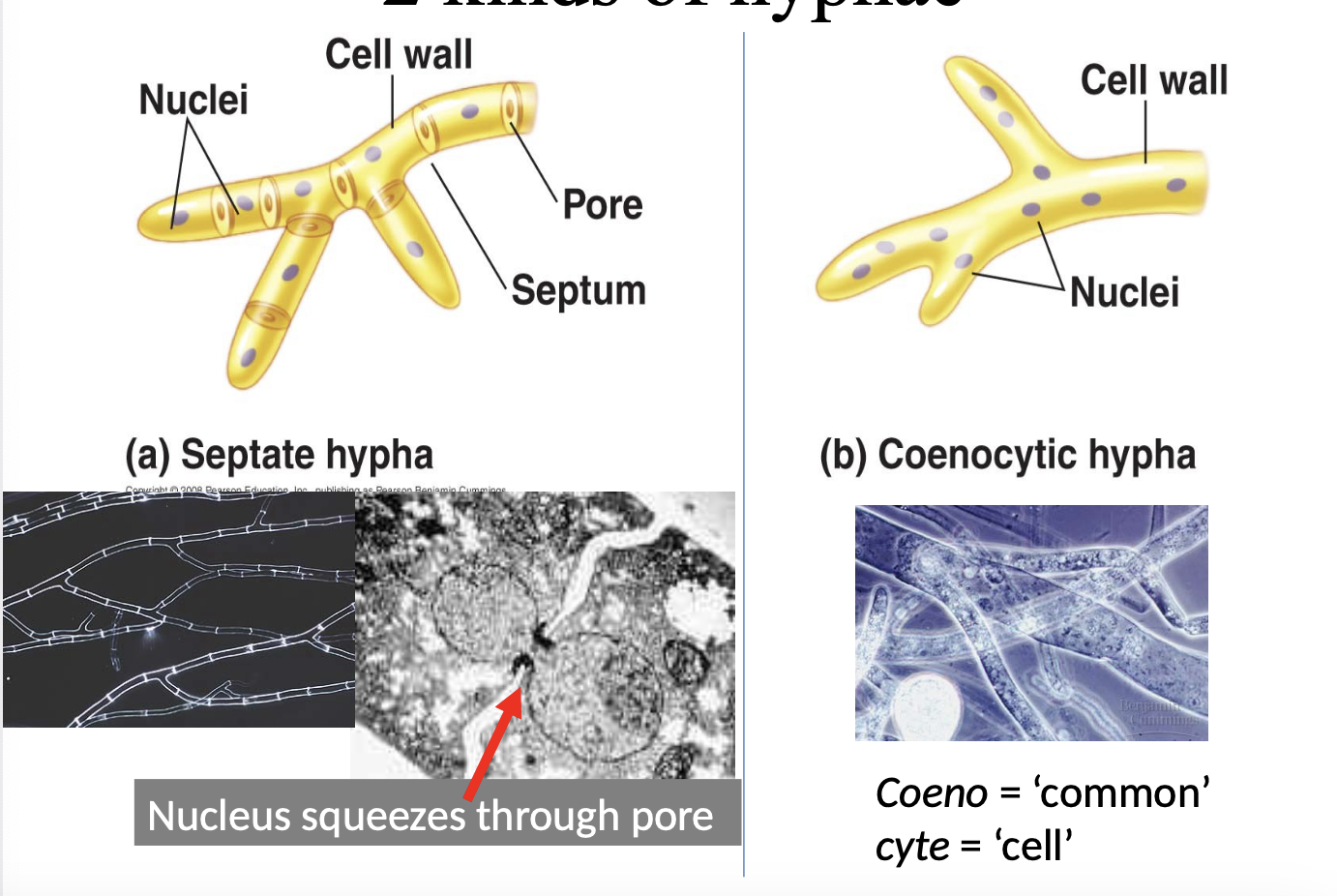
2 Kinds of Hyphae
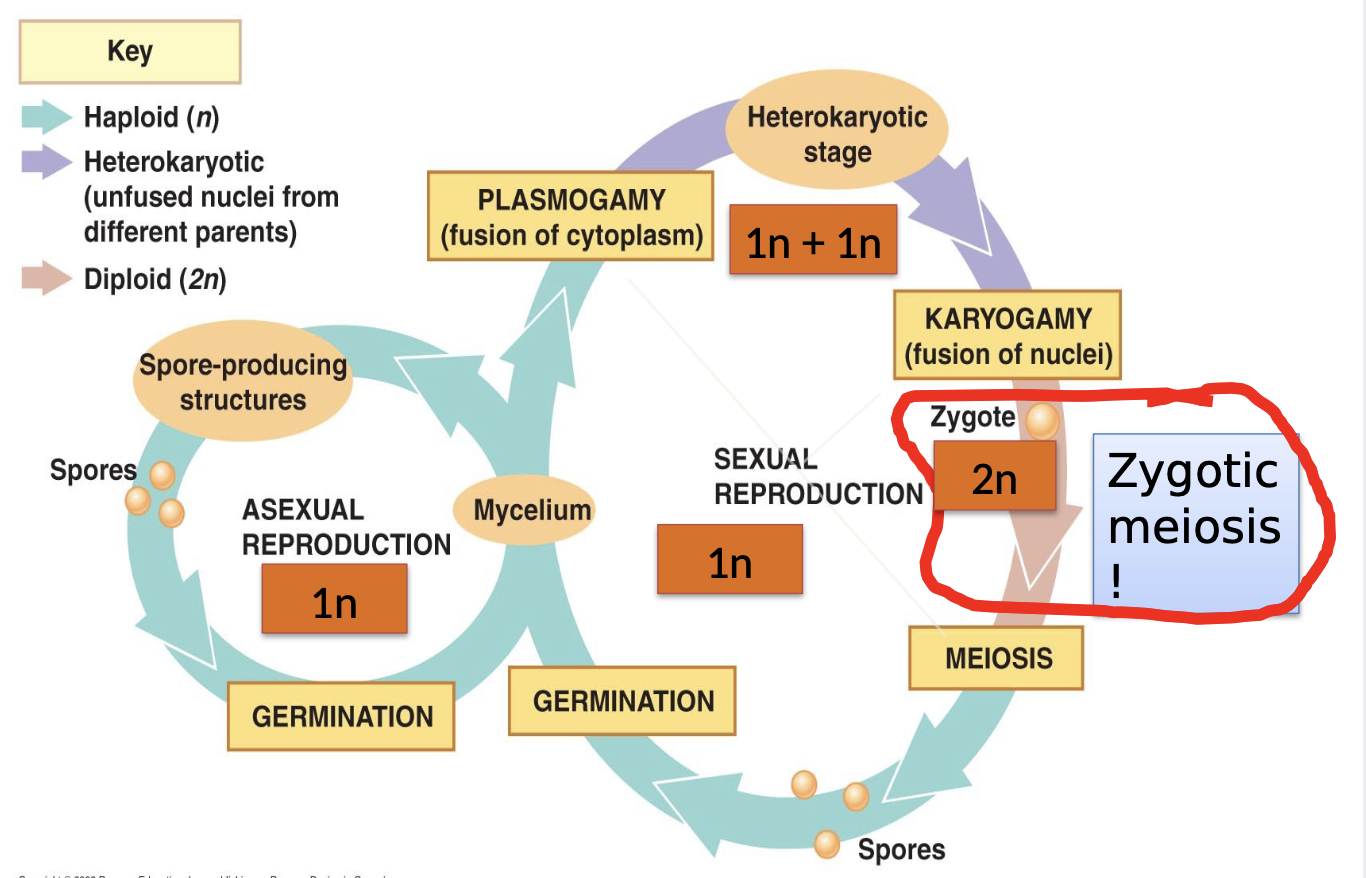
Generalized Life Cycle
Spores in Fungi
- Haploid (1n)
- Most <20 um (rarely >100um)
- Each contains nucleus, dehydrated cytoplasm and protective coat
- Some can remain dormant for long periods
- Produced by:
- Mitosis: Asexual reproduction
- Meiosis: Sexual reproduction
- Purpose (functions):
- Move to new food source
- Avoid or “wait out” adverse environment
- New genetic combination (sexual reproduction)
Sexual Fungal life Cycle:
Zygotic Meiosis 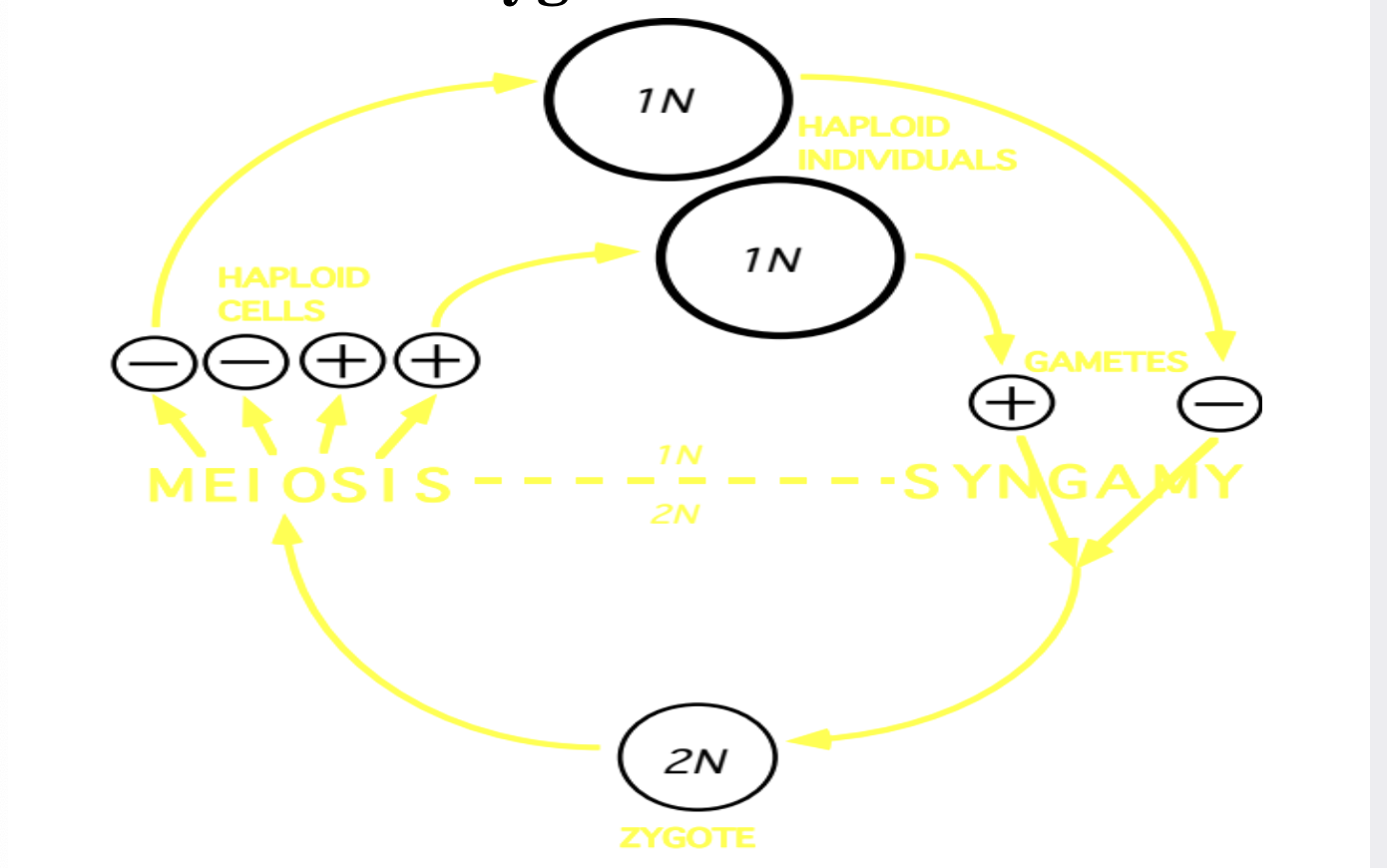
Asexual Reproduction: HOW
- Spores in sporangia
- Conidia (spores) in conidiophores
- Budding (e.x. Baker’s yeast)
5 Phyla of fungi
→ phylogeny of fungi is the subject of ongoing research
Phylum of Chytridiomycota
- 1000 species
- Single cells or colonies with hyphae
- Flagellated spore (zoospore)
- Haploid, asexually produced
- “Zoo” because swims
- Aquatic soil
- Decomposers, parasites, commensals (digestive)
Spores Release in a Chytrid
→ has converted the entire contents of its flasked-shape body, or thallus, into flagellated asexual zoospores
Phylum Zygomycota
- 1000 species
- Coenocytic (non-septate) hyphae
- Decomposers, parasites, commensals
→ spore infects, fungus grows
Death at dusk
Mind control: summiting, head glued 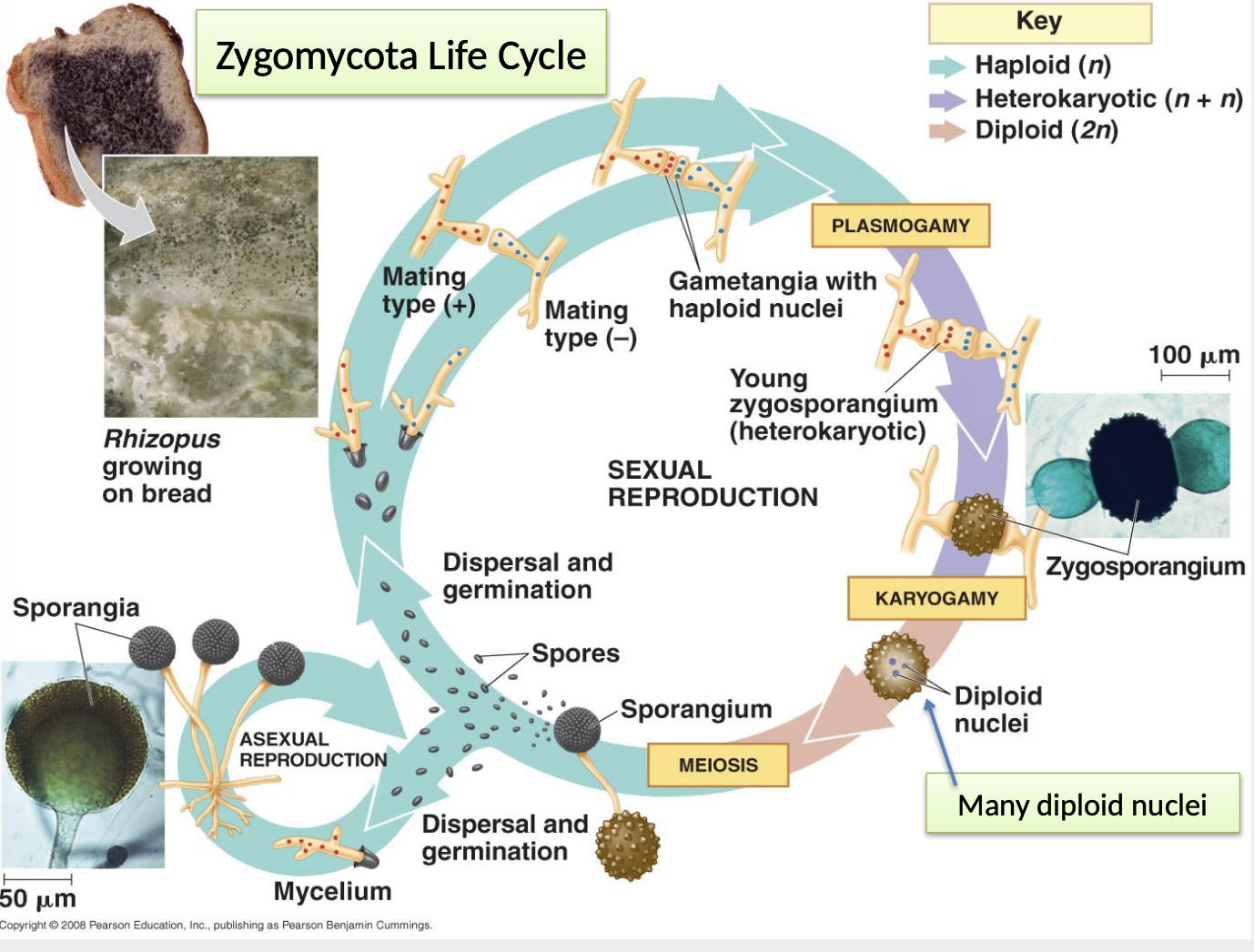
E.X. Black bread mold = asexual spores
Phylum Glomeromycota
- 160 species
- Non-septate hyphae
- Asexual only
- Obligate symbionts: mycorrhizae
Phylum Basidiomycota
- 30,000 species
- Decomposers & ectomycorrhizal
- Long-lived dikaryotic mycelium
- Multicellular (and some yeats)
- Septate mycelium
- Multicellular sexual reproduction
- Fruiting body = ‘basidiocarp’
Decomposers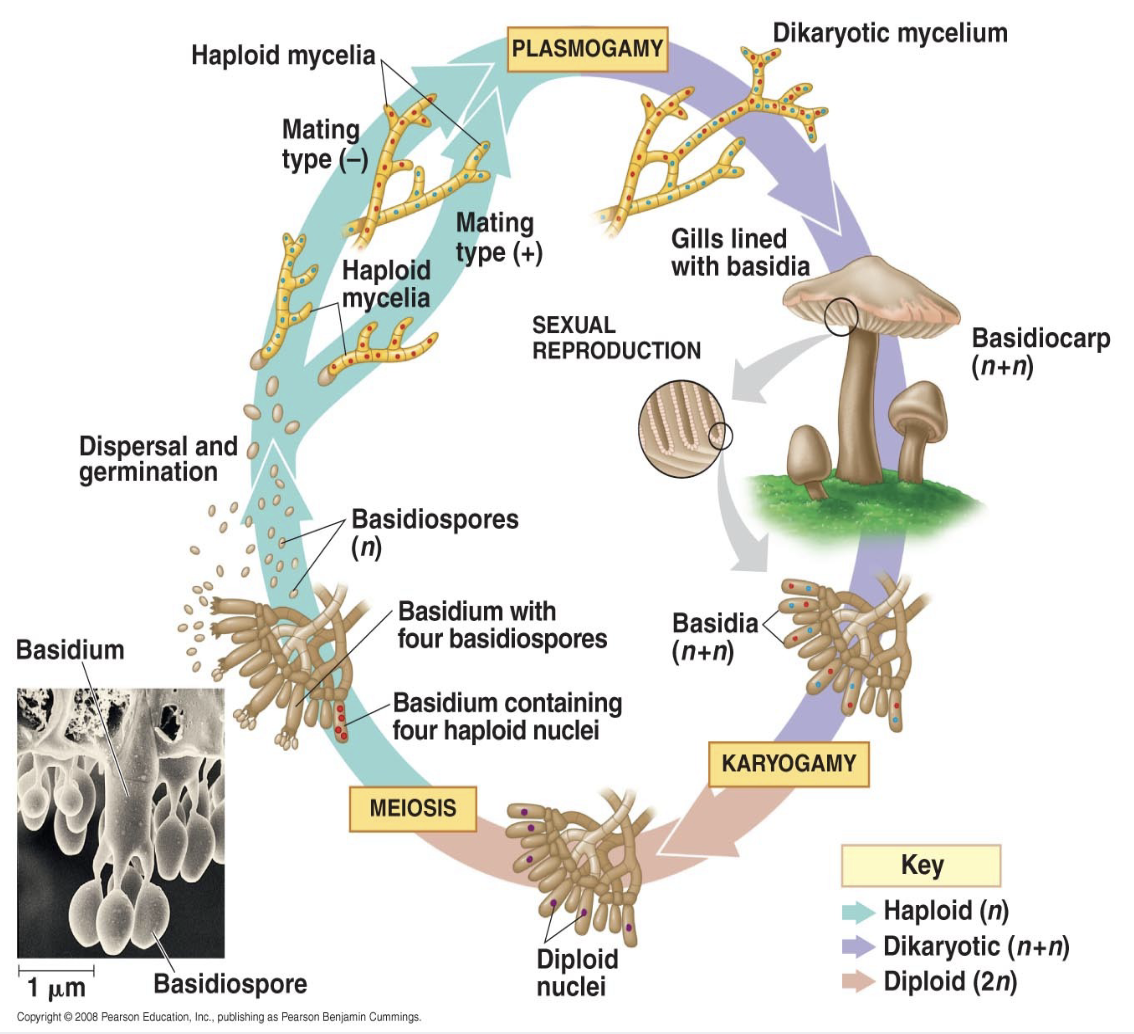
Basidiomycota: sexual reproduction
E.x. puffballs (spores on inside)
Stinkhorns
Amanita
Shiitake
Phylum Ascomycota
- ‘Sac’ fungi
- 65,000 species
- Multicellular or unicellular (yeast)
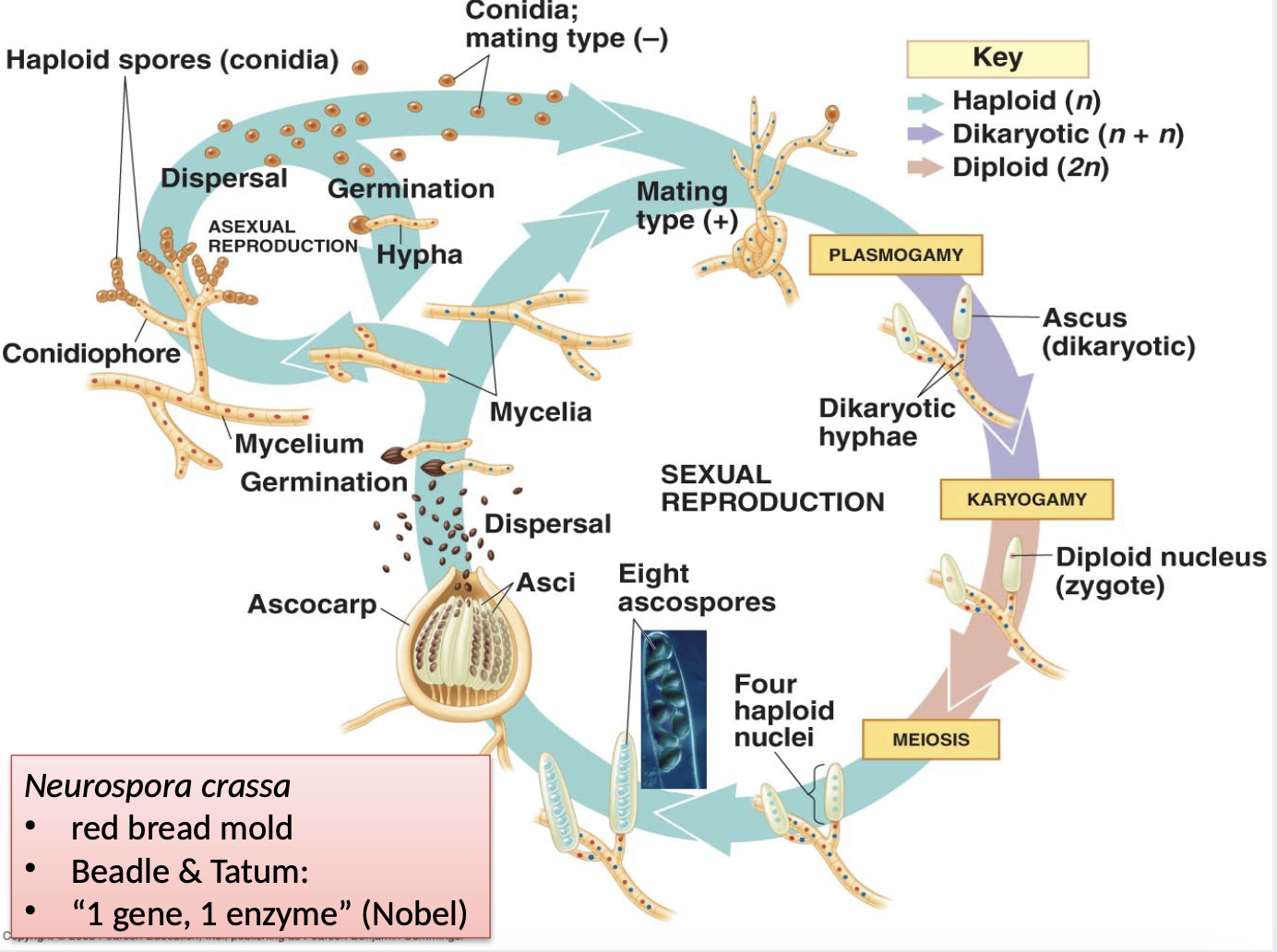
- Multicellular asexual repro: conidia
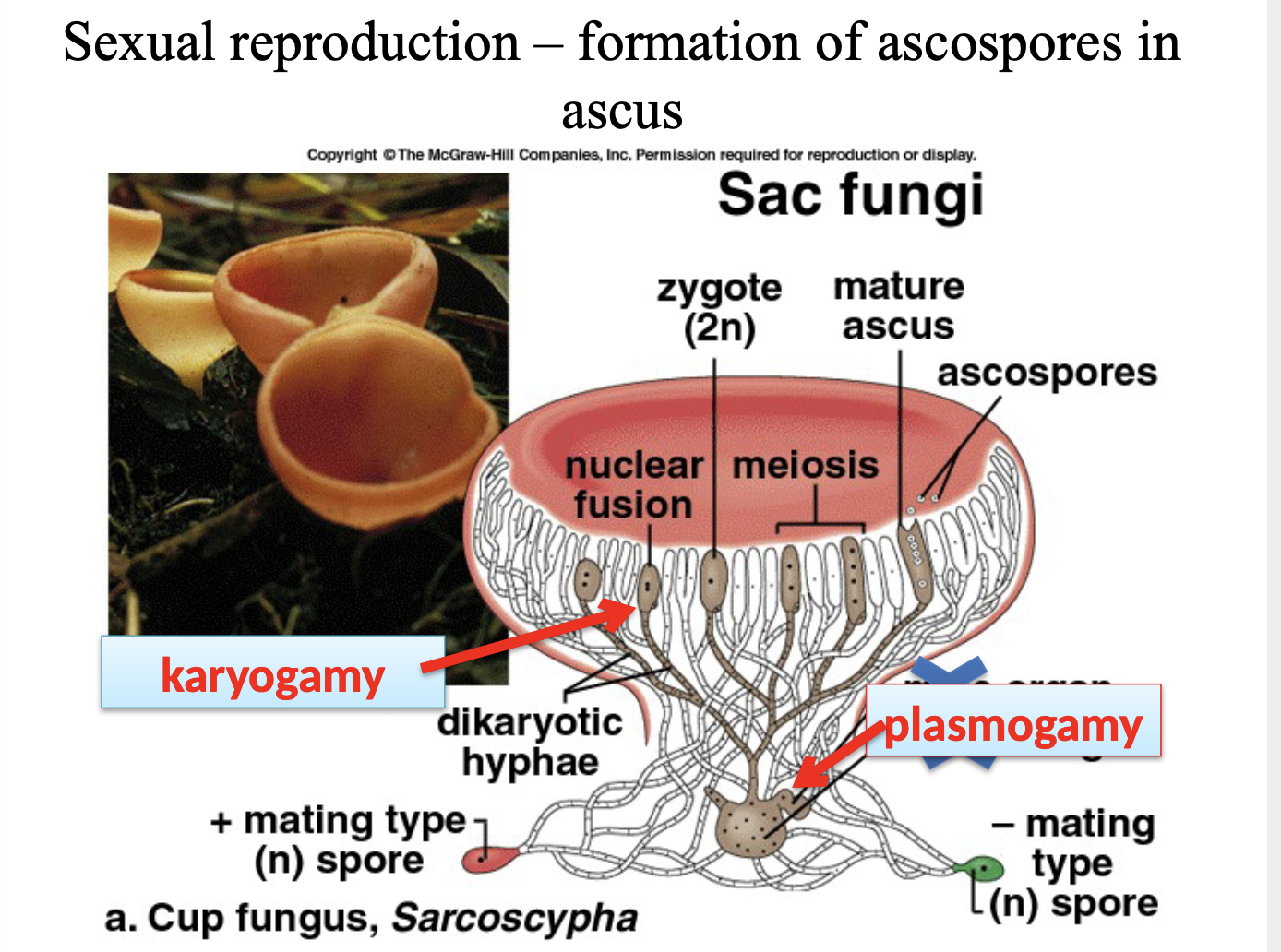
- Multicellular sexual reproduction
- Fruiting body = ‘ascocarp’
- (cup fungi, morels, truffles)
Penicillium: Source of Penicillin
→ isolation of antibiotic penicillin by alexander Fleming (1928) clinical treatment 1941
Asexual Reproduction in Ascomycota
Unicellular: Yeast_budding
Multicellular: Formation of conidia (spores) on conidiophores
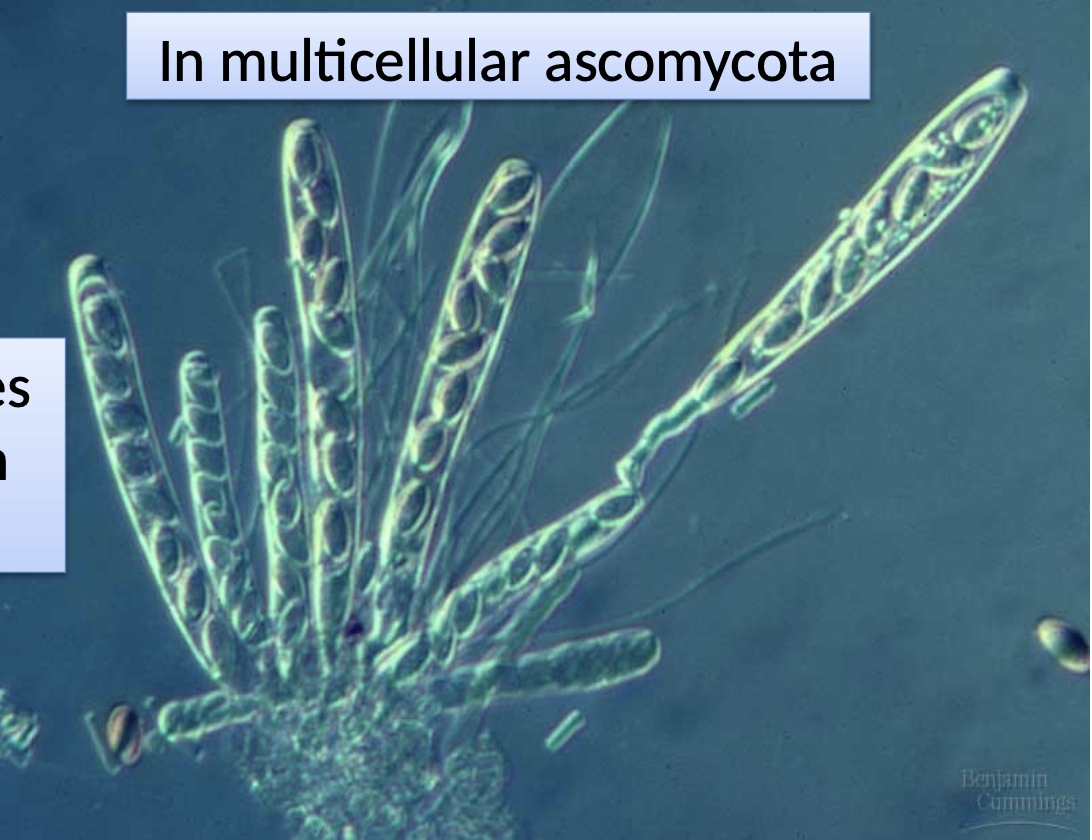
Sexual Reproduction: Asci
→8 spores in each ascus 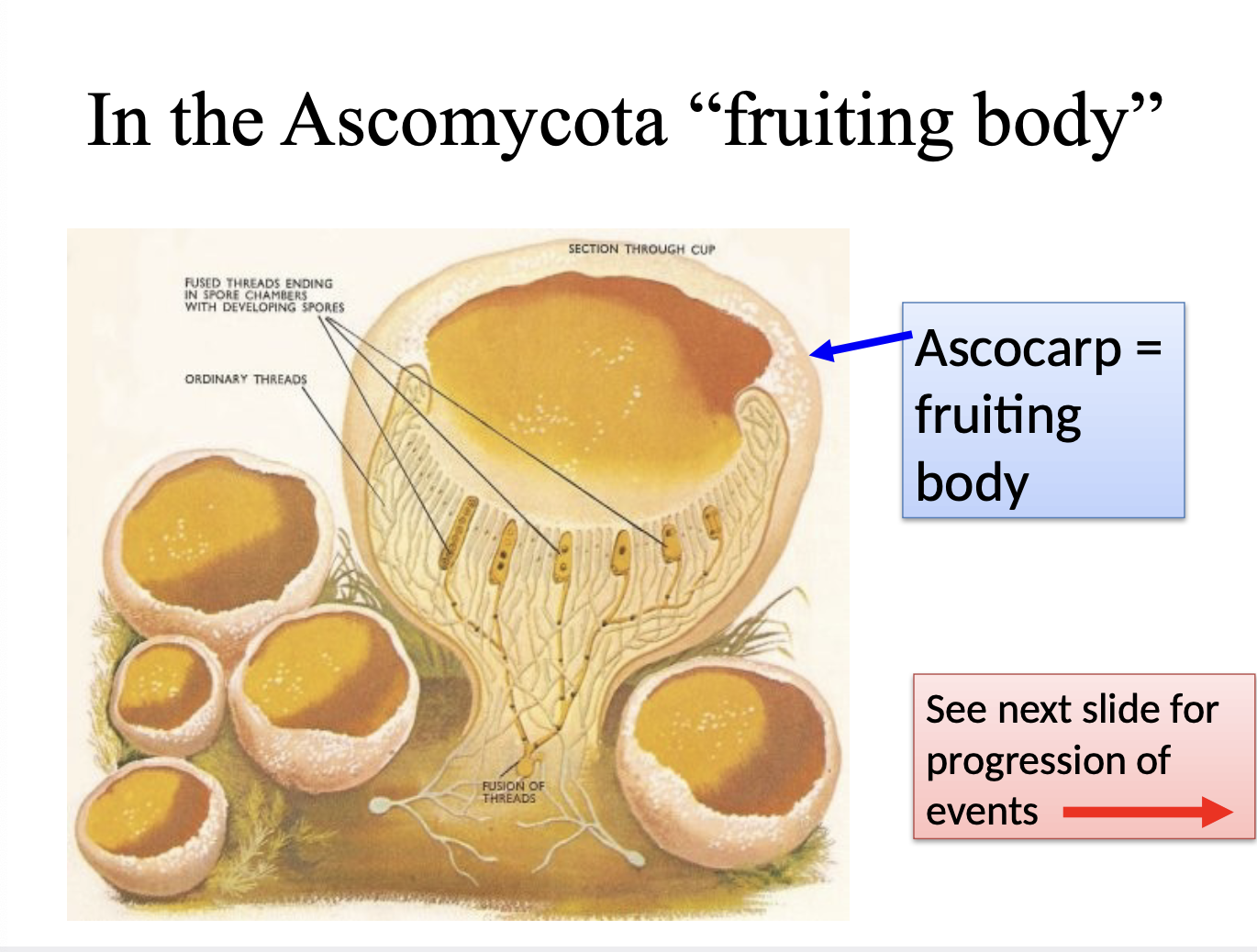
Ergot Alkaloids (claviceps purpurea)
- Several kinds
- Restrict blood flow: gangrenous ergotism
- St.anthony’s fire
- Salem (massachusetts) witch trials ?
- Others: medical uses
- LSD
- Lysergic acid diethylamide (ergot alkaloid derivative)
- Synthesized by Albert hofmann 1938 (LSD-25)
Aspergillus Fumigatus
- Inhabits solids worldwide
- Wide thermal tolerance
- Sonidia exposure constant and unavoidable
- We inhale > 100 conidia daily
- Concentration in the air indoors or outdoors is 1-100 conidia/m3
- Spores small so can reach deep into respiratory pathways
- Normally cleared from respiratory pathways
- Invasive aspergillosis disease in immunocompromised individuals (chemo,organ transplant)
- Difficult to treat
Candida albicans
- Normal part of human gut flora
- Also on skin and in oral cavity, urogentical tract
- Transmitted from mother to child duringn childbirth
- 2 morphological forms: yeast and hyphal
OVERVIEW: fungal phyla
Fungi: the future
Evolution:
- Phylogenetic relationships
- Relations to animals
- Multicellularity: how many times arose?
- Diploidy vs. haploidy
- No sex in glomerom