Part 1
GE 143: LAWS ON ENVIRONMENT & NATURAL RESOURCES
Sources of Laws on Environment and Natural Resources in The Philippines
1. 1987 Philippine Constitution
2. Civil Code of the Philippines
3. Legislations of Congress
4. Presidential proclamations and executive orders
5. Administrative orders
6. Jurisprudence
7. International Agreements
Relevant Provisions - 1987 Constitution
Right to Health
Article II Sec. 15 The State shall protect and promote the right to health of the people and to instill health consciousness among them.
Right to a Balanced Ecology
Article II Sec.16. The State shall protect and advance the right of the people to a balanced and healthful ecology in accord with the rhythm and harmony of nature.
State Ownership of Natural Resources
Article XII Sec. 2. All lands of the public domain, waters, minerals, coal, petroleum, and other mineral oils, all forces of potential energy, fisheries, forests or timber, wildlife, flora and fauna, and other natural resources are owned by the State. With the exception of agricultural lands, all other natural resources shall not be alienated. The exploration, development, and utilization of natural resources shall be under the full control and supervision of the State.
Natural Resources Owned by The State
1. All lands of the public domain
2. Waters
3. Minerals, Coal, petroleum, and other mineral oils
4. All forces of potential energy
5. Fisheries
6. forests or timber
7. wildlife, flora and fauna,
8. and other natural resources
State Control and Supervision: the exploration, development and utilization of natural resources shall be under the full control and supervision of the State
Exploration, Development, and Utilization of Natural Resources
The State may:
1. Directly undertake such activities, or;
2. Enter into agreements with individuals or corporations
Requisites of the Agreement in the Development, Utilization, or Exploration of Natural Resources:
- Must be a co-production, joint venture, or production-sharing agreement
- Must be with Filipino citizens or corporations or associations at least sixty percent of whose capital is owned by such citizens
- May be for a period not exceeding 25 years, renewable for not more than 25 years, and under such terms and conditions as may be provided by law.
Classifications of Lands of Public Domain
Article XII Sec. 3. Lands of the public domain are classified into agricultural, forest or timber, mineral lands, and national parks. Agricultural lands of the public domain may be further classified by law according to the uses to which they may be devoted. Alienable lands of the public domain shall be limited to agricultural lands. Private corporations or associations may not hold such alienable lands of the public domain except by lease, for a period not exceeding twenty-five years, renewable for not more than twenty-five years, and not to exceed one thousand hectares in area. Citizens of the Philippines may lease not more than five hundred hectares, or acquire not more than twelve hectares thereof by purchase, homestead, or grant.
Classification of Lands of Public Domain
1. Agricultural
- Alienable
- Can be classified according to use:
a. Agricultural
b. Residential
c. Commercial
d. Industrial
e. Charitable
f. Education, etc.
2. Forest or Timber
3. Mineral
4. National Parks
Indigenous Cultural Communities
Article XII Sec.5. The State, subject to the provisions of this Constitution and national development policies and programs, shall protect the rights of indigenous cultural communities to their ancestral lands to ensure their economic, social, and cultural well-being. Before the forests can be protected, their boundaries must be clearly identified and marked on the ground with clear and visible boundary markers. The Congress may provide for the applicability of customary laws governing property rights or relations in determining the ownership and extent of ancestral domain.
Institutional Arrangements
The principal agency tasked with the mandate for environmental protection is the Department of Environment and Natural Resources (DENR) pursuant to EO 192 (1987).
Responsibilities of DENR
- Conservation, management, development, and proper use of the country’s environment and natural resources (i.e. forest and grazing lands, mineral resources including reservation and watershed areas, and lands of public domain
- Preservation of cultural and natural heritage through wildlife conservation and segregation of national parks and other protected areas
- Promulgation and enforcement of rules and regulations for the control of water, air, and land pollution
- Promulgation and enforcement of ambient and effluent standards for water and air quality including the allowable levels of other pollutants and radiation
- Promulgation of policies, rules, and regulations for the conservation of the country’s genetic resources, biological diversity, and endangered habitats.
The department shall be the primary government agency responsible for:
1. Conservation, management, development, and proper use of:
- country’s environment and natural resources
- lands of public domain
2. Licensing and regulation of all natural resources as may be provided for by law in order to ensure equitable sharing of the benefits derived from the welfare of the present and future generations of the Filipinos
Bureaus
- Forest Management Bureau (FMB)
- Lands Management Bureau (LMB)
- Mines and Geosciences Bureau (MGB) -
- Environmental Management Bureau (EMB) -
- Ecosystems Research and Development Bureau (ERDB)
- Biodiversity Management Bureau (BMB)
Field Offices
- Regional Offices
- PENRO – Provincial Environment and Natural Resources Office
- CENRO – Community Environment and Natural Resources Office
DENR Attached Agencies
1. National Mapping and Resource Information Authority
2. Laguna Lake Development Authority
3. Natural Resources Development Corporation
4. National Water Resource Board
5. Philippine Mining Development Corporation
6. Philippine Reclamation Authority
7. Palawan Council for Sustainable Development
International Environmental Law
It is a branch of public international law–a body of law created by states for states to govern problems that arise between states. International Environmental Law (IEL) is concerned with the attempt to control pollution and the depletion of natural resources within a framework of sustainable development. IEL covers topics such as population, biodiversity, climate change, ozone depletion, toxic and hazardous substances, air, land, sea, and trans boundary water pollution, conservation of marine resources, desertification, and nuclear damage.
International Environmental Law Governance
The UN Environment Assembly- the highest-level UN body ever convened on the environment– opened on 23 June 2014 at the United Nations Environment Programme (UNEP) headquarters in Nairobi. UNEA feeds directly into the General Assembly and has universal membership of all 193 UN member states as well as other stakeholder groups. With this wide reach into the legislative, financial and development arenas, the new body presents a ground-breaking platform for leadership on global environmental policy.
Treaties
Customary law and general principles relating to the environment, such as the 'precautionary principle’ and sustainable development, are evolving but it is arguable whether any have yet become normative rules. The speed with which awareness of global environmental problems has reached the international political agenda has meant that customary law has tended to take second place to treaty law in the evolution of legal norms, and treaties have been the main method by which the international community has responded to the need to regulate activities which threaten the environment.
There are hundreds of bilateral and multilateral environmental treaties creating states’ rights and obligations. The UN Environment Program (UNEP) and the UN Commission on Sustainable Development have negotiated many of these treaties.
Some Major IEL Treaties
- Vienna Convention for the Protection of the Ozone Layer, 1985, and Montreal Protocol on Substances that Deplete the Ozone Layer, 1987
- Basel Convention on the Control of Transboundary Movements of Hazardous Wastes and their Disposal, 1989
- Convention on Biological Diversity, 1992, and Cartagena Protocol on Biosafety to the Convention on Biological Diversity, 2000
- United Nations Framework Convention on Climate Change, 1992 (UNFCCC)
- Kyoto Protocol to the United Nations Framework Convention on Climate Change, 1997
- United Nations Convention to Combat Desertification in those Countries Experiencing Serious Drought and/or Desertification, Particularly in Africa, 1994(UNCCD)
- Convention on the Law of the Non-Navigational Uses of International Watercourses, 1997
ENVIRONMENTAL LAW: PRINCIPLES AND CONCEPTS
Principle of Preventive Action
The principle of preventive action finds its origin in the rules governing state liability. In 1941, in the Trail Smelter dispute, Canada was held responsible for the damage caused to American farmers by emissions emanating from a plant on the Canadian side of the border. The arbitral tribunal said that a state is not allowed to use its territory in a way that can harm the territory of another state. In international law, states have a responsibility to prevent damages they can cause outside their territory, in spite of their sovereignty over their natural wealth and resources. A correlating duty has emerged imposing on states the responsibility to control and correctly manage activities based on their territory if they can impact on the territory of another state. This obligation is limited to a conduct of “due care” or “due diligence”: a state will not be held liable for damages if it took reasonable measures to prevent them from happening.
The Trail Smelter dispute was a trans-boundary pollution case involving the governments of Canada and the United States. Smoke from the smelter caused damage to forests and crops in the surrounding area and also across the Canada–US border in Washington. The smoke from the smelter distressed residents, resulting in complaints to Consolidated Mining and Smelting Company (COMINCO) and demands for compensation. The dispute between the smelter operators and affected landowners could not be resolved, resulting in the case being sent to an arbitration tribunal. Negotiation and resulting litigation and arbitration was settled in 1941. (source: Wikipedia)
Precautionary Principle (Foresight Principle)
When an activity raises threats of harm to human health or the environment, precautionary measures should be taken even if some cause and effect relationships are not fully established scientifically
The four central components of this principle are:
- Taking preventive action in the face of uncertainty;
- Shifting the burden of proof to the proponents of an activity;
- Exploring a wide range of alternatives to possibly harmful actions;
- And increasing public participation in decision making.
The precautionary principle has arisen because of the perception that the pace of efforts to combat problems such as climate change, ecosystem degradation, and resource depletion is too slow and that environmental and health problems continue to grow more rapidly than society’s ability to identify and correct them.
Common but Differentiated Responsibilities (CBDR)
Principle of international environmental law establishing that all states are responsible for addressing global environmental destruction yet not equally responsible. The principle balances, on one hand, the need for all states to take responsibility for global environmental problems and, on the other hand, the need to recognize the wide differences in levels of economic development between states. These differences in turn are linked to the states’ contributions to, as well as their abilities to address, these problems. CBDR describes the shared obligation of two or more states toward the protection of a particular environmental resource. On the other hand, the need to establish variegated levels at which different states can effectively enter into a collective response, according to both their capacities and their levels of contribution to the problem.
Rights of Future Generations
rights to inherit a clean, healthy, and sustainable environment. This concept has its most obvious and timely application in dealing with climate change.
Three Core Obligations:
1.Ensuring that future generations have the ability to make choices about how they live in the world they inherit.
2.Passing on a world that has not been damaged by our actions, and a related responsibility to repair the actions of the past.
3.A right of equal access to public resources, both to our neighbors today and to future generations.
These principles amount to an Intergenerational Golden Rule: When making decisions about our world, we should do unto our children as we wish our parents had done unto us.
Principle of Intergenerational Equity
every generation holds the Earth in common with members of the present generation and with other generations, past and future. The principle articulates a concept of fairness among generations in the use and conservation of the environment and its natural resources The principle is the foundation of sustainable development.
Principle of Intragenerational Equity
deals with the equality among the same generations as far as the utilization of resources are concerned. It includes fair utilization of global resources among the human beings of the present generation. The concept of intra-generational equity provides rights and duties to every person of a single generation to use and take care of the renewable and non-renewable resources moderately among the members of the generation
SUSTAINABLE DEVELOPMENT
development that meets the needs of the present, without compromising the ability of future generations to meet their own needs. Sustainability is development that satisfies the needs of the present without compromising the capacity of future generations, guaranteeing the balance between economic growth, care for the environment and social well-being.
Principle of Sustainable Use
founded on the theory that the present generation should be modest in their exploitation of natural resources for the benefit of the future generations. This will secure the conditions of survival for future generations. In order to achieve sustainable development and a high quality of life for all people, States should reduce and eliminate unsustainable pattern of production and consumption. Thus, use and conservation of natural resources should be an essential principle of sustainable development.
Rio Declaration on Environment and Development; Principle 4
In order to achieve sustainable development, environmental protection shall constitute an integral part of the development process and cannot be considered in isolation from it.
Treaty of the European Community Article 6
Environmental protection requirements must be integrated into the definition and implementation of (all) community policies and activities (referred to in Article 3), in particular with a view to promoting sustainable development.
Principle of Integration
due consideration be given to the potential consequences of environmentally fateful decisions. Different nations and business organizations have integrated environmental considerations into their decision-making processes through environmental-impact-assessment mandates and other provisions.
Integration through international environmental law
States’ obligations in environmental treaties must be translated into obligations for all relevant sectors, and not only for the environmental sectors and authorities in the narrow sense.
TRAGEDY OF THE COMMONS
A situation in a shared-resource system where individual users, acting independently according to their own self-interest, behave contrary to the common good of all users by depleting or spoiling the shared resource through their collective action. The theory originated in an essay written in 1833 by the British economist William Forster Lloyd, who used a hypothetical example of the effects of unregulated grazing on common land. The concept became widely known as the "tragedy of the commons” over a century later due to an article written by American biologist and philosopher Garrett Hardin in 1968. In this modern economic context, "commons” is taken to mean any shared and unregulated resource such as atmosphere, oceans, rivers, ocean fish stocks, or even an office refrigerator.
The tragedy of the commons is an economic problem. It results in over consumption, and ultimately depletion of the resource. As the demand for the resource overwhelms the supply, every individual who consumes an additional unit directly harms others who can no longer enjoy the benefits. Generally, the resource of interest is easily available to all individuals; the tragedy of the commons occurs when individuals neglect the well-being of society in the pursuit of personal gain.
Overcoming the Tragedy of the Commons
- Government regulation or direct control of a common-pool resource
- regulating consumption and use, or legally excluding some individuals, can reduce over consumption and government investment in conservation and renewal of the resource can help prevent its depletion. For example, government regulation can set limits on how many cattle may be grazed on government lands or issue fish catch quotas.
- Assigning private property rights over resources to individuals
- by effectively converting a common-pool resource into a private good. Institutionally this depends on developing some mechanism to define and enforce private property rights, which might occur as an outgrowth of existing institutions of private property over other types of goods.
- can suffer some problems as top-down government control, because privatization has occurred by way of a government forcibly assuming control over a common-pool resource and then assigning private property rights to its subjects based on a sale price or simple political favor.
- Co-operative collective action
- by limiting use to local farmers and herders, managing use through practices, and providing enforceable sanctions against overuse and abuse of the resource, these collective action arrangements readily overcame the tragedy of the commons (and other problems).
- can be useful in situations where technical or natural physical challenges prevent convenient division of a common-pool resource into small private parcels, by instead relying on measures to address the good’s rivalry in consumption by regulating consumption. Often involves limiting access to the resource to only those who are parties to the collective action arrangement, effectively converting a common pool resource into a kind of club good.
BIODIVERSITY
National Integrated Protected Areas System Act (RA 7586)
It is hereby declared the policy of the State to secure for the Filipino people of present and future generations the perpetual existence of all native plants and animals through the establishment of a comprehensive system of integrated protected areas within the classification of national parkas provided for in the Constitution.
Categories of Protected Areas
1. Strict nature reserve
- Area possessing some outstanding ecosystem, features and/or species of flora and fauna of national scientific importance maintained to protect nature and maintain processes in an undisturbed state in order to have ecologically representative examples of the natural environment available for scientific study, environmental monitoring, education, and for the maintenance of genetic resources in a dynamic and evolutionary state
- Areas with no human activity
2. Natural park
- Relatively large area not materially altered by human activity where extractive resource use are NOT ALLOWED and maintained to protect outstanding natural and scenic areas of national or international significance for scientific, education, and recreational use
- Mayon, Apo Reef, Lake Danao
3. Natural monument
- Relatively small area focused on protection of small features to protect or preserve nationally significant natural features on account of their special interest or unique characteristics
- Besang Pass, Chocolate Hills
4. Wildlife sanctuary
- An area which assures the natural conditions necessary to protect nationally significant species, groups of species, biotic communities or physical features of the environment where these may require specific human manipulation for their perpetuation
- Agusan marsh, Turtle Islands, Mount Calavite
5. Protected landscapes and seascapes
- Areas of national significance characterized by the harmonious interaction of man and land while providing opportunities for public enjoyment through recreation and tourism within the normal lifestyle and economic activity of these areas
- Siargao Island, Batanes
6. Resource reserve
- extensive and relatively isolated and uninhabited normally with difficult access designated as such to protect natural resources of the area for future use and prevent or contain development activities that could affect the resource pending the establishment of objectives which are based upon appropriate knowledge and planning
- Agno River Basin, Siocon, Zamboanga del Norte
7. Natural biotic areas
- an area set aside to allow the way of life societies living in harmony with the environment to adopt to modern technology at their pace
- Lagonoy, CamSur, Basilan
8. Other categories established by law, convention, or international agreements which the Philippine Government is a signatory
*Buffer zones: identified areas outside the boundaries of, and immediately adjacent to a designated protected area that need special development control in order to avoid or minimize harm to the protected area
Sec 7. Disestablishment as Protected Area
When in the opinion of the DENR a certain protected area should be withdrawn or disestablished, or its boundaries modified as warranted by a study and sanctioned by the majority of the members of the respective boards for the protected area as herein established in Section11, it shall, in turn, advise Congress. Disestablishment of a protected area under the System or modification of its boundary shall take effect pursuant to an act of Congress.
Section11. Composition of Protected Area Management Board
1. Regional Executive Director under whose jurisdiction the protected area is located
2. One representative from the autonomous regional government, if applicable;
3. Provincial Development Officer;
4. One representative from the municipal government;
5. One representative from each barangay covering the protected area;
6. One representative from each tribal community, if applicable; and
7. At least three representatives from non-government organizations/local community organizations,
8.And if necessary, one(1) representative from other departments or national government agencies involved in protected area management.
Functions of Protected Areas Management Board (PAMB)
1. Decide the allocations for budget,
2. Approve proposals for funding,
3. Decide matters relating to planning, peripheral protection and general administration of the area in accordance with the general management strategy.
The members of the Board shall serve for a term of five (5) years without compensation, except for actual and necessary traveling and subsistence expenses incurred in the performance of their duties.
Sec 13. Ancestral lands and Rights Over Them
Ancestral lands and customary rights and interest arising shall be accorded due recognition. The DENR shall prescribe rules and regulations to govern ancestral lands within protected areas: Provided, however, That all rules and regulations, whether adversely affecting said communities or not, shall be subjected to notice and hearing to be participated in by members of concerned indigenous community.
Sec. 16 Integrated Protected Areas Fund
IPAS fund is a trust fund established for the purposes of financing projects on the System. The IPAS may solicit and receive donations, endowments, and grants in the form of contributions, and such endowments shall be exempted from all taxes, charges or fees imposed by the Government or any political subdivision or instrumentality thereof.
Sec 20. Prohibited Acts
The following are prohibited within the protected areas:
- Hunting, destroying, disturbing, or mere possession of any plants or animals or products derived therefrom without a permit from the Management Board
- Dumping of any waste products detrimental to the protected area, or to the plants an animals or inhabitants therein;
- Use of any motorized equipment without permit from the Management Board;
- Mutilating, defacing or destroying objects of natural beauty, or objects of interest to cultural communities (of scenic value);
- Damaging and leaving roads and trails in a damaged condition;
- Squatting, mineral locating, or otherwise occupying any land;
- Constructing and maintaining any kind of structure, fence or enclosures, conducting any business enterprise without permit
- Leaving in exposed or unsanitary conditions refuse or debris, or depositing in ground or in bodies of water; and
- Altering, removing, destroying or defacing boundary mark or signs.
Expanded National Integrated Protected Areas System (ENIPAS) Act of 2018
- Declared 94 national parks as new protected areas. These protected areas are now under the management of the government ensuring a regular annual budget for its conservation. The Act also allows for the collection of funds from environmental compliance certificates (ECC) and special use permits from industries operating within the protected areas and imposes stricter fines for violators. These funds go straight to a trust fund called the Integrated Protected Area Fund (IPAF), which is then channeled back for conservation projects.
- The new law amended the National Protected Areas System (NIPAS) Act of 1992, which assigned 13 protected areas into law.
Additional Prohibited Acts under ENIPAS
- Poaching
- Cutting, collecting, gathering of timber without permit
- Possession//transport of byproducts (timber, wildlife) outside protected area
- Dumping, throwing of toxic, chemical, noxious wastes detrimental to protected area
- Kaingin or causing forest fire in protected area
- Littering or depositing refuse on the ground or bodies of water
- Possession/use of blasting caps and explosives anywhere within protected area
- Mining, quarrying within protected area
- Introduction of exotic species, GMOs, invasive species
Section 18. (of EO192.s. 1987) Protected Areas and Wildlife Bureau
There is hereby created a Protected Areas and Wildlife Bureau which shall absorb the Division of Parks and Wildlife and the Marine Parks Program of the Bureau of Forest Development as well as: Calauit Game Preserve and Wildlife Sanctuary, Presidential Committee on the Conservation of Tamaraw, Ninoy Aquino Parks and Wildlife Center (formerly Parks and Wildlife Nature Center), shares in Kabuhayan Program and Agro Forestry State Projects of the KKK Processing Authority, all national parks, wildlife sanctuaries and game preserves previously managed and administered by the Ministry of Human Settlements including
National Parks Reservation situated in the provinces of Bulacan, Rizal, Laguna and Quezon formerly declared as Bagong Lipunan Sites of said Ministry, Magat Forest Reservation and Mt. Arayat National Park, formerly with the Ministry of Tourism in accordance with Section 24 (c) hereof. The Protected Areas and Wildlife Bureau shall be headed by a Director and assisted by an Assistant Director.
The Bureau shall have the following functions:
(a) Formulate and recommend policies, guidelines, rules and regulations for the establishment and management of an Integrated Protected Areas Systems such as national parks, wildlife sanctuaries and refuge, marine parks, and biospheric reserves;
(b) Formulate and recommend policies, guidelines, rules and regulations for the preservation of biological diversity, genetic resources, the endangered Philippine flora and fauna;
c) Prepare an up-to-date listing of endangered Philippine flora and fauna and recommend a program of conservation and propagation of the same;
(d) Assist the Secretary in the monitoring and assessment of the management of the Integrated Protected Areas System and provide technical assistance to the regional offices in the implementation of programs for these areas;
(e) Perform other functions as may be assigned by the Secretary and/or provided by law.
FOREST
Revised Forestry Code PD 705
Forest lands include:
- Public forest
- Mass of lands of public domain which has not been subject to the present system of classification for the determination of which lands are needed for forest purposes and which are not.
- Permanent forest or forest reserves
- refer to those lands of the public domain which have been the subject of the present system of classification and determined to be needed for forest purposes.
- Forest reservations
- refer to forest lands which have been reserved by the President of the Philippines for any specific purpose or purposes.
Selective logging: systematic removal of the mature, over-mature and defective trees in such manner as to leave adequate number and volume of healthy residual trees of the desired species necessary to assure a future crop of timber, and forest cover for the protection and conservation of soil, water and wildlife.
License: privilege granted by the State to a person to utilize forest resources within any forest land, without any right of occupation and possession over the same, to the exclusion of others, or establish and operate a wood-processing plant, or conduct any activity involving the utilization of any forest resources.
License agreement: a privilege granted by the State to a person to utilize forest resources within any forest land with the right of possession and occupation thereof to the exclusion of others, except the government, but with the corresponding obligation to develop, protect and rehabilitate the same in accordance with the terms and conditions set forth in said agreement.
Permit: a short-term privilege or authority granted by the State to a person to utilize any limited forest resources or undertake a limited activity within any forest land without any right of occupation and possession therein.
Forest Management Bureau of the DENR
- provides technical guidance to the central and field offices for the effective protection, development, and conservation of forestlands and watersheds. It shall recommend policies and programs towards the achievement of sustainable forest management, based on science and principles of good forest governance.
- shall integrate and absorb the powers and functions of the Bureau of Forest Development (BFD) and the Wood Industry Development Authority (WIDA), in accordance with Section 24 (e) hereof except those line functions and powers which are transferred to the regional field office. The Forest Management Bureau, to be headed by a Director and assisted by an Assistant Director shall advise the Secretary on matters pertaining to forest development and conservation
Forest Management Bureau Functions
(a) Recommend policies and/or programs for the effective protection, development, occupancy, management and conservation of forest lands and watershed, including grazing and mangrove areas, reforestation and rehabilitation of critically denuded/degraded forest reservations, improvement of water resource use and development, ancestral lands, wilderness areas and other natural preserves, development of forest plantations including rattan, bamboo, and other valuable non-timber forest resources, rationalization of the wood-based industries, regulation of the utilization and exploitation of forest resources including wildlife, to ensure continued supply of forest goods and services;
(b) Advise the regional offices in the implementation of the above policies and/or programs;
(c) Develop plans, programs, operating standards and administrative measures to promote the Bureau's objectives and functions;
(d) Assist in the monitoring and evaluation of forestry and watershed development projects to ensure efficiency and effectiveness;
(e) Undertake studies on the economics of forestry and forest-based industries, including supply and demand trends on the local, national and international levels identifying investment problems and opportunities, in various areas;
(f) Perform other functions as may be assigned by the Secretary and/or provided by law.
Sec. 20 of PD 705. License Agreement, License, Lease, or Permit
No person may utilize, exploit, occupy, possess or conduct any activity within any forest and grazing land, or establish, install, add and operate any wood or forest products processing plant, unless he had been authorized to do so under a license agreement, license, lease or permit.
Grounds for suspension of license agreement, license, lease, permit
1. When the national interest so requires, the President may amend, modify, replace, or rescind any contract, concession, permit, license, or any other form of privilege granted herein:
2. Upon the recommendation of the appropriate government agency, the President may order the summary suspension of any such contract, concession, license, permit, lease or privilege granted for violation of any of the conditions therein such as those pertaining but not limited to reforestation, pollution, environmental protection, export limitation or such conditions as are prescribed by the Secretary of Environment and Natural Resources in daily issued regulations.
SEC. 77. Cutting, Gathering, and/or Collecting Timber or Other Forest Products Without License
Any person who shall:
1. Cut, gather, collect, remove timber or other forest products from any forestland, or timber from alienable or disposable public land, or from private land, without any authority;
2. Or possess timber or other forest products without the legal documents as required under existing forest laws and regulations,
3. The Court shall further order the confiscation in favor of the government of the timber or any forest products cut, gathered, collected, removed, or possessed as well as the machinery, equipment, Implements and tools illegally used in the area where the timber or forest products are found.
Provided, That in the case of partnerships, associations, or corporations, the officers who ordered the cutting, gathering, collection or possession shall be liable, and if such officers are aliens, they shall, in addition to the penalty, be deported without further proceedings on the part of the Commission on Immigration and Deportation.
SEC. 78 Unlawful Occupation or Destruction of Forest Lands and Grazing Land
Any person who:
1. Enters and occupies or possesses, or makes kaingin for his own private use or for others, any forest land or grazing land without authority under a license agreement, lease, license or permit, or in any manner destroys such forest land or grazing land or part thereof, or causes any damage to the timber stand and other products and forest growth found therein, or
2. Who assists, aids or abets any other person to do so, or sets a fire, or negligently permits a fire to be set in any forest land or grazing land, or refuses to vacate the area when ordered to do so,
The National Greening Program (NGP) aims to:
1) contribute in reducing poverty among upland and lowland poor households, indigenous peoples, and in coastal and urban areas;
2) implement sustainable management of natural resources through resource conservation, protection, and productivity enhancement;
3) provide food, goods and services such as timber, fiber, non-timber forest products, aesthetic values, air enhancement values, water regulation values, and mitigate climate change by expanding forest cover that serve as carbon sink;
4) promote public awareness as well as instill social and environmental consciousness on the value of forests and watersheds;
5) enhance the formation of positive values among the youth and other partners through shared responsibilities in sustainable management of tree plantations and forest resources, and
6) consolidate and harmonize all greening efforts of the government, civil society, and the private sector.
Executive Order No. 26, series of 2011 was issued to plant 1.5 billion trees in 1.5 million hectares of lands of the public domain for a period of six (6) years from CY 2011 to 2016.
Executive Order No. 193 was signed on November 12, 2015, the Expanded NGP will rehabilitate all the remaining unproductive, denuded and degraded forestlands estimated at 7.1 million hectares from 2016 to 2028.
Tenure Instruments
- Community Based Forest Management Agreement (CBFMA)
an agreement entered into by and between the government and the local community, represented by people’s organization, as forest managers, which has a term of 25 years renewable for another 25 years.
- Timber License Agreement
a long-term license executed by and between the Secretary of the DENR, on behalf of the government, and the grantee for the harvesting and removal from the public forest of timber and, in appropriate cases, also of other forest products.
- Integrated Forest Management Agreement
an agreement entered into by the DENR and a qualified person to occupy and possess inconsideration of a specified rental, any forest land of the public domain in order to establish an industrial forest.
- Tree Farm Lease (TFLA) and Agroforestry Farm Leases (AFFLA) agreements issued by the Department upon recommendation of the Forestry Director, for the planting of commercial trees, or non-commercial trees or both in any small forest land or tract of land purposely planted with tree crops.
- Socialized Industrial Forest Management Agreement (SIFMA)
an agreement entered into by and between a natural and juridical person and the DENR wherein the latter grants to the former the right to develop, utilize and manage a small tract of forest land, consistent with the principle of sustainable development.
- Private Forest Development Agreement (PFDA)
an agreement entered into by and between the DENR and a private land owner or his duly authorized representative for the establishment and development of forest plantation within his private property.
- Forest Land Grazing Management Agreement (FLGMA)
a production sharing agreement between a qualified person, association and/or corporation and the government to develop, manage and utilize grazing lands.
- Special and Forestland Use Permits and Agreements
a contract between the DENR and natural or juridical person authorizing the latter to temporarily occupy, manage and develop subject to government share, any forestland of the public domain for specific use to undertake any authorized activity therein for a specified period.
- Special Land Use Permit (SLUP): a privilege granted by the State to a person to occupy, possess and manage in consideration of specified return, any public forest lands for a specific use or purpose for a limited period of not more than 3 years.
- Special Land Use Lease Agreement (SPLULA): a privilege granted by the State to a person to occupy, possess and manage in consideration of specified return, any public forest lands for a specific use or purpose for a period of 25 years.
- Forestland Use Agreement for Tourism Purposes (FLAgT): a contract between the DENR and natural or juridical person authorizing the latter to occupy, manage and develop subject to government share, any forestland of the public domain for tourism purposes and to undertake any authorized activity therein for a period of 25 years and renewable for the same period upon mutual agreement by both parties. It shall include special forest land uses such as Bathing Establishment, Camp Site, Ecotourism Destination, Hotel Site (inclusive related resort facilities) and Other Tourism Purposes.
- Special Forestland Use Agreement (FLAg): a contract between the government as first party represented by the Secretary or the Regional Executive Director concerned, and a second party or a person, authorizing the latter to temporarily occupy, manage and develop in consideration of a government share, any forestland of the public domain for specific use defined in Section 3 thereof, to undertake any authorized activity therein for a period of 25 years and renewable for the same period upon mutual agreement by both parties.
Chainsaw Act of 2002 RA 9175
: to regulate the ownership, possession, sale, transfer, importation and/or use of chain saws to prevent them from being used in illegal logging or unauthorized clearing of forests.
Chainsaw: any portable power saw or similar cutting implement, rendered operative by an electric or internal combustion engine or similar means, that maybe used for, but is not limited to, the felling of trees or the cutting of timber;
Chainsaw dealer: a person, natural or juridical, engaged in the manufacture, importation, distribution, purchase and/or sale of chainsaws
Persons Authorized to Possess and Use a Chainsaw
The Department is hereby authorized to issue permits to possess and/or use a chainsaw for the felling and/or cutting of trees, timber and other forest or agro-forest products to any applicant who:
a. Has a subsisting timber license agreement, production sharing agreement, or similar agreements, or a private land timber permit;
b. Is an orchard and fruit tree farmer;
c. Is an industrial tree farmer;
d. Is a licensed wood processor and the chainsaw shall be used for the cutting of timber that has been legally sold to said applicant; or
e. Shall use the chainsaw for a legal purpose.
All persons who own or are otherwise in possession of chainsaws must register the same with DENR, through the CENRO.
The CENRO shall issue the corresponding registration certificate or permit.
Every permit to possess and/or use a chainsaw shall be valid for two (2) years upon issuance
Permits issued to non-commercial orchard and fruit tree farmers shall be valid for a period of five (5) years upon issuance.
PROHIBITED ACTS
- Selling, purchasing, re-selling, transferring, distributing or possessing a chainsaw without a proper permit from DENR
- Unlawful importation or manufacturing of chainsaw without authority from DENR
- Tampering of engine serial number
- Actual unlawful use of chainsaw to cut trees and timber in forest land or elsewhere except as authorized by the department.
PD 953: Requiring the Planting of Trees in Certain Places
Who shall plant trees:
- Every person who owns land adjoining a river or creek shall plant trees extending at least five meters on his land adjoining the edge of the bank of the river or creek,
- Every owner of an existing subdivision shall plant trees in the open spaces required to be reserved for the common use and enjoyment of the owners of the lots therein as well as along all roads and service streets. The subdivision owner shall consult the Bureau of Forest Development as to the appropriate species of trees to be planted and the manner of planting them;
- Every holder of a license agreement, lease, license or permit from the government
Reserved as Open Space
SEC 2. Every owner of land subdivided into residential/commercial/industrial lots after the effectivity of this Decree shall reserve, develop, and maintain not less than thirty percent (30%) of the total area of the subdivision, exclusive of roads, service streets and alleys, as open space for parks and recreational areas.
Coconut Preservation Act of 1995 (Republic Act 8048)
Declaration of Policy
For reasons of national interest, it is hereby declared the policy of the State to provide for the growth of the industry by embarking on a sustainable and efficient replanting program.
Rationale
Considering the importance of the coconut industry in nation building being one of the principal industries and one of the largest in come earners of the country, it becomes mandatory for the government to step in and regulate the unabated and indiscriminate cutting of coconut trees.
Definition of Terms
Economically unproductive farm: a coconut area where the cost of farm production and maintenance is greater than the generated proceeds or income for a period of at least three (3) years.
Senescent coconut trees: coconut trees which are already over age, weak, and no longer productive.
Prohibition
No coconut tree shall be cut except in the following cases and only after a permit had been issued therefore:
- When the tree is sixty (60) years old;
- When the tree is no longer economically productive;
- When the tree is disease-infested; (cocolisap)
- When the tree is damaged by typhoon or lightning;
- When the agricultural land devoted to coconut production shall have been converted in accordance with law into residential, commercial or industrial areas;
- When the land devoted to coconut production shall be converted into other agricultural uses or other agriculture-related activities in pursuance to a conversion duly applied for by the owner and approved by the proper authorities:
- When the tree would cause hazard to life and property.
No other causes other than those above mentioned shall be considered as a valid ground for cutting.
Requisites of conversion into other agri uses by PCA
Unless it shall have been verified and certified
- that for a period of at least three (3) years the majority of the coconut trees have become senescent and economically unproductive
- or where the coconut farm is not adaptable to sound management practices on account of geographical location, topography, drainage and other conditions rendering the farm economically unproductive;
Requirements of Permit to Cut
No coconut tree or trees shall be cut unless upon:
- Filing of application with the PCA and
- Payment of an application fee in the amount of twenty-five pesos (P25.00) for every tree intended to be cut
- No permit to cut shall be granted unless the applicant has already planted the equivalent number of coconut trees applied for to be cut.
Purpose of application fees
The fees shall be used:
- For the replanting program and
- For the repair and rehabilitation of roads of the respective local government units which have been damaged by the passage of heavy vehicles used for transporting coconut lumber.
Authority to Cut
The Philippine Coconut Authority shall have the exclusive authority to grant permit for the cutting of coconut trees. The authority may be delegated to the city or municipal mayors as the PCA may determine.
Penalties
- Imprisonment of not less than one (1) year but not more than six (6) years,
- Or a fine of not less than Fifty Thousand Pesos (P50,000) but not more than Five Hundred Thousand Pesos (P500,000),
- Both imprisonment and fine
- Dismissal from office, if the offender is in the government service
If the offender is a corporation or a juridical entity, the official who ordered or allowed the commission of the offense shall be punished with the same penalty.
Products and By-Products
- Copra: the dried coconut meat.
- Oil
- Coconut milk
- Latik
- Desiccated coconut
- Coconut Flour
- Coconut Shell: the protective covering of the coconut meat and water
- Activated charcoal
- Charcoal briquettes
- Novelty Items
- Coconut Husk: the fibrous outer covering of the nut
- Coco coir
- Coco dust
- Coconut Water: the liquid found inside the coconut
- Coconut Sap: a very sweet juice obtained from a young inflorescence
- Liquor
- Vinegar
- Coco sugar
PUBLIC LAND
Land Administration and Land Management
- Land Administration refer to the process of determining, recording and disseminating information about the tenure, value and use of land when implementing land management policies (Land Administration Guidelines, UN-ECE 1996). It includes activities such as land titling and land registration, cadastral surveying and mapping and development and operations of land information systems. (WHO OWNS WHAT LAND)
- Land Management is the process of managing the use and development of land resources. It includes activities such as land use planning and zoning, real property taxation, land classification for purposes of utilization and conservation, and environmental protection and sustainable development. (WHAT DO WE DO WITH THIS LAND)
Components of land administration system
A good land administration system, should have the following components to be effective:
- Land Survey and Mapping - where land boundaries are identified and land parcels are created
- Land Adjudication - where interests on land are identified and ownership resolved
- Land Registration - where land titles are created and interests on land registered in a public registry
- Cadastre - is normally a parcel based and up-to-date land information system containing a record of interests in land (i.e. rights, restrictions and responsibilities)
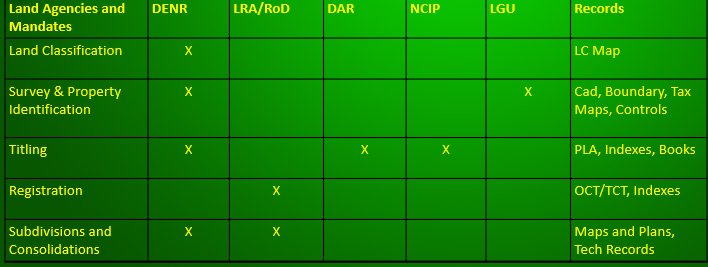
Agencies involved in Land Administration and Management in the Philippines
- Department of Environment and Natural Resources (DENR)
- Main agency involved in surveying and titling of Public Lands.
- Land Management Bureau (LMB)
- Involved in issuance of policies on land disposition and management.
- National Mapping and Resource Information Authority (NAMRIA)
- Mapping, land classification, establishment of reference point.
- Land Registration Authority (LRA)
- Issue decrees of registration, supervises Register of Deeds, assists Courts in land registration proceedings.
- Register of Deeds (RoD)
- Registers patents, CLOAs, CADT/C, registration of subsequent voluntary and involuntary transactions of registered lands.
- Department of Agrarian Reforms (DAR)
- Implements the Comprehensive Agrarian Reform Law.
- National Commission of Indigenous People (NCIP)
- Resolves issues on ancestral lands and issues Certificate of Ancestral Titles/ Claims.
- The Courts (Judiciary)
- Hears and decides land registration cases (voluntary and Cadastral proceedings).
- Local Government Units
- Issues tax declarations, prepares tax maps, maintains tax assessment rolls, zoning ordinances, conversion of lands and other land management functions
Land Ownership
Basic Principles
- State ownership under the concept of Regalian Doctrine
- Right to private ownership
Public Lands for Disposition by the State under the PLA
- Officially delimited and classified as Alienable and Disposable
- Surveyed
- Not reserved for public or quasi-public uses
- Not been appropriated by the government
- The property must not have been subject of ownership or rights recognized by law.
Modes of Acquiring Ownership
- Public Land Grants under CA 141
- Agricultural Lands
- Agricultural Free Patent
- Homestead Patent
- Sales Patent
- Lease
- Residential, Commercial, Industrial Lands
- Sales
- Direct Sale of Residential Lands under R.A. No. 730
- Residential Free Patent
- Agricultural Lands
- Land Grants by Operation of Law under PD No. 1529/ RA 11573
- Possession
- Accession/Accretion
Issuing Authority
Patents – Issued by the DENR based from its quasi-judicial powers under the CA 141, RA730 and RA10023; Administrative in nature; Free Patent, Homestead and Sales Patents
Decrees – issued by the Land Registration Authority pursuant to a final order or Judgment rendered by a Court on a land registration proceeding under CA 141 and PD 1529.
Kinds of Original Titles
- Confirmation Title
- Judicial Decree from Cadastral or Voluntary Land Registration Proceedings (Possession)
- Administrative Free Patent on Agricultural or Residential Lands (Possession)
- Homestead
- Administrative; granted in newly released areas to encourage settlement and agricultural production
- Sales
- Agricultural, Residential, Commercial and Industrial lands; Appraisal and bidding
- Direct Sale on Residential lands not more than 1,000 sqm. under RA730
- Townsites
- Special Patents
- Government Lands
Certificate of Land Ownership Award
- A certificate of title issued by the DAR to farmer beneficiaries of agricultural lands covered by CARP and acquired by the government from land owners.
- CLOAs are subject to restrictions on transfer for (10) years and amortized by the farmer beneficiaries for (30) years.
Transfer Titles
- Titles that are derived from the original title holders by sale, donation, inheritance and other forms of acquisitions allowed under the law.
- The Register of Deeds cancels the Original Certificate of Title (OCT) and a new one is created. This title is covered by a Transfer Certificate of Title (OCT). The Register of Deeds issues a new TCT to the new owner after every transfer.
Land Registration
- Land registration is a process of official recording of rights in land in a public registry. In some countries like the Philippines, it includes guaranteeing information about the ownership of land (assurance fund).
- In some countries, this information regarding ownership of identifiable parcel units are contained in a cadastre.
- Land registration is different from land titling. Land registration refers to the recording of rights while land titling refers to the manner of acquisition or holding of such rights.