Topic 9 - Plant Diversity II
Outcomes:
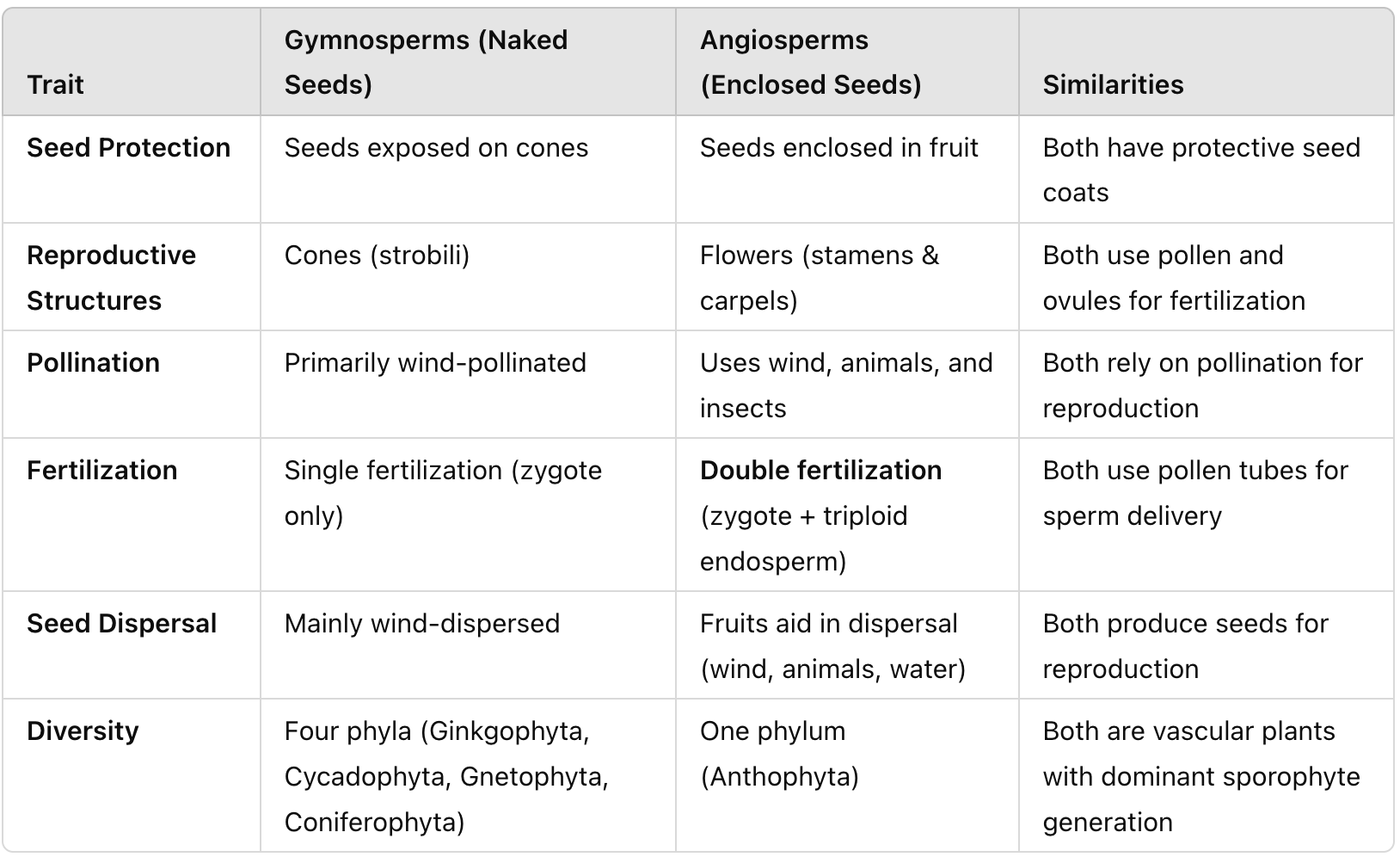
• compare and contrast derived traits of seed plants
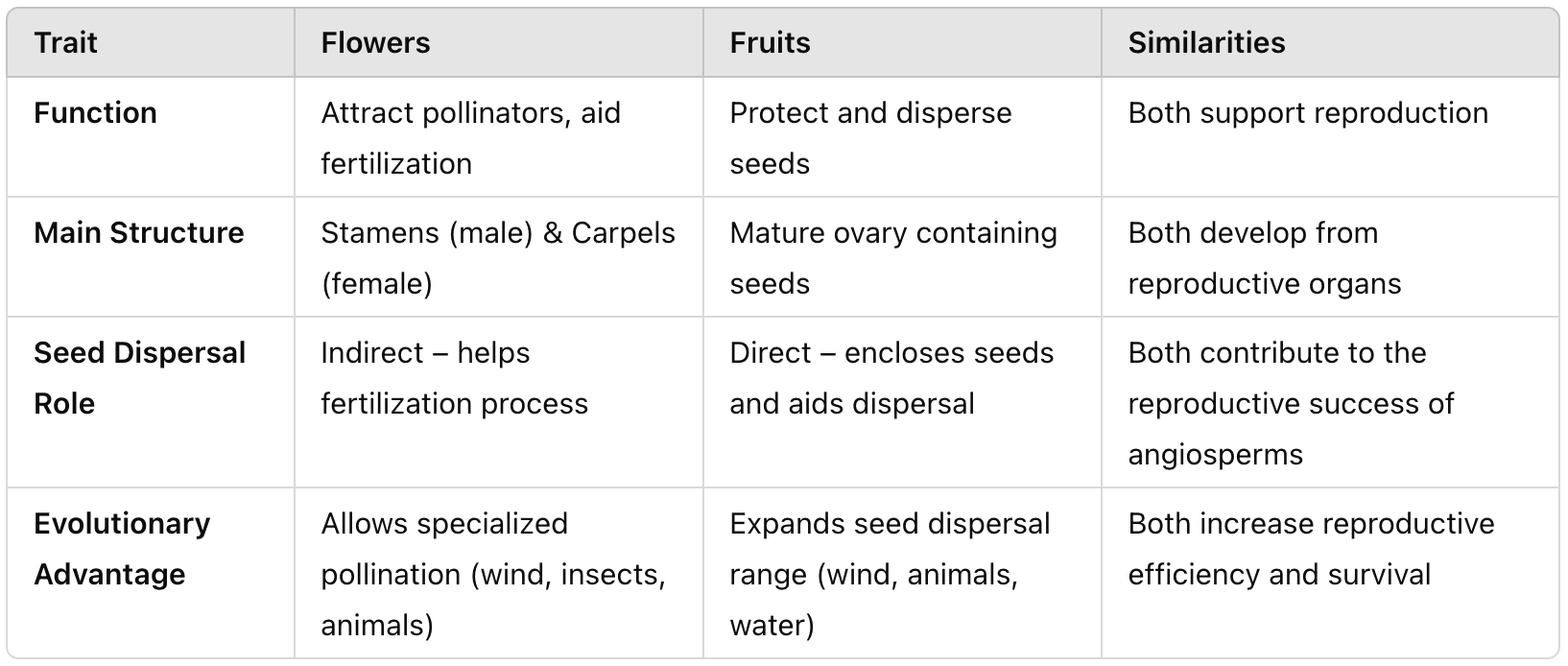
• compare and contrast derived traits of angiosperms
Derived Traits of Seed Plants
I. Seed Adaptations for Terrestrial Life
Seed plants have evolved key adaptations that allow them to thrive on land without being surrounded by water.
A. Seeds
Truly terrestrial – Unlike their ancestors, seed plants are not dependent on water for reproduction.
Challenges faced on land:
Reproduction – No longer reliant on water for sperm transport.
Desiccation (Drying out) – Must retain moisture in reproductive structures.
Structural support – Must support themselves without buoyancy.
Advantages of seeds:
Protection – Seed coat shields embryo.
Nutrient supply – Endosperm provides food for early development.
Extended lifespan – Seeds can remain dormant until conditions are favorable.
Two major groups:
Gymnosperms – "Naked seeds" not enclosed in fruit.
Angiosperms – Seeds enclosed in a "container" (fruit).
B. Reduced Gametophyte
Microscopic – Unlike in non-seed plants, the gametophyte stage is tiny.
Dependent on sporophyte – No longer free-living; relies on the parent plant.
Housed within sporangia – Provides protection from desiccation and environmental stress.
C. Heterospory (Two types of spores)
Male and female spores develop separately:
Microsporangium (2n) → Produces microspores (n) → Develops into male gametophyte (sperm in antheridia).
Megasporangium (2n) → Produces megaspores (n) → Develops into female gametophyte (egg in archegonia).
D. Ovules
Ovules contain the megasporangium and house the developing female gametophyte.
Female gametophyte develops from the megaspore and produces eggs for fertilization.
E. Pollen
Pollen grain = Male gametophyte.
Sperm develops inside microspores, eliminating the need for water in fertilization.
Pollination = Transfer of pollen from the male part of the plant to the female reproductive structures.
II. Gymnosperms ("Naked Seed" Plants)
A. Life Cycle
Seeds are exposed on cones (strobili), not enclosed in fruit.
Most gymnosperms are conifers (cone-bearing plants).
Different cones for male and female reproductive structures (heterospory):
Male cones contain microsporangia, which produce pollen grains (male gametophytes).
Female cones contain ovules, which develop into seeds after fertilization.
Fertilization process:
Pollen travels to the female cone (pollination).
Pollen tube forms and delivers sperm to the egg within the ovule.
Fertilized ovule develops into a seed containing a zygote (embryo).
B. Diversity of Gymnosperms
Four recognized phyla of seed plants:
Ginkgophyta – Includes Ginkgo biloba, a unique broad-leaved gymnosperm.
Cycadophyta – Palm-like plants with large cones.
Gnetophyta – Includes Ephedra, Gnetum, and Welwitschia.
Coniferophyta – The largest phylum, consisting of pines, firs, and redwoods.
III. Angiosperms ("Flowering Plants")
A. Specialized Structures
Flowers – Composed of modified leaves, sepals, and petals to aid in reproduction.
Stamen (male part): Produces pollen.
Carpel (female part): Contains ovaries where seeds develop.
Fruits – Develop from mature ovaries and contain seeds.
Functions of fruit:
Protects the embryo.
Aids in seed dispersal, allowing plants to colonize new areas.
B. Life Cycle of Angiosperms
Double fertilization – Unique to angiosperms, involving two sperm cells.
One sperm fertilizes the egg → Forms diploid zygote (2n) → Becomes the embryo.
One sperm fuses with central cell (n + n) → Forms triploid endosperm (3n) → Provides nutrients to embryo.
Pollination process:
Pollen lands on another flower’s carpel (cross-pollination).
A pollen tube grows from the pollen grain to the ovary.
Two sperm cells travel down the pollen tube to the female gametophyte.
Seed formation:
2n zygote → Develops into embryo.
3n endosperm → Becomes a nutrient-rich food source.
Entire ovule → Develops into a seed.
C. Angiosperm Diversity
One major phylum: Anthophyta (contains all flowering plants)