Chapter 7 - Chemical Equilibrium
Spontaneous chemical reactions
7.1 The Gibbs energy minimum
- Reaction Gibbs energy - The slope of the graph of the Gibbs energy plotted against the extent of the reaction.
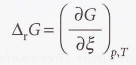
Exergonic and endergonic reactions
- Exergonic - Since the process is spontaneous, it can be used to drive another process, such as another reaction, or used to do non-expansion work.
- Endergonic - The reaction can be made to occur only by doing work on it, such as electrolyzing water to reverse its spontaneous formation reaction.
7.2 The description of equilibrium
Perfect gas equilibria
- Standard reaction Gibbs energy - The difference in the standard molar Gibbs energies of the reactants and products.
The general case of a reaction
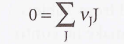
- Thermodynamic equilibrium constant - An equilibrium constant K expressed in terms of activities.
The response of equilibria to the conditions
7.3 How equilibria respond to pressure
- Le Chatelier's principle - A system at equilibrium, when subjected to a disturbance, responds in a way that tends to minimize the effect of the disturbance.
7.4 The response of equilibria to temperature
- Exothermic reactions - Increased temperature favors the reactants.
- Endothermic reactions - Increased temperature favors the products.
- Van 't Hoff equation - An expression for the slope of a plot of the equilibrium constant as a function of temperature. It can be expressed in two ways:

Equilibrium electrochemistry
- Electrodes - Metallic conductors.
- Electrolyte - An ionic conductor.
- Salt bridge - A tube containing a concentrated electrolyte solution that completes the electrical circuit and enables the cell to function.
- Galvanic cell - An electrochemical cell that produces electricity as a result of the spontaneous reaction occurring inside it.
- Electrolytic cell - An electrochemical cell in which a non-spontaneous reaction is driven by an external source of current.
7.5 Half-reactions and electrodes
- Oxidation - The removal of electrons from a species.
- Reduction - The addition of electrons to a species.
- Redox reaction - Reaction in which there is a transfer of electrons from one species to another.
- Reducing agent (Reductant) - The electron donor.
- Oxidizing agent (Oxidant) - The electron acceptor.
- Redox couple - The reduced and oxidized species in a half-reaction.
- Anode - The electrode at which oxidation occurs.
- Cathode - The electrode at which reduction occurs.
7.6 Varieties of cells
- Electrolyte concentration cell - The electrode compartments are identical except for the concentrations of the electrolytes.
- Electrode concentration cell - When the electrodes themselves have different concentrations, either because they are gas electrodes operating at different pressures or because they are amalgams with different concentrations.
- Liquid junction potential - An additional source of potential difference across the interface of the two electrolytes.
7.7 The electromotive force
- Cell reaction - The reaction in the cell written on the assumption that the right-hand electrode is the cathode.
Nernst equation
- Cell potential - This potential difference.
- Electromotive force - The resulting potential difference.
- Nernst equation
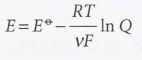
7.8 Standard potentials
- Standard hydrogen electrode - The specially selected electrode.
- Standard potential - The right-hand electrode and the standard hydrogen electrode is the left-hand electrode.
7.9 Applications of standard potentials
- Electrochemical series - The metallic elements arranged in the order of their reducing power as measured by their standard potentials in an aqueous solution.
Species-selective electrodes
- Ion-selective electrode - An electrode that generates a potential in response to the presence of a solution of specific ions.
- Gas-sensing electrode - Consists of a glass electrode contained in an outer sleeve filled with an aqueous solution and separated from the test solution by a membrane that is permeable to gas.
- Asymmetry potential - Observed even when the activity of the test species is the same on both sides of the membrane.