1.3 Energy and Equilibria
Energy in systems: Laws of Thermodynamics
1st Law of Thermodynamics is often called “The Principle of Conservation of Energy”. This principle states that energy is neither created nor destroyed.
2nd law of thermodynamics states that the entropy (the measure of the disorder of a system) of an isolated system will tend to increase over time. Think about an isolated system, that cannot exchange energy nor matter, with a problem with its equilibrium of transfers and transformations of matter and energy. THese problems will only increase as there are no other systems to support it.
Thus, an implication of the 2nd law of thermodynamics is that no ecosystemic process can be 100% efficient. Think of cellular respiration—lower-entropy chemical energy is turned into high-entropy mechanical energy. When this happens, heat energy is lost. With this energy loss, no natural ecosystemic process will ever be entirely energy efficient. This energy loss can be reflected in an energy pyramid and calculated.
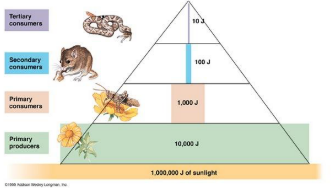
Energy Loss (percentage) = (Initial input - energy taken in)/initial input * 100
—> Know how to apply this formula!!
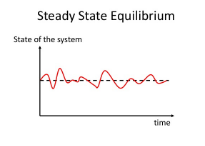
Equilibrium: The tendency of the system to return to an original state following disturbance.
Steady State Equilibrium: In an open system, even though inputs and outputs of energy and matter are continuous, the system as a whole remains more or less constant. It follows an average line, with some highs and lows.
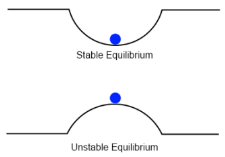
After a disturbance:
Stable returns to the same equilibrium.
Unstable returns to a new equilibrium.
Negative Feedback Loops: Helps organisms and systems return to their original state. They stabilize as they reduce change within the system/organisms. Some examples are body temperature regulation and predator prey relationships.
Positive Feedback Loops: (The viscious cycle) Changes the system to a new state. They destabilize as they increase change. Examples include blood clotting, ocean warming, and melting of polar ice (albedo effect).
Tipping Point: A critical threshold when even a small change can have dramatic effects and cause a disproprotionately large response in the overall system. Think of carrying capacity, where one small change can send the entire system spiraling. Examples:
Lake eutrophication
extinction of keystone species
coral reef bleaching
Resilience: The tendency of a system to avid tipping points and maintain stability through steady-state equilibrium. The ability of a system to avoid tipping points and be able to stay constant despite small changes, restore back to original state.
Examples:
Eucalyptus trees in Australia
Resilient to wildfires: able to grow in ash filled soil, have very thick bark to prevent fire damage, and have fire activated seeds to ensure new growth.