Recap Notes.docx
Recap Notes
March 30, 2024
9:11 PM
Lecture 1: Intro and Terminology
Terms
- Aboriginal and Indigenous - All
- Metis, Native and Indian - Specific Groups
- Aboriginal is defined in the Constitution and refers to Indian, Inuit and Metis
- In 2008 42 First Nations Chiefs launched a campaign against it
- Native is a synonym for Aboriginal People
- Indian is found in the Constitution and the Indian Act as legal "status Indians"
- Amerindian is a term that refers to American and Indian but not widely known
- First Nations = originally for Indian groups (used in class is for non Metis or Indigenous people in Canada)
- Inuit replaces Eskimo (Indian in the constitution) - based on locality and land terms may be used. The federal government was responsible for Inuit peoples in the Constitution
- Metis generally is a mixed of First Nation and European ancestry. NOT defined as Indians under the Indian Act
- Daniels Decision determined that Metis and all First Nations not just status Indians
- Metis and non-status Indians were declared to also fall under the responsibility of the federal government
Status
- People who are Indian according to the Indian Act as Status Indians
- Non Status Indians are those people who are neither Metis nor Inuit but do not follow under the Indian Act
- A Indian Person was not "status" in the eyes of the government, they were considered to be the same ad any other Canadian Citizen
- Inequality was prominent in the Indian Act
What is Indigenous Studies?
- The Changing 'Social Consciousness' of the post-war years
- First Nations Attending University
- Achieve positive results from Indigenous communities
- The Influences of the civil right movement and rise of feminism
- The lobbying efforts and activism of Indigenous Peoples
- The perceived social responsibilities of educational institutions
Treaty Indians
- People who are descendants of people who signed treaties with the Canadian Government
Lecture 2: World Views and Terminology Cont.
Terminology
- Difference between First Nations, Metis and Inuit Peoples - All are Aboriginal
- These terms are pan-Indigenous and not created by the groups that use them
Aboriginal: Defined in the Constitution Act as legally Indian, Inuit or Metis
Native: Synonym for Aboriginal people but more specifically Indian or Metis
Amerindian: used by few academics combines American and Indian
Inuit: are not Indians and do not fall under the Indian Act however they are considered part of the overall grouping of the people to be considered Indian
Metis: mixed First Nations and European ancestry
Status Indians: people who are Metis, Inuit or First Nations
- Not the same as any other Canadian citizen
Treaty Indians: descendants of people who signed treaties with the Canadian govt.
Module 3: Meritocracy, Language and privilege
- Micro assaults: intentional discriminatory actions (ex. White supremist symbols, preventing children to date outside of race)
- Microinsults: verbal and nonverbal communications that convey rudeness and insensitivity that demean ones heritage
- Microinvalidations: communications that subtly exclude the thoughts or feelings of a person of colour (ie where are you born)
- Lateral violence: people in own group inflict violence against each other
- Internal colonization: when people start to believe the words of others in your group
- Negative thoughts
- Can manifest into lateral violence
The Myth of Meritocracy : Belief is that all of us are offered the same chances for success
White Privilege:
- Racism : individual and group level processes and structures that are implicated in the reproduction of racial inequity
- Systemic racism: happens when these structures or processes are carried out by groups with power, such as governments, businesses or schools
- White privilege is not the suggestion that white people do not struggle, it’s the ability to gain resources or have access to resources or opportunities that people of colour in the same situation will not have
- Both conscious and unconscious
- White Fragility: unconscious pushback when faced with something uncomfortable
Lecture 4: Colonization, colonialism and the 5 stage model
Learning Objectives:
- List and describe the five stages of Colonization
- Describe how and each stage influences the subsequent stage
- Explain the effects of the stages on contemporary Indigenous people
- Apply this knowledge to the assigned article on Indigenous education
5 Stages of Colonization:
- Steady State
- A time prior to contact with Indigenous People
- Indigenous communities were stable
- 100,000 to 30,000 years ago (way before Canada at 150 years)
- Hundreds of thriving Indigenous cultures on the land
- Kinship systems (ways of organizing themselves)- institutions, family, systems, child welfare, people had various roles in community
- Egalitarian- everyone in that society had equal importance, value and worth (all children, men and women)
- Political systems- ways to make decisions, no voting, consensus from everyone
- Could have international relations with other Tribes
- Laws weren’t written down, they were taught when children were young (what was right and wrong, consequences from actions) elders would teach and had wisdom, experiences, histories
- Had everything they needed to keep the society functional, and successful within their ecological circle
- Education and healthcare systems were more advanced than Europeans in that time
- First Encounter
- First encounter was Columbus discovered the Caribbean in 1492 (Thought they were "Indians" bc he found India)
- Explorers from Europe also explored this new land
- Found coast of Newfoundland found in 1497 by John Cabit
- Indigenous people has blond hair and blue eyes bc of Viking blood introduced
- Indigenous people were called "Red Indians" bc of red mineral rubbed on skin
- Fur Trade: First couple of hundred years was beneficial to both sides, interaction
- Epidemics and influenzas roamed in Europe
- industry polluted the water sources
- Forests (trees) were scares therefore fur bearing animals was also scarce and owned only by the nobility and rich
- Europeans found lots of wood, animals, clean environments, they liked that bc in Europe everything was owned by the rich
- In the 1500's many ships came to fish in newfoundland, had to dry fish, encounters
- Indigenous people trade animals, and natural resources and Europeans trade more modern tools and manufactured resources (pans, alcohol, weapons)
- Towards end of fur trade 1800's
- Europeans also brought diseases that wiped out 50-90 % of the Indigenous population
- Christianity and Religious practices, social Hierarchies (racial, sexist, religious ect)
- Want land from Indigenous People, put them on Reserves to expand territory
- Imposition of Colonial Relations
- The Indian Act: Indigenous people need to assimilate into dominant culture
- Indigenous people were placed on Reserves
- Canada (John A. McDonald) needs to take care of everyone (healthcare, education ect), so planned to make Indigenous people turn into Canadians
- Residential Schools: teaching children how to integrate into Canadian cultures
- Placed Reserves in undesired land and poor resources
- Indigenous communities are weakened by diseases, and are now forced to follow the European lead, resistance was hard in this state
- Hospitals, schools and drinking water were less than others
- Internalized Colonialism
- When people are told something for many years, they start to believe it
- Has an emotional, and mental strain on many people
- 60's Scoop, children are taken away from families and put in foster care
- Start to see the intergenerational effects of trauma experienced by Colonialism
- High number of Indigenous people are in institutions like jail or foster care are due to the trauma from before and internalized colonialism
- Decolonization
- Canadian government ways to reconciliation
- Reconciliation for Indigenous people through the Calls to Action
- Try to undo the damage that was done generations ago
- Try to understand the events from before that still take effects today
- Back to Steady State
- Form another relationship between Canada and Indigenous people through reconciliation
5 Hallmarks of Civilization
- Governance
- Economics
- Socialization
- Education
- Health
Colonization
- specific era of European expansion into overseas territories from the 16-20th century also where a foreign power dominates and exploits an Indigenous sector
- Not a single action but a culmination of many differing actions throughout time
Decolonization:
- Not a word but an action
Colonialism: colonization in practice of philosophy
- ROCA
- Racism
- Oppression
- Cultural Genocide
- Assimilation
Lecture 5: The Fur Trade
- Began in the 1600s part of the response to European fashion craze for beaver fur hats
- French men worked with Indigenous peoples
- At the start all newcomers were completely reliant on Indigenous peoples particularly women as they acted as guides, interpreters, entry points into kinship relations, small animal hunters, made clothing and trapping needs
- WOMEN were key figures
- Fur trade lasted almost 3 hundred years
- Ad fur trade went on women were cut out of negotiations - women back in Europe were seen as chattel so the roles didn’t align with their worldview
- Missionaries arrived to spread Christianity
- Buffalo hunting was promoted
- Intro to patriarchy and hierarchy
French vs. British Relations
- French looked to follow Indigenous ways
- King of France wanted more French people to live in colonies, but since they were at war with Britian, he didn’t want to reduce the French population in France
- So he encouraged French and First Nations marriage to increase French citizen numbers
- As well to strengthen economic and social alliances
- The strategy did not work as many children from the mixed marriages lived in Canada
- British wanted to change everything
- Military style operations for trading posts
- Relationships with Indigenous women were forbidden although they still occurred
- English didn't travel to First Nations villages, instead First Nations travelled to forts
- Were unaware that there were middlemen
- 1760 New France fell to Britian
- Attempted to bypass the middlemen
Fur Trade Movement
- Fur trade started in Atlantic provinces then moved into Quebec and then further inland
- Movement occurred bc Atlantic Canada didn’t have the quantity of beaver needed and it did not take long for its stock to become depleted
- First Nations Middlemen: obtained furs from trappers further inland - soon the French wanted to bypass the Middlemen and go straight to the trappers
- Allowed them to trade their used European goods to the inland First Nations groups (1 year usage)
- Once they traded for furs, they would use the furs as clothing for a year before trading to Europeans
- Wearing the furs got rid of the guard hairs - English and French didn’t have tech to take the guard hairs out
- Quebec City and Montreal emerged as important fur trade centres
- Actual centre of Indigenous trade was in Ontario in the heart of Huron territory
- Since there were few opportunities for colonialists to become traders some men took a different route
- Coureur de Bois: men who illegally became fur traders- married First Nations people they lived with
- Children became a population called the ethnogenesis of the Metis - the creation of a new culture
Competition:
- First 90 years had intense competition between French, English and American fur traders
- By 1739 furs were 70% of exports into France
Hudsons Bay Company:
- 1670
- English were not significantly involved in the fur trade- settlers didn’t have good land for agriculture and poor beaver quantities
- 2 French traders Medard Chouart Groseillier and Pierre d'Esporit Radisson were originally sent to encourage First Nations to trade with the French
- Went to England and King Charles II liked the idea od the trading expedition
- No consultation with First Nations, Charles also granted HBC a special Charter which gave them exclusive rights over a large area or land named "Ruperts Land"
- No one knew about this agreement
- Northwest Company was a threat to HBC
Kinship
Western: how you are related to others
Indigenous: community and relationships
- Virgin soil epidemics: diseases brought over by Europeans that First Nations didn’t have immunity to
- Christianity was promoted on people - God would save them
- Crisis of faith and world views
- Syncretism: adopting Christianity into religion
First Nations as Consumers
- Iron pots, copper kettles, knives and hatchets
- Clothing food staples
- Guns - bow and arrow remained more practical bc early guns were poor quality and difficult to repair
- Alcohol
First Nations as traders
- After 1821 when NWC and HBC merged there was less need for First Nations traders
- Inelastic consumer demand: high prices for furs (goods not money) were high due to deamnd in Europe, so traders hoped First Nations would trade more furs, but they traded less furs for the same quantity of goods
Lecture 6: Military Alliances
- Indigenous people played a key role in numerous military conflicts that took place in North America
- Mostly French and English sought control over territory and were helped by various Indigenous allies
- Historians think Indigenous people entered these wars for their own geopolitical reasons and own interests is to protect trade routes
- Fox Wars: series of conflicts in the 1700's that involved Indigenous nations that were allied with the French and used conflict to ensure their own control over access to European goods and weapons
- French Indian War (7 years war): larger scale global war taking place on several continents and involving several European nations. British led coalition of European nations against French led coalition of various nations. British allies, they won and took over Canada
- Eastern Canada most groups supported French bc of the long history of trade alliances, saw them as less of a threat
- Iroquois eventually allied w the British bc it would benefit them
- Began to see different boarders within America and Canada
The American Revolution (War of Independence 1775-1783)
- At least 1500 Iroquois involved, British were defeated and allies were pushed out of former settlement areas in US territory
- Mohawk were allocated a plot of land in Ontario called Oka
- Industrial Revolution and rise of Capitalism fractured relationships between people
- Modernization intro to British and First Nations
- Decline in Beaver and Otter and advance of bison hide trade
- Invention of repeating rifles and railways
- Increased pressures for Indigenous peoples as no longer essential to trade or war
War of 1812
- Conflict between US and Britain
- Mohawk were crucial allies to British military
- Anishnabe agreed to relinquish lands in exchange for annuities
- Freed up land faster and Indigenous peoples served as guaranteed income- laid groundwork for future treaties
- Made connections with Methodist church
- Rise of formal schooling and institutions ie courts, prisons were evident after 1812
- 1814 Americans and British signed Treaty of Ghent where British claimed Canada excluding other nations over Ruperts land
- 1830's Mi'kmaq and Wuastukwiak faced starvation
2 Main Companies
- HBC - English
- Northwest - French : valued Indigenous peoples
Lecture 7: Treaty
- Fundamental building blocks of Canadas development
- Negotiations of Indigenous people settlement in areas was legitimated
- Given constitutional protection
- Contemporary documents
- Both sides have to gain something
- Signed over 70 treaties
- Indigenous people held power and made the settlers learn their language
- Definition of treaty: treaties are agreements made between different nations. Therefore they are considered nation to nation agreements.
- Economic treaties (trade) and peace and friendship treaties (kinship)
Peace and Friendship Treaties 1725-1779
- Two Row Wampum negotiated between Haundenosaunee and Dutch Govt.
- Each row symbolizes two boats representing the laws, beliefs and practices of the two separate groups as they travel down the river alongside one another while respecting each others way of life
- Principle of respect for the other party's way of life
- Treaties shifted from peace and friendship to land acquisition or territorial treaties after Britain acquired New France
- Royal Proclamation of 1763 -
- British knew the First Nations groups who allied with France would be concerned about them
- So they offered them protection
- Delineated boundaries of new British Quebec
- Created official guidelines concerning acquisition of land
- Essentially, they sought to establish British protection over unsettled Indian lands that still belonged to Indian people
- Declared that the Crown and not individuals could negotiate with First Nations for land surrenders this protected them from the US
- Did this to avoid uprising
Significance of the Royal Proclamation:
- Acknowledged rights to Indian land
- Some peaceful land acquisitions but as immigrants arrival results in demands for land
- After the war of 1812, Indigenous people weren't viewed as allies anymore instead economic liabilities and barriers to territorial development and expansion
- Start to see first signs of assimilation of First Nations people
- Ojibway (Anishinaabe) people in Ontario wet to govt. about unconsented mining leases in their territory
- Chief travelled to Montral to talk to general
Treaties 1763-1921
- Indigenous perspectives there was a difference between signing with the Crown and government
- Queen was more symbolic - viewed her as a mother of Britain and the people were her children
- Cultural understanding pf British ways
- Indigenous people thought of land to be shared to use of traditional resources
- No ownership, they care for the land, no selling only representing the creator
- Annuities, food, medical support, education ag.
- Provinces have more power than federal, so Indigenous people think they are children of the crown but most things fall under provincial
- After signing treaty most made the transition to farming or ranching
Role of Robinson Treaties 1850
- Without a treaty protecting them, Indigenous people took up arms and seized a mining company occupying their territory
- Govt sent William Robinson to negotiate with First Nations around Lake Superior and Lake Huron
3 Key components:
- Setting aside of reserve land in exchange for title to remaining lands
- Establishing annuities instead of lump sum payments - annual payment of cash
- Retaining the right for Ojibway to hunt and fish over the entire ceded territory so they could make a living - restricted to unoccupied crown lands
Post Confederation Treaties:
- 1867 The dominion of Canada purchased Ruperts land from the Hudson's Bay company
- No land was supposed to be sold
Free land
- Advertised free land for future settlers
- But it was taken away from indigenous peoples
Provisions for First Nations in written docs:
- Treaties established reserves - land set aside for use of First Nations Peoples
- Annual payments - 4-5 dollars per individual
- Prohibited alcohol on reserves
- Establishments of schools on reserves and payment to teachers
- Protection of hunting, fishing trapping rights on unoccupied land of Crown
- Aid for beginning farmers and technical aid
- Varying payments at the time of treaty
- Medical and health care in times of famine
- Treaties allowed
- Land to be sold and lived on
- Extract natural resources
- Urban reserves areas in cities reserved for Indigenous land
Provisions for non First Nations:
- Granted access to first nations lands and natural resources
- Live in treaty areas
- Purchase land
- Peaceful co existence
- We are all treaty people
- Indigenous people wouldn't just sign away everything they had
- Many treaties were made before the friendship treaties
- Both sides had knowledge about the treaties and how they would affect them
- Individuals will take land no matter what laws were put in place before hand
Lecture 8: The Indian Act
- Passed in 1876 had one hundred sections and had major implications on First Nations people specifically membership regulations
- How reserves were managed, sold, surrendered as well as resources on reserves
- Liquor, education, taxes regulations and power of band councils
- Federal govt decided who was "Indian" and who wasn’t
- Not a source of rights but a limitation of rights
6 general areas within the Indian Act
- Status guidelines
- Band governance
- Education
- Taxes
- Alcohol
- Use and surrender of land
Status Guidelines - determines who qualifies as a "status/legal" Indian or membership criteria
Band Governance - deals with guidelines for elections, structure of Chief and council
Education - allowed the govt to contract with other parties for the purposes of delivering educational services to First Nations and allowed Indian affairs to involve themselves in school regulations and enforce attendance (not free education)
Taxes- people do not own their property on reserve, the Indian Act sets out taxation guidelines which says that there are no taxes on Reserve land but they pay all other taxes
Use of Alcohol- prohibits use of alcohol on and off reserve
Use and Surrender of land - allowed govt control over Indian people and land although originally thought to be for protection the govt exploits land and resources
- Urban reserves ie gas stations don't charge tax bc they are on treaty land
Federal govt- deals with Indigenous peoples
Provincial govt - deals with non indigenous people
- Two areas to undergo change the most frequent amendments include land appropriation and provisions and "assimilation/civilizing" provisions
- The goal of both was to eliminate Indians as a separate group of people in society
Indian Act defined Indian as follows:
- Any male person of Indian blood reputed to belong to a particular band
- Any child of such persons
- Any woman who is or was lawfully married to such persons (sexist rule)
- As well as subsections that excluded people from considered Indian ie illegitimate, absentee, women who married non Indians, non treaty Indians, Metis
Enfranchisement
- A status Indian would lose status his or her status and be recognized as Canadian citizens with the right to vote and hold property
- Was not popular at all
- People were immediately and illegally franchised if they had a university degree, military ect
- Involuntary enfranchisement for any First Nations in the military during WW2 increased dramatically in 1942
- Usually a govt official or Indian agent said they had no choice
- Duncan Campbell Scott Indian Affair deputy said the govt beliefs were to absorb Indians into Canada
Land Appropriation
- Act in 1906 that gave the Department of Indian Affairs the ability to distribute higher percentage of sale proceeds directly to Band members, thereby incentivizing voting in favors of surrenders
- 1896-1911 land surrenders grew significantly
- Peggy Martian McGuire said that 21 % of First nations land in the prairies were surrendered to make way for western expansion
Political Suppression
- Allowed govt greater control of first nations during 1885
- Amended to supress First Nations leadership, culture and traditional governance
- Allowed Mister of Indian Affairs with authority to depose Chiefs for various reasons such as immorality, drunkenness or corruption
- Due to Chiefs who were seen as not upholding government policies or who posed a threat to government control
- Chief Piapot was removed in 1910 mostly bc of his resistance to govt authority
- Wanted to do traditional dances ie Raindance
- In 1885 it became illegal for first nations to be on another reserve without permission of the Indian agent
Economic Restrictions
- 1881-1882 regulated sales, exchanges of Indian groups
- 1885 specified that it require all First Nations people who wished to sell any products off reserve such as crops or farm animals to obtain a permit from the Indian Agent
- Occurred up to the 1960s
- Permit to sell
Cultural Restrictions
- Religious and other cultural practices became outlawed under the Indian Act
- Control the movements of Indian people, speed up the process of assimilation and criminalize the Indigenous culture
Gender Oppression and discrimination
- 116 years a status woman who married a non status man would lsoe her status, treaty rights, property rights and the right to live on reserve
- Status men could do the same with out losing anything
- Women were prohibited from participating in the band system and the new system of governance replaced indigenous governance structures and models and imposed a new patriarchal system
- Denied women the right to poses marital property
- In 1884 this was changed to allow a man to will their marital property to his wife if the Indian agent deemed her of "good moral character"
- Chattel - viewed woman as property
Court Cases
- Jeanette Corbiere Lavell married a non status Indian in 1970 and lost her status and court case but won appeal
- Yvonne Berard lost her status as well in 1964 when she separated from her husband and wanted to return to the reserve but no longer had Indian status
- The cases were joined in appeal to the Supreme Court of Canada and in 1973, Bedard and Lavell lost their cases for "marrying out" rule in the Indian Act
- 1970's was a push of activists from Indigenous and non Indigenous communities about gender and inequality in the Indian Act
- Sandra Lovelace challenged the Indian Act to the United Nations Human Rights Committee
- Married a non Indigenous man and moved from her reserve
- After she and her children wanted to return
- Took her case to the Supreme Court and lost
- In 1981 she went to the UN and won due to the Canada in breech of International Convent on Civil and Political Rights
- Indian Act went under many amendments though to 1927 that sought to accelerate the assimilation process and also used to control and punish First Nations people
Lecture 9: Gender
- Women could repair snowshoes and other hunting equipment
- Made decisions on military and war - they have the ability to veto the men's decisions
- Instrumental in understanding military campaigns
- They knew the food rations and how long travel would take
- Opposite gender in opposite role was seen as honoured, appreciated and nothing negative
- But people weren't pushed towards those opposite roles
- Gender roles were socialized and followed
- Fluidity to this, there were female hunters, warriors and healers and some men more active in caregiving, breading
- Generally men took part in the military, protection and hunting while women were in complete control of the camp
Misconceptions of Gender roles
- Historians have painted a picture for Indigenous women being beasts of burden during the fur trade that only benefited from their marriages to the Europeans traders as a means of escape but that was not true
- European observers viewed indigenous women as being slaves or beasts of burden of the society because of the differing roles compared to European women
- Belief was that if the women married settlers they are saving them
- Differing worldviews, understanding of lifestyles
Egalitarian Society
- Emphasizes equality and equal treatment across gender, religion, economic status, political beliefs ect
- Also can be understood as all prople being equally important and of equal value to society
- One gender will compliment the other or one cannot survive without the other
- Indigenous communities were described this way
Story summary:
- Hunting expedition with the settlers and Indigenous men
- It failed bc the women weren't present
- The male part of the job is only half the battle
- Males and females work together to succeed
- Indigenous women were strong - he talked highly about sacrifices they took to take care of the society
- Europeans didn't understand women's roles in the community
Gender and Sexual Diversity
- Knew that gender and sexual diversity was in communities and it was respected
- Knowledge, terminology and cultural understandings have been lost due to various colonial practices
- First Nations had to adhere to heterosexual marriages and lifestyle
- In most Indigenous communities marriage was not a traditional practice
- People just stayed together if they wanted
- Partnership wasn't seen as traumatic thing like Europeans did
- Children are in the middle of the circle, then grandparents, then women, then males
- Males are protectors
- Females protect elders and children
- Elders are protectors of children - those who were older are seen as people who taught the children
- Children were seen as future of that community, so they were protected by everyone
- The relationships with other family members - can be multiple people called mothers with no hierarchy
- Community children still exists today - many people are close to that child
- Reason why child welfare doesn’t work in Indigenous Communities with the western understanding
- Huge cultural loss with the use of Residential schools and the Indian act
Terminology
- Common term used for male persons who dressed and took more female traditional role was "berdache"
- Lakota "Winkte" for males who took on female gender roles - have spiritual powers and artistic abilities
- "Double woman" for women who expresses more masculine traits
Two Spirit
- Recognized as a pan native north America term
- Not necessarily considered to carry a religious connotation
Women and Bands
- Until 1951 women were excluded from political activity by law, could not vote, or hold positions within the band - accidently gave the right of women to vote in amendment
- 1960 govt gave all Aboriginal people the right to vote
Bill C31
- After 1857 married Indigenous women and their children lost their status if husband/father lost status
- Changed in 1951
- In 1981 govt right their previous wrongs
- Reinstatement of Registered status
- First time registration of many children
- New rules governing entitlement to Indian registration for all children born after April 16 1985
- Right to develop own rules of governing
- 174 000 individuals have been registered and regained status with 106 000 losing their status
Indian Act of 1985
- Persons entitles to be registered
- Those who can pass Indian status to their children
- Those who have lost status to the children unless the other parent also has status
Band membership
- Now granted to each band if they wished to develop their own membership regulations
- Control of Indian Status still remained under the Federal government
- Those who now became band members were now the bands responsibility and without funding it led to housing shortages and other issues
Sexual policing of women
- Some settlers marry Indigenous wives and treat them well while hes there until he goes back to his European wives and the Indigenous wives were passed along to another man
- Women were not respected by those men
- These are the roots of the murdered and missing indigenous girls
- Bc those women's are being seen as objects to be protected, or gained, not as people like before
- Indian Agents forbid divorces in indigenous marriages
- Section of Sexual Immorality were filed against women being immoral not men
World views:
- Indigenous
- Do not own land
- Cannot sell land
- Given to take care of it
- Western
- Ownership and purchasing
- Crown understood that first nations owned that land
- Conflict over treated exists bc of differing interpretations about their purpose and importance
Motives of the Government:
- Treaties are most prudent and economically viable way of obtaining access to Indian lands
- Sovereign control over western Canada before US. Needed western expansion
- Warfare or treaties- not enough numbers and money for war
- Although the crown signed the treaties as lasting agreements, the idea at the time was the Indian peoples were vanishing race and would be assimilated
- First Nations wanted to learn from settlers ie education, farming, agriculture but the Crown didn’t want anything from them
- Permits and the Pass system arose to try to interfere with first nations success
- Lots of oral treaties that weren’t upheld
5 Dollar Treaty
- First Nations get 5 dollars on Treaty Day
- As a means of protest against govt.
- Should take into account of inflation for equal sum of money for today
- Elders understand that treaty was supposed to be revisited for land use/money
Motives of the First Nations
- Treaty was a way for them to adopt a new way of life
- But still continue they're old way of life before without interference, agreed by the Commissioners
- By smoking the pipe, the crown was seen to acknowledge these concepts and accept the responsibilities (mother and child) kinship
Reviewing the Treaty Relationship
- Both parties smoked the pipe as a way of sealing friendship
- Touched their hand to the pen - signed with X
- Not everything was written down on treaty some oral
- Many on both sides didn't speak each other language
- Source of conflict today has to deal with the oral promises made that were not incorporated into the written versions of treaty + terminology and idea of cultural misunderstandings
- Spirit and intent treaty issue - medicine chest would be kept at home of Indian Agents, given poor health and disease in First Nations populations, demands for negotiators access to the "white mans" medicines were high - they wanted knowledge and access to their healthcare not a medicine chest
- Plants were used as medicines, others took it and patented it so Indigenous people couldn't use it anymore
Lecture 10 + 11: Residential Schools
- 1600s day schools, agriculture schools, domestic training schools
- 1880 onwards as the era of Residential schools
- Created for Indigenous children to attend and practice the cultural assimilation was undertaken
- Funded by Federal government and Christian missionaries
- Roman Catholic 3/5, Anglican 1/4, Methodist and Presbyterian
- Purpose was to educate and convert Indigenous youth and to assimilate them into Canadian society
- 150,000 children attended residential schools
- 6000 children died at residential schools
- 130 schools operated in canada between 1831-1996
- 1931 there were 80 schools operating in Canada the most at one time
- Mohawk first to open in 1831
- Gordon Residential school in Punnichy Sask closed in 1996 and was the last federally funded school in Canada
- Many ill children
- Due to poor nutrition
- Many children part of a secret nutritional and dental testing through denial of particular foods
- At least 3200 children in reports died but more like 6000
- 2021 Kamloops Indian Residential School uncovered 215 children in unmarked graves
- School ran from 1890-1969 reportedly having 500 children
- Resistance was shown by parents and children
- Parents hid children from govt officials
- Children ran away from schools and set fires to try to escape
- Indigenous leaders joined in condemning and calling for change
- 1940 govt and churches saw that the system was failing and said that it was lacking
- 1969 the Department of Indian Affairs took over from govt
- Some Indigenous communities wanted schools to remain open or be transferred to Indigenous control
- 1986 majority of schools were closed and turned over to local bands
60's Scoop
- At end of 50s and continued to 80s
- Residential schools phased out and families were deemed unsuitable to care for children
- 1951 included the "general law of applicability" meaning provincial or territorial child welfare legislation could now be applied on reserve and the provincial govt could intervene in emergencies
- 1951 29 children were in BC provincial care, in 1964 there were 1466 children from 1 to 34% of children in care
- Social workers were unfamiliar with the culture and history of Aboriginal communities had European middle class values
- They didn’t understand the diets in the houses, clothing or appliances and assumed that the parents weren't providing for children
- Poverty, unemployment, addiction some social workers felt a duty to protect local children
- Children were taken from homes even if they were in poverty but a good home without consent
- Not until 1980 where social services had to tell band if a child was being removed
- Children were put in non Indigenous homes, separated from family, forced sterilizations
- Outcomes: displaced children didn’t fit
- Later finding heritage
TRC- The truth and recognition commission of Canada was launched in 2008 as a part of the residential school settlement agreement
- Process that would give canadians though history of facts
Lecture 12: War
- Indigenous peoples were not getting the same recognizing their efforts in the war
- Taking a long time for the govt to properly thank them
- Canadian govt and people have historically not been fair to them
- Reasons why Indigenous peoples are still feeling oppressed
- Have to think of the reasons why and historically
- Oppression on multiple levels
WW1
- One in three able bodied First Nations men of age who enlisted
- Many Indigenous people lived in isolated areas where guns of Europe were hard to get
- 4000 people left and fight international
- Prairies contributions were especially signifigant bc the per capita rates of enlistment were the highest in the country
- Reserve land alienation for returning soldiers also was big on the prairies
- 1 year in the war Duncan Campbell Scott the Indian Affair deputy said first nations wernt allowed in war
Why did they enlist?
- Patriotism and to follow others who signed up
- Connection to the crown and british royalty
- Escaping poverty on reserves and good paying - compensation for families
Controversy
- Not all first nations people were in support of enlistment efforts
- In 1940 some protests bc of agreements from treaty that argued against any legal obligation to serve
- Despite not allowed to vote, people still enlisted
War experiences
- Many Indigenous men said they grew identities as canadian soldiers
- Battlefield equality
- Seen as Canadian and not Indian
- Didn’t face the same racism like at home
- Felt more included
Achievements
- Awarded many prestigious awards
- Tommy Prince was Ojibwa from Manitoba
- Henry Louis Norwest got the Military Medal and bar was Metis
- David Greyeyes one of 14 Canadians to receive the Greek Military Cross was Cree
War efforts
- Indigenous women served overseas and joined war efforts
- Many worked in factories and increased agriculture production on their reserves
- Made packets with food and clothing
- Contributed to reserve lands used for airports, rifle ranges and defense posts
- War Measures Act
- Land taken for ag, training, factories
- Didnt give land back
- Gave it away to veterans
- Indigenous veterans were homeless when they came back bc of enfranchisement
- Land was appropriated for these purposes with the promise of return after war but it never happened
- Also supported financially donated 400 $
- Old Crow Chief Moses walked from Alaska to RCMP with money that he got from trading furs to help orphan children in London
- 23,000 from Canadian Indian bands
- Big deal as people didn’t have much money and also fighting alongside people who oppressed them
- Letter to Minister of National Defence as contributions are inherent loyalty of the Indian population and desire to assist in the war
- Got graciousness from govt and Crown like never before
Tommy Prince
- Turned down several times before being accepted for military duty
- Became highly skilled marksman and tracker
- Part of Special Forces team that merged with UC elite unit
- Devils Brigade - going behind enemy lines, spying on Germans and reporting back to camp
- Did this to show Indians are equal to the white man
Charles Tompkins
- Indigenous code talker
- Disguised information so it couldn’t be intercepted
- Recently publicly acknowledged
Lecture 13: Inuit LOTS OF EXAM QUESTIONS
- Used Inuit people as human flagpoles to ensure sovereignty in the far north to warn other nations not to expand
- Govt used Inuit funds to transfer them to remote areas
- Ensured that Indigenous people are always in debt to the got
- Cashback places with high interest
- HBC Controlled everything
- Inuit initially lived in the Artic and Northern Canada
- National voice is the ITK Inuit Tapiriit Kanatami
History
- Inuit have lived in their territory for a very long time (1050)
- Sivullirmuit means first people - Tunnit
- Western docs trace contact between the Norse and Inuit
- Inuit claim regional sovereignty but they have been ignored bc the land covers 20% of Canada and its resources are important
- 18th century there has been trade between Inuit and European whalers resulted in exchange of furs, skin, meat, cloth ect
- Inuit guides were in high demand
- Trade increased the hunting of caribou, walrus, seal so populations declined Europeans brought unknown diseases ie measles, flue, syphilis and tuberculosis
- Whaling industry failed the Northwest Mounted Police and HBC led to greater Inuit participation in the fur trade, decline to their local knowledge and increased a dependency on things like flour and sugar and imported goods
- 1930 collapse of fur prices
- Inuit way of life started changing
- Problems w food
- War
- Famine
Inuit and Canadian Policy
- 60 years after Canadian Confederation in 1867, Inuit were not recognized as Indians nor Canadian Citizens
- When oil was found
- 1939 Inuit are Indian defined under the Indian Act
- 1951 Eskimo exempt from being Indian for specific cases bc of federal govt arguing over responsibility
Relocations
- 1949-1959
- Very tragic for families
- Minimal relief
- 1945 after WW2 the federal govt supported Inuit returning to traditional ways of live, but unable to happen bc of overhunting animals
- Thought it would be cheaper for the govt to let them go back
- Over 10 relocations that were apologized for
- Feared starvation
- Meant to assist people with jobs and federal resources
Aftermath
- 1996 Monetary settlement for 10 000 000 in compensation to the 84 survivors and descendants
- 2 million to people and rest in a trust to be secure for next 35 years
- 84 people got 840 000 dollars over 6 years ( 5 million)
- Each surviror is 10 000 a year
- Not enough money to do anything
- In 2002 the trust collapsed
Advancements and Accomplishments
- 1960 Indian and Eskimo Association was founded
- 1970-71 Inuit Tapirisat of Canada was established to secure Inuit land title, establish research management to protocols w federal govt and to ensure the Inuit were included in regional policy formation ie a separate territory Nunavut to be created
- Federal govt. advised Inuit people on how to run things
- Split into 2 land claims to ensure that one would be successful
Creation of Nunavut
- 1976 Inuit from Inuialuit break from Nunavut process and negotiate first comprehensive land claim settlement in NWT the Iqaluit agreement
- 60,000 square miles assigned owner ship rights and 8000 square miles of land
- Special harvesting and enviro protection
- Federal support for economic and social development
- 45 million until 1997
- 1990 agreement for Nunavut created
- May 25, 1993 land claim agreement is signed by federal, territorial and Inuit (70% of Inuit agreed)representatives
- Wanted a decentralized gov people represented different areas via satellite to have meetings
- 1999 Nunavut was Canadas 3rd territory after 25 years of negotiations
- Beacon of advancement and Indigenous self government
CALDER CASE
- 1973 was decided by the supreme court that Aboriginal title to land was founded to be
- use of the land for long periods of time and continuously occupancy before first contact
- Ensured Inuit people were in remote locations to be flagpoles
- Between 1971-79 negotiations about Inuit and govt
- 1979 ITC drafted new proposal w 4 points
- Inuit ownership rights over portions of land rich in non-renewable resources
- Inuit decision making power over the management of land and resources within the settlement area
- Inuit financial indemnity and royalties from resources developed in the area
- Commitment from Ottawa to negotiate self governance once a land claim was finalized
- Land claims were split into 2 groups of Inuit, govt saw as a weakness between Inuit, but they thought it was better in case one group failed so they had knowledge for the second to succeed
The Korean War
- Russ Moses served in Korea
- Hosted CBC radio show Our Native Land
Naval
- Canadians serve in navy
- Ships were named to respect Indigenous peoples
Land Claims ON EXAM
- 1973 govt started new processes for comprehensive land claims
- Comprehensive land claims are based on Aboriginal peoples traditional use and occupancy of the land (traditional use ie Calder Case)
- Unfinished business of treaty making
- Arise in areas where aboriginal land rights haven't been dealt with by treaty of legal means
- Self governance
- James Bay= First modern treaty
- Specific land claims are based on assertions that the govt failed to deliver specific obligations under treaty, agreements or the Indian Act (not upheld)
- Past wrongs against first nations
- Ie failure to provide enough reserve land as promised in a treaty or improper handling of money by the federal govt)
- Settling claims is the right thing to do
- Govt doesn’t take away land from third parties to settle specific claims
- Modern Treaty = comprehensive land claims
What Happened?
- Despite the 1999 creation of the APTN Aboriginal Peoples Television Network and strong regional communications there is an ongoing problem with the communications in Nunavut
- Housing costs are high and housing is not available
- Training and education is not being met and Inuit are suing govt for breach of promise regarding training
- Decentralization of govt to included all parties also created further problems when were are telecommunication issues
Reasons:
- No one wanted to build houses and it was to expensive to import food
- 18-20 people per home
- Children are born with respiratory problems (black mold in houses)
- Transfer to hospitals but to expensive so, they turned children over to Child Protective Services and they will be transferred w those funds to hospital to be treated
- Children werent returned home bc of over crowding in Nunavut
- All bc of lack of housing and different problems Nunavut faced w self governance
- Statistically

Lecture 14: Activism, resistance and resilience
- Resistance - stopping something from occurring or attempting to stop something from occurring
- Continuing to cultural practices in secret
- Legal challenges to the Indian Act
- Running away from Residential schools
- Resilience - rebounding after oppression/hardship
- Wheelers article and Indigenous scholars
- Campbells story on Jacob- he shows resilience through his survival and resistance through the creation of the journal names
- Challenges to the child welfare system
- Calder, Marshall, Daniels case
- Refusal to accept enfranchisement
- Resurgence- bringing something back
Activism
- Red Power Movement - 1960 when Indigenous peoples were given ability to votes in elections
- George Manuel and Frank Calder presented brief to House of Commons and Senate advocating for Aboriginal title recognition and basis of the 1763 Royal Proclamation
- Nisga claim in 1969 leads to Calder decision in 1973 that upheld Nisgas held title to their lands prior to the creation of BC
1960-70s
- 1969 Minister of Indigenous Affairs Jean Chretian w Elliot Trudeau introduced White Paper
- Ending all aspects of separation between Indigenous and Non indigenous people though the permanent destruction of the Indian Act
- Everyone will be the same
- But Indigenous people said the govt was removing responsibility off of them as the Indian Act protects Indigenous rights and Treaty in Canada
Important organizations
- AIM American Indian Movement
- NIB National Indian Brotherhood
- AFN Assembly of First Nations
- RED POWER MOVEMENT
- Assert indigenous sovereignty and ensure treaties be honoured
- 1972 AIM had a country wide protest called the Trail of Broken Treaties
- Travelled from Washington to West Coast of US
- 20 point presentation to President Richard Nixon
- 1974 Native Peoples Caravan and the Constitution Express
- Raise awareness to broken treaties, Metis rights, educational disagreements
- BC to Ottawa to meet with Trudeau
- One woman from Sask was on the Constitution express (other supported but didn’t go)
- Based on Treaty 6 protesting govt was a break of Treaty
Lecture 15 +16: Metis
- metis - French word meaning mixed blood (European and First Nations)
- Used to describe those that have a specific cultural understanding and ancestral land base
- Metis - specific/different cultural group
- Refers to those groups where mixed blood arose that were culturally different from First Nations and European practices
- Aboriginal Status - whether or not a person is from First Nations, Metis, Inuit of Treaty Indians
History
- French monarch pushed for relationships to develop between Indigenous and European fur traders
- Kinship
- Help expand the colonies without reducing French numbers
- Families and kids would come back to France but not many did
- Intermarriage and combining of peoples the other ensuring purity of the differing race
- Labrador and Newfoundland - fishing along river can see Europeans and Indigenous communities interacting with each other
- Some became the Labrador Metis
- Did this to fight for rights acknowledged by many First Nations communities
- But never acknowledged by govt
- Some groups call themselves metis for mixed blood
- Metis have specific culture
- Mixed ancestry communities developed and chose to live apart from local Indigenous, British and French settlements
- Vs the Red River Metis group
- Self identified as Metis with unique cultural blending of Indigenous and Acadian practices
- Relocated to Nova Scotia and New Brunswick
- Metis accepted by the provincial govt as Aboriginal peoples but individual Metis negotiations were abandoned
- Prov govt of New Brunswick specifically trued to have Metis assimilated into Indian culture
- Pushback from federal govt bc didn’t want to fund
- Federal and provincial govt clash
Lecture 17 +18 : Health and Justice
Health perspectives:
- Western bio-medical approach to health is our public health care system in Canada
- Hard to get other forms of medical care
- Acupuncture, holistic, meditation, massage
- Licenses were not covered bc it came from outside western health or had a mental aspect
- If you have an illness in your body we only look at that part, is an older view
- Western models of health are changing slowly
- Indigenous views such as connection to land, ancestors, is an identifiable trait to Native health
- Ceremonies played a key role in promoting such balance
- Maintaining healthy relationships w the enviro, and spiritual forces
Eras
- Pre contact era- relatively good health, some upper respiratory infections from bacterial infections
- Early Contact era- arrival of Europeans introduced "virgin soil epidemics"
- Disease is new and populations don’t have antibodies
- Lots of people died
- Reserve era- govt Starvation Policies withholding rations contributed to reduction in health
- Poor housing, sanitation conditions
- Contributed to high numbers of tuberculosis infections
- Tipis had better living conditions than houses bc of mold and poor ventilation systems
- Dr Peter Bryce - advocate for poor residential school conditions but was ignored and fired
- Dr. EL Stone expressed concerns
- Developed special medical health centres unit at Fort Qu Appelle Sask to treat tuberculosis
Lecture 19: Saskatchewan cultural appropriation and revitalization
Helen Betty Osborn
- 1971 four men assaulted her and were not charged for a long time
- Within months most family members and friends of assaulters knew about the crime but not reported
- Brought attention to Prairies
- 15 years later, a different police officer reopened the case and arrested the men
Tina Fontaine 2012:
- Missing Indigenous girl in Winnipeg
- Raised by great aunt
- Wanted to connect with mother in Winnipeg, mother kicked her out on the street
- Police find her and leave her on the street
- Picked up and left in hotel with other homeless children
- Came into contact with police, social worker and doctors, but she disappears (healthcare, child welfare systems are failing children)
- Left her alone even thought there was an alert for her
- Body found in Red River 9 days later
- 5 years later people say very little has changed
Mama Bear Clan
- Clan walk takes approach to streets to promote change in communities
- Group that looks for missing children
Bryan Sinclair
- Went into hospital - amputee to see a family physician
- Told his the chapiter was blocked
- The emergency doctors would have to fix it
- Sat in emergency for 36 hours and ignored him and others patients plead to help him
- Left alone until he died
- Found that he died of racism not the blocked chapiter because he was ignored
Starlight Tour Neil Stonechild in Saskatoon 1969-current:
- Police would take Indigenous men to fields far away from the city and leave them there
- Said it was a drive under the stars
- Inquiry showed that the man was with police the day he disappeared
- Police have been mistreating Indigenous people and there have been 3 killed men found since
- Police denied allegations (Larry Heartwig police officer)
- Continuing across Canada not just in Saskatoon
Colton Boushie 2016:
- Man and friends were having fun and car got a flat tire
- There were reports on break in on farms at the time
- Driving to Gerald Stanleys house bc he fixes cars
- People have been drinking
- Stanley thought his wife might have been run over and shot at the boys and
- Stanley claims that he was trying to turn off the car and a hangfire (accidental shot) killed him
- Stanleys family went back inside and the evidence was wash away
- Trial for this case legally there were motions made for anyone to appear in the jury was dismissed if they were First Nations
- Human rights commissions and higher government got involved and stood behind Boushie
- Stanley wasn't found guilty of anything
- Cultural Appropriation: taking elements from one culture and absorbing them into another
- Usually done by dominant culture
- Celebrities wearing traditional head wear or clothing
- Hairstyles, clothing, jewelry- cultural appropriation or appreciation
- Karly Kloss, Madonna and Kim apologize about outfits
- Adele kept it positive bc she was at an event celebrating black culture
- Becomes appropriation when you deliberately tell someone that it was Indigenous traditional clothing when it isn't. Because its only used for specific traditional usage
- Appreciation is when you wear the piece made by the Indigenous person
- If your not sure don't do it
- Ashley Callingbull Mrs. Universe
- Satire article on Murdered and Missing Indigenous girls
- Making a point on only supermodels can make the front cover and not the missing girls
- Stereotype: overgeneralized belief about people and a particular group
- We infer that a whole group has a range of characteristics when they don’t
- Myth: widely held about false notions not about the person themselves but the group the belong to
- Ex. All Indigenous people get free housing/are lazy
- Using "us" and "they" marginalize groups even unconsciously
- So we use the actual group to avoid this
- Revitalization: bringing cultural practices back
Sarain Fox:
- Power of Indigenous Storytelling
- Moccasins are traditional footwear used for walking and dancing
- Keeping culture alive though traditional things
Emerald Edge- largest forest In the world
- Over 35 Indigenous communities care for it doe decades
- Guide people through water and tell visitors about history
- Relationships and respect over resources
- Try to preserve Indigenous culture through canoe carving
- Gave access to land
- Protect the land
- Nature conservation is very important for livelihood
- Fishing
- Forestry
- Tourists
- Modernization can still occur with some of the cultural aspects
Examples from USask
- Lindsay Knight is a rapper who advocates for Indigenous
- Tenille Campell is a poet who focuses on traditional storytelling
- Tasha Hubbard is a filmmaker
- Randy Morin teaches cree language
- Christie Belcourt - artwork
Contemporary health
- 2016 stats
- Tuberculosis is less common but rates among First Nations is 6x higher than the rest of canada
- Inuit are 17x (Nunavut housing issues)
- Life expectancy is 11 years less for Inuit, 10 year for FN, 5 years for Metis
- Indigenous people 3-5 times more likely to get diabetes
- Suicide for Indigenous males is 15-24 year - 126 per 1000 people
- Non indigenous is 24 per 1000
- Woman is 20 times more likely
- all numbers going up
Quebec
- Quebec had a big concentration of French fur traders
- Coureurs de bios
- Mixed marriages were encouraged
- Called middle men
- Quebec specialists called metis
- Can track line back to woman in 16th centry
- Mixed families establishing their own communities see permanent Metis settlemetns around great lake
- Created Rules of the Hunt - Metis tradition and policy pertaining to Metis buffalo hunts
- Later used for governance of province Manitoba
- Indigenous accounts for 5 % of overall population accounted for 11% of HIV in Canada
- Saskatchewan rates of HIV are the highest - Indigenous people account for 80% all new cases
- High bc of generational trauma and poverty
Population health approach
- 2005 health council addresses health disparancy between Indigenous and Non indigenous people
- Improving health status through action
- Only population to undergo colonization in Canada
- Indigenous and other cultural holistic views vs western view of only physical illness
- Mental health was one of the first things the western biomed model looked at
- Incorporates social and economic correlates of health and well being
Poverty
- Poverty and lack of sanitation in Indigenous communities and overcrowding
- Don’t have clean water
- Hard to maintain clean homes
- Poverty is main factor in this
- Higher costs of healthier foods in northern communities, reduction in access to traditional foods, lack of access to physical fitness facilities, health care
- Lower incomes make it hard to buy nutricious foods
- First Nations have the well being to the worlds least developed countries
- Issue of safe drinking water
- 20 % of FN communities are under drinking water advisories
- More than 10 years 73% remain medium or high risk
- Rates of illness caused by unsafe drinking water at 26 times higher than national average
- Elijah Harper - refused to vote in favour of the Meech Lake Accord bc they didn’t meet with the Indigenous peoples in creating the accord
- Tied to Quebec's separation
- Next time groups were consulted in the Charlottetown Accord that acknowledged Aboriginal self government but never was put through
Oka Crisis
- Kanesatake Resistance or Mohawk Resistance
- 78 day standoff 1990
- Mohawk protesters, Quebec police, RCMP and Canadian Army
- Proposed expansion of a golf course on land that was being disputed in Kanesatake - Mohawk burial ground
- One police officer was killed
- Federal govt purchased land but did not expand
- Brought 4500 army in for 75 protesters
- Solidarity of people around Canada so got limited military responses
- Govt relied on Indigenous people had to appease certain groups
- Burned weapons but didn't surrender
Gustafson Lake Crisis
- 1995
- Dispute over land owned by American land owner but considered sacred Sundance land
- Owner initially had good relationship with Indigenous peoples and the sundance was held for several years
- Later it deteriorated - argued that they had rights to the land by treaty with the crown
- BC attorney general argued that it was private property
- No resolution and RCMP had to take campers by force
- Truck driven into 2 defenders near camp hit by explosive planted by RCMP
- Activists had shootout lasting 45 min only a dog died
- 5.5 million dollars and 400 RCMP
- 14 First Nations were charged, 21 charged, 4 allies charged
- A man hid the RCMP explosived
- Fled to US when given parole
- News against Canada bad
- Us refused to send him back to canada and gave him asylum
UNDRIP - United Nations Declaration on the Rights of Indigenous Peoples
- Canada is one of four that opposes this
- Canada heavily involved in creation of declaration 1985
- 2007 Canada voted against
- Human right issues from Canada, New Zealand, Australia and US for Indigenous people
Idle No More
- 3 women activists in Saskatoon lead a movement
- Teaching, cultural traditions
- Calls for renweal of relationship between Canada and Indigenous peoples
- 2007 Aboriginal day of Action
- 2007 Cindy Blackstock FNCFCS
- 2008 Harper Apology
- 2010 Grassy Narrows Mercury Poisoning
- 2011 TRC
- 2012 Idle No More - Bill C45
- 2012 Teresa Spence Attawapsikat
- 2013 Neil Young Honour treaties
- No indigenous sovereignty without black liberation
RCAP - Royal Commission on Aboriginal Peoples
- Defines Metis culture as being conceived in Quebec, and Ontario and born on Western plains
- Common markers - needed cultural aspects
- Language
- Dance
- Music
- Sash
- Red River carts
- Flag
- Ethnogenesis - creation of new culture
Birth of Metis Nation
- Late 18th century Metis are settling in large numbers in the Red River Region (Winnipeg)
- Farms, hunting buffalo and trade agents
- Competition with the HBC and governor Miles MacDonnell attempts to decrease success of trade through the Pemmican Proclamation - prohibited the export and trade of pemmican which was a key component for trade success for Metis
- 1816 Metis and Native forces join under Cuthbert Grant to fight armed HBC force
- Battle of Seven Oaks
- 15 minutes
- 21 people died
- First time metis defined as Metis
- Metis diversify and grow socially unique culture
- Economy flourished
- Biannual bison hunt (to pay HBC debt and then to purchase stocks for upcoming winter)
- Hunt grows from 540 to 1630 individuals
- Rules of the Hunt created
- York Boats and Red River cart system transporting goods
- Self governance
Healthcare
- Non Indigenous people had access to resources to accommodate needs for sick children
- Northern or remote locations had little access to healthcare
Racism
- Brian Sinclair from Winnipeg
- ER of hospital for treatment for bladder infection
- Sat in wheelchair for 34 hours while staff ignored him
- They testified that he was just their to warm up or perhaps sleep off intoxication
- Found to be bc of racism
- Common experience in health care
Culture in respect to authority
- Many medical professionals thought when patients didn’t look them in the eye, the symptoms were fake or not important
- But in Indigenous culture it was a sign of respect to not look authority in the eye as it was challenging them
- Many people who don’t live on reserves
- Implenting culture in urban setting is different than reserves
- The cultural differentiation
- Cultural understanding in terms of learning, spirituality, family practices should be acknowledged
Birth of Metis
- 1849 HBC tried to assert its authority by convicting Metis trader Guillamune Sayer of violation of the Ruperts Land trade provisions(a monopoly) - didn’t have a license
- Convicts as guilty
- Massive demonstrations during trial, judge waves all penalties and the HBC trade monopoly loses ability to be enforceable
- HBC withdraws from area bc of this and fur trade decline
- 1867 British North American Act is passed and dominion of Canada is created
- 1869 Ottawa didn’t consult with FN or Metis when negotiating to purchase Ruperts land from HBC
- Metis (lead by Louis Riel) blocked land surveyors access to the Red River colony
- Metis formed provisional govt in 1870 after Canadian officials attempt to infiltrate territory
- Riel sends 3 people to ottawa to negotiate regions entry to confederation
- Manitoba Act of 1870 creates Manitoba includes French language rights, promise for lands for Metis
- Created mainly bc Metis said they wanted their own govt
- Indigenous land plots were circular around the water source (pie shape)
- Settlers made them square shaped and it would ruin Metis way of life
Louis Riel
- Leader of provisional govt
- Anger at govt he takes 3 prisoners including Thomas Scott an Orangeman at Fort Gary
- Scott was a racist, Riel needed to show Canadian govt that the idea of self governance was not going to disappear and Riel didn't want to show weakness so he goes through with sentencing and he was hanged
- John MacDonald sends a force to squash the Rebellion and Riel becomes a fugitive as the Canadian govt decides to prosecute him for death of Scott and places a 5000 bounty
- Riel flees to US
- Elected to parliament in hiding
- MacDonald urges Riel to stay in US for less fighting
- Manitoba act 1870 created
- Provides specific protection of Red Reiver residents, guarantees French will be taught in Roman Catholic schools
- Attached verbal promises weren't kept some written promises delayed so long that ehy have no value or allowed settlers to move toward their land
- Dominion Lanc Act furthers issues as land claims for Metis are so far from their home bases it is of no use to them and the Scrip process begin
Scrip
- Promissory note that could be exchanged for the same value in land
- Initially Metis children of family heads were allocated 240 acre s and family heads were allocated 160 in form of scrip
- 1.4 million acre allocations still had a claim were also issued scrip
- Never upheld, well documented and forms of govt fraud, shortages of land and discrimination
- Result was Metis dispossessed lots of land then used for settlers
- Supreme court acknowledged this
- Bill C53 is a form of self governance for Metis in SK, BC, ON, MB
- Scrip redeeming was difficult to do
- Metis were forced to sell their scrip to settlers bc of starvation and need for money
- Illegal
- SO govt paid 50% of scrip to get it back
- Govt officials would adopt children after their parents died, then abandon them to take the Metis scrip
Halfbreed Adhesion
- 1875 Metis at Rainy Lake negotiated a Halfbreed adhesion to treaty 3
- Only time Metis dealt with as a collective in one of the numbered treaties
- After signing Canada fails to the adhesion in terms with ongoing attempts to make Metis in the region identify with Indian
Justice
- Traditional Indigenous Principles of Justice
- Indigenous societies had no govt or formal institutions of law
- There was a system of sanctions
- Certain words didn’t exist in some languages
- Rape bc it was a horrible thing that never happened
- Within the communities the concept of kinship and structures provided central foundations for social control
- Minor violations were addressed by social sanctions ie ridicule, avoidance and shame
- Elders played an important teaching and mediation roles
- Dispute mediation - banishing or execution someone
- Warrior Societies existed, where no specific responsibilities related to justice principles
- Police force and enforced rules
- Little known about executions
- If band won a battle over another band the winners would adopt the losers into their community (marry)
- Little hostages and killing each other rather incorporate them into the new life
- Diff than western culture
- Murder - atonement or reparation
- The family of the victim would be obligated to seek revenge or atonement by killing the perpetrator or one of their family members
- Could result in blood feud
- But can be avoided through reparation in payment of property
- Members of the warrior society took involved individuals to lodge and preform a pipe ceremony- gift giving settlement
Culture and traditions
- Sundance
- 3 days of fasting
- Dance around pole w piercings until its ripped from skin
- Piercings were seen as bodily sacrifice and levels you can move up on spiritual level
- Many communities have sacrifice and there is western perception was unfair on these ceremonies
- Ceremonies were driven underground (bc they were banned)
- Criminalized by western society
- Traditional clothing banned
- Western shows had positive views on Indians so govt didn’t want that
- Settlers scared of First Nations and railway built
- Moved from fertile land and further regions
Metis self Government
- Metis migrate from communities to settle in Montana in 1875
- Lots from the Red Reiver Nation
- 1881-85 Canadian Pacific Railway is constructed from Ontario to BC bringing more settlers
- Road Allowance people
- People had to live in Crown land in ditches in tents
- No taxes, so the govt didn’t allow children to go to school
- Gabriel Dumont is acclaimed president - at as local police and will follow process of Rules of the Hunt
- 1885 group and Louis Riel who returns create a petition declaring provision Metis govt
- Metis Bill of Rights
- Acknowledging the Metis nation
North West Resistance
- results with Metis and Native forces holding off the North West Mounted Police
- Ottawa send 5000 soldiers
- Several battles but resistance is crushed and most leaders are arrested
- Cree population participates particularly from Big Bear at Frog Lake
- In their interest bc his people were starving and needed to open negotiations
Ways westerners had made it difficult for Indigenous peoples
- Pass and Permit system
- Banned clothing and ceremonies
- Negative light
- Deposing chiefs
- Indian Agents
Justice system
- Increase of Indigenous peoples in jails
- Bc of racism and oppression
Addressing inequalities
- Installing more culturally relevant practices and Indigenous personal into the system
- Incorporation of Indigenous philosophies and practices is seen as a way of addressing effects of racism and discrimination
- 1995 sentencing reform Act Bill C41
- Helping people in prison by giving them a part of their culture doesn’t fix their problem
- For women even small infractions they are arrested
- Children are taken by social services and its hard to get money to get children back and the cycle continues
Changes:
- Indigenous policing
- Appointment of Indigenous judges and justices of peace
- Training indigenous court workers
- Cultural awareness training for non indigenous justice officials
- Problems indigenous people face and understanding oppression and power creates ongoing marinization
- Need anti racism and anti oppression
- Use of Indigenous courts
All forms of Indigenization
- Internal colonization
- When in jail are not welcomed back to reserve community
Initiatives above seen as indigenizing the current system
- Need more meaningful changed
- Restorative justice needed to promote essential justice reform
- Money is not a deterrent - doesn’t need as much as it used to
- The idea of paying a fee is better than restorative justice
Political organizing
- After Riel Resistances in Manitoba 1869 and Saskatchewan 1885 Metis became landless
- Lived in tents in ditches on Crown land
- Neither seen as Indian of white so govt felt they weren't responsible for them
- Not acknowledged in hunting trapping and fishing so rights were not protected
- 1930s Metis form a regional political organisation called The Metis Association of Alberta (MAA)
- 1933 MAA had 1200 people
- Had some success
- Metis Betterment Act 1938
- System of farm colonies
- Metis harvesting rights
- Educational changes
- Land settlements
Provincial and Federal issues
- Alberta didn't recognize Metis under the Metis Betterment Act and only 10 settlements
- Debate on whether metis rights were provincial or federal
Politics of identity
- 1940 a Metis person was defined on blood quantum - at least 1/4 Indian blood
- Ewing commission said Metis had to look like an Indian, live like an Indian and prove Indian ancestry
- Constitution Act 1982 mentioned Metis but did not define it
- Lack of formal definition of Metis rights
- Drove a wedge between Metis and First Nations
- Metis National Council (MCN) represents organizations in ON, MB, SK, AB, BC
- 2002 declares: Metis means a person who self identifies as Metis, is of historic Metis Nation ancestry, is distinct from other Aboriginal peoples, and is accepted by the Metis Nation
- Dependent upon those that can trace their ancestry to the Red River Settlement
- December 8 1869 Provisionary govt of the Metis in Northwest govt or 1816 Battle of Seven Oaks
- 2002 declares: Metis means a person who self identifies as Metis, is of historic Metis Nation ancestry, is distinct from other Aboriginal peoples, and is accepted by the Metis Nation
Ramifications
- Areas of Metis settlement above become little m metis rather than big M Metis
- MNC says that actual cultural group called Metis was birthed when the Metis had a sense of nationhood, prior to that they were culturally different and of mixed blood but not Metis
- Congress of Aboriginal Peoples (CAP) says definition excludes many people who have legitimate claims to Metis identity (think of status and non status Indians)
- 1992 MNC and federal govt signed Metis Nation Accord called for negotiations to begin for Metis self govt - connected to Charlotte town accord
Metis vs metis
- Trace to Red River Valley and prairies beyond
- Ancestral language (Minchif)
- History and political traditions
- Common culture
- Kinship large circle
- Self identification
- Distinct from aboriginal people
- Accepted by the Metis nation
metis
- Origins life in many regions throughout Canada and US
- Do not have common ancestral language
- Differing political and history
- Differing culture
- Self identification
- Kinship small circle
- Differs from aboriginal groups but don’t have differences in common across all groups claiming Metis peoplehood
- Accepted by varying different Metis organizations that may or may not be recognized on provincial or federal levels
- Metis is for those who identify as Metis, have an ancestral connection to historic Metis community and is accepted by the modern community with continuity to the historic Metis community
- metis is derived from French understanding of this word and will mean mixed heritage or mixed blood
Current legal issues and questions
- Section 35 of the Constitution Act 1982 recognizes " Indian, Inuit and Metis peoples" as aboriginals people under Canadian law but does not define Metis
- 2004 Powley Decision results in the SCC acknowledging Metis possess aboriginal rights
- 2016 Daniels case ruling turns jurisdiction over Metis peoples to the federal govt
Legal Cases
- The Marshall Case 1993 (Mi'kmaq)
- Donald Marshall Jr
- Caught and sold over 200 kg of eel without a license during off season fishing and Had Illegal net
- Arrested and charged under Federal Fisheries Act and Maritimes Provincial Fishery Regulations and was found guilty in 1996 and again in appeal 1997
- In 1999 the Supreme Court reversed the convictions bc it upheld the hunting and fishing rights in the Peace and Friendship Treaties
Peace and Friendship Treaties
- Do not involve land cessation or rights at all
- British and French were at odds regarding the fur trade and wished to create alliances w Indigenous People as they were considered essential to success
- Mi;kmaq, Makiseet, Passamaquoddy and other groups allied together called the Wabanaki
- The Powley Case 1993 (Metis)
- Steve and Roddy Powley killed a moose in 1993 and were charged w contravening Ontario hunting law
- Argued that the constitution act protected Metis rights to hunt for food
- Found guilty but appealed to Supreme court
- They ruled in favor to the Powleys in 2003
- Protected under section 35
- Only applies to Metis who live around Sault Ste Marie
- Sparrow test - defines existing aboriginal rights
- Van Der Peet Test- firther defined aboriginal rights
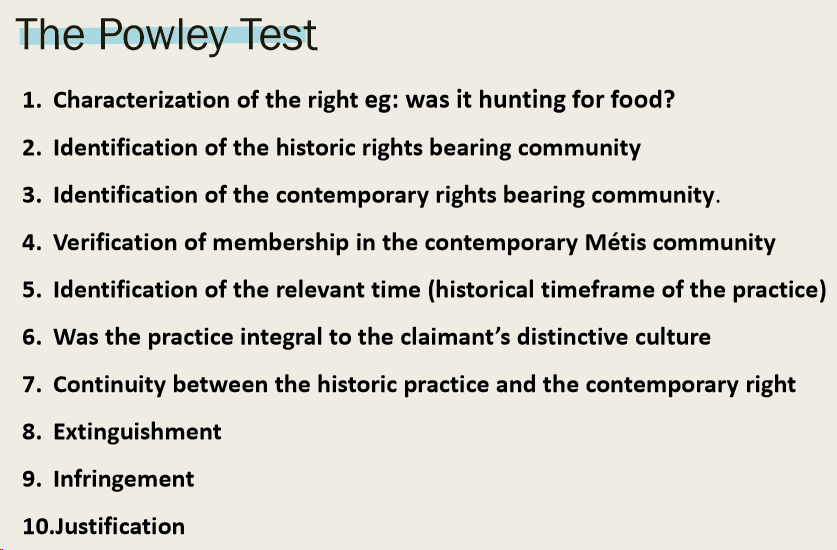
- The Daniels Case
- 1999 (Metis and non status Anishinaabe and CAP now represents non status Indians)
- Argued for 3 points
- Metis and non status Indians must be recognized as Indians under section 91 under the Constitution Act
- Crown has a fiduciary duty to Metis and non status Indians
- Metis and non status Indians have a right to be consulted by the federal govt w respect to Indigenous rights interests and needs
- Ruling- Ruled unanimously that under the constitution act 1867 the federal govt is responsible for all Indigenous people including Metis and non status people
- Supreme court described Metis as : distinctive peoples who in addition to their mixed ancestry, developed their own customs and recognizable group identity separate form their Indian or Inuit and European forbears. A Metis community is a group of Metis with a distinctive collective identity, living together in the same geographical area and sharing a common way of life