World Regions in Global Context Master Note
Lecture 1: Introduction
- Geography - In Greek, geo means “earth” and -graphy means “to write”
- Geography: study of places and relationships between people and their environments. Geographers explore both the physical properties of Earth’s surface and the human societies spread across it.
- seeks to understand where things are found, why they’re there, and how they develop and change over time.
- Physical geography: climate, weather patterns, landforms, soil formation, and plant and animal ecology.
- Human geography: The spatial organization of human activity and how humans make Earth into a home.
- Environmental Geography: connects physical and human geography
Lecture 2:
Environmental geography: The study of relationships between humans and the natural and built environments in which they live.
Geographic definition of Place: Is dynamic, with changing properties and fluid boundaries the product of a wide variety of environmental and human factors.
- exerts strong influence on people’s physical well-being, opportunities, and lifestyle choices
- contributes to people’s collective memory and are powerful and emotional and cultural symbols
A Sense of place: feeling resulting from the experiences and memories a person or people associate with a place and to the symbolism they attach to that place.
- develops out of the human capacity to reorganize the natural world into a built environment. Geographers think of the built environment as landscape.
Regions: connections that emerge between and among places over time.
- At a global scale, these are world regions. World regions are an aggregation of places and connections that develop between those places over time.
Regionalism: describes the strong feeling of collective identity often shared by people who inhabit a region with distinctive characteristics. The feeling that one has toward places and regions also generates one’s geographical imagination.
Regionalization: process of making new global connections that allows or causes world regions to change.
Globalization: system of elements-- political, economic, sociocultural, environmental—linked together so that changes in one element often result in changes in another.
- We live in a globalized world, where our environments, economies, and societies are largely interconnected and interdependent. Despite the intensification and expansion of globalization, regions and countries retain their uniqueness. 15th century and 18th century considered times of biggest expansion to globalization.
World regions are:
- best studied by considering how they interact and develop as part of wider global political-economic, sociocultural, and environmental systems;
- best conceptualized as interdependent, as they affect, and are affected by, each other; and
- best understood as products of change over time
Relationship between Regionalization and Globalization: Globalization becomes an engine of regionalization and regional differences can contribute to globalization.
New global connections- through trade, migration, or environmental exchange- that allows or causes regions to change… → The creation of new global and regional trade networks, ethnic neighborhoods, new products and ways of shopping, new migrant communities
ENVIRONMENT, SOCIETY AND SUSTAINABILITY: The environment is the physical and ecological setting for human activities and is critical to the study of world regions. Environmental characteristics that are studied by Physical geographers, and other Earth scientists, study the environmental characteristics of places including rainfall, temperature, vegetation, soils, wildlife, geology, and landforms. World regions are shaped as the environment influences opportunities for societies, but also as people transform the environment.
Weather: current state of temperature and precipitation at a particular time and place.
Climate: average weather or typical conditions of temperature, precipitation, and other weather variables at a location over the longer term.
Our weather and climate are products of the climate system— the effects of the sun’s energy with the interactions of air, water, ice, landforms, and ecosystems.
Climate change occurs when components of the climate system change.
IPCC - Intergovernmental panel on climate change
United Nations Framework on Climate Change – 1992
Kyoto Protocol 1997: cosigners agreed to reduce green gas emissions by 5% between 2008 and 2012.
Paris Agreement 2015 – keep global warming under 2°C by 2020
Lecture 3:
History:
- For most of the world's history movement, not settlement, had dominated the lived experiences of human societies on Earth.
- The Silk Roads: network of maritime and land routes through South Asia and Southeast Asia, crossing Central Asia subcontinent, the Russian steppes, the Iranian and Anatolian plateaus, etc.
- Age of Exploration:
- Columbus -1492
- Cabot - 1497
- Vasco da Gama - 1497
- Cabral - 1500
- Magellan and del Cano - 1519
- Da Verrazano - 1524
- Hudson - 1609
- Industrial revolution: early 19th century rapid development of mechanized manufacturing
- Capitalism: social and economic organization characterized by the profit motive and individual and corporate ownership of goods and resources
Decolonization of the 19th century:
- USA in 1776
- Haitian Revolution 1791-1804
Communism and the Cold War:
- Communism: form of economic and social organization characterized by the common ownership of industry, transportation, agricultural land, other key resources
- Cold War: 1946-1991, a fight over these systems
- Regional relations from the Cold War: Western Europe became economically integrated with the US and Canada, whereas Eastern Europe was more tightly linked to Russia and parts of Asia.
- The end of Cold War in 1991 resulted in another radical configuration of political and economic connections.
- NATO was established in 1949: military alliance by the US, Canada, France, UK, and eight other European countries in the context of the Cold War, their key principle is collective defense against the Soviet Union.
- Warsaw Pact: in the east, Soviet Union + seven European satellite states (Albania, Poland, Romania, Hungary, East Germany, Czechoslovakia, and Bulgaria). Divided Eastern Europe from Western.
- Four types of economical activity: Primary (extractive, raw materials), Secondary (manufacturing, finished goods), Tertiary (services, retail, communication), and Quaternary (education, public sector, research and development)
- Sovereign state: exercises power over a territory and people and is recognized by other states. The independent power of a sovereign state is codified in international law. These laws give states the right to develop political and economic systems, regulate markets, and invest in the social and economical enterprises of its people.
- Nation: a group of people sharing common elements of culture, such as language and religion. Ultimately, a national identity is built on a common sense of history, geography, and purpose. National identity sometimes compels people to defend the nation and to further the objectives of the state.
Lecture 4:
Europe:
- Where is Europe: situated between the Americas, Africa, and the Middle East
- Key Physical features of Europe: region consists mainly of a collection of peninsulas and islands in the western edge of the Eurasian landmass.
- Key Factors distinguishing Europe from Asia: The most significant factors separating Europe from Asia are human and relate to ethnicity, language, and a common set of ethical values that stem from Roman, Catholic, Protestant, and Orthodox forms of Christianity.
- To the East, Europe merges into Asia, so where is the border?: The eastern boundary of Europe is often demarcated through political and administrative boundaries, rather than physical features.
Climate of Europe: Even though the latitude is farther in the west, the water keeps the region warmer in the winter
- Norther Europe is dominated by midlatitude climates. Westerly winds and storm tracks bring marine coastal wetter conditions to most of northwest Europe for most of the year.
- Eastern Europe, farther from the moderating effects of the oceans, has colder and drier conditions associated with the continental midlatitude climate type.
- Southern Europe, along the shores of the Mediterranean, has drier conditions and winter rains associated with a Mediterranean climate type.
- Regions farther from the sea in Spain and north of the Black Sea have dry conditions for most of the year. Parts of Italy and the Balkans are wetter than the Mediterranean climate but warmer than climates to the north and are classified as humid subtropical climates.
History: The Roman Republic was established in 509 BCE and took almost 300 years to establish control over the Italian Peninsula. By 14 CE, however, the Romans had conquered much of Europe together with parts of North Africa and Asia Minor.
World Systems Theory: a way to address the way that certain nations, as they became industrialized, created a dynamic globally that is about dependency.
- Core Nations: are nations of high income, Industrialized, have control of global markets, have skilled labor force, and need labor and natural resources from periphery and semiperiphery nations
- Semiperiphery Nations: are nations of middle income, are Industrializing, mostly capitalist, share characteristics of core and periphery countries, and are moving toward becoming core nations.
- Periphery Nations: are nations of low income, less skilled labor force, export labor and natural resources, and need investment from other countries.
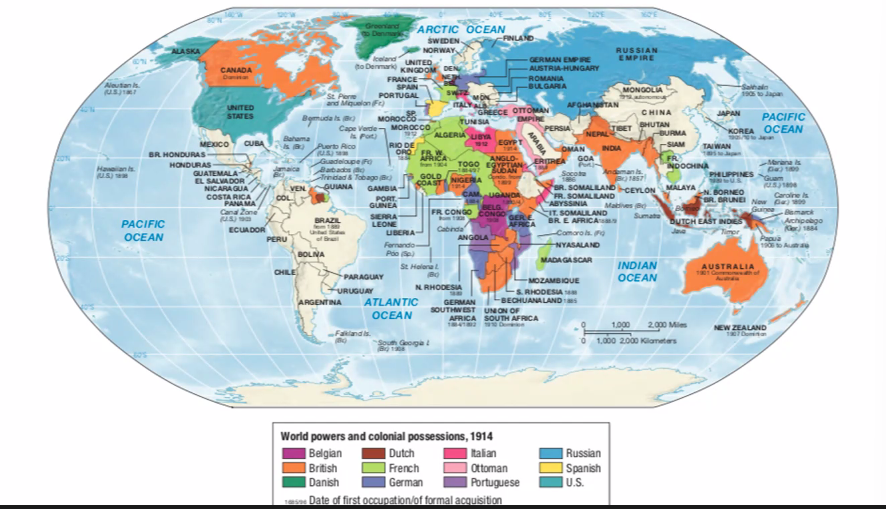
Key factors in Europe's rise as a colonial power: Merchant capitalism, existing trade system between city-states, introduction of banking and finance, technological innovations -- compass, clocks, firearms, metal processing, etc., geographical knowledge also expanded.
- First Wave of Colonialism: 1400-1800; establishment of port cities and trading networks, development of plantation economies, mining of gold and silver, European monopoly of trade routes
- Second Wave of Colonialism: 1800-1900; Incorporation of Africa, Asia, Australia, and South Pacific, Industrial revolution, and rise of Capitalism
Waves of Industrialization:
- First Wave: 1790-1850; steam engine, cotton textiles, iron works
- Second Wave: 1850-1870; coal-power, steel products, railroads and shipping
- Third Wave: 1870-1914; electricity, telecommunication, spread of industrialization.
- Imperialism: early 19th century; Britain becomes a global empire, and in 19th century Latin American revolutions and decolonizes so Spain loses global power.
- World War 1: 1914-1918
- Great Depression: 1929-1933
- Spanish Civil War: 1936-1939
- World War 2: 1939-1945
- The Cold War: 1946-1991
- Communism: a form of economic and social organization characterized by the common ownership of industry, transportation, agricultural land, and other key economic and social resources
- European Reintegration: Europe today is 12% of the world population and 35% of world exports, as well as 43% of world’s imports. Europe also accounts for 33% of the world’s national income.
- Income disparities: rural economics or metropolitan areas
- Development of Welfare states: Institutions with the aim of distributing income and resources to the poorer members of society.
Lecture 5:
- Neoliberalism: a political and economic philosophy that emphasizes free trade, deregulation, globalization, free-market capitalism, less government intervention, and a reduction in government spending
- Region most responsible for climate change based on per capita emissions in 2011: Oceania (pg 41 of pdf)
- Believed to be one of the causes of global warming and climate change associated with it: burning of fossil fuels
- Even on a low submissions scenario on climate change, water stress will increase by: 24% (pg 42 of pdf)
- Commodity chains begin with: the extraction and production of raw materials
- This economic policy emphasizes universal faith in markets, reduction in government programs, and development as an economic process: Neoliberalism
- Purchasing Power Parity (PPP): Statistic that gives a more accurate measurement of buying power and the cost of living in a country. In effect, it measures how much of a common “market basket” of goods and services each currency can purchase locally, including goods and services not traded internationally.
Lecture 6:
Russia, Central Asia and the Transcaucasia
- General characteristics: the region encompasses a vast territory, sparsely populated. Bordered by: Eastern Europe, the Arctic, and the Pacific Ocean
- Includes Armenia, Azerbaijan, Georgia, Belarus, Kazakhstan, Kyrgyzstan, Tajikistan, Turkmenistan, Uzbekistan and Russia.
- To the south it is bordered by: Middle East, South Asia, and East Asia
- Similarities and differences between the physical geographies of the Russian Federation, Central Asia, Transcaucasia, and Europe. How do these natural environments relate to, or how are they distinct from one another? - They all sit on one tectonic plate, More waterways in the Arctic area because of glaciers melting
- History and political geography: Russians have a history of invasions in Caucasia, so there are disputes of territory etc. going on in the same place on the regional scale. But zoomed out, regions in the East are becoming politically tied together because of these invasions, so the territorial and power gain of Russia causes this connection on a broader scale.
- Looking at the world at the regional scale: if we look at the world at a bigger scall we miss the nuances of closer relationships like cultural aspects and some of the complexity we can observe if we zoom in more.
- Environmental Zone- Tundra: Arctic wilderness, Winters have weak daylight and snow, Summers have long days, and bogs and marshes. Inhabited by indigenous people, who are reindeer herders.
- Environmental Zone- Steppe: Flat grasslands with limited rainfall, cleared for agricultural like wheat belts, corn, or cotton.
- Environmental Zone- Semidesert and Desert: Central Asia like the salt pans. Nomadic Pastoralists. Extensive sand dunes and have scattered oasis with few fertile valleys.
- Four major climate zones: Arid, Semiarid, Continental/Midlatitude, and Polar
- Mountains & Plains in Russia, Central Asia and Transcaucasia: Russian Plain, Urals, West Siberian Plain, Central Siberian Plain, Desert plateaus of Central Asia.
- Rivers & Seas in Russia, Central Asia and Transcaucasia: Lena, Ob’ and Amur Rivers, Black and Caspian Sea.
- Positive Effects of Climate Change: Milder winters in the Northern latitude, longer growing seasons, Increased water availability
- Negative Effects of Climate Change: Melting of the permafrost, Heat waves/increased forest fires, Geopolitical implications: border tensions
- Geopolitics of the Arctic: Northwest Passage allows for global trade, global climate change has created new commercial routes, access to the seafloor, negative impacts on wildlife, and geopolitical ramifications.
- Historical Legacies & Landscapes: Silk Roads in Central Asia connected China and the Mediterranean. Samarkand was a center of mathematics, music, and Islamic architecture. The Khans were nomadic people in this region.
- Rise of the Russian Empire: Muscovy was just one principality centered on the city of Moscow. Muscovy was a tributary state to the Mongol-Tatar Empire, whose armies were known as the Golden Horde. In 1552, under Ivan the Terrible, the Muscovites defeated the Tatars at the battle of Kazan, a victory that prompted the commissioning of St. Basil’s Cathedral in Moscow. Over a 400-year period, Ivan’s successors and the Muscovite state expanded at a rate of about 135 square kilometers (52 square miles) per day.
Revolution and the rise of the Soviet Union:
- Tsars and serfdom: members of the lower class were attached to the lord and his land → 1861: rural and urban change -- industrialization
- Soviets: grassroots councils of workers coordinating strikes
- Severe depression + World War 1
- October 1917: Bolshevik Revolution
- Led to State Socialism: in which the state controls industry and services and provides education, housing, and healthcare
- Vladimir Ilyich Lenin: idealist and internationalist → Union of Soviet Socialist Republics (USSR)
- Joseph Stalin: against nationalism → command economy, apparatchiks and collectivization
- Industrialization led to territorial production complexes, industrialization targeted less developed sub-regions. Development of “secret cities”
Lecture 7:
Soviet History and the Region Today:
- Working conditions and everyday people during the industrial era
- Socialism, the communist international, worker movements
- Leon Trotsky
- The Cold War
- Ethnonationalism
- Conflict in Ukraine
Rise of the Soviet Union:
- Tsars and serfdom: members of the lower class were attached to a lord and his land
- 1861: rural and urban change -- industrialization
- Soviets: grassroots councils of workers coordinating strikes
- Economic recession + World War 1
- October 1917: Bolshevik Revolution -> Soviet Union
Soviet Industrialization:
- Territorial production complexes
- Military-Industrial Development -- Secret Cities
- Environment mismanagement - high levels of pollution
- Chernobyl disaster of 1986
The Cold War (1950-1989):
- War of ideology and proxy conflicts
- Industrialization/inadequate equipment for agriculture
- Shadow economy: Private production that was tolerated by the government even though it did not align with state socialism
- Regional inequalities stemmed because of this
- Pros of Socialism/Communism exist too
- Inflexibility and rejection of computerized information technologies
- Soviet Union in crisis by 1980:
- Failure to deliver consumer goods
- Population becoming aware of consumerism elsewhere
- Regional inequalities
- Economic drain of the arms race
- Inflexibility and lack of computer technology
- Between 1989 and 1991, the Soviet Union broke apart into 15 independent states
- Shift to capitalism after 70 years of central planning has been problematic
- Mafiyas (organized crime groups) -- Oligarchs
- Dramatic economic growth between 2000 and 2014
- 2013-2014: Russia became the 9th largest economy in the world
- Largest Russian exports include: crude petroleum, refined petroluem, metals, and petroleum gas
Territory and politics:
- Ethnonationalism
- Nagorno-Karabakh: Armenian citizens of Azerbaijan, civil war, oil pipeline
- South Ossetia: Georgia
- Tajikistan: Civil war, Uzbek insurgency
- Geopolitical shifts:
- Commonwealth of Independent States (CIS)
- Near Abroad - former USSR-nations under the Russian spere of influence
- BRICS - Brazil, Russia, India, China, South Africa
- Conflict and War in Ukraine: Crimea annexed by Russia in 2014, and another region held by Moscow-backed separatists
- Even though the military campaign has formally ended, the war landscape remains as a reminder of the tension that exists in places like Chechnya. People remain displaced as a result of the conflict.
Culture and Populations:
- Religion:
- Russia = 75% Eastern Orthodox, 10% Islam
- Georgia = Eastern Orthodox
- Central Asia = Sunni Islam
- Language:
- Slavic (Russia and Belarus)
- Turkic - Azeri and Baskir (Central Asia and Transcaucaus)
- Paleo-Siberian (Eastern edge of the region)
- Georgian (Georgia)
- Dagestani (Transcaucaus)
- Influence of European culture present in music, styles of dress, fine art, literature
- Increasing economic inequality, rise of the oligarchs, emergence of new class factions.
- Low population density, high-levels of urbanization in Russia and Belarus, medium-levels throughout Central Asia and the Transcaucaus
- Migration: predominantly from Central and East Asia to Russia
Future Geographies:
- Energy dependencies
- Democracy or plutocracy
- Economic boom
- Demographic implosion