ONE - CERT+.
1A: Understanding Project Management Basics
project managers apply project managments to help companies meet goals.
specialize in coordination & communication.
they know everything about project’s progress & disseminate the information
continually.
project management can work on a undertaking of any size or complexity.
projects can last for years or for just one day.
project management aims to deliver work in an efficient, orderly manner.
standard processes (activities that underlie the effective practice of project management; including all the phases of concept/discovery, initiation, planning, excecution, & closing a project) & systems reduce wasted time.
standardization increases data quality, which makes it easier to measure project performance.
template: a formatted document that outlines the information you need to provide.
make work easier & works well when you create the same artifact repeatedly.
every project needs a project budget (the total financial sum available to pay for a project’s expenses; includes the cost estimates & additional reserves to cover issues) the information you need doesn’t change much from one project to the next.
many organizations favor cloud computing (computing architecture where on-demand resources provisioned with the attributes of high availability, scalability, & elasticity are billed to customers on the basis of metered utilization) models, & cloud providers want organizations to migrate to their services.
as a result, many cloud service providers (organization providing infrastructure, application, &/or storage services via an “as a service” subscription-based, cloud-centric offering.) share cloud migration project plans that you can freely access & use.
a project follows a project life cycle (a process that defines the five phases that a project goes through from the beginning to the end) that starts with a great idea & ends with a succesfully delivered project.
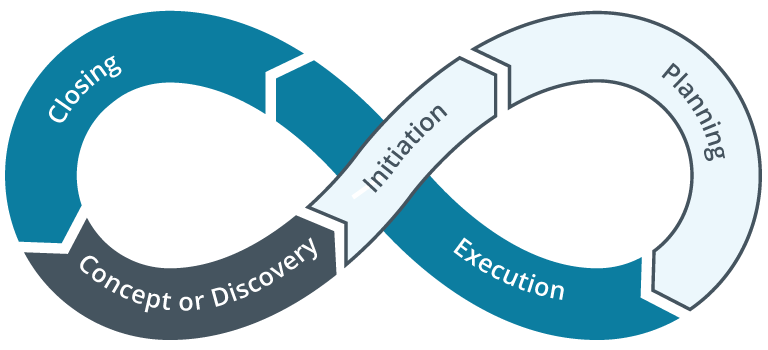
concept or discovery phase:
occurs before the project starts
1. leaders / analysts review ideas for potential projects & decide if they’re practical.
analyze financial returns, feasibility (a study to analyze hardware, software, facilities, & databases needed for aproposed project.), & implementation options.
2. create a report summarizing their research.
if the decision that the idea is a good fit, a request for approval is initiated.
ideas that don’t fit end during this phase.
this phase filters infeasible projects, saving time.
initiation phase:
after approval, the initiation phase starts project work.
projects are outlines during this phase to learn everything about the project goals, what it needs to deliver, & how the final product looks.
project team (consists of project manager, project management team, & other individual team members from different groups who posses knowledge on specific subjects, or have unique skill sets to carry out the project work) is created.
planning phase:
after drafting a high-level summary of project goals & timeline, team will turn the project goals into detailed planning, defining all activities needed to complete a good activity sequence.
project manager managers team logistics (practice of providing materials & facilities needed by the team to accomplish their task.) & ensures the project has adquate resources.
project manager creates the plan for keeping the project on track & sharing project progress.
by the end of this phase, the team will have everything they need to begin delivering work.
project work schedule & performance metrics (quantifiable measurements of the status of results or processes.) for tracking progress.
execution phase:
the team delivers work in this phase.
work varies by project:
writing code
configuring systems
building homes
etc
create supporting materials & coordinate with each other to complete the work.
busiest phase
project manager helps team to stay in sync & be productive, monitor progress & measure performance enabling you to find & solve problems, maintain records, & create reports.
by end of this phase, the team has finished implementing the plan & should meet goals set in the initiation phase.
closing phase:
project is winding down & project manager ensures everything is ready to close.
confirms project is thorough
update documentation
create an accurate financial summary
request official approval to close the project
after final approval, the project ends & the team disbands.
1B: Develop the Business Case
business case:
summarizes information about the project:
serves as the first project proposal.
“business justification”, “business objective”
shared with leaders to obtain approval to start a project & secure funding & resources.
presents an analysis of a business problem, potential solutions, & financial impact.
a brief document that justifies the investments made for a project & describes how a particular investment is made in accordance with the organization’s policy.
should be concise, visually appealing & easy to read.
template:
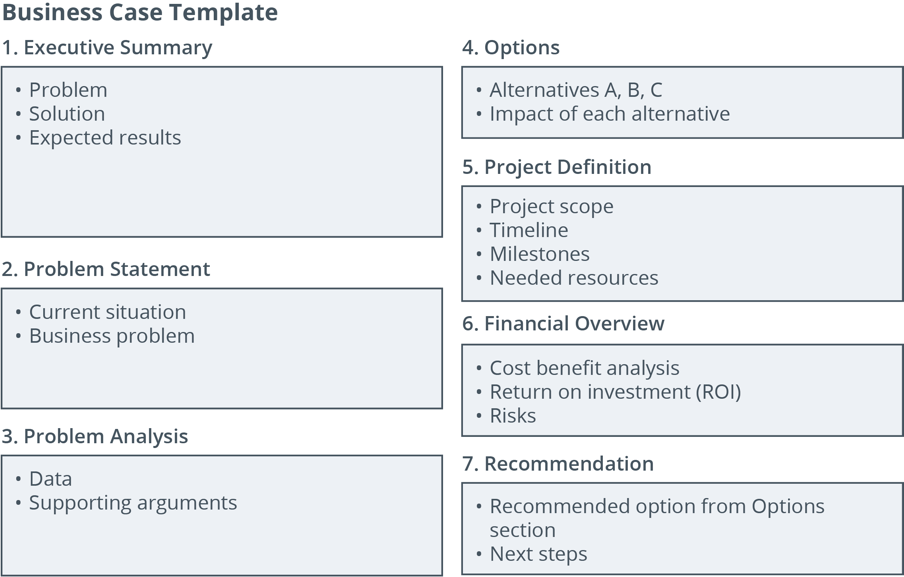
executive summary:
- a brief synopsis of the rest of the business case.
- a few sentences:
- a problem statement
- a solution
- expected result
- usually written last.
problem statement:
- shares concise details about the problem.
- thorough analysis of the current situation & business problem, opportunity or unmet need.
- describes something the project will change
problem analysis:
- provides context about why project should be a priority
- includes historical performance data, environmental assessment, other supporting evidence
options:
- describes several approaches to solving the problem.
- should contain at least 3 - 5 sentences
- compares solutions against each other with pros & cons
- every business case has at least 2 solutions
- do nothing
- the project proposed in the recommendation section
- alternatives identification: the act of generating different plans for achieving project goals.
project definition:
- includes additional relevant information about the proposed project.
- ex: scope of project, necessary resources, milestones, timeline.
financial overview:
- covers relevant economic impacts of the project.
- ex: project cost, funding, company gain.
- contains a cost-benefit analysis or ROI analysis & relevant risks & assumptions.
recommendations:
- narrows down options to the best solution & justifies why approach is the best business case.
- should reflect project described in financial overview & project definition sections.
current & future states:
current state:
- describes what is happening now.
- business case template describes the current state in the problem statement & problem analysis sections.-
future state:
- describes what business will look like after implementing the project.
- business case template describes the future state in the financial overview & recommendation sections.
side-by-side summary comparing the differences between current & future states highlighting the stark differences.
a visual summary uses diagrams or charts to show differences between the states.
- process flowchart: displays sequence of events & the flow of inputs & outputs between elements in a process or system.
- visualizes when a project will eliminate process steps or handoffs.
- shows steps, sequences, & possible outcomes using a standard set of shapes.
financial benefit is a primary business justification reason for working on a project. when deciding which projects to invest in, the company is more likely to invest in a project with strong financial returns, assuming all else is equal.
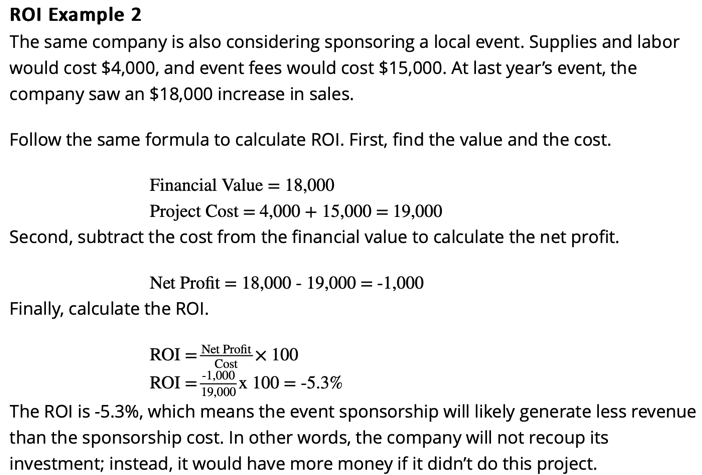
return on investment [roi]:
a standard financial analysis tool that is easy to understand & compare across multiple projects.
compares financial benefit of the project to the cost & written as a percentage.
if roi is positive, the project is profitable, if roi is negative, the project lost money.
in essence roi has three main values:
- benefit:
- the money guaranteed or explicitly saved due to the project.
- often referred to as “financial value” or “revenue”.
- this variable is the money flowing into the company.
- “revenues”, “cost reduction”, “cost avoidance” or any other measurable return.
- cost:
- represents all the money spent on this project.
- “project cost”, “project expense”.
- this variable is the money flowing out of the company.
- expenses will include direct & indirect expenses
- labor
- equipment
- contracts: mutually binding agreements that details obligations
of the buyer & vendor
- net profit:
- the difference between benefit & cost.
- numerator
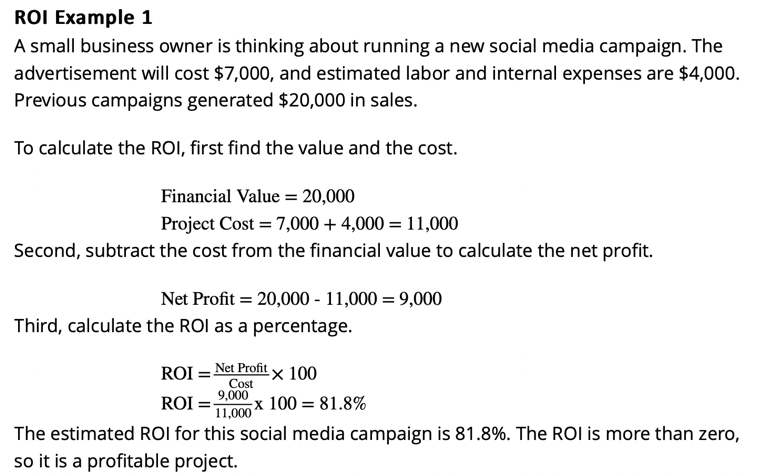
positive roi doesn’t mean a project will automatically move forward & negative roi doesn’t automatically cancel a project.
roi is one factor in a larger decision, other factors include:
- business context
- regulations: compliance-mandatory characteristics for specific products,
services, or processes.
- environmental requirements
it is helpful to include a summary of your assumptions & risks in a financial plan section.
- assumptions: the statements that must be taken to be true in order the begin project planning.
- factors that are stated as true in the calculations to present a simplified financial plan.
- ex: 5% growth in revenue per year, which is industry standard is a reasonable assumption & stating within the business case can help others find confidence in data.
- risks: any unexpected event that can affect the project either positively or negatively.
- they are difficult or impossible to predict.
- including risks with a higher likelihood of occurrence balances the optimism of business case assumptions.
although financial factors play a significant role in approving a business case, they’re not the only relevant factors.
many benefit measurement models incorporate profit & other factors to select the most valuable projects.
- benefit measurement model: a project selection decision model that analyzes the predicted value of the completed projects in different ways.
- they may present value in terms on forecasted revenue, roi, predicted consumer demand in the marketplace or the internal rate of return [irr].
environmental, social, & governance [esg] factors: organizational performance measures unrelated to financial performance that assess how an organization contributes to society.
- environmental factors: how an organization impacts the natural world.
- landfill consumption
- waste generation & disposal methods
- pollution, habitat protection/destruction
- resource consumption
- social factors: how a company develops relationships & treats people, including
employees, the community & groups impacted by the company’s products & services.
- employee wellbeing
- working conditions
- employee pay
- community involvement
- governance factors: how a company operates, including its policies, transparency & structure.
- board’s diversity
- lobbying activities
- political donations
- management structure
- influences the environmental & social factors & the projects available
a company must apply esg factors; in the US public companies must submit to audits to maintain transparency in their finances.
local, state, & federal regulations control factors through labor protection laws & emissions regulations.
corporate identity includes the vision, mission statement, values, & brand of a company.
- describes how a company is perceived.
- the brand is influenced by the company’s consumers, employees, community members & business partners.
- business partner: individuals & organizations who are external to the company & provide specialized support to tasks such as installation, customization, training, or support.
incorporating esg into project design & decision-making throughout.
projects should align with the company’s esg stance & corporate identity & must comply with mandatory regulations.
to improve alignment with the company mission, redesign the project solution or incorporate a better strategy.
1C: Identify Project Characteristics
it is easier to define a project by understanding how it exists in the organization’s context.
projects are a type of work & work can be classified into two types:
operational work: routine, predictable & repetitive.
project work: accomplishes something new, each project is a discrete, standalone event.
each project must have three criteria:
- unique: each project aims to complete a brand-new objective.
- has a specific purpose or reason:
- project objective: the criteria used to measure whether or not a project is successful.
- is temporary & must have a start or finish.
the organizational structure (compositional makeup of an organization that dictates how the various groups & individuals within the organization correlate) affects the project management process.
defines how work moves & how people form into teams in a company.
three main organizational structure types:
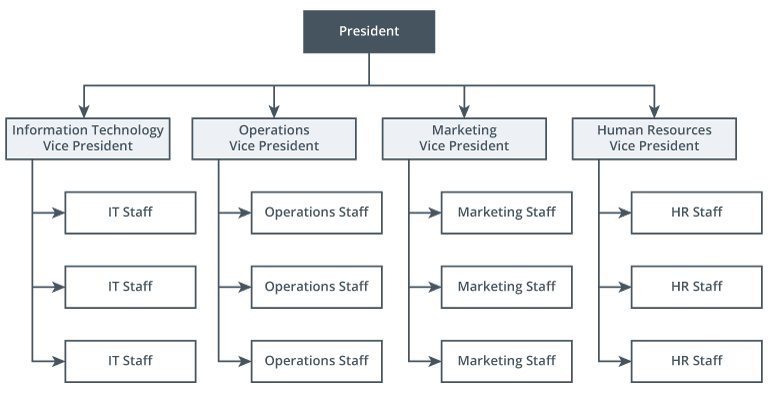
functional organizational structure: an organizational structure where reporting is hierarchical, with each individual reporting to a single man.
divides the organization by areas of expertise or specialization.
suits small businesses that may not have resources to hire project management teams.
functional manager: individuals who are part of management in the administrative or functional side, such as human resources, finances, accounting, or procurement of the business in the organizations. they act as subject matter experts & may provide services needed for the project.
retains budget & people management & functional organization.
project managers have little to no relative authority (the authority relative to the functional manager’s authority over the project & project team) over people or cost.
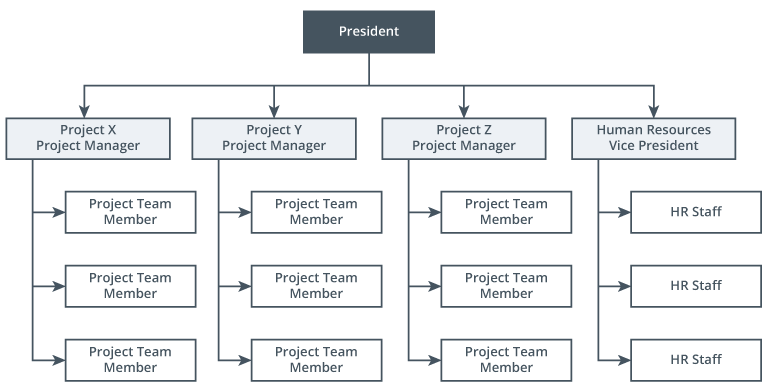
projectized organization: pool resources around projects.
a project manager leads a group of people as long as a project exists & when the project ends the team disbands & reforms around new projects.
might have static functional divisions that serve all projects.
ex: everyone needs payroll services, but individual projects do not need a dedicated payroll specialist. therefore, payroll would be in a separate department.
projected organizational structure: an organizational structure where the project manager & a core project team operate as a completely separate organizational unit within the parent organization.
benefits companies that spend most of their resources on project work, such as construction companies or event planning companies.
the project manager has more control in a projectized organization than in a functional one. project manager owns the budget & line manager responsibilities.
matrix organization: include functional leaders & specialized roles.
most organizations are matrix organizations
when a project forms, team member from functional areas work on the project teams, either part-time or full-time.
matrix organizational structure: an organizational structure with a blend of functional & project-based structures in which individuals still report upward in the functional hierarchy, but they also report horizontally to one or more project managers.
resembles a grid
solid line indicates reporting structure & dotted line indicates an indirect management relationship. “dotted-line manager”, “dotted-line reporting”. Manager is responsible for assigning work, but doesn’t have official authority over the people doing the work.
divided into two subtypes:
weak matrix: the functional manager retains all budget & staff management responsibilities, thus, the project manager has less control over the project.
strong matrix: project manager has substantial control over the project & is responsible for budget & staff.
if functional & project organizations represent the extremem ends of a spectrum, matrix organizations represent everything in between.
a project has a single objective that clearly explains what it intends to accomplish, however some business ideas are too big for a single project & businesses could set up a program.
a program is a group of related projects that have a common objective.
programs last longer than projects because they run for the start of the first project until the end of the last project.
when a project is in a program, it increases your responsibilites & you must collaborate with other project teams & the program manager.
program manager: an individual who coordinates with the project managers, oversees related projects in a program to obtain maximum benefits, & provides guidance & support to every individual project.
project management roles depend on size & structure of the organization.
project manager [pm]: lead projects by planning, organizing, & keeping teams on track throughout the project life cycle. they aim to deliver projects on time, on budget & within scope.
program manager: lead programs, which are related groups of projects. keep programs aligned to organizational strategy & ensure it’s within budget
& on time.project management office [pmo]: a centralized, ongoing administrative unit or department that serves to improve project-management performance within an organization by providing oversight, support, tools, & helpful methodologies to project managers.
the functional department for all pms in a company.
evaluates new projects, assigns them to a pm, & manages the flow of projects.
provides administrative support, such as maintaining archives, best practices, & pm tools.
oversees project performance management & tracks metrics for projects throughout the organization.
provide coaching & training.
the pmo’s strength & authority will vary depending on its format. there are three PMO types:
supportive pmo: provides support when it’s requested.
a library of project information.
doesn’t for adherence to standards & may not assign or evaluate projects.
organizations that favor decentralization may opt for a supportive pmo.
controlling pmo: actively motiors project performance.
coordinates resource selection & allocates pms to projects.
coordinating communication & sets some project standards.
does not have full authority, influence limited by functional management
matrix organizations often use this format.
directive pmo: sets rules for everybody in the company
has full authority over projects, standards, & procedures.
prioritizes & allocates pms for all projects in the company.
organizational strategy & will start, cancel, or adjust projects to ensure stategic alignment.
an organization that cannor afford missing documentation & half-finished procedures will opt for a directive pmo.
throughout the project, you will interact with various people who indirectly influence the project. these individuals operate adjace to the project, & their requirements its direction & ultimate success.
project stakeholder: a person who has business interest in the outcome of a project, or is actively involed in its work.
senior management: the highest level of management in an organization, such as the executive team.
their influential role in the organization can affect project success, even when they aren’t directly involved in a project.
sponsor: individuals or groups that provide financial assistance to the project. if the sponsor is outside of the company, such as a customer, their duties may be the responsibility of the project manager.
accountable for a porject.
often a single senior management member.
reviews & validates the initial business case & is more familiar with the project than anybody else on the senior management team is.
secure funding & remove resource-related barries.
approves deliverables & decides when a project starts & ends.
customer: the parties who receive the benefits from the projects. can be further classified as internal or external:
internal customers: a consumer of a good or service that works in the same organization as the supplier.
external customers: a consumer of a good or service who does not work in the same organization as the supplier.
end-user: the people who will be affected by the product or service generated by the project.
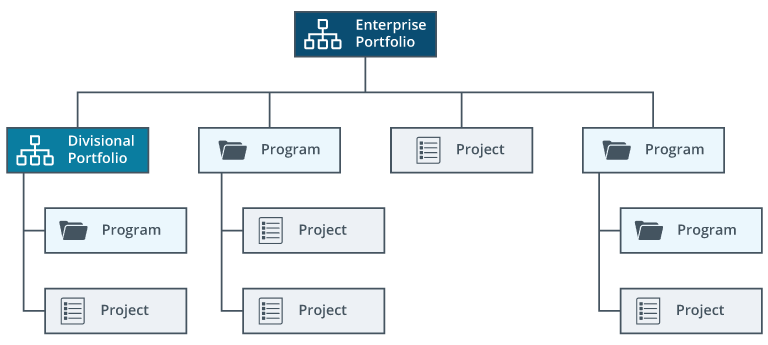
portfolio: a collection of projects, programs, & operational work to achieve the strategic business objectives of an organization.
a grouping mechanism.
projects within a program don’t need to be related, but they share a portfolio because they exist in the same arbitrary group of approved projects.
the enterprise portfolio contains all the programs & projects in an organization.
in large organizations, the enterprise portfolio might include sub-portfolios as well.
portfolio management: individuals in the portfolio review board who are apart of the project selection committee & belong to the high level projecto governance side of the organization.
are the counterbalances to individual project sponsors.
helps the organization maintain a maximum number of projects & can help prioritize items according to broader priorities.
someone who works in a company that operates more than one project at a time is a part of a project portfolio.
porfolio projects go through a more rigorous prioritization process called project selection, where researchs is invested in to justify project’s priority.
project selection: the art of choosing a project from among competing proposals.