Entrep
Chapter 1, Lesson 1
Overview of the Definition:
There is no universally accepted definition of entrepreneurship, even among universities and colleges offering entrepreneurship program in the Philippines and abroad.
Some of the reasons:
Different views and theories have been developed in the field of entrepreneurship.
The scholars who provided the definition for entrepreneurship are largely influenced by their own individual personal beliefs.
The entrepreneurial models introduced by scholars are predominantly influenced by the prevailing economic situations during specific periods in history.
The frameworks and methodologies of researches on entrepreneurship are highly dependent on the theories and the contexts of the research endeavors.
Entrepreneur
originates from the French word “entreprendre” which means “to undertake”. Which connotes a business paradigm which signifies the start of a new business undertaking.
Defines as a person who organizes, operates, and assumes the risk of pp poppp pop business ventures. (American Heritage Desk Dictionary)
In this book, entrepreneur is defined as a person who strongly advocates and correctly practices the concepts and principles of entrepreneurship in operating and managing the self owned business venture called enterprise.
Entrepreneur owns and manages the small entrepreneurial endeavour or small business.
Entrepreneurship
comes from the word entrepreneur which refers to a particular field of practice or process.
It is the art of observing correct practices in managing and operating a self-owned wealth creating business enterprise by providing goods and services that are valuable to the customers.
Small Business
refers to a business or enterprise that correctly adopts and practices the principles of entrepreneurship.
It is owned by one person with a limited workforce of not more than 20 persons.
Includes the small and medium enterprises (SMEs) that have been strongly promoted by both
government and non-government organizations (NGOs) in their desire to improve the lives of the Filipino people through entrepreneurship.
Ordinary Small Business
pertains to a business enterprise managed and operated by an owner who is not an advocate of and does not practice the concepts and principles of entrepreneurship.
The mere opening of a business enterprise is not entrepreneurship and the person owning and running its day to day operations is not an entrepreneur but rather a business person.
A Successful Entrepreneur
Acquiring basic working knowledge in entrepreneurship becomes a necessity for people who wants to be an entrepreneur and will manage their own business in the future.
Ignoring of the fundamental entrepreneurial concepts may contribute to the failure of the business.
Acquiring sufficient knowledge of entrepreneurial principles equips you with the necessary tools in handling and maximizing entrepreneurial opportunities.
However, even a full understanding of the concepts and principles of entrepreneurship is not an assurance that you will become a successful entrepreneur.
You need to work hard to go through the whole entrepreneurial process and withstand a competitive position in the business industry in making entrepreneurial decisions.
Chapter 1, Lesson 2
Five Salient Features of Entrepreneurship
Wealth-Creating Venture
Providing Valuable goods and Services
Opening and Managing Self-owned Business
Risk-Taking Venture
Art of Correct Practices
Entrepreneurship is an Art of Correct Practices
Entrepreneurship is an art and not a science.
It is not governed by fixed and absolute rules unlike science.
There is a constant change that denotes movement and innovation.
Entrepreneurship is not static or stagnant.
It continuously grows, develops, improves and expands, the change does not stop.
The development of entrepreneurship through the years is proof that it is an art that continuously evolves and responds to the changing needs of the people.
Entrepreneurship as an Art
Entrepreneurship is dynamic. By the moment the economic activity changes, the political, social, and entrepreneurial activities will eventually change.
Entrepreneurship is closely related to creativity. By creativity, there is a constant change or evolution that contributes towards the enhancement of the enterprise.
Creativity results in new ideas which are the backbone of entrepreneurship. Entrepreneurship keep on searching for something new.
They find ways to transform new ideas into entrepreneurial opportunities.
Entrepreneur transforms feasible new ideas into an entrepreneurial venture. An ordinary small business person only builds upon existing ideas to gain immediate earnings from his/her business.
Nothing is permanent in the field of entrepreneurship.
What is applicable to one entrepreneur may not be applicable to another.
Certain things may happen to one entrepreneur but may not happen to another.
Entrepreneurship should be practice not as a science but as an art.
Creativity should always be applied to entrepreneurial undertakings by regularly evaluating the market and the environment and responding to the changes in them.
Art in entrepreneurship is also related to the correct practices or ways of carrying out entrepreneurial activities.
An entrepreneur has to perform entrepreneurial activities correctly regardless of whether they are undertaken easily or not. What is important in entrepreneurship is that the business activities are performed correctly.
The owner of an ordinary small business has the freedom to manage and operate his/her business according to what pleases him/her. He/she prefers business activities which are done easily.
Entrepreneurship is a Wealth-Creating Venture
Ordinary small business people equate wealth with the term profit; in accounting, profit represents the excess income or revenue from the cost and expenses.
Entrepreneurship is operating within the concept of wealth creation rather than profit generation.
The concept of profit is more applicable in the area of accounting.
Wealth is defined as the abundance of money, property or possession (Random House Webster’s Dictionary)
The concept of abundance, and not of accounting profit, is the very essence of wealth in entrepreneurial endeavor.
The venture improves the life of the entrepreneur in terms of economic, financial, social, moral, and psychological aspects
Entrepreneurship Provides Valuable Goods and Services to Customers
The mere act of selling goods or providing services does not make a person perform or act within the concept of entrepreneurship. Anybody can sell goods or services for a price.
Entrepreneurship creates economic wealth by providing goods and services to the consumers. These goods and services must have a value in order to create wealth. Anything of no value to anybody is definitely a waste.
Valuable goods and services highly satisfy the target buyers in terms of quality and price. The entrepreneur convinces the consumers that they gain more benefits than what they pay for the goods and services.
The entrepreneur defines value from the perspective of the buyers and not only from his/her own because what is valuable to the entrepreneur may not be of any value to the consumers.
When consumers are satisfied with the products and services offered by an entrepreneur, they tend to patronize the business and even endorse it to others. The business will definitely be a wealth-creating venture.
Entrepreneurship Entails Opening and Managing the Self-Owned Enterprise
The entrepreneur open his/her own business under the principle of entrepreneurship. It must be self-owned in order to qualify as an entrepreneurial endeavor and managing its daily activities by the owner.
Businesses that are being managed by others for the benefit of the owners do not fall within the sphere of entrepreneurship. Such businesses are operating under the concept of intrapreneurship.
Entrepreneurship is not about the size of the business but rather about its sole ownership. It includes small, medium and multi million businesses that are managed by their respective owners.
Generally, entrepreneurship includes all types of business operations, namely production or manufacturing, merchandising or services.
The entrepreneur, being the owner and manager, must clearly set the goals of his/her business. He/she should establish a clear direction of his/her entrepreneurial venture by planning, which is the process of setting the goals of the business.
Entrepreneurship is a Risk-Taking Venture
All businesses, whether big or small, are operating within the concept of risk-taking because of uncertainty. Nobody knows what will happen tomorrow.
Business risks cannot be eliminated. They are inherent in the venture. The risk in entrepreneurship is called a business risk.
Entrepreneurs face the business risks instead of avoiding them. They find ways to minimize the effects of the business risks.
Chapter 1, Lesson 3
Theory
is a generalization that explains a set of facts or phenomena.
It is not an absolute truth.
It can be supported by another observation or proven to be otherwise.
Various entrepreneurship theories were developed or contributed by scholars mostly are anchored their concepts on the economic events which were happening in the past.
Theories on Entrepreneurship
Innovation Theory
Keynesian Theory
Alfred Marshall Theory
Risk and Uncertainty Bearing Theory
Weber’s Sociological Theory
Kaldor’s Technological Theory
Leibenstein’s Gap Filling Theory
Kirzner’s Learning Alertness Theory
Innovation Theory
Contributed by Joseph Schumpeter, an Austrian economist and political scientist.
He wrote about this in his book, The Theory of Economic Development.
Innovation Theory regards economic development as the product of structural change or innovation.
An economy without any revolutionary change is deemed to be static and cannot expect any economic development.
Schumpeter strongly believed that innovation theory is the force that will propel the revolutionary change.
It becomes the primary role of the entrepreneur to introduce innovation in any of the following forms:
New Product
New Production Method
New Market
New Supplier
New Industry Structure
Keynesian Theory
Developed by John Maynard Keynes, a British economist.
Key concepts of the theory were included in his book, The General Theory of Employment, Interest and Money, which was published during the Great Depression in 1936.
This theory suggests that entrepreneurial activities may not be favourable in the future unless the short-term problem of economic disequilibrium is finally resolved through the active participation of the government.
Alfred Marshall Theory
The entrepreneurship theory of Alfred Marshall, an English economist, was introduced in his book, Principles of Economics.
He strongly asserted that there are four factors in the production (land, labor, capital, and organization) of good and services in the economy.
He considered organization as the coordinating element.
Without the participation of organization, the other factors of production will remain inactive in their role for economic development.
Marshall regarded the entrepreneurs as the prime movers in the organization. They are expected to create new commodities or improve the existing ones.
Risk and Uncertainty Bearing Theory
Frank Hyneman Knight, an American economist, conceptualized the risk and uncertainty-bearing theory of entrepreneurship in his book, Uncertainty and Profit.
Knight viewed an entrepreneur as an agent of the production process where he/she connects the producers and the consumers.
Knight considered uncertainty an important factor in the production of good and services.
He believed that the entrepreneur must anticipate possible random events to happen while shouldering the risk at the same time.
The entrepreneur would be eventually rewarded with high profits.
Weber’s Sociological Theory
The theory of Max Weber asserts that social cultures have significant contributions to entrepreneurship.
Social cultures are the primary driving elements of entrepreneurship.
The entrepreneur is expected to perform the role of a good constituent by executing his/her entrepreneurial activities in line with good customs and traditions, religious beliefs and morals.
Kaldor’s Technological Theory
Developed by Nicholas Kaldor who considered modern technology as an essential factor in production.
The entrepreneur is expected to keep abreast with modern technology and find ways to apply the same in the entrepreneurial endeavour.
Proper application of modern technology will promote efficiency in the production of goods and services.
Leibenstein’s Gap Filling Theory
Henry Leibenstein proposed that the primary role of entrepreneurship in any economic activity is to fill the existing gap.
Entrepreneurship is responsible for recognizing trends in the market.
The entrepreneur is expected to possess abilities that will connect the different markets.
He/she must extend assistance to entrepreneurial ventures experiencing failures and deficiencies.
Kirzner’s Learning Alertness Theory
Israel Kirzner, main proponent of the theory, pointed out spontaneous learning and alertness as the two major attributes of entrepreneurship in any given economy.
The entrepreneur must be alert in recognizing entrepreneurial opportunities and the ignorance of consumers as well.
He/she must immediately find an appropriate remedy to correct the error or wrong perception.
Chapter 1, Lesson 4
Differences of Entrepreneurship and the Activities of Ordinary Small Businesses
Motive in opening a business.
Perception of risk in the business.
Reactions to changes in the environment.
View on competition.
Vision for development and growth.
Horizon of business operation.
Sources of business funds.
Motive in Opening a Business
An Entrepreneur:
An Entrepreneur
Starts a business venture based on entrepreneurial concepts and principles and the aspiration to become successful.
Constantly on the look- out for new and fresh ideas which can be found in the business environment.
The business environment is marked by creativity and innovation.
It continuously changes and evolves.
A wealth-creating venture that will ultimately improve the life of the entrepreneur.
Owner of an Ordinary Small Business:
Opens a business with the primary goal of making it as the source of livelihood.
The business becomes a major provider of the family for financial requirements.
Operates with a basic motive of earning profit.
Perception of Risk in the Business
The Entrepreneur:
Takes and faces the business risk squarely.
Considers it inherent in the business venture, prepares the business for it and finds ways to minimize its effects.
Owner of an Ordinary Small Business:
Believes that the business risk is a deterrent to the operation of the business and must be avoided.
Reactions to Changes in the Environment
Entrepreneur:
Reacts positively to the changes in the environment.
Changes bring new ideas for entrepreneurial opportunities.
Changes a creative mechanism for development and growth
Owner of an Ordinary Small Business:
Remains passive and static to changes in the environment.
Believes that changes in the environment is not a plus factor to daily operations but a source of negative consequences.
View on Competition
Entrepreneur:
Presence of competition is a sign of a healthy economic environment
The environment can be considered neutral or free trade because of healthy competition.
Owner of an Ordinary Small Business:
Views competition as an unhealthy element in the business environment and tries to avoid it.
Finds it very uncomfortable working in a competitive environment and strongly discourages competition in the business community.
Vision for Development and Growth
Entrepreneur:
Entrepreneur
Outlines the course of entrepreneurial venture in terms of short, medium or long term plans of action
Makes sure his vision and mission of the business is clear
Aligns daily business activities toward the attainment of the plans.
Properly manages the operations of the venture to provide development and growth to the venture.
Owner of an Ordinary Small Business:
Relies upon the chance or luck in maintaining the status quo of the business.
Not so much concerned about the development and growth of the business as long as satisfied with its earnings.
Horizon of Business Operation
Entrepreneur:
Thinks globally but acts locally.
Concerned with the major economic events not only in the local environment but also in the global business market.
Strong notion that the business will be going out of the local market and soon face healthy competition in the international market.
Has both local and global perspectives.
Owner of an Ordinary Small Business:
Centered only on the local environment.
Does not intend to participate in the global environment.
Expansion is never been an idea worth entertaining.
Sources of Business Funds
Entrepreneur:
Explores ways to generate the much needed funds from both internal and external resources.
Believes that the wealth the venture creates is more than enough to compensate for the sourced funds.
Owner of an Ordinary Small Business:
Tends to limit the funding of business enterprise to personal resources
Loans from external resources can be a risky undertaking
Fears financial institutions will not be willing to extend financial assistance to the business.
Chapter 1, Lesson 5
Common Misconceptions on Entrepreneurship
Entrepreneurship applies only to manufacturing businesses.
Entrepreneurship applies only to small businesses.
Entrepreneurship applies mostly to persons with good educational background in business courses.
Entrepreneurship applies only to a good economy.
Entrepreneurship is simply opening a small business.
Entrepreneurship Applies Only to Manufacturing Businesses
Misconception:
Entrepreneurship is only applicable to manufacturing but not to merchandising and service.
Truth:
Merchandising and providing services are also business ventures.
With exchange of values and there is also risks.
In merchandising, creativity and innovation appear limited because the appearance of the product does not change from the time it is bought from the manufacturer until it is sold to the consumer. Major activities involved are buying and selling only.
Creativity and innovation are hardly noticeable in merchandising and service. In case there will be creativity, it can be imitated easily by the competitor.
In manufacturing operation, the process passes through the different stages of processing from raw materials to finished goods where creativity and innovation take place.
Regardless of whether the business venture is merchandising, service or manufacturing the concept of entrepreneurship is applicable.
Entrepreneurship Applies Only to Small Businesses
Entrepreneurial concepts and principles do not make any distinction as to the size of the business venture.
The amount of the business capital does not serve as a reckoning ground for classifying whether the venture is operating within the concept of entrepreneurship or ordinary small business.
Entrepreneurship principles apply to small, medium and big businesses.
When business venture becomes big, expands its operations, or opens other branches locally or abroad, the owner usually employs a qualified manager to run the operations of the branches.
The owner pass on to the manager certain functions such as decision-making and marketing then the entrepreneurship becomes corporate entrepreneurship.
Corporate entrepreneurship is a process that goes on inside an existing business venture and may lead to new ones and development of new products and services.
Entrepreneurship Applies Mostly to Persons with Good Educational Background in Business Courses
Nobody is born an entrepreneur.
To be a successful entrepreneur, one must know the basic concepts and principles of entrepreneurship and apply them properly to chosen business.
The environment in which the business operates also contributes to its success.
Business courses may help in the field of entrepreneurship, however it does not provide an assurance to be a dynamic entrepreneur.
There are several forces that significantly influence the success of a business venture.
Successful entrepreneurs come from all walks of life and have different educational backgrounds from different colleges and universities.
Inner driving force of a person carries towards becoming a dynamic entrepreneur.
Entrepreneurship Applies Only to a Good Economy
An entrepreneur finds business opportunities in both flourishing and distressed economies.
Entrepreneurship can exist in both good and bad economies.
Even during a financial crackdown, new ideas can be created and new business opportunities can be identified.
The bad economy does not completely serve as a constraint to the continuation of entrepreneurial ventures and even the creation of new ones.
Entrepreneurship is Simply Opening a Small Business
Entrepreneurship does not merely mean opening a small business.
This is the first step in actualizing the entrepreneurial venture.
Prior to this, the business already passed through the preliminary stages of scanning the environment and preparation of the feasibility study and business plan.
Entrepreneurship does not start and end with opening a small business.
It is a long, continuing process.
Chapter 1, Lesson 6
Compounded Benefits of Entrepreneurship
The benefits derived from entrepreneurship are compounded from one level to the next.
It produces a chain of progressive results from the individual entrepreneur to the community and finally to the whole Philippine economy.
The contributions of entrepreneurship cannot be specifically delineated from one party to another.
Once the life of the entrepreneur or any individual Filipino is benefitted, the local economy where entrepreneurship is practiced benefits as well.
Importance to the Filipino People
It provides guidelines in their wealth- creating ventures.
It helps improve their financial and social life.
It helps broaden their creativity.
It helps make their lives happy, fruitful and successful.
Importance to the Local Community
It provides employment in the community.
It creates new demand in the market.
It makes substantial contribution to the raising and collection of taxes.
It facilitates the movement of the factors of production.
It creates new business opportunities.
It promotes a peaceful and loving community.
It creates constructive competition.
Importance to the Philippine Economy
It encourages competitiveness and challenges entrepreneurs to keep improving their products and services.
It helps find an entrepreneurial niche in the world market.
It helps hasten the economic recovery process of the Philippines during financial turmoil or crackdown.
It facilitates the smooth flow of money in the local market.
It assists the national government in its desire to have favorable economic ratings in the world market.
Chapter 1, Lesson 7
The Entrepreneurial Process of Creating a New Venture
Creation of Entrepreneurial Idea
Identification of Entrepreneurial Opportunities
Opening of Entrepreneurial Venture
Sources of Entrepreneurial Ideas
Changes in the Environment
Technological discovery and advancement
Government’s thrust, programs, and policies
People’s interests
Past experiences
Changes in the Environment
External Environment
refers to the physical environment, societal environment and industry environment where the business operates.
Physical Environment
Climate
Natural Resources
Wildlife
Societal Environment
Economic Forces
Political Forces
Socio-cultural Forces
Technological Environment
Industry Environment
Government
Customers
Competitors
Creditors
Suppliers
Employees
Technological Discovery and Advancement
A person with entrepreneurial interest looks at the possibility of business opportunities in any new discovery or advancement in technology.
Other people welcome technological discoveries and advancements but cannot identify or determine entrepreneurial opportunities stemming from them.
Government’s Thrust, Programs, and Policies
Government
(in this lesson) refers to the local government(municipal, city or provincial) or the national government and its branches.
The programs and agenda of the Philippine government intuitively address the needs of the Filipino people.
There are also instances that the national government responds to the call of international agencies of the world market.
Whenever there are changes in the policies and programs of the government, new entrepreneurial ideas are likely born.
People’s Interests (Wants and Needs)
The interest, hobbies and preferences of people are a rich source of entrepreneurial ideas.
The rise of amusement parks and nature farms could be a response to the need of people for fun and relaxation.
However, an entrepreneur must be keen in identifying the cycle of interests and trends of his/her target market since these tend to continuously change.
He/she must be ready to address the change properly and immediately to avoid possible negative effects on the operations of the business venture.
As a future entrepreneur, business venture should be adaptive to the interests and hobbies of the people to protect and sustain the business.
Keep evaluating the interests of your target customers.
Past Experiences
The expertise and skills developed by a person who has worked in a particular field may lead to the opening of a related business enterprise
Chapter 2, Lesson 1
Entrepreneurial Character Traits
Character trait
refers to the mark or attribute that distinguishes an entrepreneur from the owner of an ordinary small business.
Based on studies conducted by the Small Enterprise Research and Development Foundation (SERDF) of Department of Trade and Industry (DTI), there are ten entrepreneurial characteristics grouped into three major classes:
Achievement Cluster
Planning Cluster
Power Cluster
Achievement Cluster
Consists of entrepreneurial character traits that are directly related to the entrepreneur’s desire to be an achiever in the field of entrepreneurship.
The entrepreneur ordinarily does not settle for mediocrity but instead aspires for quality.
The entrepreneur who belongs to the achievement cluster is:
an opportunity-seeker
Committed
Persistent
a risk-taker
efficient and quality oriented
Planning Cluster
It is a set of characteristics of successful entrepreneurs that basically supports the character traits in the achievement cluster.
The concept of planning is inherent in the entrepreneur, being both the owner and the manager of the business.
The entrepreneur who belongs to the planning cluster is:
a goal-setter
an information-seeker
systematic in planning and monitoring
Power Cluster
It includes a set of character traits that reflect the degree of the interpersonal relations maintained by successful entrepreneurs in the community.
Refers to the relationship and image of the entrepreneur in the community.
Power
refers to the ability of the entrepreneur to maintain the highest degree of interrelationship in the business community and influence others over to his/her line of reasoning.
An entrepreneur in the power cluster is:
a persuasive and positive networker
self-confident
Ten Entrepreneurial Character Traits
an opportunity-seeker
Committed
Persistent
a risk-taker
efficient and quality oriented
a goal-setter
an information-seeker
systematic in planning and monitoring
a persuasive and positive networker
self-confident
Chapter 2, Lesson 2
Entrepreneurial Skills
Skills are considered as the personal abilities to do things well.
Sources of Skills come from the totality of the knowledge, practice or experience and aptitude of a person.
Skills plays a significant role in the practice of entrepreneurship.
Skills are acquired and developed by a person through constant and correct practice.
Entrepreneurial Skills
refer to the set of cognitive, technical and interpersonal skills required in the practice of entrepreneurship.
Entrepreneurial Skills
Cognitive Skills
Problem-Solving Skills
Technical Skills
Interpersonal Skills
Cognitive Skills
Refer to the mental ability of the entrepreneur to learn new things, generate new ideas and express knowledge in both oral and written forms.
Human brain
responsible for the development and cognitive skills, which are essential in making systematic and effective plans and monitoring them.
Cognitive Skills of an Entrepreneur include:
Ability to understand written materials.
Ability to learn and apply new information.
Ability to solve problems systematically.
Ability to create new ideas.
Ability to innovate new products and procedures or methods.
Problem Solving Skills
Problems are common in the life of an entrepreneur as he/she manages the operations of the business venture.
Problems can be big or small, ordinary or unusual and repetitive or non-repetitive.
Entrepreneur must face business problems, solve and make a decision using a scientific approach instead of making an intuitive decision.
Scientific Approach in Solving Business Problems:
Defining the real problem.
Gathering information about the problem.
Formulating alternative solutions.
Evaluating alternative solutions.
Selecting and implementing the optimal solution.
Evaluating the decision.
Technical Skills
Relate to entrepreneurs knowledge and proficiency in a specialized field like computer technology, accounting, marketing, operations research, engineering, medical fields or other related technical fields.
In the absence of the technical skills, the output of the cognitive skills may not carry any significant value, an idea will remain to be an idea and a business opportunity will remain to be a business opportunity.
The technical skills of an entrepreneur include proficiency and ability among others in the following areas:
information technology
feasibility study and business plan preparation
technical writing skills
Marketing
management and finance
Technical skills are highly mechanical in character rather than theoretical. They must be studied and learned in the most practical way, hands-on.
Learning by doing
is the best approach in enhancing technical skills.
Why Entrepreneurs must develop their technical writing skills?
To be able to:
Respond immediately to the problems of customers.
Negotiate easily with suppliers.
Make the necessary financial arrangement with creditors.
Attract prospective consumers without difficulty.
Transact effectively with investors.
Communicate easily with employees.
Interpersonal skills
Basically about the relationship and interaction of the entrepreneur with the workers, suppliers, creditors, prospective customers and other members of the business community.
Interpersonal Skills of an entrepreneur may include:
Skills in verbal communication.
Skills in non-verbal communication.
Skills in listening.
Skills in leading.
Skills in negotiating.
Interpersonal Skills must be developed and enhanced to equip the entrepreneur in:
saying what he or she wants to say and how he or she says it.
working with his or her workers and employees.
relating, negotiating and dealing with his or her customers, suppliers and creditors.
communicating his or her ideas, beliefs, values and opinions to the people he or she works with.
Core Competencies
A person who aspires to become a successful entrepreneur:
Must fully understand and apply the concepts and principles of entrepreneurship.
Possess and internalize the character traits that are common among successful entrepreneurs.
Entrepreneurial Competency
is the harmonious combination of entrepreneurial concepts and principles, entrepreneurial character traits and entrepreneurial skills.
provides competitive advantage in the business venture and becomes the core competency.
Entrepreneurial Core Competency
is defined as the combination of entrepreneurial concepts and principles, entrepreneurial character traits and entrepreneurial skills that provide and become the ultimate source of competitive advantage of the entrepreneur.
Competitive Advantage
refers to the strategic position and condition of the entrepreneurial venture that
Provides the necessary attributes to out-perform competitors.
Distinguishes the venture from competitors
Achieves superior performance in the industry
Produces a product or develops production methods that can hardly be copied by competitors.
generally establishes the solid foundation of sustainability of the entrepreneurial venture in the heart of the competition.
The Total Perspective of a Successful Entrepreneur
A successful entrepreneur overcomes all obstacles and problems in entrepreneurship.
To ensure victory as a future entrepreneur, he/she must …
fully understand the concepts and principles of entrepreneurship.
internalize and live out the character traits that are common among successful entrepreneurs.
Acquire, develop, sharpen and focus his/her entrepreneurial skills.
Doing all these will define the core competencies of the entrepreneur, provide and establish his/her competitive advantage in the business world.
Chapter 3, Lesson 1
The Physical Environment
Known also as Natural Environment
It is composed of the natural elements that are inherent in the Earth.
Three natural elements of the Physical Environment:
Climate
climatic condition of the business to be established must be evaluated whether it can withstand or it is fit to the climatic condition in the local area.
Physical Resources
availability of raw materials to be used for the proposed business are sufficient for a long-term operation.
Wildlife
business should contribute to the preservation and not the destruction of the ecological system of the local community and our country in general.
Chapter 3, Lesson 2
The Societal Environment
Business is directly affected by the changes in the societal environment
The different factors comprising it should be evaluated first.
Composition of Societal Environment:
Social
Political
Cultural
Economic
Legal
Technological Forces
Environmental Scanning
critical evaluation and thorough study of the environment where the business will operate
Social Forces:
They are elements in society resulting from human interactions that can influence the thoughts, behavior, attitude, actions, and even beliefs and customs of the people.
People are the most active participants in what happens in society.
Social Forces includes:
Values
Traditions
Literacy Level
Consumer Psychology
Time Orientation
Lifestyle Patterns
Professional Career Roles
Political Forces:
They are various elements usually comprising of the political parties, political systems and other related political groups that substantially influence the political stability of a country.
In the Philippines, the political forces of the macro-environment have major and essential influence on the business.
Foreign investors are very watchful of the political atmosphere of a country.
Political Forces include:
Trade Regulations
Taxation
Government Stability
Unemployment
Workers’ Benefits
Election Practices
Future legislations may have adverse effects on the proposed business.
Cultural Forces
Culture
basically refers to the integrated characteristics of a group of people or ethnic group in a particular society.
In the Philippines, cultural forces have significant influence on any entrepreneurial endeavor because of our cultural diversity.
The entrepreneur must evaluate the prevailing culture of the local community where the proposed venture will be established.
What is acceptable practice in one particular ethnic group is prohibited in others and what is considered a special delicacy in one ethnic group is a taboo in another.
Cultural Forces include
Religion
Language
Beliefs
Customs
Education
Economic Forces
They are factors which are primarily caused by changes or movements in the Philippine economy that have direct or indirect effects on the entrepreneurial venture.
Economic forces include the following:
Interest Rates
Inflation Rates
Fiscal Policies
Monetary Policies
Income
Exchange Rates
Employment
Consumer Confidence
Legal Forces
They are the elements and bodies that are directly involved in the legislation and interpretation of laws and ordinances directly affecting the business.
In the Philippines, the legal system has been formally established in the different levels of the government.
The entrepreneur must determine what is legally permitted at the barangay level.
Non-observance of the local and national legislations may lead to a problematic business situation in the future.
Legal forces include:
Product control, pricing and labeling
Health and safety of the workers
Administration of election process
Advertising and promotion
Exercise of profession
Education administration and fees
Technological Forces
This forces refer to the trends and developments in computer and information technology that have impact on the business.
The different technological inventions have dramatic effects on the demand for the product and the existence of a particular business.
A new product launched in the market may become obsolete over a very short period or the business may be phased out unexpectedly once the rapid changes in computer and information technology are not critically evaluated and addressed accordingly.
Technological Forces include:
Internet
Social Media
E-commerce
Technological Advancement
Technological Infrastructure
Environmental Scanning
Refers to the gathering, critical evaluation, and utilization of information on events and activities and their relationships with the physical, societal and industry environments.
Societal Environment Scanning Approaches:
PESTEL Analysis
a tabular framework of the trends and developments in the different forces in the external environment.
PESTEL stands for Political, Economic, Sociocultural, Technological, Ecological and Legal forces.
Environmental Forces Matrix
a modified version of the issue priority matrix
Clarifies the various environmental forces into their frequency of occurrence and level of effect to the existing or proposed business.
The type of rating used in this matrix is high, moderate or low.
Evaluation if this matrix, entrepreneur must give preferential attention to the forces that have high frequencies and effects or those considered high environmental forces.
Chapter 3, Lesson 3
Industry Environment
It is the external environmental layer where the trends and changes are easily and immediately felt by the business where it conducts its various operational activities.
Industry forces include the following:
Government
Suppliers
Customers
Competitors
Employees
Creditors
Government
refers to the system or institution that handles the affairs of a particular country.
Has jurisdiction over the major activities happening within the country, including international trade relations, the type of government system operating in a particular country highly influences the business.
Classifications of Government: democratic, autocratic, republican, monarchial or dictatorship type.
The Philippine government is both presidential republican and democratic that promotes entrepreneurial ventures through its thrusts, programs and priorities.
Suppliers
refer to individual persons or companies that provide the required materials, parts, or services to the business.
Have crucial role in the production of goods or services.
Can adversely affect the production process by delaying the delivery of the required raw materials and supplies or services or by providing defective materials or inefficient services.
The criteria of selecting suppliers must be defined as to the quality of goods or services, terms of payment, stability, ability to respond to urgent needs, and proximity of the location.
Customers
are buyers of goods and services produced or rendered by the business.
Business realizes profit from its transactions with the customers.
Customers should constantly evaluated and studied for their behavior, tastes, preferences, inclinations and future activities.
The business must protect its customers in order to win their loyalty, and to attract new loyal customers.
Competitors
are the forces that produce, sell or render products or services which are similar to those of the business.
They can be direct or indirect competitors.
Direct competitors produce and sell similar products or services in your business.
Indirect competitors produce and sell substitute products.
Both competitors should be critically evaluated and studied, most especially the direct competitors and find strategic ways to surpass them in production and delivery of goods or services to customers.
Employees
are the workers of the business who are highly responsible for the production of goods or delivery of services to the consumers.
They help ensure the quality and quantity of products or services provided to the customers.
They are the backbone of the business.
Employees are selected according to their educational background, character, experience, skills and competencies.
Their aspirations and priorities must be in line with those of the business.
Creditors
refer to banks, financial institutions and financial intermediaries engaged in the lending of money to the borrower usually for a fee or charge in the form of interest.
They provided the much-needed funds by extending credit to the business.
They are the regulatory arm for the flow of money in the economy.
Maintaining favorable financial records and business image with creditors provides favorable advantage to the business or entrepreneur in times of financial needs.
Industry Analysis Scanning Tools
The primary objective in scanning the industry environment is to determine the strategic position of the business.
The following are industry environmental scanning tools that can be used by the business:
SWOT Model (Lesson 4)
Forces of Competition Model
Competitive Forces Matrix
Forces of Competition Model
Known as the “five forces of competition”, popularized by Michael Porter.
The industry environment is a competitive environment.
The five forces competing within the industry are the following:
Potential new entrants
Buyers
Suppliers
Rivalry among existing firms
Substitute products
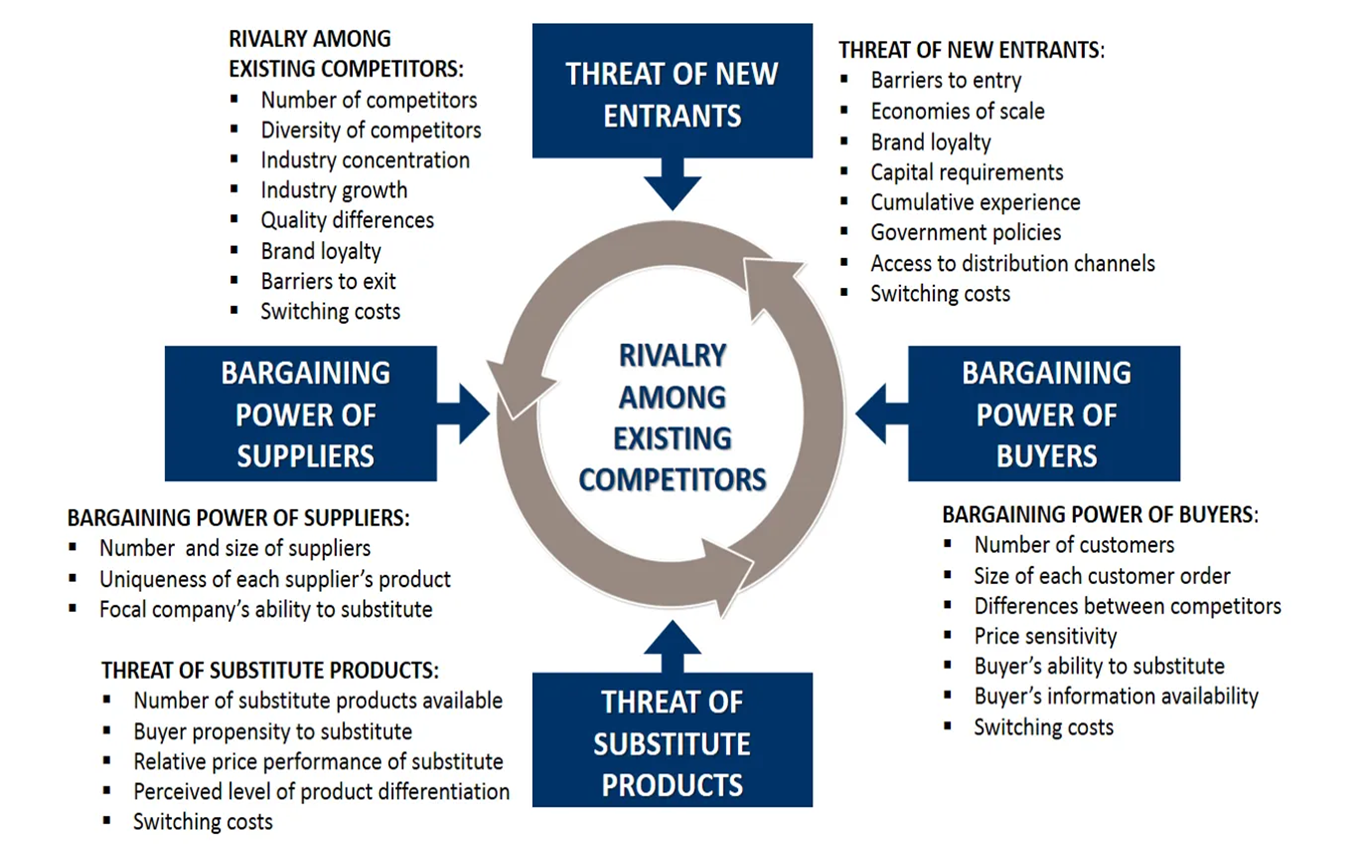
Competitive Forces Matrix
After all the competitive forces have been identified, the entrepreneur can plot them using the competitive forces matrix, by which the entrepreneur can view the total perspective of the competition within the industry where the business operates.
The possible effects and the intensity of the threat of the competitive forces can be high, moderate or low.
The relationship between the possible barriers and the threats is inversely related.
If the potential barriers to the competitive forces are high, then the possible threats are considered low.
Once the threats are considered low, the effect to the business is also low.
Barriers to the Five Forces of Competition
The five forces are considered threats to the entrepreneurial venture.
Each competing force has its own bargaining power in the industry environment.
The intensity of the threat of the five forces is highly influenced by the level or degree of barriers affecting the particular force.
The more barriers against the force, the lesser the intensity of the threat of such force.
Potential New Entrants
It is a threat to the business. The intensity of its threat will be affected by the presence of the following barriers:
Strict government policy.
Substantial capital requirement
Economies of Scale
Economies of scale are cost advantages reaped by companies when production becomes efficient. Companies can achieve economies of scale by increasing production and lowering costs. This happens because costs are spread over a larger number of goods. Costs can be both fixed and variable.
High cost of product differentiation
High switching cost
Difficulty in accessing distribution channels.
Buyers
Have strong and magnified bargaining power in the industry.
However, the threat of its bargaining power will be less if the following factors exist:
The buyer has the potential for backward integration.
backward integration is when a company buys another company that supplies the products or services needed for production.
The cost of switching the supplier cost is minimal.
The buyer purchases large portions of the seller’s products or services.
There are several suppliers available in the market.
The product represents a high percentage of the buyer’s cost.
Suppliers
The intensity of the threat of the suppliers is strong if the following factors hold true:
The product or service is unique.
The switching cost is very high.
Suppliers in the industry are few, but the sales volume is high.
Substitute products are not readily available in the market.
The supplier has the ability for forward integration.
Forward integration is the acquisition of all or part of a distribution chain by a firm that sells the goods distributed, so that the firm becomes or become closer to the direct seller of the goods
Rivalry Among Existing Firms
The intensity of rivalry among existing firms in the industry is attributable to the following factors:
Number of competing firms
Rate of industry growth
Characteristics of the products or services
Amount of fixed cost
Increased capacity
Diversity of rivals
Substitute Products
Substitute products can be great threats in the industry environment if the following factors are present:
The price of the substitute product is substantially lower.
Preferences and tastes of customers easily change.
The quality of substitute products dramatically improves.
Switching cost is low.
Product differentiation is hardly noticeable.
Chapter 3, Lesson 4
Internal or Micro Environment
Refers to the environment within the business.
The different forces within the micro environment are interrelated with other forces in the business environment.
The Forces within Micro Environment as follows:
Business Resources
are assets or properties owned or controlled by the business. The resources can be tangible or intangible.
Business Culture
otherwise known as the organizational or corporate culture.
It is a collection of values, beliefs, principles, and expectations learned and shared by the employees, founders, stakeholders and members of the management.
Two types of Cultures operating in the internal environment:
Culture of the Business or organization
Individual culture of the employees.
Business Structure
refers to the formal organizational arrangement of the business in terms of hierarchy of positions, flow of communication, relationship of functional areas, and production and marketing processes.
Complexity of the business structure depends on the type of business, nature of operation, capital base requirement, leadership style and scope of operation.
Scanning Tools of the Internal Environment
SWOT Analysis
sometimes called as TOWS
Pioneered by George Albert Smith, Jr. and Roland Christensen (Harvard Business School Professors of Business Policy)
SWOT - stands for Strengths, Weaknesses, Opportunities and Threats
BCG Analysis Matrix
developed by the Boston Consulting Group
Most appropriate when there are several products or services that are produced or rendered by the business.
Equally effective even the business produces only one line of product or service.
Various business units of corporate business are scanned using the BCG Analysis Matrix where products or services are classified as:
Stars
Cash Cows
Question Marks
Dogs
BCG Analysis Matrix where products or services are classified as
Understanding the Boston Consulting Group (BCG) Matrix
The horizontal axis of the BCG Matrix represents the amount of market share of a product and its strength in the particular market. By using relative market share, it helps measure a company’s competitiveness.
The vertical axis of the BCG Matrix represents the growth rate of a product and its potential to grow in a particular market.
In addition, there are four quadrants in the BCG Matrix:
Question marks: Products with high market growth but a low market share.
Stars: Products with high market growth and a high market share.
Dogs: Products with low market growth and a low market share.
Cash cows: Products with low market growth but a high market share.
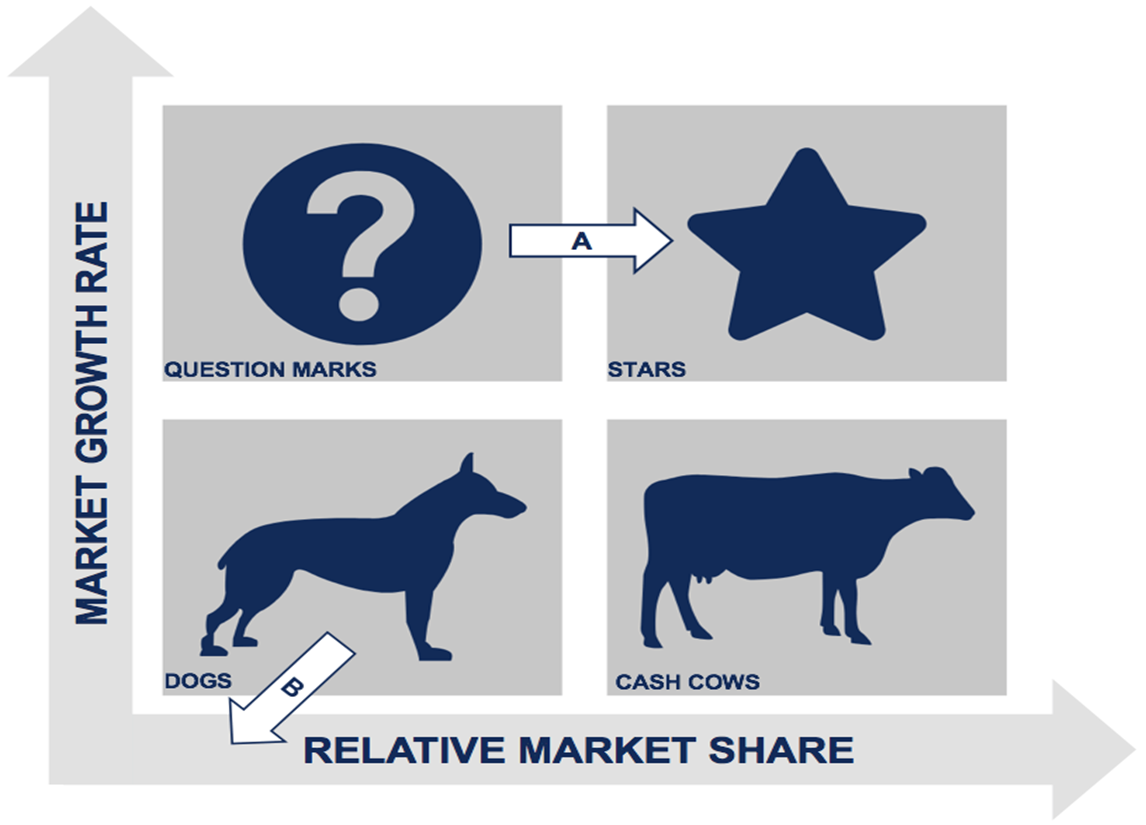
The assumption in the matrix is that an increase in relative market share will result in increased cash flow. A firm benefits from utilizing economies of scale and gains a cost advantage relative to competitors. The market growth rate varies from industry to industry but usually shows a cut-off point of 10% – growth rates higher than 10% are considered high while growth rates lower than 10% are considered low.
The BCG Matrix: Question Marks
Products in the question marks quadrant are in a market that is growing quickly but where the product(s) have a low market share. Question marks are the most managerially intensive products and require extensive investment and resources to increase their market share. Investments in question marks are typically funded by cash flows from the cash cow quadrant.
In the best-case scenario, a firm would ideally want to turn question marks into stars (as indicated by A). If question marks do not succeed in becoming a market leader, they end up becoming dogs when market growth declines.
The BCG Matrix: Dogs
Products in the dogs quadrant are in a market that is growing slowly and where the product(s) have a low market share. Products in the dogs quadrant are typically able to sustain themselves and provide cash flows, but the products will never reach the stars quadrant. Firms typically phase out products in the dogs quadrant (as indicated by B) unless the products are complementary to existing products or are used for a competitive purpose.
The BCG Matrix: Stars
Products in the star quadrant are in a market that is growing quickly and one where the product(s) have a high market share. Products in the stars quadrant are market-leading products and require significant investment to retain their market position, boost growth, and maintain a competitive advantage.
Stars consume a significant amount of cash but also generate large cash flows. As the market matures and the products remain successful, stars will migrate to become cash cows. Stars are a company’s prized possession and are top-of-mind in a firm’s product portfolio.
The BCG Matrix: Cash Cows
Products in the cash cows quadrant are in a market that is growing slowly and where the product(s) have a high market share. Products in the cash cows quadrant are thought of as products that are leaders in the marketplace. The products already have a significant amount of investments in them and do not require significant further investments to maintain their position.
Cash flows generated by cash cows are high and are generally used to finance stars and question marks. Products in the cash cows quadrant are “milked” and firms invest as little cash as possible while reaping the profits generated from the products.
Business Competency
Competency
is a combination of entrepreneurial concepts and principles, entrepreneurial skills and entrepreneurial characteristics.
Entrepreneurial Competency
considered inherent in the entrepreneur and provides competitive advantage.
Without entrepreneurial competency, the entrepreneur may find great difficulty in managing the entrepreneurial venture.
Business Core Competency
is the harmonious coordination of competency in business resources, business structure and business culture.
Chapter 3, Lesson 5
Forms of Entrepreneurial Venture
Classification of business ventures according to form (number of owners):
Sole Proprietorship
Partnership
Corporation
Sole Proprietorship
A business venture owned by one person only.
Characteristics:
It is easy to form and manage. (the primary advantage)
It is a simple business operation.
It has a limited pool of resources.
Its growth is limited.
The owner has unlimited liability.
Partnership
A business venture that is owned by two or more persons. The owners are called partners.
Whatever profit or loss that results from the entrepreneurial operation is divided among the partners.
Partners may contribute money, property or industry to a common fund of the partnership.
Partners are held personally liable to the partnership’s liabilities in the event that the partnership does not have the ability to settle its financial obligations.
The life of a partnership is easily dissolved compared to corporation for the following reasons:
Death of one of the partners.
Admission of a new partner.
Personal insolvency of one of the partners.
Permanent withdrawal of the investment of a partner.
Corporation
A business venture formed by at least five but not more than 15 persons.
A corporation an either be stock or non-stock, profit or non-profit and domestic or foreign.
The persons originally forming the corporation are called incorporators.
The certificate of stock is an evidence of ownership of a corporation.
Nature of Entrepreneurial Venture
Classification of entrepreneurial venture according to its nature are as follows:
Merchandising
engaged in the buying and selling of products or goods.
Service
provides services to customers
Manufacturing
produce goods or products. Buy raw materials, processed into finished products.
The “four Ms” in production operations are manpower, method, machine and materials.
Agriculture
engaged in the production of agricultural goods and animals.
Hybrid Business
possesses the characteristics and nature of combined types of business entities.
Special Corporation
include cooperatives, joint ventures and non-profit organizations.
Production System
Three Important Elements in the Production System are:
Input
includes manpower, materials, machine, design and instructions.
Transformation or Production Process
also known as conversion process
The stage of production where the materials are transformed into the final product with the aid of manpower and machine.
Output
represents the final products from the production process and distributed to customers.
4 Ms on Production
Inputs and transformation process – are the most critical factors in the whole production system.
Their quality determines the quality of output. Also known as “garbage in, garbage out” or GIGO in computer technology.
The four Ms of Production:
Manpower
refers to the human workforce involved in the manufacture of products.
Method or Production Method
refers to the process or technique of converting raw materials to finished products.
Machine
refers to the manufacturing equipment used in the production of goods or delivery of services.
Materials
refers to the raw materials needed in the production of a product.
Chapter 4, Lesson 1
Market Identification
Is a strategic marketing approach and process that is intended to define the specific customer of the product.
Three Strategic Marketing Approaches in Defining the Specific Market of the Product:
Market Segmentation
Market Targeting
Market Positioning
Market Segmentation
It is an entrepreneurial marketing strategy designed primarily to divide the market into small segments with distinct needs, characteristics, or behavior. (Kotler & Armstrong, 2014).
The entrepreneur must divide the total market and focus the business strategy to a smaller market that is considered homogeneous or have similar interests, preferences, needs, wants, and other related variables.
The identified market segment will be the market that can be served better by the entrepreneurial venture based on its competencies. This approach is called niche entrepreneurial marketing.
Common Methods for Segmenting the Market:
Geographic Segmentation
Demographic Segmentation
Psychological Segmentation
Behavioral Segmentation
Geographical Segmentation
The total market is divided according to geographical locations in the Philippines like provincial regions, cities, provinces, municipalities, and barangay units.
Variables to be considered in geographical segmentation:
Climate
Dominant ethnic group
Culture
Density (rural or urban)
Classification of the geographical unit (first class, second class, etc.)
Demographic Segmentation
The market is divided based on the demographic variables of the consumers.
The common demographic variables:
Gender
Age
Income
Occupation
Education
Religion
Ethnic Group
Family Size
Psychological Segmentation
The market is divided in terms of what the customers think and believe.
Psychological Segmentation Variables to consider:
Needs and Wants
Attitude
Social Class
Personality Traits
Knowledge and Awareness
Brand Concept
Lifestyle
Behavioral Segmentation
The market is divided based on the following variables:
Perceptions
Knowledge
Reactions
Benefits
Loyalty
Responses
Points to Consider in Segmentation
Market Segmentation
is a strategy that can assist the entrepreneur in identifying the particular homogeneous segment to serve.
Important Factors to consider in segmenting the market:
Accessibility of the market segment to the business.
Size of the market segment must be large enough to provide wealth to the entrepreneurial venture.
Distinction of the market segment can be easily differentiated from the total market.
Chapter 4, Lesson 2
Market Targeting
It is a stage in market identification process that aims to determine the set of buyers with common needs and characteristics.
They are the market segment that the entrepreneurial venture intends to serve.
Market Segment Evaluation
Factors to consider in the evaluation of market segment:
Size of the segment and its expected growth.
The size of the segment is expressed in terms of estimated product demand while the expected growth
Existing and probable structures of the segment.
The Five Forces of Competition may be use to evaluate segment to serve.
The forces of competition may be classified as strong, moderate or weak.
Capability of the business.
Evaluation of internal environment including the resources of the business.
The segmentation process is easily facilitated through the use of the segmentation matrix.(refers to textbook page 150)
Market Segment Selection
The number of segments to serve determines the appropriate entrepreneurial marketing strategy to use.
The entrepreneur can select one segment or all segments of the total market with different entrepreneurial marketing strategies.
Basic Entrepreneurial Marketing Strategies:
Individual or One-on-One Marketing
Segmentation Marketing
Differentiated Marketing
Concentrated or Niche Marketing
Mass or Undifferentiated Marketing
Entrepreneurial Marketing Strategies
Individual or One-on-One Marketing
Products are tailored to the needs of individual consumers.
Based on the concept that consumers have different needs and wants.
Customized or made to order products (e.g. customized furniture or bags)
Differentiated Marketing
Covers several segments of the total market
Designs a particular product for each segment based on the market evaluation and capability of the business
Basic concept is for the business to exist in almost all segments but to serve few customers only in each segment.
Several products from the same maker will be available and compete with each other in the market.
Examples: Different shampoo and milk products intended for different segments. Each type of shampoo and milk products is prepared to serve different set of customers from several segments.
Concentrated or Niche Marketing
The business selects one or few segments but intends to serve a large number of customers in the chosen segments
Mass or Undifferentiated Marketing
Products are mass produced for the whole market where consumers are not differentiated.
Customers have common needs and wants.
The product cater to all types of customers in general.
Applicable when product is a simple commodity that can be used by all types of customers regardless of their differences in geographical location, demographic profile, psychological and behavioral concerns.
Staple commodity like refined white sugar, rice
Chapter 4, Lesson 3
Positioning
simply refers to the act of occupying a certain place.
In entrepreneurship, positioning refer to the act of placing the business in a specific place in the industry or placing the product in a certain place in the market.
Business Positioning
refers to the process of determining the place of the business in the industry.
Entrepreneur conducts industry analysis of the different forces that are strong in the industry in order to determine the correct position of the proposed venture.
Market Positioning
refers to the process of arranging a product to occupy a clear, distinct and desirable place in relation to other competing products in the mindset of target consumers (Kotler & Armstrong 2013).
Last stage in the product identification process after conducting market segmentation and identifying the particular segment to serve.
Different Market Positions
Foremost Objective of Market Positioning:
To have a distinct place in the minds of the target consumers.
The concept of differentiation becomes inherent and directly linked to the process.
Steps in the Process of Determining the Market Position of the Product:
The Entrepreneur ….
determines if the market position is distinct from others.
evaluates the advantages or benefits of every possible market position.
decides on the market position.
Product is differentiated from its competitors primarily in terms of value and benefits that customers will gain from it.
Two major dimensions that will differentiate the product from its competitors in the market:
Lower Price
More benefits than those being sold at a higher price.
Filipino consumers are generally price-conscious and prefer to buy products that are reasonably priced.
When the price of the product can hardly be lowered, the entrepreneur must define its substantial benefits by stating clearly on the packaging and promotional materials of the product.
Market Positioning
done with the help of the positioning or perceptual map.
Positioning Map
shows the position of similar products competing in the market as perceived by the customers.
The different products are represented by the circles and plotted on the perceptual map as low or high in terms of price and quality.
The size of the circle represents the market share of the product.
Evaluating the Benefits of Every Market Position
After evaluation on the target position of the product in terms of price and quality, the entrepreneur determines the advantages, benefits and attributes of the product.
The product must have at least one attribute which is considered distinct from other products in the market.
The entrepreneur must strongly promote the said attribute or benefit to the consumers.
Criteria in identifying the attributes or benefits to be promoted:
Identifiable. The benefit or attribute is easily associated with the product.
Beneficial. The attribute provides valuable benefits to the target consumers.
Distinctive Advantage. The attribute is distinct to the product and can hardly be copied by the competitors.
Efficient and Rewarding. The cost in attaching the attribute or value to the product is not higher than the expected benefits in terms of profit.
Deciding on the Market Position
Two Basic Dimensions Considered in Deciding the Market Position of the Product:
Price
Quality
Guide Questions in Deciding the Market Position of the Product:
Will the product be sold at a higher price due to its attributes and benefits?
Will the product be sold at the same price as the competitor’s price in spite of its benefits?
Will the product be sold at the same price as the competitor’s because they have similar benefits?
Will the product be sold at a lower price because it offers less benefits?
Will the product be sold at a higher price even if it offers less benefits?
Normally, a product sold at lower price is expected to be of inferior quality and offers less benefits.
A product sold at a higher price is expected to be of better quality and offers more benefits.