Atmospheric Pollution
Air Pollution
Sources
Point air pollution: Where you can point to where the pollution is happening.
Nonpoint Air pollution: Larger area of pollution (cars in a city)
Natural: Pollen, volcanos, and dust storms
Anthropogenic: Combustion of fossil fuels
Primary Vs. Secondary
Primary | Secondary |
|---|---|
Released directly into the atmosphere (Carbon monoxide, sulfur monoxide, sulfur monoxide, hydrocarbons, and particles.) | Created when a primary pollutant combines with other gases, water, or sunlight. (So3, HNO3, HSO4, O3, PANS) |
Pollutants
Pollutant | Description | Sources | Effects/other |
|---|---|---|---|
Sulfur Dioxide (SO2) | Colorless, foul smell | Released from the combustion of fossil fuels (coal) | Respiratory irritant and can combine with water to form acid rain |
Particulate Matter (PM) | Solid and liquid particles in the air | Natural sources, plants, skin cells, volcanos, combustion of fossil fuels | Respiratory irritant PM10 - Upper respiratory issue PM2.5 - Lower respiratory PM.1 - appears In the bloodstream |
Lead (PB) | Heavy metal, was used in gasoline until the 1980s | Mining operations and old paints | Neurotoxin, lower reading levels, lower IQ levels, bioaccumulation |
Ozone (O3) | Secondary pollutant | Forms from VOCS + Nitrous oxides + the sun which causes O3 to form | Respiratory irritant and is good in the stratosphere |
Nitrogen Oxides | NO2 Nitrogen dioxide NO Nitric oxide | Combustion of fossil fuels | Respiratory issues/irritant combines with water to form acid rain |
Carbon Monoxide | Colorless and odorless | Combustion of fossil fuels | Prevents oxygen from binding with the hemoglobin in the blood |
VOCS (Volatile Organic Compounds) | Carbon-containing | Combustion of fossil fuels and in a lot of household object | Also called hydrocarbon |
Radon - 222 | Gas that results from decaying uranium | Decaying uranium | Lung Cancer |
Asbestos | Fiber | Naturally occurring minerals that is mined from the earth | Lung cancer and mesothelioma |
Reducing Air Pollution
Regulate air pollution: (Tax breaks), Policies (ideal free zones), and laws (Clean air act)
Conserve and reduce fossil fuel use
Alternative fuels: Wind and solar
Clean Air Act
Sets standards for the six criteria for air pollutants
Limits emissions from industry and transportation
Funds pollution research
Decreasing Vehicle Pollution
Vapor Recovery Nozzle
A tube inside gas nozzles that sends VOCS to an underground tank
Catalytic Converter
Required on all cars since 1975
Reduces harmful emissions by converting toxic gases like carbon monoxide and nitrogen oxides into less harmful substances like carbon dioxide and nitrogen through chemical reactions with a catalyst.
Decreasing Industrial Pollution
Scrubber
A scrubber works by passing polluted air through a liquid or solid material to remove pollutants before releasing it into the atmosphere. The pollutants are absorbed or chemically reacted with the scrubbing material, reducing industrial pollution.
Electrostatic Precipitator
An electrostatic precipitator reduces industrial pollution by using electric charges to attract and capture particles like dust and smoke from the air. The charged particles are then collected on plates or filters, preventing them from being released into the atmosphere.
Photochemical Smog and Thermal Inversions
How is NOx created?
NOx is created through the combustion of fossil fuels in vehicles, power plants, and industrial processes. It forms when nitrogen and oxygen in the air react at high temperatures.
What have scientists found that people exposed to high levels of NOx may suffer from?
Lung disease, heart disease, asthma, plants can be affected
What is the equation for photochemical smog
Photochemical Smog: (NO + VOC + UV + O2 → O3 + PANS
NO + VOCs come from urban areas with many cars
NO is highest in the morning
O3 is highest in the afternoon
UV: Environment
O3 + PANS: Secondary
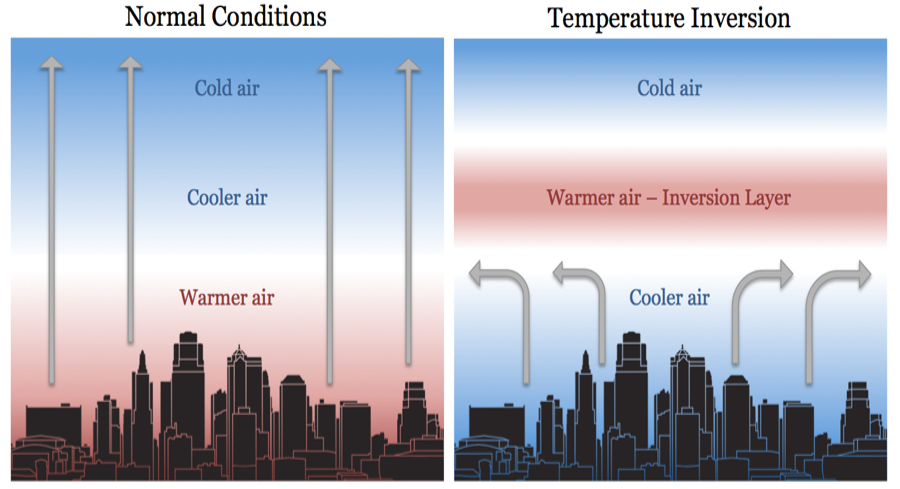
Temperature Inversion
Normal Temperature Gradient: Temperature decreases with increasing altitude.
Inversion: Temperature increases with increasing altitude, trapping pollutants.