GS1
Waves and Characteristics
P waves: Fast, Weak, goes through Solids Liquids & Gases(also known as Primary waves)
S waves: Strong, Slow, goes through Solids only (also known as Secondary Waves)
Seismic waves: carries the energy of an earthquake away from the focus, through the Earth’s interior and across the surface
Longitudinal: Horizontal waves, think of slinky effect, P waves (Ex. Sound Waves)
Transverse: Vertical waves, think of rope effect, S waves (Ex. Light Waves)
Mechanical Wave: Mechanical waves are any wave that travels through matter. When talking about mechanical waves, you could be referring to either/both P waves and S waves.

Amplitude: In both sound and electromagnetic waves - this is a key factor in determining the energy of a wave; greater the height - means more energy.
Frequency: Is the number of occurrences of a repeating event per unit of time. (Hertz, Hz)
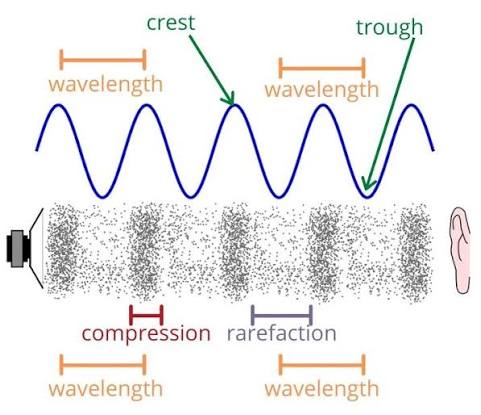
Wave length: The amount of space in between two waves
Crest: The top of a wave, right before it goes down again
Trough: The bottom of a wave, right before it goes up again
Compression: When the dots of a wave are closer together (think of the IXL assignment)
Rarefraction: When the dots of a wave are farther apart (think of the IXL assignment)
Tools and Graphs
Seismograph: An instrument used to detect and record seismic waves produced by earthquakes.
Seismogram: is a record produced by a seismograph, which measures the motion of the ground during an earthquake or other seismic events. It displays the amplitude and frequency of seismic waves, allowing scientists to analyze the characteristics of the earthquake, such as its magnitude and location. Seismograms are crucial for understanding seismic activity and improving earthquake preparedness.
Seismometer: an instrument used to detect and record the vibrations caused by seismic waves as they travel through the Earth. It is valuable data for understanding the Earth's internal structure and behavior.

Miscellaneous Vocabulary
Epicenter: the point on the Earth's surface directly above the focus of an earthquake. It is where the seismic waves first reach the surface, often resulting in the most intense shaking. The location of the epicenter is typically determined using data from seismographs. where your feet are. (above ground)
Focus: The actual location within the Earth where an earthquake originates, also known as the hypocenter. below your feet (underground)
Seismologist: A scientist who studies earthquakes and the propagation of seismic waves through the Earth. They analyze data to understand seismic events and assess risks
Seismo: A prefix related to earthquakes or seismic activity
Earthquake: Shaking and trembling that results from the movement of rock beneath Earth’s surface
Basic Concepts
When an earthquake occurs, it generates P waves and S waves. P waves are fast and weak, while S waves are slow and Strong. They both move away from the focus (location where the earthquake originates). Earthquake scientists, called Seismologists use seismographs to detect and record seismic waves. That creates a seismogram. It displays the amplitude and frequency of the earthquake’s waves. Amplitude is the height of the wave on the seismogram, (Taller the wave = more energy = more destructive/powerful) and frequency is how often a wave starts over. When a mechanical wave is traveling through matter, it travels fastest through Solids, then Liquids, then Gas. “Mechanical waves” are any wave that travels through matter and seismic waves are waves that usually travel through the earth.
Learning Tools & Tricks
When trying to remember the characteristics of S waves, remember:
- Slow - Strong - Solids only
When trying to remember the difference between Transverse and Longitudinal waves, think of when you go skiing. Instead of going straight down a mountain/hill, you are likely going to Zig-Zag (curvy path), that’s called traversing the mountain. Traverse sounds a lot like Transverse
When trying to remember the difference between seismogram and seismograph, think of when you’re cooking or baking. The gram in Seismogram makes you think of the measurement, gram. On a seismogram, you measure the amplitude, wave length, and frequency