Module 10: Revolution in Military Affairs and its Limits
Revolution in Military Affairs and its Limits
Overview
- What is RMA?
- Current RMA
- Future of RMA
The entire framework in technological military leading to changes in warfare is not quite net at all.
What is RMA?
Revolution in military affairs- will look at historical cases and its defining features
- Some scholars may use different terms when discussing this topics and further research requires more nuanced terms
Revolution in Military Affairs
- “A Revolution in Military Affairs (RMA) is a major change in the nature of warfare brought about by the innovative application of new technologies which, combined with dramatic changes in military doctrine and operational and organizational concepts, fundamentally alters the character and conduct of military operations” (Office of Net Assessment, DOD)
- “the application of new technologies into a significant number of military systems combines with innovative operational concepts and organizational adaptation in a way that fundamentally alters the character and conduct of conflict (Krepinevich 1994)”
Ukranian War
- Ukrainian usage of certain missiles (javilin missile), that are small and can be quite small but proved to be quite lethal whilst Russia have tanks which are used for blitz techniques and are expensive but were assumed to have strategic superiortiy
- Chnaged what chanegd a prominent role in the battle field
- Makes tanks less effective changing thef fundamentals of warfare, some argue
- Usage of Drones, which are unmanned Aircraft systems
What is RMA?- It’s Four elements
- Technological change
- Systems development
- Operational innovation
- Organizational adaptation
These four elements together determine the occurrence of military revolution
What is RMA- Historical examples
Historical examples: The Phalanx
- It’s role in the successful campaign led by Alexander the Great
- From Military point of view, Alexadner of the Great organised the technological innovation of the time, where he organsied the heavily armed infantry (the Phalanx) with very large spears so they could push forward whilst moving forward, whilst being organised in collumns and rows
Historical examples: Gun powder
- Once it was utilised to shoot guns and for artilery reasons- was not good for destructive power but because it standarised the performance of military soldiers
- Soldiers physical conditions were not as significant
- Modern militaries could standarise and organsie by effective calculation of what the military could or could not do
- Gun powerder had o be combined with significant organsiational elements like soldiers fighting in rows
Historical examples: Machine guns
- Before machine gunds, soldiers were marching in rows, but with machien guns the rows could be annihilated in short times- soldiers could no longer run and attack each other
- Lead to the building of trenches- where each side could not advance as they would be faced with machine guns
- Tatic and organisational achnegs- changes in conduct of warfare especially in early stage of WW2
Historical examples: Aircraft carriers
- Important in the military innovation of naval warfare
- Uncertainity if whether the furture would be aircraft carriers or huge battle warships
- Aircaraft carriers, large ships, carrying aircrafts
- Their successful performance in naval warfare in WW2, it was ocncluded that aircarft acrriers are cirticla in ensuring state’s mairtime advantage
Nuclear weapons
- Its sheer destructive power has fundamentally changed the idea of warfare in today’s warfare
- Changes in military tactics, but also the organisation of the military
Current RMA
- Often called “Information Revolution”, began/recognized in GWI in 1991
- Need to create a highly information-alised military
- Military has to become something capable of adapting of communication revolution
- US had achieved infromation-alisation of military at the beinning of the Gulf War era which allowed them to win
- Communication of the allied forces were very storng?
Current RMA- RMA today
- Precision Firepower + Small Ground Units + C4ISR (Command, Control, Communications, Computers, Intelligence, Surveillance, and Reconnaissance: Highly integrated and efficient information/command structure) + Psychological Operations (Diminish will to fight and communications)
- —> Speed, manoeuvre, flexibility, and surprise
- Hit the adversary as quick as possible before they are capable as responding and also maneuver to hit where they are weakest
- —> Defeat conventional forces at very low costs
- —> Speed, manoeuvre, flexibility, and surprise
- Showed firepower is not just important in size but also accuracy- precision firepower
- Dropping many bombs not only requires more resources but can actually undermine one’s military
- To gain more expensive and more effective information surveys with information gathered and developed by computers to produce the optimine choice
- Highly information-alised process from military POV
- Need to make adversary less willing to fight but also less capable in communicating with each undermining their ability to fight, need to hit the military by suprise (by the back if possible)
- Almost all major militaries today advocate one version of this formula
- Emphasis on “network warfare”, “information warfare”
- Heavy investments in information assets (computers, communications, etc), big data, and personnel training
- End of mass army, highly technology intensive
Future of RMA
- The Afghan Model
- Airpower + Special Forces + Indigenous Troops (under highly advanced C4ISR)
- Decapitation strategy (Warden)
- By changing or paralyzing enemy government (or by threatening to do so), coerce
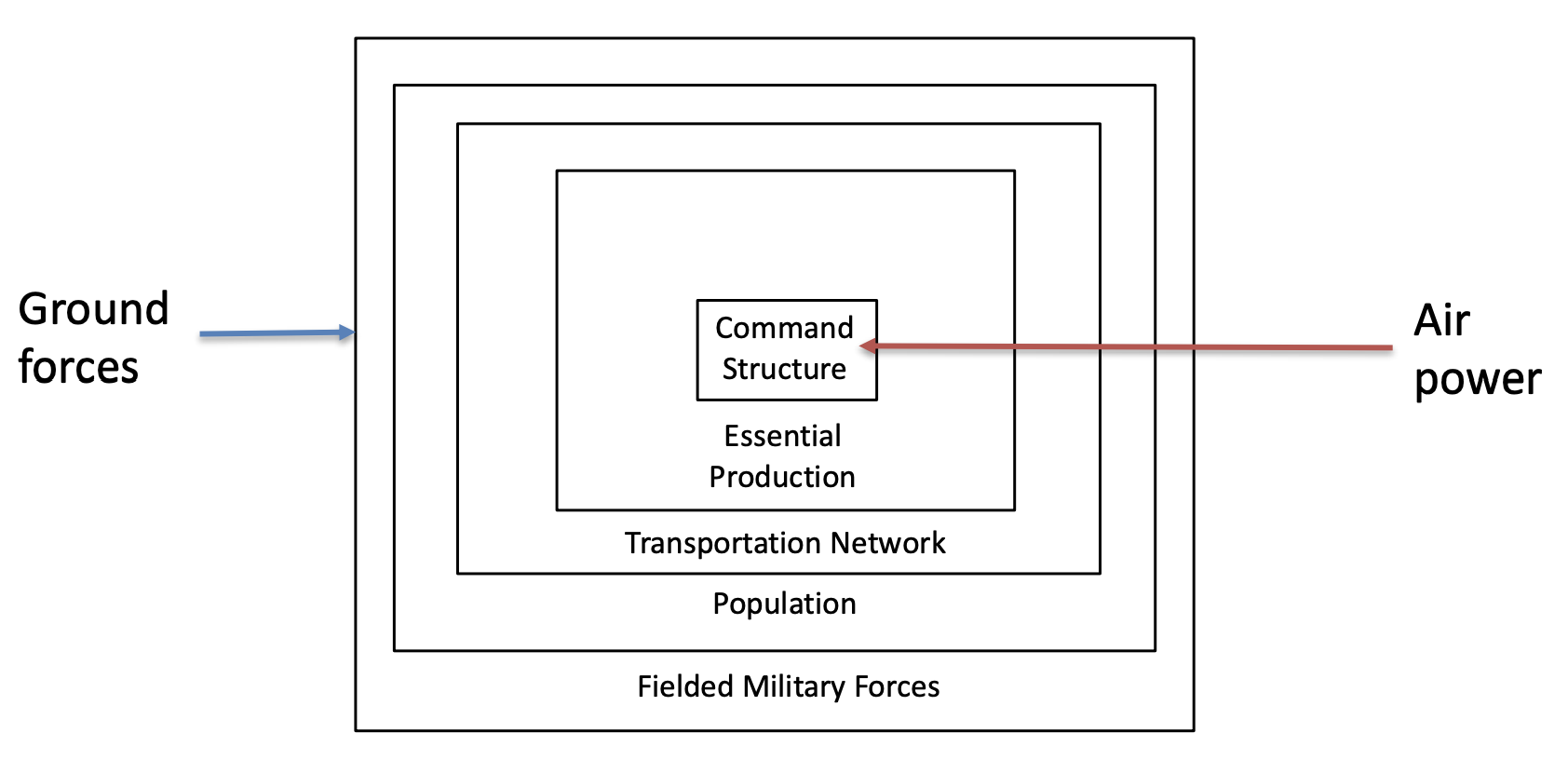
Future of RMA- Political Implications of RMA
- After the initial defeat of the Taliban, Many in US believed they ultimately found the magic formula to win a war
- Belief that US can easily defeat any adversary, even using force unilaterally
- Then, get the job done in one country, and move on to another country or adversary. Why negotiate? Topple rogue states militarily.
- The idea of easy military victory was at the heart of the Bush Doctrine and less US reluctant to use military means
- Less Cost with US veiw of cost is typically the cost of lives of US soldiers
- Political implications of RMA
- Important factor in Iraq War (2003)
Future of RMA- Limits in RMA: Experiences in Afghanistan and Iraq
- Toppling the regime alone cannot achieve the political goals
- For the political goal (democracy and stability), ultimately had to occupy the
- country (e.g. Iraq and Afghanistan after initial victory)
- Then, the problem of fighting guerillas: Need to send large ground forces
- Limits in technological innovation
Future of RMA- Historical lessons (Krepinevich)
- Emerging technologies make RMAs possible, but not automatic
- Short lived advantages of a RMA: Imitation and adaptation
- Often cannot achieve full transition; niche competitors can exist
- War and RMA are different entities
- Huge variations in ability to understand and implement RMA
- Importance of non-military sectors in technology development
Future of RMA- Importance of the basics (Biddle)
- Need to be well versed in the “modern system of force employment” for combat effectiveness (the ability to destroy hostile forces while preserving one’s own, the ability to take and hold ground, and the time required to do so)
- Contexts of wars in 20th and 21st centuries (technology and lethality)
- For offense and defense, cover (difficult to hit), concealment (difficult to aim), dispersion, small unit independent maneuver, suppression, and combined arms integration (thereby reduce exposure and conduct operations)
- Key for military success (in operations) is not technology or size per se, but diverging ability to internalize the modern system