Further anatomy - Kai flashcards
7.1.1 - labeling the skin
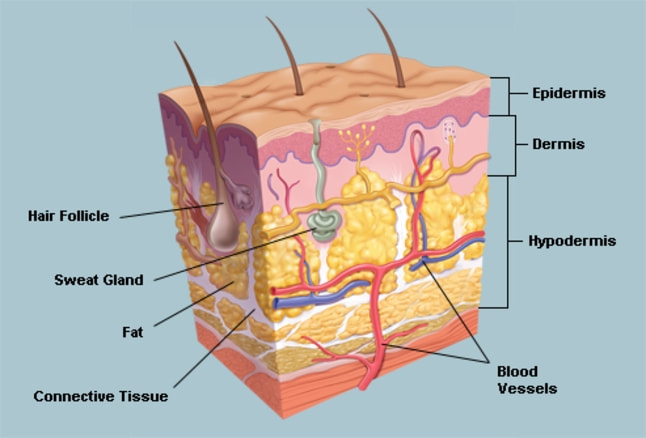
Epidermis - Outermost layer of the skin and consists of keratinocytes which produce keratins which are proteins that give our skin strength and also help protect to environmental toxins and physical stress.
Dermis - connects the epidermis to the rest of the body. The inner layer of the two main layers of skin (thin upper layer and thick lower layer)
Hypodermis (fat) - Storing energy and insulating your body and protecting it from harm. Also, it connects the dermis of the skin to the muscles and bones.
Sebaceous gland - produces sebum/oil
Sweat gland - produces sweat
hair follicles - grows hair, assists with skin repair and forms new blood vessels.
Blood vessels - They go through each layer of the skin and capillaries that reach into the dermis and blood makes its way inside. Nutrients and nourishment make its way into the dermis.
7.1.2 - functions of the skin
Regulation of body temperature - Protect the body from cold/heat.
During hot weather vessels dilate and sweat forms on the surface. More blood flow = greater direct heat loss.
During cold weather vessels constrict trapping heat. Less blood flow = reduced heat loss.
Protection and immunity - Physical barrier to anything harmful to your body. The immune system of the skin is innate and adaptive. Immune cells inhabit the epidermis and dermis.
The key immune cells are in the epidermis (Langerhans and keratinocytes)
Sensation - The dermis layer contains the nervous system. If we touch or feel something it triggers a response avoiding things that may cause pain (heat/cold). Most nerve endings are in the hand/finger
Excretion - Sweat is a form of a waste product and helps maintain the temperature of the skin. Also helps maintain the PH of the body. (e.g. too much water in your system you will sweat it out balancing your PH)
Synthesis of vitamin D - cholecalciferol (form of vitamin D) is synthesised from a derivative of the steroid cholesterol in the skin. Liver converts cholecalciferol to calicidiol and then converted to calcitriol. Vitamin D Is needed to synthesise vitamin A
7.2.1/7.2.2 - Labelling of the brain
7.2.5 - function of the brain
Brain stem
Function: Respiratory and cardiovascular control centres.
Sport example: During exercise the receptors in our body will send signals to the brain stem (medulla) to regulate or increase heartrate. The brain stem also controls the ability to vasoconstrict or vasodilate, helping us cool and sweat.
Diencephalon
Function: Involved in many crucial bodily functions such as coordinating with the endocrine system to release hormones, relaying sensory/motor signals to cerebral cortex, regulating circadian rythems (sleep/wake cycle)
sporting example:
Cerebrum
Function: Initiates and coordinates movement
Sport example:
Frontal lobe
Function: High level thinking, reasoning, problem solving, planning, emotions
Sport example: Planning where to place a freekick ball
Parietal lobe
Function: Touch and movement senses. Body awareness and navigation (kinaesthesis)
Sport example: ‘feeling’ the basketball as you dribble
Occipital lobe
Function: Visual sensory (sight). Helps us perceive what we are seeing.
Sport example: Reading the speed/spin/flight of a tennis ball
Temporal lobe
Function: Auditory sense (hearing). Short and long term memory.
Sport example: Remembering how to ski or ice skate each year. hearing the table tennis ball hit the table.
Limbic lobe
Function: Emotion, behaviour, motivation, long term memory. Goes back to primal instinct for survival “fight or flight”
Sport example: Getting a red card in football (how you would react)
Cerebellum
Function: Motor control, helps coordinate smooth macular contraction and regulates posture and balance.
Sport example: A gymnast doing a cartwheel on a beam.
7.2.3 - blood supply to the brain
Heart
Aorta
Subclavian arteries
Carotid arteries
vertebral artery
cerebral artery
Circle of Willis
Brain
Blood Brain Barrier (BBB) - Formed by brain endothelial cells lining the cerebral microvasculature. it is an important mechanism for protecting the brain from fluctuations in plasma composition and from circulating agents such as neurotransmitters and xenobiotics capable of disturbing neutral function.
The brain obtains energy using glucose and oxygen, which pass rapidly from the blood to the brain cells
Glucose and oxygen are used to make ATP inside the brain by the process of aerobic respiration
Carbohydrate storage in the brain is limited, so the supply of glucose must be continuous.
If blood entering the brain has low glucose or oxygen levels, mental confusion, dizziness, convulsions, and loss of consciousness may occur.
Aerobic restoration = glucose + oxygen = carbon + water + ATP dioxide