Chapter 4
Bacteria cell walls are made of: peptidoglycan
Archaeal cell walls are: distinct from bacteria and eukaryotes
Bacteria can act as a group: colonies and biofilms
Average size of bacteria: 1 micrometer
Bacteria size can range from 1 micrometer to 0.2 micrometer
Pleomorphism: variations in size and shape among cells of a single species
Tetrad cocci: groups of four coccus
Staphylococci: irregular cluster
Streptococci: chains of a few to hundreds of cells
Sarcina: cubical packet of 8, 16, or more cells
Diplobacilli: pairs of cells with their ends attached
Streptobacilli: chains of cells
Palisades: cells of a chain remain partially attached and fold back, creating rows
Spirochetes rarely remain: attached after cell division
Flagella and axial filaments: provide motility
Fimbriae and pili: provide attachment points or channels
Polar flagella: flagella attached to one or both ends of the cell
Monotrichous: single flagella
Lophotrichous: tuft of flagella
Ampitrichous: flagella at both pole of the cell
Peritrichous: flagella dispersed randomly over the surface of the cell
Chemotaxis: movement in response to chemical signals
Positive chemotaxis: movement towards stimulus
Negative chemotaxis: movement away from stimulus
Flagella run: counterclockwise movement of the flagella to move linear
Flagella tumble: clockwise movement causing stopping or change course
Phototaxis: movement towards light
Attachment can enhance what in some bacteria: pathogenicity
Fimbriae: bristle-like fibers made of protein and are responsible for biofilms
Pili are also know as: sex pilus; transfer DNA between cells
Pili are made of: pilin
Pili are only found in: gram-negative bacteria
S-Layer: Thousands of copies of a single protein linked together to provide protection in hostile environments
Slime Layer (Glycocalyx): protects cell from water loss
Capsule (Glycocalyx): Dense version of slime layer formed by pathogenic bacteria to protect from antibodies
An example of a biofilm: plaque on teeth
Parts of Cell Envelope: cell wall, cell membrane, and outer membrane (in some bacteria)
Gram-positive bacteria: 20 to 80nm peptidoglycan cell wall with teichioc and lipoteichoic acid and inner cytoplasmic membrane
Gram-negative bacteria: 1 to 3nm thin peptidoglycan cell wall with an outer and inner membrane; sensitive to lysis
Peptidoglycan is made of: glycan chains linked with peptide fragments
Mycolic acid/cord factor: found in cell walls of Mycobacterium and Norcardia; it is a long fatty acid chain and contributes to pathogenicity
Liposaccharide functions as: antigens and receptors and is an endotoxin that stimulates shock and fever
Lipoproteins anchor: the outer membrane to the peptidoglycan
Gram-negative bacteria also have porins which: regulate molecules going in and out of the membrane by changing size
The cell membrane of bacteria is made of a: lipid bilayer
The lipid bilayer is made of: 30-40% phospholipids and 60-70% proteins
Archaea don’t have phospholipids instead: they have unique chains of hydrocarbons
Secretion (cell membrane): discharge metabolic products into the extracellular environment
Gram-negative bacteria’s cell membrane make them impervious to: antimicrobial chemicals
Proteins in the outer cell wall of gram-positive bacteria can be: toxic
Bacterial chromosome: single circular strand of DNA and is aggregated in an area called the nucleoid
Plasmid: non-essential pieces of DNA; separate double stranded circles of DNA
Ribosomes are made of: RNA and proteins
Svedberg units: measure the relative size of cell parts
Ribosomes are made two pieces: large subunit (50S) and small subunit (30S)
Bacterial inclusion bodies: storages sites for nutrients
Bacterial cytoskeleton is made of: long polymers similar to actin and arranged in helical ribbons around the cell just under the cell membrane
Bacterial endospores: withstand hostile conditions
Life cycle of endospore: Vegetative cell (metabolically active) and endospore (inert)
Sporulation: spore formation induced by environmental conditions
Sporangium: sporulating cell
Bacterial germination: exposure to water stimulates the formation of hydrolytic enzymes and the core rehydrates so the bacterium grows out of the endospore coats
Endospore forming bacteria: anthrax, tetanus, C.diff, gas gangrene, and botulism
Endospores are nuisances in: clean environments
Archaea is more related to: Eukarya than bacteria because they share RNA sequences no in bacteria
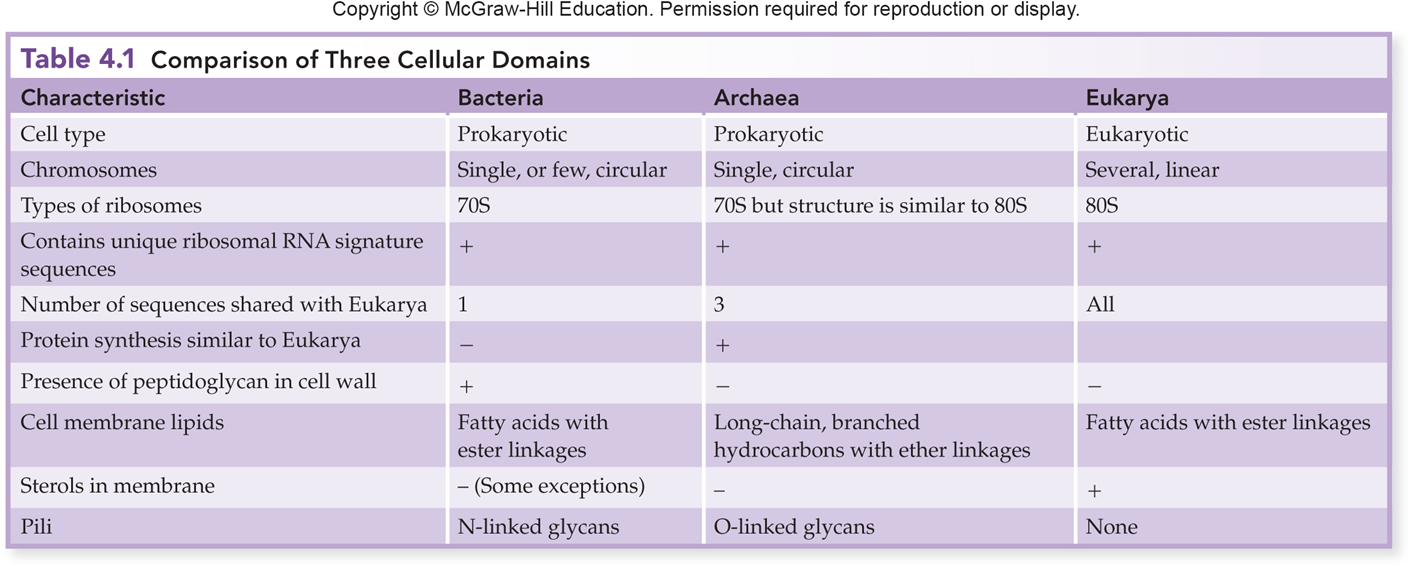
Unique characteristics of archaea: Certain genetics sequences in rRNA; unique DNA compaction; unique cells walls
Archaea are usually found in: extreme environments
Methanogens convert: CO2 into H2 and are commonly found in swamps
Extreme halophiles: require salt to grow and use red pigment the make ATP
Psychrophiles: grow at low temps
Hyperthermophiles: live in volcanic waters and soils