Learning
Learning Overview
Learning is a ~~relatively permanent~~ change to a person’s behavior due to experience and it occurs both consciously and unconsciously.
2 Main Types
- - learning not respond to a stimulus that is repeated
- Certain noises in a house cause a newborn baby to cry, until they become desensitized ton the noises and they no longer frighten the child.
- Ducks in a small pond at a park are scared of people and fly away when approached. They become used to humans over time as they interact with them, and as people feed them, causing them to realize that the humans are not a threat.
- - learning or expecting that certain events will occur together
- %%Classical Conditioning%% - (involuntarily) learning to link two or more stimuli and anticipate events
- %%Operant Conditioning%% - (voluntarily) learning to associate a certain response with a certain consequence
- %%Observational Learning (social learning)%% - learning from others’ experiences
Classical Conditioning
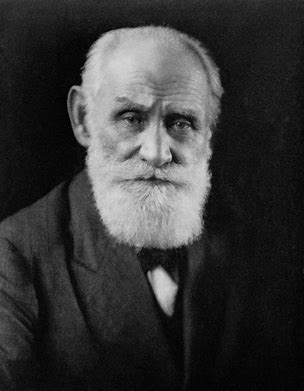
Pavlov accidentally discovered classical conditioning while study digestion in dogs. Him and John B. Watson believed the basic laws of learning were the same for all animals (responsive and adaptive). This view of learning and that psychology should only revolve around the study and observation of behavior is called behaviorism.
Parts of Classical Conditioning
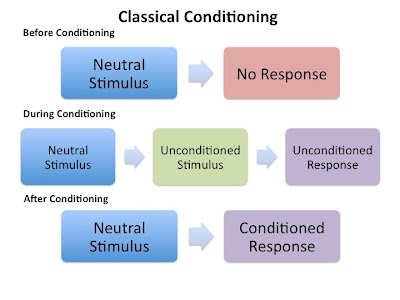
- {{^^Neutral Stimulus^^ - a stimulus that does not trigger any response on its own{{
- {{^^Unconditioned Stimulus^^ - naturally/automatically triggers a response{{
- {{^^Unconditioned Response^^ - unlearned/naturally occurring response to an unconditioned response{{
- {{^^Conditioned Stimulus^^ - used to be a meaningless stimulus but has since garnered a response because it has been connected to a stimulus that evokes that specific response (always the same as neutral stimulus){{
- {{^^Conditioned Response^^ - the learned response to a previously neutral but now conditioned stimulus{{
Examples: https://youtu.be/y5aE5-skiaM
Five Principles of Classical Conditioning
- ==Acquisition== - the initial learning of the stimulus-response relationship
- The neutral stimulus must come before unconditioned stimulus by about 1/2 of a second to bring about the conditioned response
- Higher-order conditioning is when conditioned stimulus is paired with a new neutral stimulus, creating a second (and weaker) conditioned stimulus.
- ==Extinction== - the loss of a learned response (conditioned response) when the unconditioned stimulus is no longer paired with it
- ==Discrimination== - the ability to tell the difference between a conditioned stimulus and other stimuli (opposite of generalization)
- Can be adaptive
- ==Spontaneous Recovery== - the reoccurrence of a conditioned response after extinction has occurred (weaker)
- ==Generalization== - automatically responding to a stimulus that is like the original conditioned stimulus
- Can be adaptive
{{Pavlov’s Mistake{{
Because he was a behaviorist, he failed to consider the importance of cognitive processes (memories, thoughts, and perceptions) on learning.
Learned Helplessness is when one is repeatedly faced with traumatic events that they cannot avoid, so they become depressed, helpless, and give up.
Operant Conditioning
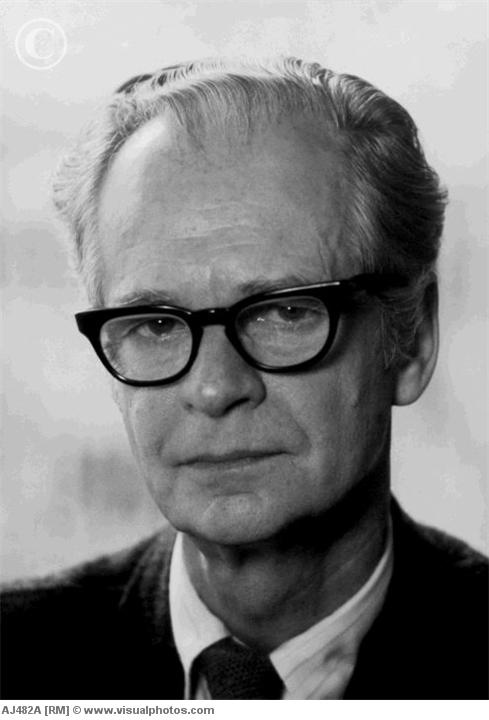
Operant behavior operates on the environment producing an either rewarding or punishing stimulus. Edward Thorndike’s law of effect states that behaviors followed by a reward are more likely to occur and behaviors followed by a punishment are less likely to occur. B. F. Skinner tested Thorndike’s law through his experiments with an operant chamber, AKA the Skinner Box. Skinner was also a behaviorist.
Parts of Operant Conditioning
@@Shaping@@ - you can shape behavior by rewarding those close to the desired one until you get there.
- Example: To get your crawling child to start walking, you praise them every time they stand up, and eventually, every time they take a step. Overtime, your child learns to walk based on being rewarded with your praise.
- In this case, the discriminative stimulus is the praise your child receives when they walk (or at least attempt to).
- <<Reinforcement - strengthening a behavior<<
- %%Positive Reinforcement%% - strengthening a behavior by adding desirable stimulus like getting a hug or getting paid.
- %%Negative Reinforcement%% - strengthening a behavior by taking away a non-desirable stimulus like fastening seatbelt to stop beeping.
- <<Punishment - weakening a behavior<<
- %%Positive Punishment%% - weakening a behavior by adding a non-desirable stimulus like chores.
- %%Negative Punishment%% - weakening a behavior by taking away a desirable stimulus like your child’s bedroom door.
| Primary Reinforcers - non-learned biological reinforcers; innately satisfying | Conditioned (Secondary) Reinforcers - get their influence from association with primary reinforcers. Most human reinforcers are secondary. |
|---|---|
| food | money |
| water | praise |
| shelter | status |
| pleasure | grades |