Geography
What is a gyre?
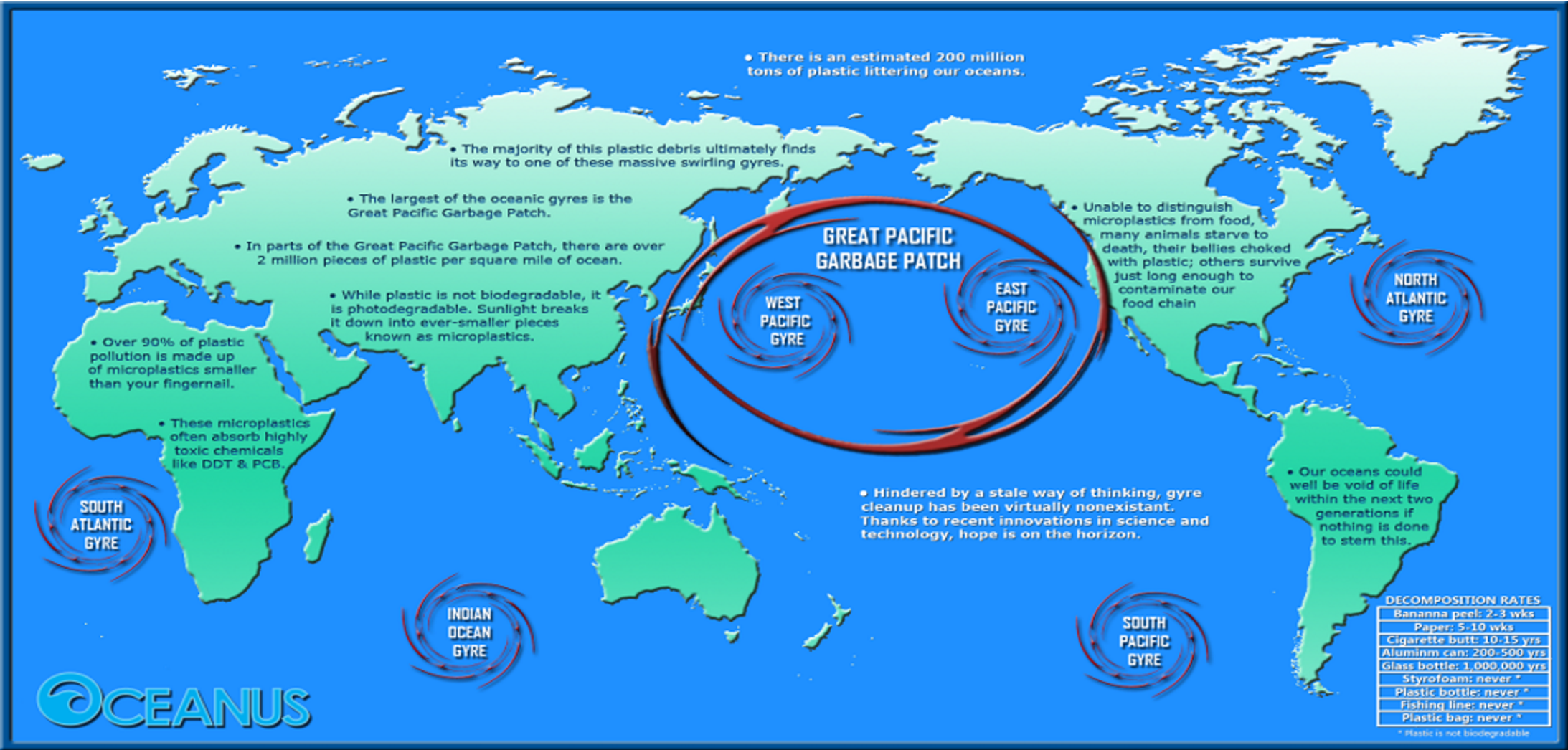
The Great Pacific Garbage patch is an example of a gyre. This is a large system of circulating ocean currents, particularly those involved with large wind movements.
1. What is the Great Pacific Garbage Patch?
It is a gyre that is a spinning mas of water that accumulates plastic. Gryres are made from a convergence zone where warm water and cool water mix and create a circuit that accumulates trash in it.
2. Where is it found in the world?
It is in the Pacific Ocean between Hawaii and California.
4. Why do plastics accumulate in the gyre?
Because it is a vortex and a gyre that hold it and inside it there is plastic that form into micro-plastics that can't break down.
5.What is the problem in trying to manage the Great Pacific Garbage Patch?
The problem is that firstly there is so much plastic so all the countries would have to help to clean it up not just divers. Also a lot of it is underwater so there would have to be a massive group of divers that have to be really careful not to harm the wild life when they do it for example if there is fish eggs attached to it they have to delicately take them off without killing them. Also countries would have to use a lot of money for transport of people and when they collect plastics they will need boats/cars/planes to bring it back. They would also need to put chemicals to take out the micro-plastics which could harm wildlife. We could solve it but our population is increasing so more amounts of plastic will be made so more will end up in the Great Pacific Garbage Patch making it more harmful to the environment that affects us which could kill us over time.
America wastes the most probably because they are rich enough to afford enough food and they probably don't care about their waste. Athor countries like China could have the same reason butt also could be because they have a big population.
Most bottles ends up in land vile.
When the rain water and the garbage mix, the toxins and water creates a harmful stew called Leachate which is highly toxic and if it goes to a water source like a river it could affect the animals.
Harms eco-systems.
It takes one thousand years to decompose/break down.
Gyer (other patches like the great garbage patch) all around the world.
Seabirds and animals mix the plastic with food so it affects the whole system.
It goes up the food chain.
Micro-plastics could be in the seas together.
Step 1- takes a recycling plant.
Step 2-squeezed flat into a block.
Step 3-shredded into tiny pieces.
Step 4- then are washed and melted to become the raw materials which can be used again or made into something else.
Where bottles could end up:
End up in land vile
Marine patch
Or recycle patch (best option)
If current production and waste management continue, 12 billion tons of plastic will end up in a land vile or marine patch by 2050.
Diaper/nappy= 450 years
Woolen sock=1-5 years
Tin can/foam cup= 50 years
Rivers deposit 2.75 million metric tonnes of plastic into seas every year.
. Know and understand what plastics are and how they are made as well as appreciate a plastic bottle’s life cycle
2. Know and understand the scale of plastic pollution (microplastics) and its impact on our oceans
We should be concerned because most plastics end up in a land vile or marine patch which affects the planet and eco-systems. When the rain water and the garbage mix, the toxins and water creates a harmful stew called Leachate which is highly toxic and if it goes to a water source like a river it could affect the animals and us humans that eat it. If we continue doing what we are doing now lots of wildlife will become extinct and humans will get very sick or starve.

hat are microplastics?
Microplastics are small plastic pieces less than 5 millimeters which can be harmful tour our ocean.
Microplastics are really bad for turtles which may lead to bad health or death. The reason it is bad is because the plastic bags look like jelly fish so they eat it which make bad toxins in their belly and eating plastic is bad overall. Another reason is that they get entangled in nets which can lead to cuts and other injuries which can lead to problems swimming, reduced grow4th, difficulty finding food, making it easier for predators to catch then and eat them (e.g. the blood leaking from their body makes it easier for sharks or other animals to follow them and the injuries will slow the turtles down). Turtles help the eco-system so we don't want to lose them or any sea creature at all. Therefore it explains one of the reasons that plastics are bad and we don't want them to end up in the ocean affecting the animals and all human life.
Most bottles ends up in land vile.
When the rain water and the garbage mix, the toxins and water creates a harmful stew called Leachate which is highly toxic and if it goes to a water source like a river it could affect the animals.
Harms eco-systems.
It takes one thousand years to decompose/break down.
Gyer (other patches like the great garbage patch) all around the world.
Seabirds and animals mix the plastic with food so it affects the whole system.
It goes up the food chain.
Micro-plastics could be in the seas together.
Step 1- takes a recycling plant.
Step 2-squeezed flat into a block.
Step 3-shredded into tiny pieces.
Step 4- then are washed and melted to become the raw materials which can be used again or made into something else.
Where bottles could end up:
End up in land vile
Marine patch
Or recycle patch (best option)
hat is fast fashion?
They have moved from catwalk to stores to meet new trends.
Zara and H and M are two examples of fast fashion.
Fast fashion companies competes with fashion houses.
Explain the rise of fast fashion:
Globally: the world becomes more interconnected
Richer countries out source so they give to poorer countries as it was cheaper to make them.
Also because of inflation people want cheaper clothes.
Social Media: because of celebrities always posting on social media, people around the world want to have the same thing as they are influenced by their idol or favourite celebrity that they adore.
What are some of the social, economic and environmental impacts of fast fashion?
Zara alone churns out roughly 840 million garments every year for its 6,000 stores worldwide, often at sub-poverty wages for its workers. The once-thriving rivers in China, India etc are wrecked from factories with cancer-causing chemicals and non biodegradable pieces of plastic in the water affecting a lot of people and causing bio-accumulation meaning we would have plastic and cancer-causing chemicals in our food.
Every year consumers in the UK purchase 2.15 million tones of new clothing, shoes and accessories. A recent survey revealed that on women buy 14 items of clothing each year that they never wear (equal to 12,800 pounds over a working life). Over the same 12-month period we throw away more than 900,000 million items.
Social = people
Economic = money
Environmental = pollution/nature
3,781 litre during the life cycle of a pair of Levi's jeans.
You can donate your clothes to charity
You can use Vinted to not waste clothes

33.4 kilograms of CO2 emissions is used during the life cycle of a pair of Levi's jeans.
1 billion litres of water is being saved by Levi's since 2011 by using new garment finishing processes.
The life span of jeans are 3 years until they lose shape or colour.
If current production and waste management continue, 12 billion tons of plastic will end up in a land vile or marine patch by 2050.
Diaper/nappy= 450 years
Woolen sock=1-5 years
Tin can/foam cup= 50 years
Rivers deposit 2.75 million metric tonnes of plastic into seas every year.
Video:
300 species have suffered
Move up food web
Coral reefs are affected
Plastic getting in the food we eat
Animals eat it/small fish eat it then get eaten by bigger fish then we eat bigger fish
Plastic goes to ocean
Gets broken down into microplastics
Bioaccumalation is the gradual accumulation of substances, such as pesticides or other chemicals, in an organism.
Trophic transfer: we have shown that trophic food chain transfer is an indirect yet potentially major, route of microplastics ingestion for these predators.
Q2: Where do the ocean’s microplastics come from?
They come mostly come from textiles 35 percent, car tires 28 percent and city dust 24 percent.
What are the impacts of microplastics?