Psychology
The basic definition of Psychology is the scientific study of behavior and mental processes. Psychologists use empirical evidence to gather objective data to support their theories, this is how it differs from Philosophy.
Basic Definitions
Empirical Evidence: This is the type of evidence that is gained through research studies
Behavior: Observable actions that can be directly measured systematically
Mental Processes: Non-observable actions that can be measured systematically (sensations, thoughts, emotions, etc.)
Structuralism: The type of Psychology that breaks mental processes into their basic elements
Functionalism: The type of Psychology that analyzes the function or purpose of the conscious experience instead
Systematic Introspection: The process of looking inward to describe experiences
Contemporary Approaches to Psychology
Biological Approach
Examines how the body influences behavior, thoughts, and feelings.
Key Factors:
Nervous System
Brain Chemicals
Hormones
Genetics
Behavioral Approach
Focuses on how environment and experience shape measurable behavior.
Key Concepts:
Reinforcement/Punishment
Behavior Modification
Psychodynamic Approach
Explores how unconscious conflicts and inner forces affect behavior and thoughts.
Key Elements:
Family Origin
Conscious Awareness
Unconscious Desires
Originated with Freud
Humanistic Approach
Aims to create a fulfilled life through personal growth.
Key Ideas:
Free Will/Choices
Self-Actualization
Positive Psychology
Cognitive Approach
Investigates how thoughts influence behavior and feelings.
Key Areas:
Reasoning
Memory
Intelligence
Beliefs/Thoughts
Evolutionary Approach
Studies how natural selection and adaptive evolution impact us today.
Sociocultural Approach
Examines the influence of social and cultural factors on thoughts, feelings, and behavior.
Key Insight:
The power of culture and society is often underestimated.
The scientific method is a technique that generates empirical knowledge/systematically seeking answers to testable questions about mind and behavior
Steps of the scientific method;
Observe
Hypothesize
Test
Conclusions
Evaluate
A Variable is any factor, trait, or condition that can exist in differing amount or types or vary across individuals
Theories are broad integrated principles that explain and predict observed events. Composed of abstract ideas or concepts that are linked together in some logical way
Variables
Independent Variable: This is the variable that is manipulated or is the variable you expect to affect the other variables
Dependent Variable: This is the variable that you expect to be affected by the IV
A within-subjects design is an experimental design where the same participants are exposed to all conditions of the experiment. This approach allows researchers to control for individual differences, as each participant serves as their own control. It is often used in psychology and medical research to assess the effects of different treatments or conditions on the same subjects.
A Quasi-experimental Design is like a true experiment however random assignment is not feasible because the IV is a preexisting condition/cannot be manipulated by the researchers.
Internal Validity is the validity within your study, you know the change in your IV caused the change in the DV
External Validity is when the study reflects/captures real world issues (results can be applied to the real world outside of the study).
Lab experiments have high internal validity due to the highly controlled environment, but low external validity due to the low ecological similarity to the real world. Quasi-experiments/correlational studies have low internal validity due to the environment being less controlled, but high external validity thanks to the better ecological similarity.
The Nervous System
The nervous system is the body’s electrochemical communication system. One cubic centimeter of the brain has over 50 million nerve cells. The nervous system integrates all of our 5 senses into our 1 perceived reality. There are also electrochemical transmitters (neurotransmitters), the brain communicates with these chemicals and electric signals. If one particular signal is sent more often is can create a larger neural pathway for easier communication.
Action Potential: An action potential is a rapid change in a neuron's or muscle cell's membrane potential, triggered by a depolarizing stimulus.
Brain’s Plasticity: This is the brain’s ability for change
Synapse: This is the part of the neuron that read electro signals and convert the information into chemicals to send between the synaptic gap.
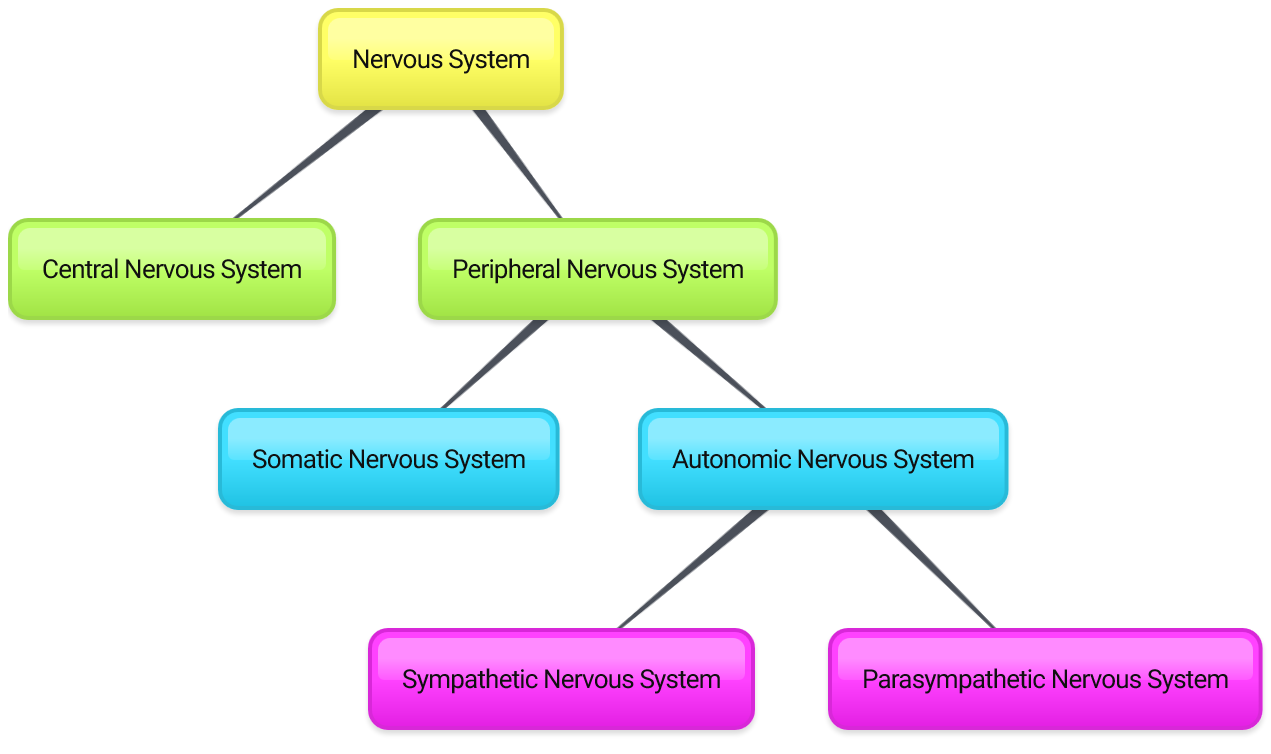
The nervous system is divided into 2 sections;
Central Nervous System (CNS): This is the brain and the spinal cord
Peripheral Nervous System (PNS): This is the nerves that connect to the rest of the body. The PNS is split into 2 parts;
Somatic: This includes our senses and the motor neurons
Autonomic: This includes our organs and other involuntary actions such as the digestive system. The Autonomic System is further split into 2 separate parts.
Sympathetic: This is responsible for the activation of stress/arousal (fight or flight)
Parasympathetic: This is responsible for relaxing the body after the sympathetic system does it’s job (mine is apparently weak)
Neuron: These are brain nerve cells that handle information processing
Glial Cells: These brain cells that provide support and nutritional benefits.
Mirror Neurons: These are brain cells that activate when we watch an action instead of doing the action ourselves. They are also responsible for empathy and we are able to understand other’s positions.
Neuron
Cell Body
Dendrites (Receive Messages)
Axon (Sends Messages)
The Axon is incased in fat cells called the “Myelin Sheath”. Neural information is processed in the Axon hillock and when the charge in the neuron reaches a threshold (-55mV) the neuron fires. There are both positively and negatively charged ions. The negative ions are inside of the Myelin Sheath and the positive ions are outside of the myelin sheath, this helps to carry the action potential along the length of the Axon. These neurotransmitters are sent in large groups called Vesicles. Sometimes after the transmitter can have a Reuptake after use, this is basically recycling the chemical that was used in the signal transmission between the synaptic gap.
Different Types of Neurotransmitters
Dopamine: This neurotransmitter is partially responsible for movement, attention, learning, reinforcement. It has also been linked to Schizophrenia and Parkinson’s
Acetylcholine: This neurotransmitter is partially responsible for movement, learning, memory, REM sleep. It has also been linked to Alzheimer’s.
Serotonin: This neurotransmitter is partially responsible for mood, sleep, appetite, impulsivity, aggression. It has also been linked to Anxiety, Depression, and Eating Disorders.
Endorphins: This neurotransmitter is partially responsible for relief from pain, feelings of pleasure, and wellbeing.
There are are drugs that can inhibit (antagonist neurotransmitters), or mimic/increase (agonist neurotransmitters) the effects of neurotransmitters.
Parts of the Brain
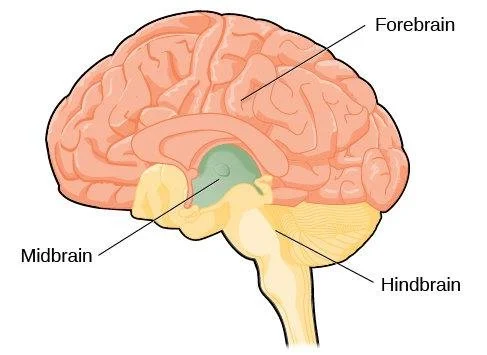
Hindbrain
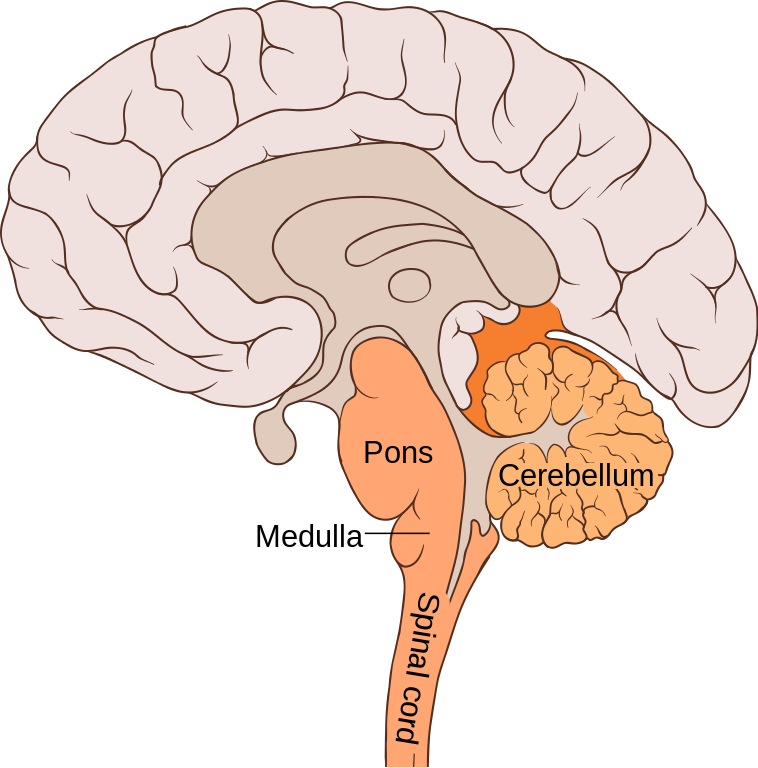
Medulla
The Medulla begins where the spinal cord enters the skull
The Medulla controls vital automatic functions (heartbeat, breathing, etc.)
The Medulla controls reflexes such as coughing, vomiting, and sneezing
Pons
The Pons is the bridge that connects the Cerebellum and the brain stem, it also contains fibers involved in sleep and arousal
Cerebellum
The “Little Brain” controls complex motor movements
Brain Stem
The brain stem connects at the spinal cord and extends upward. It is a primitive structure that includes much of the hindbrain. The Cerebellum is not included in the brain stem.
Midbrain
The Midbrain relays Physiological messages from the hindbrain to the cognitive functions of the forebrain. Some parts include the Substantia Nigra (Dopamine Center) and the Reticular Formation (Network of neurons/nerves responsible for general alertness and consciousness)
Forebrain
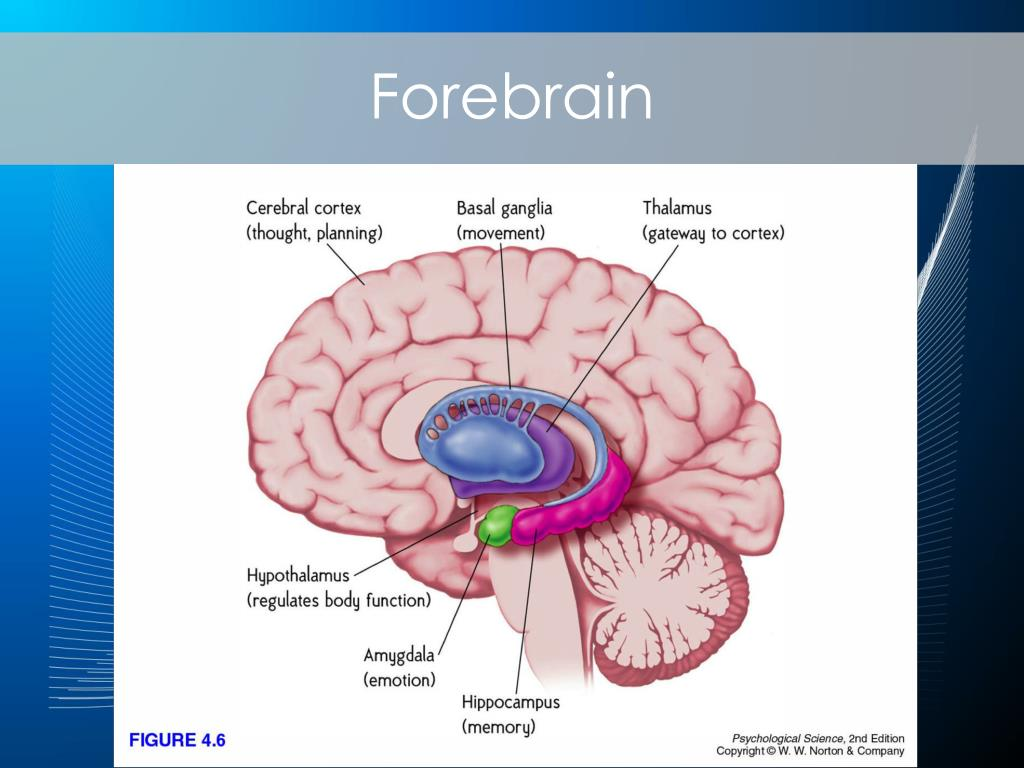
Thalamus
The Thalamus is a relay station for all sensory messages, except for smell
Hypothalamus
The Hypothalamus regulates hunger, thirst, sexual behavior, emotional behavior, internal body temperature, etc.
The Limbic System
The Limbic system is a collection of brain structures that account for emotional expression, memory, and motivation
Amygdala: The Amygdala is responsible for intense emotional responses like fear; also links emotion to memories
Hippocampus: The Hippocampus stores new memories, give us our internal “map” (navigation skills)
Cerebral Cortex
The Cerebral Cortex is responsible for higher mental processes of language, memory and thinking
The Cerebral Cortex is split into 4 different lobes
Frontal Lobe: The frontal lobe is the motor area, it controls our voluntary movements, the frontal lobe is also home to Broca’s Area (Speech production)/ It is also associated with thinking, planning, and impulse control.
Parietal Lobe: This is the somatosensory area, home to touch and pain sensors and awareness of body placement.
Temporal Lobes: This is the primary Auditory Cortex. It is also home to Wernicke’s Area (ability to understand language)
Occipital Lobes: This is the primary Visual Cortex
Corpus Callosum
The Corpus Callosum are nerve fibers that connect the two hemispheres of the brain
They transfer information and synchronize the activity between hemispheres.
The Divided Brain
The brain is divided into 2 hemispheres. The right side is responsible for controlling movement and feelings on the left side of the body. It also receives visual information from the left side of the body. The Right side of the brain is additionally responsible for Music processing, emotional thinking, and perceiving visual-spatial relations. The left hemisphere is responsible for controlling movement and feelings on the right side of the body. It also receives visual information from the right side of the body. The left hemisphere is additionally responsible for Spoken and written language, numerical skills, and reasoning (Logic).
Genes and Environment
Genes: Genes are biochemical units of heredity, coded instructions to carry out genetic characteristics
Behavioral Genetics: Behavioral Genetics attempts to determine how much of our behavior is genetic vs. the environment
Heritability: Heritability is the statistical measure of how much as trait is inherited and how much is because of other factors.
Twin/Adoption Studies: Twin/Adoption Studies are ways to test heritability
Sensation and Perception
Sensation: Sensation is the process of receiving stimulus energies from the external environment and transforming those energies into neural energies.
Perception: Perception is the process used to arrive at a meaningful interpretation of sensations.
Bottom-Up Processing: Bottom-Up Processing stats with the actual physical messages - sensory receptors receive information and send it up to the brain.
Top-Down Processing: Top-Down Processing starts with cognitive processing in the brain. Knowledge, beliefs, and expectations are used to organize and interpret the incoming information.
Sensory Receptor Cells: These are specialized cells within sense organs that transmit stimulus information to sensory nerves and the brain.
Absolute Threshold: This is the smallest magnitude of a stimulus that can be detected.+
Difference Threshold: This is the smallest detectable difference between two stimuli.
Weber’s Law: The difference threshold between two things depends on the strength of the original stimulus.
Sensory Adaptation: The is the change in responsiveness due to the average level of surrounding stimulation.
Vision
Your eyes must have light to be able to see
Light is one form of electromagnetic energy, light is made up of different components;
Hue: The Wavelength of light gives us color
Brightness: The Intensity of light is due to changes in the amplitude, this is determined by the amount of light falling on an object
Purity: Complexity of light, this is determined by a mix of wavelengths present. It influences saturation or the richness of the perceived colors.
Light must be directed toward the receptor cells in the back of the eye. Reflected wavelengths of an object are scattered about and must be focused to process an image. The eye is made up of many parts;
Cornea: Light first passes through this protective coating on the surface of the eye. The cornea participates in the focusing process.
Pupil: Light next travels through the opening in the middle of the iris (the black part)
Iris: This is the colored part of the eye that regulates the amount of light that enters the eye.
Lens: Light next travels through here, the transparent portion of the eye behind the pupil that focuses light onto the retina. Focusing happens by changing the shape of the lens (muscles contract and the lens is thicker and rounder when an object is close)
Retina: Images fall here, sensory receptor cells are here. This is a thin layer of tissue that covers the back of the eye. These receptor cells change the light energy into electrochemical impulses. These cells contain substances called photopigment, which reacts to light, and this chemical reaction leads to a neural impulse. The Retina has 2 types of receptor cells and is made up of a couple sub-parts.
Rods: These are the receptor cells that are more sensitive to light and are needed to generate visual signals (120 million cells per eye)
Cones: These are the receptor cells that code information about fine detail and the early process of color, which need high levels of light to operate. (6 million cells per eye)
Fovea: This is the central spot in the retina where the cones are concentrated, this is why things we look at directly are the most focused.
Optic Nerve: These are a collection of nerve fibers that carries visual neural messages to the brain. The area where the optic nerve connects to the eye has no rods or cones, therefore is a blind spot.
Color vision
Trichromatic Theory: This is the first level of color processing. This theory states that there are 3 different kinds of cones in the eye and that each respond to light in either red, green, or blue wavelengths. Therefore all sensations of colors results from stimulating a combination of these 3 types cones.
The Opponent Process Theory: This is the second level of color processing. In addition to the 3 main types of cones, there are “opponent process mechanisms” certain colors are specifically linked.
Gestalt’s Principles of Perceptual Organization
Proximity: Things that are close together are grouped together in the mind as if they belong together
Closure: Incomplete figures tend to be seen as complete because our brain fills in missing information
Similarity: Similar things are see as being related
Figure-Ground Concept: When we see something, we separate an image into a figure and a ground. Whatever is the center of our attention is the figure, whatever is in the background is the ground.
Depth Perception
Monocular Cues: These are the types of cues in the environment that suggest depth and can be seen by only 1 eye.
Familiarity/Relative Size: The brain knows that both the farther away and smaller something is, the smaller the image on the retina. So, the brain uses the size of the retina image and combines it with what it already knows about a familiar size to figure out how far away it is.
Height in field of view: Things that are higher in a picture are perceived to be farther away
Linear Perspective: Parallel lines receding far into the distance converge on a point. Closer together lines must be farther away.
Overlap: Something that conceals or overlaps something else is closer
Shading: The position of light relative to the viewer impacts shading, which helps our brain draw conclusions about where things are located.
Texture Gradient: Texture becomes more indistinct/denser/finer as it becomes farther from a viewer
Binocular Cues: These are the types of cues in the environment that suggest depth and use both eyes.
Convergence: This is when both eyes angle inwards as an object gets closer to us and our eyes converge
Retinal Disparity: Due to the fact that each retina is a few inches apart, they have slightly different images and this helps with depth perception.
Perceptual Constancy
Color Constancy: We understand that colors do not change despite different conditions of light
Size Constancy: The size of an object does not change
Shape Constancy: The shape of an object does not change
Hearing
Sound: This is a type of mechanical energy that travels in waves, the physical message is delivered to the auditory system. A vibrating stimulus pushes air molecules into space, where they collide with other molecules. The rate of the vibrating stimulus determines the frequency, which determines the pitch. The pressure of the amplitude of a wave determines the intensity or loudness of a sound.
Sound waves enter the ear through the Pinna which helps capture the sound. The sound is then funneled down the Auditory Canal toward the Ear Drum (tympanic membrane), which responds to the sound by vibrating at the same frequency. The vibration pattern of the ear drum is transmitted through the Middle Ear (portion between the ear drum and cochlea, containing 3 small bones that help intensify vibration patterns). The vibration pattern makes it to the inside of the inner ear and the Cochlea, where the sound energy gets translated to a neural impulse.
Inside the Cochlea
Basilar Membrane: This is the base for the sensory cells of hearing. Flexible membrane running through the Cochlea that through its movement displaces the auditory receptor cells, or hair cells, lying along it. As tiny hairs (Cilia) are bent through movement of this tiny membrane, receptor cells fire.
Auditory Nerve: These are neural impulses generated by the hair cells that leave the Cochlea along this nerve.
Other Sense Systems
Touch: Based on pressure, the message delivered is mechanical energy, this is because the cells in the skin are deformed due to pressure. This provides the neural impulse
Temperature: Cold and Warm fibers respond to cooling and heating of the skin by increasing neural impulse production
Pain: Adaptive reaction that generates a response to a stimulus that is causing tissue damage
Control Theory of Pain: There are neural gates (endorphins) that control the transmission of pain impulses. The gate can be open or closed, and critical pain signals can be blocked from reaching higher neural centers when necessary
Phantom Limbs Pain: Amputees often feel the amputated limb as if it is still there and sometimes feel pain in the missing limb. “Muscle Memory” Theory - the neurons in charge of the missing limb don’t know that its gone - but eyes see that the limb is gone this causes a mismatch between eyes and neurons
Smell (Olfaction): Airborne molecules enter the nose, receptor cells in the upper region of the nasal cavity contain tiny hairs, which bond with airborne molecules and generate a neural impulse. Then it gets transferred to the Olfactory Bulb in the brain for processing
Taste (Gustation): This consists of 4 basic tastes (Sweet, Bitter, Salty, Sour), these are detected by Tastebuds which are on the tongue code for taste which is processed in the somatosensory cortex.
Flavor: A rich psychological experience influenced by taste, smell, visual cues, and expectations.
Supertasters: These are people who have relatively more taste buds than non-tasters
Speech Perception: One example of how this can be effected is through the “McGurk Effect” (The way that mouth movement affects hearing)
Consciousness
Consciousness is subjective awareness of external events and internal sensations under a condition of arousal.
Locked-In Syndrome: A condition where the victim is totally paralyzed but still conscious of the world around them.
Awareness is made up of four main parts: Thoughts, Feelings, Sensations, and External Stimuli
Arousal: The physiological state of being engaged with the environment
Metacognition: Thoughts about your thinking
Theory of Mind: We also recognize that other people have their own, different private thoughts and feelings about their own independent experiences
Levels of Consciousness
Higher Level Consciousness: Involves controlled processing in which the individuals actively focus their efforts on attaining a goa;, this is the most alert state of consciousness
Lower Level Consciousness: Includes automatic processing that requires little attention, it also includes daydreaming
Altered States of Consciousness: Can be produced by drugs, trauma, fatigue, possibly hypnosis, and sensory deprivation
Subconscious Awareness: Can occur when people are awake as well as when they are sleeping and dreaming
No Awareness: Freud’s belief that some unconscious thoughts are too laden with anxiety and other negative emotions for consciousness to admit them.
Attention: The internal processes that set priorities for mental functioning
Selective Attention
Cocktail Party Effect: We can focus on just one auditory stimulus, and tune the other stimulus out.
Dichotic Listening Task: Participants get two different messages pumped into each ear and are asked to tune out one ear and just repeat the message in the other ear
Automaticity: The fast and effortless processing that requires little or no focused attention. Not under higher conscious control.
Sleep
Sleep is a type of subconscious. Transitions from sleep to waking is an example of a Circadian Rhythm. Blue light from screens inhibit melatonin.
Sleep Spindle: Trains of high frequency waves
Sleep Cycle:
Stage N1: Lightest Sleep - some claim thoughts are simply drifting. Theta waves begin, which are a bit larger in amplitude and more irregular than the alpha waves experienced when you are relaxed/drowsy just prior to sleep
Stage N2: Somewhat more deeply asleep. Brain still reacts to loud noises, sleep spindles occur.
Stage N3: Deep Sleep, if woken up in this stage, people often act confused. Delta waves (more synchronized and slow). Heart and breathing slow, blood pressure and brain activity at lowest points in 24 hour period.
REM Sleep: This occurs 70-90 minutes into a sleep cycle. Called “active sleep” or “paradoxical sleep”. Internally there is intense brain activity, brain temperature rises rapidly, Epinephrine leads to increases in blood pressure, heart rate, and respiration. Externally, the body appears calm. Large muscles become paralyzed, eyes dart around, dreaming occurs in 80% of people. Consolidates learning and memory.
Sleep Deprivation can result in difficulty concentrating, general irritability, decrease of cognitive functioning, impairs learning, long-term health effects, technically could be fatal.
Variations in Human Sleep
Infants and young children sleep 16 hours a day. They have the highest amount of REM and slow wave sleep.
Ages 6-puberty people usually go to sleep and wake up at the same time every day
Adolescents sleep patterns are influenced by schedules, they need sleep for brain growth, poor sleep may contribute to poor school performance.
Dreams
Cognitive Theory: Dreams should be viewed as a mental simulation that is very similar to our waking thoughts
Activation-synthesis Theory: The brain attempts to give a meaning to random activity that occurs while we sleep. The cerebral cortex is synthesizing random neural signals generated from the lower parts of the brain while we sleep.
Sleep Disorders
Insomnia: This is the difficulty stating or maintaining sleep, due to stress, emotional issues, alcohol use, medical conditions, or learning
Somnambulism (Sleepwalking): This occurs during partial arousal from deepest sleep
Somniloquy (Sleeptalking): This occur during any sleep stage and is usually genetic.
Nightmares: These are frightening dreams that occur during REM sleep.
Sleep Terror: This happens during partial arousal from deepest sleep, usually begins with a piercing scream.
Narcolepsy: This is the sudden extreme sleepiness “sleep attacks”. This causes a person to enter REM sleep directly
Sleep Apnea: This is the failure to breath properly during sleep.
Hypnosis: This is an altered state of consciousness, or psychological state of altered attention and expectation in which someone is very receptive to suggestions. The process of hypnotizing happens in 4 steps;
The distractions are minimized
The individual is told to concentrate on something specific
The individual is told what to expect
The individual is told certain obvious event/feelings are suggested
Divided State of Consciousness: This is the theory of hypnosis that states, when hypnotized your consciousness is split into two different parts. The part that is obedient to the hypnotist and a hidden observer
Social Cognitive Behavior: It is a normal conscious state and we act as told because of the social expectations for how to act when hypnotized.
Meditation: A peaceful state of mind, being mindfully present of thoughts/feelings but not consumed by them.
Focused Attention
Open Monitoring
Cognition: How information is processed and manipulated when remembering, thinking, and knowing
Steps in Problem Solving:
Find the frame of the problem
Develop good problem-solving strategies
Evaluate Solutions
Rethink and Redefine problems and solutions over time
Well-defined Problem: It has a clear goal, a clear starting point, and it is easy to know when we have a solution
Ill-defined Problem: It has no clear goal, no clear starting point and no way to evaluate our progress
Functional Fixedness: This is the tendency to see objects and their functions in certain fixed and typical ways, allowing preconceptions to lock you into an incorrect view of problem
Heuristic: This is a mental shortcut that provides quick estimates for judgements and decisions
Types of Heuristics and Biases
Anchoring Heuristic: Using a starting point to estimate how frequent or likely an event is, and then making adjustments up or down from this starting point
Representative Heuristic: The tendency to judge the frequency or likelihood of an event by the extent to which it “resembles” the typical case
Availability Heuristic: The tendency to judge the frequency or likelihood of an event by the ease with which relevant instances come to mind
Loss Aversion Bias: Losses loom larger than equivalent gains. So, people are less likely to take a risk when it is framed as a potential loss, instead of a potential gain
Endowment Effect: This is the tendency for people to place a higher value on things that they own
Sunk Cost Fallacy: This is the tendency for people to keep investing is something purely due to the fact that they have already invested in it
Confirmation Bias: This is the tendency for people to confirm their expectations. They seek out and notice information that is consistent with their beliefs and ignore the information that is not
Tendency to Ignore Base Rates: This happens when you use the representative heuristic to perceive/judge something as being likely if it resembles the typical case, disregarding actual likelihood
Conjunction Error: If only 1 statement can be true and one of the 3 possible answers in a conjunction the other 2 answers, we tend to choose the conjunction, despite logically if only one of the answers can be true, it cannot be a conjunction of the other 2 because that would imply that all responses are true.
First Instinct Fallacy: The first instinct fallacy refers to the cognitive bias where individuals tend to stick with their initial judgment or choice, even when presented with new information that suggests a different answer may be more accurate. This fallacy highlights the difficulty in changing one's mind and the overconfidence in first impressions.
Cognitive Misers: These are people who have a reluctance to do much extra thinking
Thinking and Decision Making Systems
System 1: This is the thinking and decision making system that is more automatic, rapid, heuristic, associative, and intuitive
System 2: The is the thinking and decision making system that is more controlled, slower, analytical, and requires more effort
Memory
Memory is the retention and retrieval of information and experiences over time. Memory can be further divided into 3 parts:
Encoding: How memories are initially acquired
Storage: How memories are maintained
Retrieval: How stored memories are recovered/translated into performance
Effective Encoding requires Attention, Deep processing, Elaboration, and Use of Imagery
Shallow Processing: Noting physical features
Intermediate processing: Recognizing it/giving it a label
Deep processing: Thinking about their meaning
Atkinson and Shiffrin Multi Store Memory Model (1968)
This model proposes that memory storage involves 3 processes
Sensory Memory: After a stimulus disappears, the brain retains very briefly the raw sensations. Materials stays in sensory memory for only about ¼ of a second for visual information (icon) and 2 seconds for auditory information (echo). Sensory memory has a large capacity
Short term Memory: Not everything makes it to Short Term Memory, usually the information that the individual was selectively attentive to. Short Term Memory has a very limited capacity of about 5 to 9 items. There is a longer span than sensory memory of about 30 seconds. The information in short term memory is not an exact copy of environmental stimuli. Information can stay in Short Term Memory for longer with rehearsal (internal repetition). It can also store more information with chunking
Long Term Memory: Long Term Memory has practically unlimited storage, the validity of the information in Long Term Memory can vary as information is Long Term Memory tends to become distorted. Information in Long Term Memory can feed back to Short Term Memory upon recall.
Chunking: The process of grouping information together (U, S, A —> USA)
Working Memory: This is an update to Atkinson and Shiffrin’s model made by Baddeley and Hitch in 1974. It replaces Short Term Memory with Working memory and provides further cognitive distinctions to certain short term memory processes.
Explicit (Declarative) Long Term Memory: Conscious Recollection information
Episodic Memory: The memory of things we have personally experienced
Semantic Memory: Memory of general knowledge and facts and word meanings
Implicit (Non-Declarative) Long Term Memory: Unconscious Recollection Information
Procedural Memory: Memories of common physical procedures/muscle memories
Classical Conditioning: Classical conditioning is a learning process in which a neutral stimulus becomes associated with a meaningful stimulus, eliciting a conditioned response through repeated pairings.
Priming: A psychological phenomenon where exposure to a stimulus influences a response to a subsequent stimulus, often without conscious guidance or intention.
Schema: A Pre-existing mental framework of how we store information