Reproductive Processes in Biology
Biology is fundamentally the story of life on Earth, encompassing a broad range of topics such as evolution, ecology, anatomy, and physiology. It involves the study of living organisms, their interactions, and their environments, along with the biological processes that define life, from cellular functions to intricate ecological dynamics. Key branches of biology include molecular biology, genetics, microbiology, botany, zoology, and evolutionary biology, each examining different aspects of life.
Individual organisms may die, but species can persist for millions of years unless they are threatened by environmental changes, habitat loss, or extinction events. The concept of evolution, driven by natural selection, explains how species adapt to their environment over time through genetic variation, survival advantages, and differential reproduction based on traits. The preservation of biodiversity is crucial for ecosystem stability and species resilience to environmental changes.
Reproduction is a vital process for species survival, occurring either through asexual or sexual means. Asexual reproduction, such as budding or binary fission, yields genetically identical offspring, whereas sexual reproduction involves the fusion of gametes, generating new variants that enhance genetic diversity. This diversity is critical for the resilience and adaptability of populations, especially in changing environments.
This unit covers reproductive processes in flowering plants and humans, inclusive of discussions on human reproductive health, which engage both biological and social aspects, such as reproductive rights and health education.
Structure of the Unit
Chapter 1: Sexual Reproduction in Flowering Plants
Exploration of mechanisms of sexual reproduction, with an emphasis on flower anatomy and various pollination strategies.
Discussion on the importance of pollinators like bees and butterflies for biodiversity and ecological balance.
Chapter 2: Human Reproduction
Overview of human reproductive systems, including anatomical structures and physiological functions, highlighting aspects of sexual health.
Examination of reproductive technologies such as in vitro fertilization (IVF), contraception, and associated ethical considerations.
Chapter 3: Reproductive Health
Focus on reproductive health issues, including menstrual health, infertility, birth control methods, and prevention of sexually transmitted infections (STIs).
Panchanan Maheshwari (1904-1966)
Maheshwari was a renowned and instrumental botanist in advancing plant embryology. He founded the Department of Botany at the University of Delhi, where he significantly contributed to botanical education in India. He popularized embryological classification in taxonomy, establishing a framework for studying plant development. His innovations include the artificial culture of immature embryos, which influenced plant breeding and agricultural practices. Additionally, he authored the first NCERT biology textbook for schools in 1964, shaping biology education for generations.
Importance of Flowers in Sexual Reproduction
Flowers are the primary site of sexual reproduction in angiosperms (flowering plants). They play essential roles in promoting biodiversity and maintaining ecological balance. Specialized structures have evolved for successful reproduction, and flowers have substantial aesthetic, cultural, and economic implications that impact human endeavors, such as art, literature, and industry. For biologists, flowers are both embryological and morphological marvels that serve as sites of sexual reproduction with numerous adaptive features.
Flower Structure
According to Goethe, a flower represents a modified shoot, which is an organ of angiosperms facilitating reproduction. Key components include:
Androecium: The male reproductive part, composed of stamens which produce pollen.
Gynoecium: The female reproductive part, comprising pistils containing ovules.
Inflorescence: The arrangement of multiple flowers in a cluster, enhancing pollination efficiency and reproductive success.
Thalamus: A modified stem with nodes and internodes. The whorls in flowers are modifications of leaves organized into four circles: calyx (sepals), corolla (petals), androecium (stamens), and gynoecium (pistils), each playing critical roles in reproduction.
Anthophore: When the internode length between the calyx and corolla increases (e.g., Silene plant).
Androphore: When the internode between the corolla and androecium increases (e.g., Passiflora).
Gynophore: Increased internode length between the androecium and gynoecium, elevating pistils above stamens for better pollination efficiency (e.g., okra and hibiscus).
Androgynophore: Presence of both androphore and gynophore in a flower, promoting effective pollination and fertilization (e.g., certain orchids).
Sepals: Modified vegetative leaves.
Monocarpic plants: Flower and fruit only once in their lifespan.
Polycarpic plants: Can flower and fruit multiple times throughout their lifespan.
Reproductive Structures
Stamen Components:
Filament: Slender stalk supporting the anther.
Anther: Produces pollen grains essential for fertilization; it is equivalent to microsporophyll. The anther and filament connect through a region called connective, which contains vascular tissue.
Structure of anther: As we know anthers are dithecous and contain 4 microsporangiums, two in each lobe, which develop into pollen sacs where pollen grains are formed. Microsporangia (Microsporangia = Pollen sac) is surrounded by 4 diff. layers of tissue known as the tapetum, which nourishes the developing pollen, the epidermis, the endothecium, and the middle layer, which collectively aid in the protection and eventual release of pollen. Pollen grains, once mature, are released into the air or transferred to the stigma of a compatible flower, initiating the fertilization process and ultimately leading to seed development.
Microspore mother cells (MMC), also known as pollen mother cells, are found within the pollen sacs (also called microsporangia) of the anther
Pollen Grain:
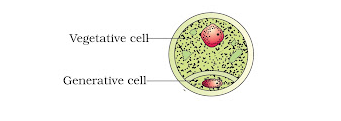
Represents the male gametophyte, typically containing two cells (vegetative and generative) or three cells in some species; crucial for successful fertilization.
The exine (outer layer made of sporopollenin) provides protection against environmental factors. No enzyme that can degrade sporoppollenin has been known till now. It can withstand high temp. , strong acids and is alkali.
Pollen grains are well preserved as fossils because of the presence of sporopollenin.
Intine: The inner layer of the pollen grain, made of cellulose and pectin, plays an essential role in the growth of the pollen tube during fertilization.
Generative cell: It is the smaller cell which floats in the cytoplasm of vegetative cell. It has dense cytoplasm and nucleus. It is responsible for production of male gametes.
Vegetative cell: It is the larger cell. It provides nutrition to developing male gametes. It is the food reserve.
Pistil Structure
Components include:
Stigma: Sticky surface that receives pollen grains.
Style: Structure connecting the stigma to the ovary, facilitating pollen tube transport.
Ovary: Houses ovules developing into seeds post-fertilization; ovules derive from the placenta in the ovary through megasporogenesis.
Ovule: The structure contained within the ovary that develops into seeds after fertilization, formed from the megasporangium and containing the female gamete.
Pollination Mechanisms
Types of Pollination:
Autogamy: Self-pollination within the same flower ensures reproduction without external pollinators.
Geitonogamy: Self-pollination among different flowers of the same plant to enhance genetic variation while maintaining reproductive success.
Xenogamy: Cross-pollination between different plants to increase genetic diversity, vital for adaptation.
Pollination Agents:
Abiotic: Wind and water as non-living pollinators.
Biotic: Insects and birds essential for transferring pollen between male and female structures.
Pollen-Pistil Interaction
Critical for successful fertilization, this interaction involves pollen recognition by the pistil, determining acceptance or rejection based on compatibility. This mechanism prevents inbreeding, ensuring healthy offspring.
Double Fertilization
Unique to flowering plants, one sperm fertilizes the egg to form the zygote (future embryo), and another sperm fuses with two polar nuclei to produce a triploid endosperm nucleus that becomes the nutritional tissue for the developing embryo during seed development.
Embryo Development
Development stages include:
Proembryo: Early stage of embryo development.
Globular: Formation of embryonic axes.
Heart-shaped: Further tissue differentiation and structural development.
Mature embryo: Fully developed state ready for seed formation.
Dicotyledons have two cotyledons for energy and nutrients during germination, whereas monocotyledons have one.
Seed Formation and Structure
Seeds are the mature ovules crucial for angiosperm propagation. Components include:
Seed coat: Protective outer layer.
Cotyledons: Seed leaves storing nutrients.
Embryonal axis: Part that develops into the new plant.
The significance of seeds lies in their reliable reproduction and adaptive advantages allowing plants to survive adverse conditions.
Special Mechanisms
Apomixis: Seed formation without fertilization, mimicking sexual reproduction; advantageous for producing seeds genetically identical to the parent plant.
Polyembryony: Occurrence of multiple embryos within a single seed, increasing offspring potential (e.g., orange seeds with multiple embryos).
Exercises for Understanding
Identify reproductive structures in angiosperms.
Differentiate between microsporogenesis and megasporogenesis.
Explain the significance of double fertilization in flowering plants.
Discuss strategies to prevent self-pollination, including flower manipulation and genetic engineering techniques.
Describe the bagging technique in plant breeding, entailing the covering of flowers with protective bags to control pollination and improve hybridization outcomes.