AP Psychology - Research Methods & Statistical Analysis
Research Methods
● Types of Research
○ Experiments
○ Correlational studies
■ Relationship between two events
■ It is not enough to simply find a relationship
■ Significance is when the relationship is not due to chance (see below) ■ Advantage: they happen outside of the lab
■ Disadvantage: they do not prove causality (x causes y).
■ Usually showed in scatterplots
● If the line goes up and to the right, the relationship is positive ● If the points are completely random, there is no relationship ● If the line goes down and to the right, the relationship is negative ● Correlation coefficient: a statistical measure of how strongly related any two sets of scores are (aka x and y)
○ Between +1.0 and -1.0
○ +1.0, one set of scores increases in direct proportion to
increases in the other set (positive relationship)
○ 0, there is no relationship
○ -1.0, one set of scores goes up precisely as the other goes
down.
○ The stronger the relationship, the closer to -1 or 1. The
weaker it is, the closer it is to 0.
○ There is a perfect correlation for coefficients of either 1 or
-1
○ Survey Research
■ Includes giving participants lists of questions to be answered, which can be delivered as paper-and-pencil questionnaires, administered
electronically, or conducted verbally.
■ Advantages: cheap because of free software and websites make distributing these easily, they’re easy because people without training can
make surveys, and, finally, multiple variables can be examined at the same time
■ Disadvantaged: badly written/biased questions, people might misinterpret questions, it only provides “shallow” information (broad but not deep), and can not prove causality
○ Naturalistic Observations
■ Observing behavior in its natural setting where observers are normally unnoticed
■ Advantage: real behavior (not affected by lab settings), no reduced Hawthorne Effect or Demand Characteristic
■ Disadvantage: Might not be studying what you think you’re studying (if someone comes to your school, they’re not really going to get a valid picture because every day is different), there’s no control over the experiment, and you cannot prove causality
○ Case Studies
■ A study that focuses on one person or simply a few individuals ■ Examples include Phineas Gage (the guy with a rod in his head in the 1800s) or Clive Wearing (the guy who forgets things a lot)
■ Advantages: researchers can dig deep to find relationships or other ideas to make a hypothesis, and it’s the opposite of a survey
■ Disadvantages: time-consuming, subjects to not represent all of society, and these cannot prove causality
○ Longitudinal Studies
■ When the researcher follows the same participant or same group (Cohort) of participants for an extended period
■ Advantages: you get to find new confounding variables, can be used in a variety of other research methods (case studies, surveys [2 surveys over four years])
■ Disadvantages: time-consuming, expensive, difficult to control (odd variables may show up — maybe a car accident), does not prove causality ○ Cross-Sectional Studies
■ When a researcher compares multiple segments of the population at the same time (Example: online vs face to face education)
■ Advantages: you gather data immediately, can be used in other research methods (2 opposing case studies)
■ Disadvantages: only a snapshot (example: the one day your parents check your grade may be the day your teacher accidentally put in a missing
assignment)
● Operational Definition (for this study, we define sadness as the number of tears you cry) and Measurement (FRQ’s will use these words: operationally defining, operationalize)
○ You must define your hypothesis
■ Example: how effective is online school?
■ What is an online school? Is it using Zoom? Google Classroom?
■ How do you measure it? GPA? Student feelings?
○ Empiricism: measurable and observable
■ Your hypothesis should have empiricism
● Validity and Research Design
○ You must have facts
○ Everything must be defined (sadness = the number of tears shed)
■ Advantages: allows for scientific measurement
■ Disadvantage: oversimplifies the issue (sadness isn’t just the number of tears you cry )
Experimental Method and Ethical Guidelines
● Independent Variable (IV) — Given to the Experimental (Treatment) Group ○ Also called “the treatment”
○ Think of the question as a hypothesis…
■ If _____ then _____
■ The “if” is the IV
● Dependent Variable (DV)
○ Data the researcher receives (the results)
○ You’re looking for what changes
○ There are two possible errors with DV’s
■ False alarm, there really wasn’t actually a relationship
■ There was some sort of change, but you don’t notice (example: side
effects that you don’t notice until later cause you weren’t looking for
them)
● Control Variables: steps taken by researchers to eliminate any confounding variables from the experimental design so that the only difference between the control and experimental groups is the independent variable (NOT THE CONTROL GROUP) ● Confounding Variables (lurking variable, research bias, bias)
○ Variables that may affect the result of DV that aren’t the IV
○ The more control you have, the less bias comes through (you eliminate every other variable; yay!). However, if there is too much control, people will not behave normally (increase the Hawthorne Effect: people act differently when being watched)
○ Self-Report Bias (surveys only): people may have one idea about themselves, but that’s actually false (you think you’re good at singing but you REALLY
AREN’T)
○ Placebos
■ When people's expectations or beliefs influence or determine their
experience in a given situation
■ Placebo is good for the individual, the placebo effect is bad for research, but the placebo treatment is necessary (given to control group)
■ Example: if studying the effect of caffeine, give experimental group coffee and the control group decaf — they both think they got coffee, but how to actions change? Make sure the coffees have the same temp, taste, etc.
○ Hawthorne Effect (Demand Characteristic)
■ To eliminate, use the single-blind technique (the participant is deceived about something: usually, if they got the placebo or IV)
● Deception is unethical, however
● Participant doesn’t know the hypothesis either
○ Experimenter Bias
■ To eliminate, use the double-blind technique
● The researcher also doesn’t know which participant is in which
group
○ Representation (Representative) Bias (Participants are not representative of the larger population, think demographics
● Random Sample vs Representative Sample
○ Random Sample
■ Everyone in the population has the same chance to be chosen for the sample group (usually impossible, because if you ask for volunteers from your social media, you’ll be limited in that, or if you pass out flyers to random students, some students might be sick)
○ Representative Sample
■ The same proportion of demographic characteristics
■ Example: the average age of the US population is 38, but does your sample have the same average age?
● Random Selection vs Random Assignment
○ Random selection
■ See above
○ Random assignment
■ Those participants have an equal chance of being in either the
experimental group or the control group
■ This helps reduce experimenter bias
● Ethical Issues in Research
○ All experiments cause some anxiety or stress (maybe somebody is late for work but agreed to do this)
○ Some studies need to cause stress or anxiety
■ Is the information worth the pain?
■ Who benefits from this?
○ Institutional Review Board (I.R.B.)
■ Experiments must be proposed to this board to make sure ethics are
looked at
○ Placebo Effect: is it okay to lie to people to look at the results?
○ Fiduciary Responsibility
■ Researchers must put the participant first, even if it means stopping an experiment
○ Informed Consent
■ The subject understands what is going on
● Minors may be too young, people with Alzheimer’s may not
understand
● However, this institutes the Hawthorne Effect
○ Debriefing
■ After the study, the researcher must tell everything to the participant and offer counseling (if stress was involved). Includes information that the
participant may not enjoy, like that the researcher lied.
○ Right to Decline
■ Subjects pay quit participation at any time
○ Confidentiality
■ the researcher/therapist cannot disclose confidential communications to any third party unless mandated or permitted by law to do so
● Considering the Strength of an Experiment
○ Possible ideas: is it easy to replicate (i.e. duplicating an experiment to strengthen confidence in the findings by obtaining the same or similar results), what about ethicality (did they use animals so no humans were harmed and no deception was needed?), or goal (could it lead to the development of a medication?)
Statistical Analysis in Psychology
● Statistics
○ Data exploration techniques designed to aid in the comprehension of large amounts of data
● Inferential Statistics
○ When a researcher analyzes numerical data in order to determine the likelihood that the given findings are a result of systematic (aka apply to a larger population) rather than random fluctuations or events.
○ Let’s say P represents an error, chance, confounding variables, everything that makes an experiment messy
○ If P = .05, there is a 95% chance that your experiment is correct. Anything below this makes the difference not significant and the experiment is not good. ■ P is significant when <.05
○ Null Hypothesis
■ A prediction that there will not be a significant relationship, or that you cannot take a small sample and apply it to a larger population
■ The goal is to disprove the null hypothesis, which, in inferential statistics, predicts the results cannot be applied to a larger population (basically, your P will be big)
■

○ Inferential Errors
■ When a researcher links a smaller group to a larger population when a link does not exist.
● Descriptive Statistics
○ Numerical analysis that summarizes quantitative information about a population (usually the smaller one)
○ Mean: the arithmetic average of scores summed and divided
○ Median: the score that appears exactly in the middle of the whole set ○ Mode: the most frequently occurring score
○ The median and mode are relatively unaffected by the presence of a few extreme scores (outliers), but one extreme score can throw off the mean
○ Skewed Data: occurs when an outlier disproportionately affects the mean ■ Skewed negatively: there’s an extreme outlier that’s really low and pulls the score down more than it should
■ Skewed positively: there’s an extreme outlier that’s really high and pulls the score up more that it should
○ Charts
■ IV on x, DV on y
■ Bar charts
● Categorical data (each bar is a category, vanilla ice cream,
chocolate ice cream)
● Columns don’t touch!
● Nominal - name only,
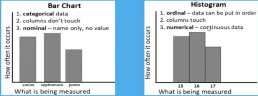
no value
■ Histograms
● Orginal (data can be put
in order)
● Columns touch
● Numerical
○ Dispersion (Measures of Variability)
■ Measures how far the scores differ from the mean
■ Low variability means the scores are close together (high amplitude on graphs)
■ High variability means the scores are spread out (low amplitude on graphs)
■ The range is the highest score minus the lowest
■ Standard deviation: people usually vary about x amount from the average ● The further from the mean you are, the rarer that score is
■ A set of scores with a small range has a small standard deviation ○ Z-Scores
■ Same thing as a standard deviation
■ Helps researchers compare scores from different studies with different standard deviations (used usually when there is a different number of participants)
■ Scores below the mean have a negative Z-score and vice versa ● Example: if Chuck scored a 40 on a test with a mean score of 38 and the standard deviation was 4, what is his z-score? Answer: .5
\n