APUSH Semester Exam
Task List:
I can identify the core beliefs of the following political parties in the 18th and 19th centuries:
a. Democratic Republican - Were the opposition to federalists policies. They wanted the states to have more power than the federal government. They also opposed a national bank because it would give too much power to the federal government. Supported the French
b. Federalist - Were supporters of the ratification of the constitution. They were also in favor of a strong federal government and greater power than the states. Also were in favor of a national bank to collect taxes and pay bills. Supported the British.
c. Democrat - A product of the split of the Democratic-Republicans in the early 1820s. The party wanted limited federal power. The party eventually became very southern focused and supported the institution of slavery. Supported American expansion.
d. Whig - A political party that was formed to oppose the Democratic party and Jacksonian Democracy in the 1830s. To gain support, they attempted to have a diverse coalition from around the country by promoting commercial interests and moral reforms. Was for the national bank, protective tariffs, and the construction of roads and canals.
e. Free-Soil - Founded in 1848 by political abolitionists that promoted the economic benefit of ending slavery, providing more economic opportunities for white Americans in the west.
f. Republican - Was against slavery and was a union of the anti-slavery Whigs and Free-Soil parties. Was in favor of protective tariffs and construction of roads and canals and wanted to give land to farmer in the West.
g. American (Know-Nothing) - Was anti-immigrant and anti-catholic and was formed in the Northeast during the 1840s. Supported workers’ rights against business owners because they saw corporations as supporters of immigration so they could keep wages low. Supported Nativism.
I can identify two significant political figures from each of the following parties:
a. Democratic Republican - Thoma Jefferson, James Madison
d. Federalist - Alexander Hamilton, John Adams
c. Democrat - Andrew Jackson, Jefferson Davis
d. Whig - Henry Clay, John Quincy Adams
e. Republican - Charles Sumner, Thaddeus Stevens
If given a grouping of 4 American presidents from the 18th and 19th centuries I can place them in chronological order.
George Washington
John Adams
Thomas Jefferson
James Madison
James Monroe
John Quincy Adams
Andrew Jackson
Martin van Buren
William Henry Harrison
John Tyler
James Polk
Zachary Taylor
Millard Fillmore
Franklin Pierce
James Buchanan
Abraham Lincoln
Andrew Johnson
Ulysses S. Grant
Rutherford B. Hayes
James Garfield
Youtube presidents song
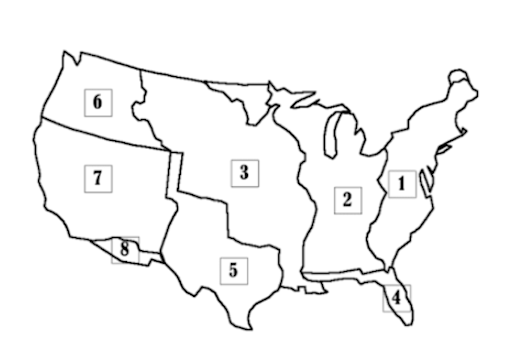
If shown a map highlighting territory gained but the United States I can explain how (and roughly when) the US gained said territory.
Territory 1 came from the American Revolution, from 1776-1783, that the Americans won over the British. From the Treaty of Paris.
Territory 2 came from the Americans victory over the British and the establishment of the Northwest Ordinance (1785). Also from the Treaty of Paris
Territory 3 came from the Louisiana purchase in 1803 that was authorized by Thomas Jefferson.
Territory 4 came from the Adams-Onís Treaty in 1819 where Spain ceded all of its land east of the Mississippi River to the US.
Territory 5 came from the Annexation of Texas in which the US finally allowed Texas into the Union.
Territory 6 came from the Oregon Treaty where the US and Britain resolved shared territory dispute
Territory 7 came from land ceded by Mexico in the Treaty of Guadalupe Hidalgo
Territory 8 came from the Gadsden Purchase in the Gadsden Purchase Treaty
I can identify significant causes of the following conflicts:
a. French and Indian War - Caused by a dispute between the French and British over territories in North America. Specifically there was a trade post opened by the British in the Ohio River Valley, and colonists in the French territories of Virginia and Pennsylvania
b. American Revolution - Tensions before the war were caused by quartering and impressment. Along with the end of salutary neglect, there came an increase in taxes and acts that restricted where colonists could shop. Colonists eventually became fed up when the intolerable acts were passed.
c. War of 1812 - This war is considered the second part of the revolution because Britain was still continuing to practice impressment on American citizens, the British were blocking trade with France, and the British were trading weapons to nearby Native Americans
d. Mexican War - Caused by a dispute between the US and Mexico where the border of Texas was. Mexico believed it was the Nueces River when the US believed it was the Rio Grande. There was also the fact that the US had now annexed Texas into the Union.
e. American Civil War - There was an increasing amount of sectional tensions, especially as the north became Republican and the south Democratic. A series of acts caused the war as well; Compromise of 1850, Fugitive Slave Act of 1850, Kansas-Nebraska Act. Some events that led to it were the Dred Scott Case, Bleeding Kansas, and the election of Abraham Lincoln.
I can identify significant effects of the following conflicts:
a. French and Indian War - Caused Britain to end salutary neglect in the colonies and increase taxes to pay off debts.
b. American Revolution - Gave the United States independence from Britain.
c. War of 1812 - Did not change much for the US and Britain, but Britain stopped impressment. Increased national unity.
d. Mexican War - Mexico ceded all of Texas, Arizona, New Mexico, and parts of Utah, Nevada, and colorado. California declared itself independent during the war but was later annexed into the Union. Brought on sectional tensions about slavery in those lands. Leading to the American Civil War.
e. American Civil War - Led to the abolishment of slavery in all of the United State, created the Thirteenth, Fourteenth, and Fifteenth Amendments, and the era of Reconstruction began which gave rights and attempted to help freedpeople and slowly add the south back into the Union.
I can identify the significance of the following acts of Congress:
a. Alien and Sedition Acts 1798 - The Alien Act was passed by a Federalist controlled Congress that gave the president the ability to imprison of deport noncitizens, and the Sedition Acts put strict conditions on political speech.
b. Embargo Act 1807 - The Act was passed under Thomas Jefferson’s presidency. It prohibited American ships from leaving their home ports until Britain and France repealed their restrictions put on US trade. But the act had a devastating impact on American commerce.
c. Missouri Compromise - An act passed in 1820 that allowed Missouri to enter the union as a slave state and Maine a free state and created a southern border at Missouri as the boundary between slave and free states throughout the Louisiana purchase.
d. Force Bill 1833 - Passed under Andrew Jackson’s presidency by Congress to responded to South Carolina’s ordinance of Nullification. The bill gave the president the authority to use force to enforce national laws.
e. Compromise of 1850 - A series of acts following California’s application for admission into the US as a free state. The acts were meant to ease sectional tensions over slavery by providing something for all sides, but the at ended up fueling more conflicts.
f. Thirteenth Amendment - Was passed on January 31, 1865 during Abraham Lincoln’s presidency. The act prohibited slavery and involuntary servitude in the US.
g. Fourteenth Amendment - An amendment to the Constitution that defined citizenship and protected individual civil and political rights from abridgement by the states. The act was adopted during Reconstruction and the Fourteenth Amendment overturned the Dred Scott Case.
h. Fifteenth Amendment - The amendment prohibited the abridgment of a citizen’s right to vote on the basis of “race, color, or previous condition of servitude.” From the 1870s on, southern states devised multiple strategies avoiding the fifteenth amendment.
i. Sherman Antitrust Act - An act passed in 1890 to outlaw monopolies that prevented free competition in interstate commerce.
j. Pendleton Act - Act passed in 1883 that required federal jobs to be awarded on the basis of merit through competitive exams rather than through political connections.