A Christmas Carol Context
Poor Law
Introduced in 1834
Stated that in order to earn money or support, the poor had to work in the workhouses
Workhouses
Difficult + crowded for inmates
Many lived in slums where disease quickly spread and children had no education
Harsh and unforgiving prisons
Working age was 5
in 1833 'The factory Act on Child Labour' was put into effect which meant that children had to be at least 9 years old to work.
Malthusian Theory
Thomas Malthus was an economist who believed that poverty was a natural product of population growth
Because population was growing, there would obviously be a lack of food and necessities
Dickens’ childhood
Born into middle class family
Father sent to debtor’s prison as a result of financial troubles
Father, John Dickens was a clerk like Bob Cratchit
Cratchit house based on Dicken’s childhood home: 16 Bayham Street, Camden, London
Camden is now in the top 25 richest boroughs in the UK but in 1700s and early 1800s was full of poverty
12 years old, Dickens sent to Warren’s Blacking Factory to live and work by himself for 3 years (Till father got enough money) and experienced poverty first hand
Christmas for Dickens
Daughter Mary Dickens wrote how Christmas with father was full of merriment, dancing and full of guests
Ragged schools
Schools set up to provide basic education
Dickens believe education was the way to combat poverty
Elementary Education Act of 1880 required all children to attend school until the age of at least 10 years old. →Children viewed as an economic liability as they could not go to work.
Victorian Christmas
Gained popularity, especially through the royal family
Prince Albert helped start tradition of decorating Christmas trees
Christmas cards also became a tradition
Why Dickens wrote the novella
Dickens wrote the novella whilst on tour of Italy in 1843, an extremely religious place
Inspired after reading 1843 parliamentary report on Britain’s child labourers and seeing families starving on streets in Manchester when visiting his sister - he was 2 perfectly stricken down by it”
ACC originally thought to be pamphlet titled “An appeal to the people, on behalf of the poor man’s child” but fictional novella thought too be more impactful
Dickens wanted a ‘sledgehammer’ blow + created ACC to have “twenty times the force” of a government pamphlet
Christianity in Victorian society
Values of love, compassion, generosity , family
Holy Trinity reflected in the Three Spirits
Sabbatarianism was rest day where people did not work
Dickens disagreed with blue laws which prohibited leisure on Sundays so stopped poor earning
Dante’s ‘The Divine Comedy’ links
Dickens was a fan of Dante
Divine Comedy and ACC may share similarities
Dante starts his text ‘ Inferno in the Dark Forest’ with the description “savage , rough and stern in the very thoughts renews fear” which has a similar atmosphere to ACC
Divine comedy talks about a religious journey - Hell→Purgatory→Heaven - Stages are similar to ACC
Etymology of names
Ebeneezer Scrooge
‘Ebeneezer’ derives from Hebrew and has links to the word ‘stone’
‘Scrooge’ links to the 16th century word ‘scruze’ which means to squeeze
Jacob Marley
‘Jacob’ is a biblical name- in the Bible , Jacob was a shrewd businessman who became exceedingly prosperous
A ‘Jacobus’ was also a golden coin minted in the 1600s
‘Marl’ is an archaic(no longer used). 11th century word meaning ‘soil’
Bob Cratchit
‘bob’ was Victorian slang for a shilling
‘Cratchit’ suggests the scratching of the clerks pen
‘croquet’(French) means feeble person
Tiny Tim
Timothy is the English form of the Old Greek name Timotheus, which means honoured by God
Tim could be short for ‘timid’
Gothic, supernatural influences and tropes
Traditional to read ghost stories
Gloomy atmosphere
Victorian Life
Tuberculosis and rickets was prevalent - 50 % of population contracted TB and 1% died from it each year
Poor particularly affected by smoggy streets and poor diet
sewage ran through the streets
meat was a luxury
clothes often repaired + dark colours used to hide dirt
card games very popular
tennis ,fishing, cricket played by the rich
Poor- rat catchers, street sweepers, factories
Long hours, had to share a public bathroom
Structure
Novella - short novel
Staves instead of chapters
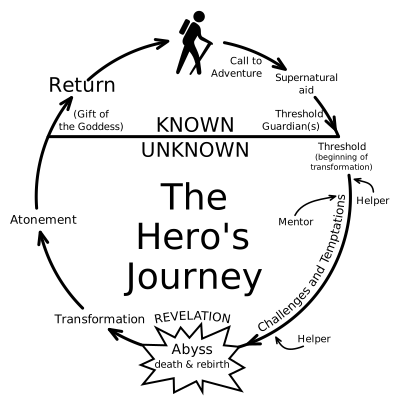
Staves are staffs often used on pilgrimage - pilgrimages are a journey
Follows Hero’s journey - concludes with atonement
The novella
Contradictions
The book included hand painted colourful illustrations which made it expensive to publish - Dickens wanted a book that could reach the poorest yet it cost an enormous amount
Illustrator
John Leach - A distinguished and very famous artis and very close friend of Dickens
Profit
Dickens did not profit much from the novella due to high production costs and many pirated versions which dickens failed to stop
Scrooge
Believed to be based on John Elwes-
Born in 1714
Inherited a fortune whilst young
Went to Westminster school
Member of Parliament for Berkshire
Lived very frugally
Bad clothes, rotting mansion,ate rotting food
Locations
Royal exchange (change) was the official centre of commerce in the city of London
Current exchange opened in the 1840s so would have been very new
Leadenhall market - near Scrooge’s house and work, best place to buy a turkey