Chapter 9: Cellular Respiration & Fermentation
Cellular Respiration and Fermentation is how cells convert the chemical energy in food to ATP.
The chemical energy contained within the bonds and electrons of the food we eat are used to add a phosphate to ADP making it ATP - the energy currency of the cell.
Cellular Respiration:
Energy is stores in bonds of organic molecules.
Catabolic pathways break bonds (exergonic).
Cells convert energy through cellular respiration (in presence of O2) or fermentation (absence of O2).

The bonds in food are potential energy waiting to be released.
Cells release energy through oxidation, but large molecules cannot be oxidized all at once.
Reduction Oxidation Reactions (Redox reactions) - transfer electrons from one substance to another.
Reduction reaction - substance gains electrons
Oxidation reaction - substance loses electrons
LEO = Lose Electrons, Oxidized
GER = Gain Electrons, Reduced
Cellular Respiration is a Redox Reaction:
Cells convert glucose and oxygen into carbon dioxide, water, and ATP.
Glucose loses electrons and is oxidized to carbon dioxide.
Oxygen gains electrons and is reduced to water.
Cells transfer potential energy contained in bonds of glucose to electron carriers.
Electron carriers move electrons to the last phase of cellular respiration.
Cellular Respiration Overview:
1st phase: Glycolysis/“sugar splitting”
Breaks glucose into 2 pyruvate molecules; go to mitochondrial matrix.
One 6-carbon molecule (glucose) to two 3-carbon molecules (pyruvates).
Happens in Cytosol of cell.
Goes in:
Glucose
2 ATP
2 NAD+
Comes out:
2 net ATP; goes to cell immediately.
2 NADH; goes to electron transport chain (ETC).
2 pyruvate molecules; goes to mitochondrial matrix.
2nd phase: Pyruvate Oxidation
Pyruvate is oxidized, bonds with Coenzyme A.
Happens in mitochondrial matrix.
Goes in:
2 pyruvates
2 Coenzyme A
2 NAD+
Comes out:
Forms Acetyl-CoA; goes to citric acid cycle.
2 NADH; go to ETC.
2 CO2; is exhaled.
3rd phase: Citric Acid Cycle (CAC)
Breaks 2 Acetyl-CoA (from the pyruvate molecules).
Happens in mitochondrial matrix.
Goes in:
1 Acetyl-CoA
3 NAD+
1 FAD
Comes out:
2 CO2; exhaled.
1 ATP; cell uses.
3 NADH; ETC.
1 FADH2; ETC.
Remember: there were two Acetyl-CoA produced during Pyruvate Oxidation, each goes through CAC.
So per molecule of glucose, 6 NADH, 2 FADH2, 2 ATP, 4 CO2.
4th phase: Oxidative Phosphorylation
Electron Transport Chain (ETC).
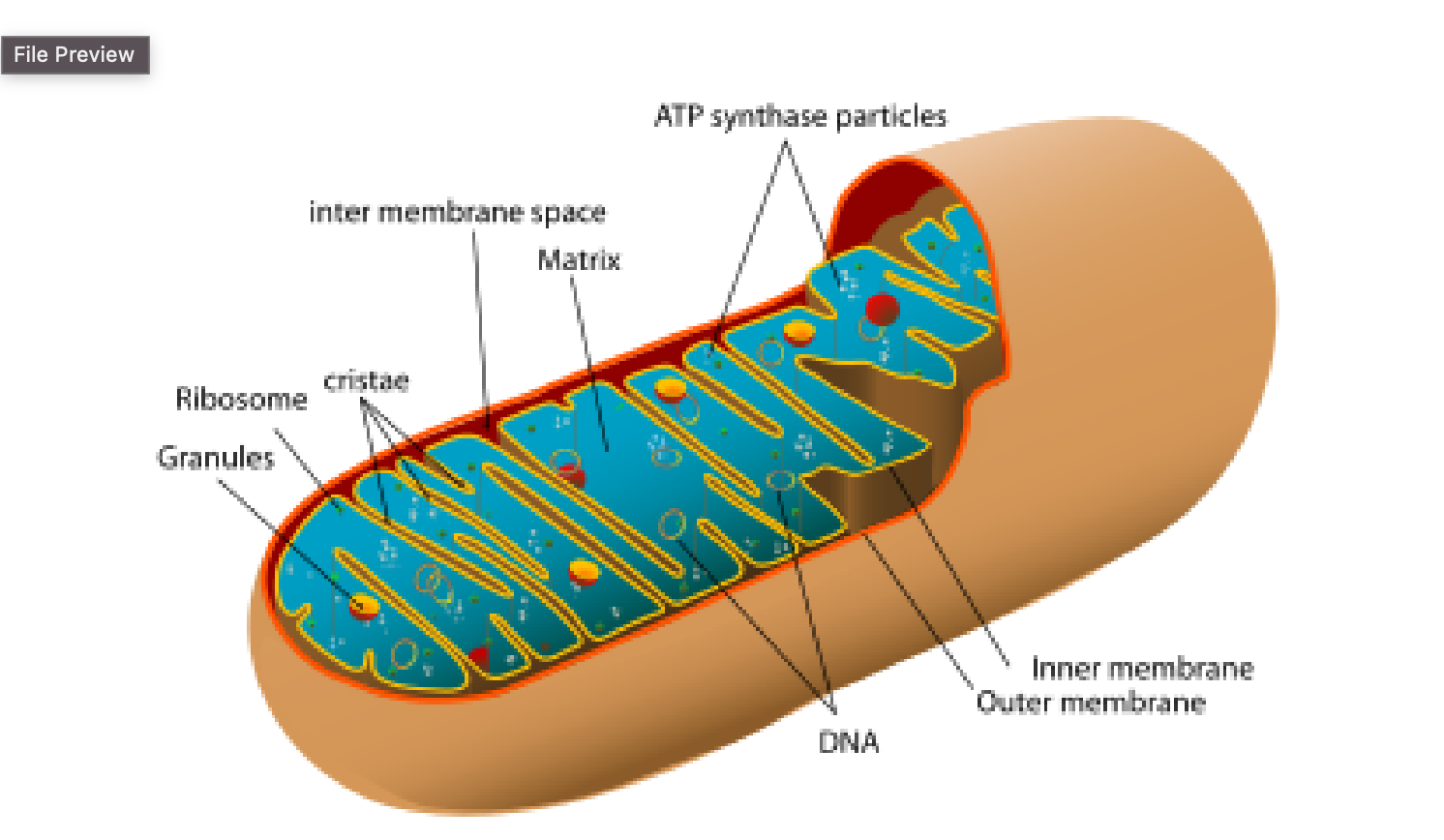
In mitochondrial inner membrane.
NADH and FADH2.
Chemiosmosis.
In mitochondrial inner membrane.
H+ ions.
Produces lots of ATP.
Goes in (per molecule of glucose):
10 NADH: glycolysis (2), pyruvate ox (2), CAC (6).
2 FADH2 from CAC.
O2 from breathing.
Comes out:
26-28 ATP (varies depending on type of cell.
Water.
Electron Transport Chain (ETC) Overview:
In Prokaryotes, takes place in plasma membrane.
In Eukaryotes, takes place in mitochondrial inner membrane.
Electron Protein Complexes embedded in mitochondrial inner membrane take electrons stored in NADH and FADH2 and pass them from one complex to another, down the chain to lower energy levels.
4 large complexes (I-IV).
2 smaller shuttles: Ubiquinone (Q) and Cytochrome C (Cyt c).
NADH deposits electrons at complex I.
FADH2 deposits electrons at complex II.
Electrons “fall” from one electron carrier to another, each giving off a bit of free energy.
Energy is used to pump H+ ions from the matrix into the intermembrane space.
Against gradient.
Each electron carrier complex bounces back and forth between being reduced and being oxidized.
The final electron acceptor is oxygen.

To make ATP, cells add a phosphate to ADP to make ATP, this process is called phosphorylation.
Substrate Level Phosphorylation - A substrate with a phosphate and an ADP bind to the active site of an enzyme, the enzyme catalyzes the removal of the phosphate from the substrate and adds it to the ADP to make ATP.
Oxidative Phosphorylation - ATP is generated by the addition of a free (unbound) inorganic phosphate to ADP. This is powered by the electron transport chain in cellular respiration.
The removal of an electron from a molecule (oxidizing it), results in a decrease in potential energy in the oxidized compound. However, the electron (sometimes as part of a hydrogen atom) does not remain unbonded in the cytoplasm of a cell.
The shift of an electron from one compound to another removes some potential energy from the first compound and increases the potential energy of the second compound.
Transfer of energy in the form of high-energy electrons allows the cell to transfer and use energy in an incremental fashion—in small packages rather than in a single, destructive burst.
In living systems, a small class of compounds functions as electron carriers: they bind and carry high-energy electrons between compounds in biochemical pathways.
These compounds can be easily reduced (that is, they accept electrons) or oxidized (they lose electrons).
ATP in Living Systems:
A living cell cannot store significant amounts of free energy.
Excess free energy would result in an increase of heat in the cell, which would result in excessive thermal motion that could damage and then destroy the cell.
A cell must be able to handle that energy in a way that enables the cell to store energy safely and release it for use only as needed.
Living cells accomplish this by using ATP.
ATP is broken down - energy is released - energy is used to do work by the cell.
ATP Structure & Function:
At the heart of ATP is a molecule of adenosine monophosphate (AMP), which is composed of an adenine molecule bonded to a ribose molecule and to a single phosphate group.
Ribose is a five-carbon sugar found in RNA, and AMP is one of the nucleotides in RNA.
Addition of a second phosphate group to this core molecule results in the formation of adenosine diphosphate (ADP).
Addition of a third phosphate group forms adenosine triphosphate (ATP).

Dephosphorylation - The release of one phosphate group from ATP, releasing energy.
Energy From ATP:
During hydrolysis, water is split, or lysed, and the resulting hydrogen atom (H+) and a hydroxyl group (OH-), or hydroxide, are added to the larger molecule.
The hydrolysis of ATP produces ADP, together with an inorganic phosphate ion (Pi), and the release of free energy.
To carry out life processes ATP is continuously broken down into ADP, and like a rechargeable battery, ADP is continuously regenerated into ATP by the reattachment of a third phosphate group.
Water is regenerated when a third phosphate is added to the ADP molecule, reforming ATP.
Substrate-Level Phosphorylation - A phosphate group is removed from an intermediate reactant in the pathway, and the free energy of the reaction is used to add the third phosphate to an available ADP molecule, producing ATP.
Most of the ATP generated during cellular respiration is derived from a much more complex process, chemiosmosis, which takes place in mitochondria within a eukaryotic cell or the plasma membrane of a prokaryotic cell.
Chemiosmosis - A process of ATP production in cellular metabolism in the mitochondria.
H+ concentration gradient.
More H+ in intermembrane space than matrix.
Drives ATP production.
Oxidative phosphorylation - The production of ATP using the process of chemiosmosis (involvement of oxygen).
Other food sources?
Free glucose not abundant in most diets.
Carbohydrates are hydrolyzed to glucose.
Proteins must be hydrolyzed to amino acids.
Amino group removed.
Carbon backbone enters glycolysis or CAC.
Lipids are hydrolyzed to glycerol or fatty acids.
Glycerol enters middle of glycolysis as G3P.
Fatty acids are converted to Acetyl-CoA and enter CAC.
Glycolysis - The first step in the breakdown of glucose to extract energy for cellular metabolism.
Begins with the six-carbon ring-shaped structure of a single glucose molecule and ends with two molecules of a three-carbon sugar (pyruvate).
The first part of the glycolysis pathway traps the glucose molecule in the cell and uses energy to modify it so that the six-carbon sugar molecule can be split evenly into the two three-carbon molecules.
The second part of glycolysis extracts energy from the molecules and stores it in the form of ATP and NADH

Alcohol Fermentation - Pyruvate converted to ethanol.
Lactic Acid Fermentation - Pyruvate converted to lactate.
Happens after glycolysis.
Only makes 2 ATP (less efficient).
Cycle repeats.
No progression to CAC or Oxidative Phosphorylation.
Some poisons interrupt/block one or more stages of cellular respiration.
ETC:
Rotenone
Disrupts Complex I to Ubiquinone
Cyanide
Disrupts Cytochrome C complex
Carbon monoxide
Prevents O2 from being final electron acceptor
Chemiosmosis:
Oligomycin
Blocks ATP Synthase
DNP
Allows H+ to leak back into matrix