Sources of Diversity: Speciation
How do species evolve?
Speciation requires certain conditions and mechanisms for species to evolve.
Speciation: Processes and Examples
Definition of Speciation
Speciation is defined as a by-product of the genetic divergence of separated populations.
Barriers are necessary regardless of the species concept employed.
These barriers can be classified into:
Geographic barriers (physical separation)
Reproductive barriers (biological separation)
Allopatric Speciation
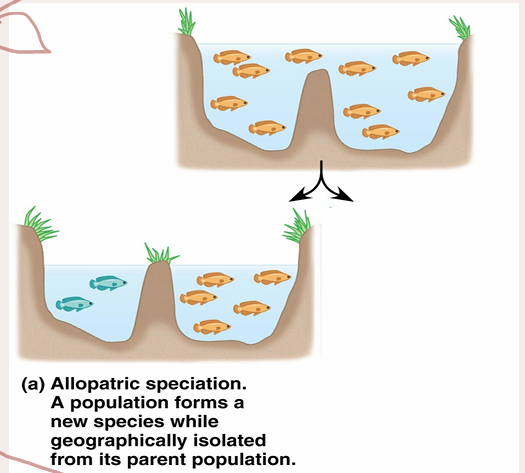
Explanation
Allopatric speciation occurs when a population forms a new species while geographically isolated from its parent population.
This geographic isolation leads to interrupted gene flow due to environmental changes that create physical barriers.
Example of Allopatric Speciation
A practical example includes the Abert and Kaibab squirrels found in Arizona’s Grand Canyon, illustrating how geographic separation can result in the emergence of distinct species.
Islands are also significant examples where populations may become geographically isolated and undergo speciation.
Sympatric Speciation
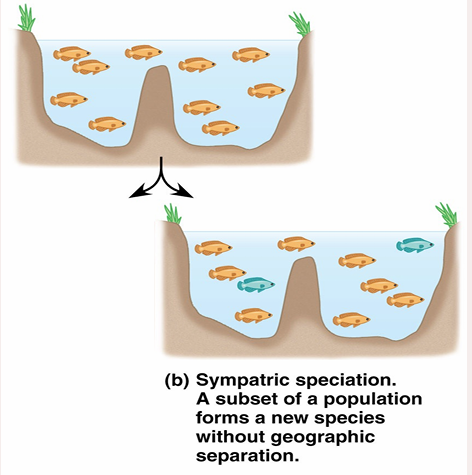
Explanation
Sympatric speciation occurs when a subset of a population forms a new species without geographic separation.
Key Characteristics
It involves interrupted gene flow although there is no physical barrier present.
Example of Sympatric Speciation
An example illustrating sympatric speciation is the apple maggot fly. This species originally fed on hawthorn berries, which are native to North America.
Following the introduction of apple trees to North America, a new apple feeding race emerged spontaneously from the ancestral population.
This new population does not interact with the original population that feeds on hawthorns, leading to reproductive isolation between the two races.
Polyploidy in Plants
Mechanism
In plants, a significant mechanism of sympatric speciation is polyploidy, characterized by:
Failure of cell division leading to increased chromosome numbers (e.g., from diploid 2n to tetraploid 4n).
Resultant polyploid plants are often fertile when crossed with other tetraploids or can self-pollinate.
Polyploidy is essential for several critical crop plants, showcasing the importance of mutation within normal diploid populations in prompting speciation.
Duration of Speciation
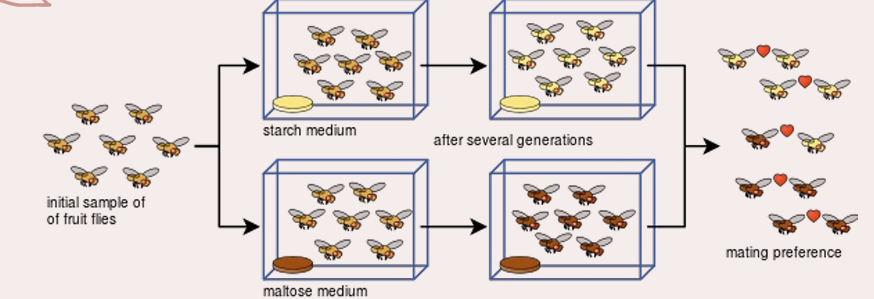
Case Study
Diane Dodd’s research demonstrated that after only eight generations in different environments (specifically with different food sources of starch and maltose), populations of Drosophila pseudoobscura (fruit flies) could develop distinct mating preferences, highlighting the rapid mechanisms by which speciation can occur.
Reproductive Barriers
Definition of Reproductive Barriers
Prezygotic barriers: These prevent fertilization by inhibiting mating between species or hindering fertilization should mating occur.
Postzygotic barriers: These occur after successful fertilization, preventing the hybrid zygote from developing into a viable, fertile adult.
These barriers are a cornerstone of the biological species concept, emphasizing reproductive isolation and the absence of gene flow between species.
Types of Prezygotic Barriers
Habitat Isolation: Different species live in different habitats and do not meet.
Temporal Isolation: Different species breed at different times.
Behavioral Isolation: Different species have different mating rituals or behaviors.
Mechanical Isolation: Structural differences prevent mating.
Gametic Isolation: Even if mating occurs, gametes may not be compatible.
Types of Postzygotic Barriers
Occurs when mating attempts are successful, resulting in hybrid zygote development; however, they often lead to limited offspring survival or fertility, thus maintaining long-term genetic isolation between species.
Summary of Speciation Processes
Speciation requires barriers that can be either geographical or reproductive in nature.
Allopatric Speciation: Results from geographic barriers leading to reproductive barriers afterward.
Sympatric Speciation: Occurs within the same geographic area, resulting in reproductive barriers that lead to reproductive isolation.
Understanding these reproductive barriers, whether prezygotic or postzygotic, is crucial not only for the biological species concept but also applies to other species concepts as well.