Sem 1 exam
SEMESTER 1 EXAM NOTES
MEMORY
Sensation and Perception
Sensation
- The detection of environmental stimuli by the sense organs and the conversion of sensory information to electrochemical energy
SENSE | STIMULUS ENERGY | SENSORY ORGAN |
Vision | Light waves | Eyes |
Touch (pressure, pain, temperature) | Mechanical and thermal energy | Skin |
Hearing | Sound Waves | Ears |
Smell | Chemical Energy | Nose |
Taste | Chemical Energy | Tongue |
- Involves three steps; reception, transduction, transmission.
- Reception: The detection of sensory information in the sense organs of the body by sensory receptors
- Transduction: the changing of sensory information into electrochemical energy (the brain is unable to process sensory info, thus stimulus energy is transformed into electrochemical energy)
- Transmission: The movement of electrochemical energy from sensory receptors to the brain for interpreting
Perception
- The mental representation that the brain creates using information detected by the senses.
- Involves three steps:
- Selection: crucial features of info are selected for further processing and insignificant content is disregarded
- Organisation: Selected info I categorised, allowing for the arrangement of meaningful patterns
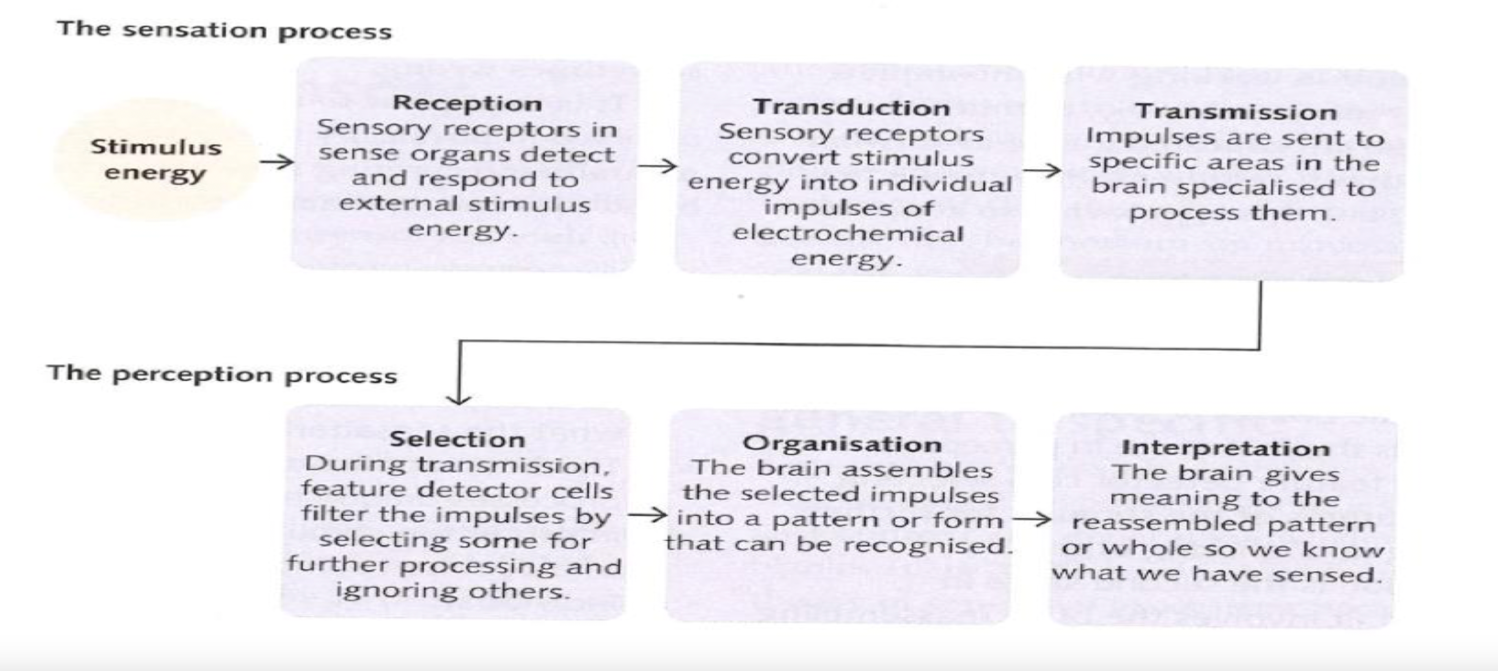 Interpretation: Meanings assigned to the groups of patterns
The role of attention in memory
Attention: The mental capacity to concentrate on a specific stimulus while ignoring other stimuli
Memory: the cognitive function through which information and past experiences are actively processed, stored and retrieved
Cocktail Party Effect (Cherry, 1953)
- Selective attention: the process of concentrating on chosen stimuli whole disregarding others.
- Divided Attention: the ability to concentrate on two or more stimuli simultaneously.
- The cocktail party effect refers to the ability for an individual to be aware of multiple conversation occurring around them at the same time using divided attention, as well as using selective attention, where their focus is on one conversation and the rest is neglected
- Cherry conducted two experiments, explained below:
- Experiment 1: Two speech recordings of entirely different topics participants were to listen to them simultaneously. Participants were tasked to then repeated ONE of the speeches word by word. While participants could play back the tape as often as the want, the task was to be completed verbally and they were unable to write anything down. Researchers marked down on the scripts the words and phrases that were correctly recognised by the participants. While participants described the task as extremely difficult, with some replaying the tape up to 20 times, participants were generally successful in separating speeches
- Experiment 2: Two recorded speeches were played concurrently to participants via headphones with one speech presented to the right ear and a different speech to the left ear. Participants were asked to verbally repeat back one of the message while simultaneously listening to it. Participants were able to complete this task easily, understandably with a slight delay behind the recording. It was tricker to recall what the speech was about, even though they repeated it correctly. Participants were unable to describe what they were played in the other ear
- Cherry’s experiments demonstrated how we use divided attention via our awareness of simultaneous conversations in a crowded noisy space, and how we are able to focus our attention toward one conversation and subsequently disregard all other conversation using selective attention
Models for explaining memory.
Processes of memory
- Storage: the retention of information within the stores of memory
- Retrieval: The movement of information from the long-term store of memory to conscious awareness
- Encoding: the form in which info is stored
- Acoustic encoding (encoded based on sound)
- Visual encoding (encoded according to images
- Semantic encoding (encoding based from info meaning)
Multi-store Memory (Atkinson and Shiffrin, 1968)
- The memory system is divided into three components; the sensory register, short-term memory and long-term memory
- These three stores can be understood as being connected to each other through attention, rehearsal and retrieval processes
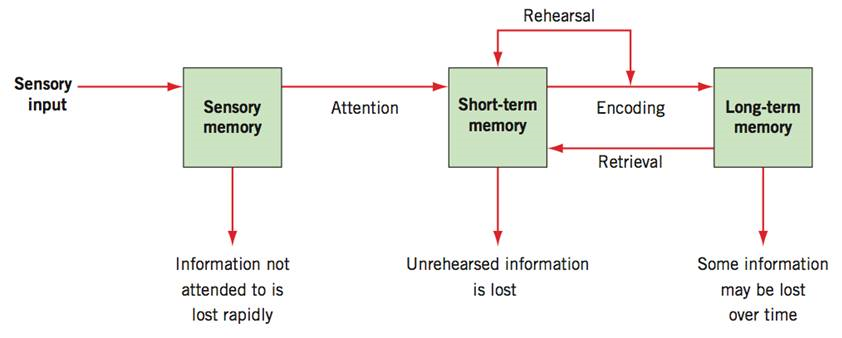
- Sensory Register
- The memory store where sensory information is briefly held before decaying or transferring to the short-term store
- There is although separate stores for each our senses
- Duration: iconic store - visual info (less than a second), Echoic store - Auditory info (3 to 4 seconds)
- Capacity: Unlimited
- Encoding: Visual and Acoustic, but also sensory info
- Short-term memory
- A temporary memory store for limited information received from the sensory register and long-term memory.
- Duration: 15-30 sec (unless a control process such as rehearsal is used to hold it for longer)
- Capacity: the magic number of 7(+/-2) pieces of info
- Encoding: Mostly acoustic (inner voice)
- Long-term memory
- A relatively permanent memory store for a limitless amount of information that sends or receives information from the short-term store.
- Duration: relatively permanent
- Capacity: unlimited
- Encoding: visual, auditory and semantic (via elaborate rehearsal)
- There are two types of long term memory.
- Procedural (implicit memories)
- A type of long term memory for skills and actions that are usually difficult to explain in words
- Register in low brain areas that are beyond conscious control
- Being able to demonstrate HOW to perform an action
- Declarative (explicit memories)
- A type of long term memory for factual information that can be expressed in words
- Takes a Conscious effort to receive these memories
- Semantic Memoires: a type of declarative memory for impersonal factual knowledge about the world
- Episodic Memories: a type of declarative memory for personally significant events
- Procedural (implicit memories)
Working Memory Model (Baddeley and Hitch, 1974)
- Baddeley and hitch described the short term store (from Atkinson and Shiffrin’s model) as a complex active store that holds pieces of information while they are being manipulated
- A view of short-term memory as a dynamic storage system capable of simultaneously holding multiple pieces of information
- Baddeley and Hitch suggested in 1974 that working memory consisted of a central executive which integrated information from two slave systems, the phonological loop and visuospatial sketchpad. Baddeley added a third slave system to the model in 2000, the episodic buffer
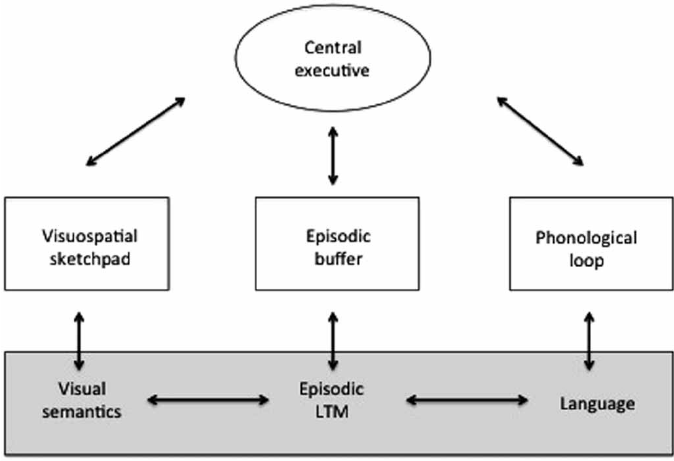
- Central executive
- A component of the working memory model responsible for coordinating slave systems as well as controlling attention given to info and decision making
- Phonological Loop
- A component of the working memory model that temporarily stores and process auditory information
- Visuospatial sketchpad
- A component of the working memory model that stores and manipulates visual and spatial information
- Episodic Buffer (only added in 2000)
- A component of the working memory model that temporarily stores consolidated information from the central executive, visuo-spatial sketchpad, phonological loop and long term memory
Memory Formation
Structures of the brain
- Hippocampus: the region located deep within each temporal lobe that plays a major role in memory and learning
- Cerebellum: the structure underneath the cerebrum involved in balance, judging distance and coordination of fine motor movement
- Amygdala: A collection of nuclei deep within each temporal lobe that plays a role in emotional responses and modulates the fear response
Role of brain structures in the formation and storage of memory
Brain Structure | Role in the formation of memories | Role in the storage of memories |
Hippocampus |
|
|
Cerebellum |
|
|
Amygdala |
|
|
Henry Molaison – Case Study
- Experienced epileptic seizures form when he was 10 years old and their severity increased from the age of 16. He was knocked off his bike at 9 and this was believed to be the contribution to his epilepsy
- Doctors used EEG to measure his brain activity and determined they were originating from the middle of both temporal lobes
- Henry underwent a bilateral medical temporal lobe resection in 1953. The removed his middle parts of the temporal lobes, resulting in the removal of the amygdala and hippocampus
- The surgery reduced the severity of his seizures, his personal stayed the same, and his childhood memories were unaffected. However he did suffer from partial retrograde amnesia (the inability to recall past memories to the onset of amnesia)
- Henry struggled to transfer info form his short term memory to his long-term memory. His long-term memory was assessed from wo tests; incomplete picture test and mirror drawing.
- His performance on the test improved overtime, leading to the understanding that long-term memory is made up of declarative and procedural memories. It demonstrated that he was creating procedural memories unconsciously.
- However, he had no memory of sitting the tests on a daily basis
- Henry inability to form new declarative memories after the hippocampus removal led to the understanding that the hippocampus plays a significant role in declarative memory production
- Info in his short-term memory as unable to be encoded into long-term memory
Process of forgetting
Forgetting: the inability to retrieve memoires
Types of Forgetting
- Retrieval failure
- The inability to consciously recall information stored in the long-term store due to the absence of retrieval cues that could trigger memory retrieval
- Interference
- When information in the long term store cannot be retrieved due to it being disrupted by similar information
- Proactive interference: when previously stored information interferes with retrieval of new learning
- e.g. old phone number is interfering with the retrieval of the learning a new phone number
- Retroactive Interference: where new learning interferes with retrieval of previously stored information
- E.g. needing to enter the previously used password in order to change it to a new password that you have selected
- Motivated forgetting
- The intentional or unintentional suppression of memories or thoughts form conscious awareness to minimise emotional distress
- Repression: unconscious
- Suppression: conscious, effort to push certain memories out of one’s conscious awareness
- Decay Theory
- Theory that suggest memories fade over time (unless they are actively strengthened through rehearsal)
- Short-term memories ate predominantly affected by decay
- Episodic memories tend to be more resistant to decay
Process of Remembering
The role of recall in memory
- The process of retrieving information from long-term memory without the provision cues to aid in retrieving the information
Type of recall | Description | Example |
Free Recall | The retrieval of as much information as possible about a specific topic in any order | Name the teachers that you remember from primary school |
Serial Recall | The retrieval of information in a set order | List in order the planets in the solar system starting nearest to the sun |
Cued Recall | Provided retrieval cues help with the retrieval of memory | Fill in the missing words within a sentence |
The role of recognition in memory
- The ability to identify previously stored information by matching stimuli to stored memories.
- In a recognition task, individuals select the correct answer from a set of alternative options e.g. multiple-choice questions.
The role of re-learning in memory
- Reacquiring knowledge or skills that were previously learned but may have begun to decay over time
- Relearning identifies information that was not remembered and can now be successfully encoded into long-term memory via elaborative rehearsal
- E.g. writing down everything you have learned abut a topic in class, identifying the key points you have missed, and then having a classmate re-teach them to you
Levels of processing model of memory (Craik and Lockhart, 1972)
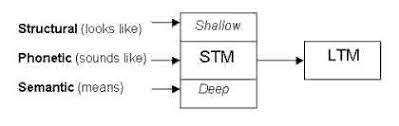
- According to Craik and Lockhart, the endurance and strength of long-term memories depend on the depth of cognitive processing.
- Levels of processing theory is one explanation for why elaborative rehearsal more successfully transfers information from the short-term store to the long-term store of memory maintenance rehearsal
- Shallow Processing
- This form of processing encodes physical information based on appearance, known as structural encoding and via phonemic encoding which is the encoding of auditory information
- E.g. physical or auditory qualities including brightness and loudness
- Maintenance rehearsal is used in shallow processing to hold information in short-term memory for longer than the usual 15-30 seconds. Information processed in this way results in memories that are short term and difficult to recall
- Deep Processing
- Elaborative rehearsal of information allows for deep processing because the information is encoded semantically. Semantic encoding works by attaching meaning to the information and/or linking the information to knowledge currently in the long-term store
- It is easier to recall information encoded via deep processing than shallow processing
Depth of processing and the retention of words in episodic memory (Craik and Tulving, 1975)
Aim
- Investigated the impact that levels of processing had on recall ability
Participants
- 60 male and female students at the university of Toronto
- Convenience sampling
Variables
- Independent variables: type of encoding used to memorise a list of words; structural, phonemic, semantic
- Dependent variable: The number of words recalled
Procedure
- Participants were told the study was about perception
- They were randomly allocated into three groups; structural encoding, phonemic encoding and semantic encoding
- All participants were given a list of 60 words and had to answer one question for each word
- Participants in the structural encoding condition were asked, ‘Is the word in capital letters or lower case?’
- Those in phonemic encoding condition were asked, ‘Does the word rhyme with…?’
- Participants in the semantic encoding were asked, ‘does the word go in this sentence…?’
- A list of 180 words, including the 60 original words were given to participants. They were asked to indicate which words are from, the original list of 60
Findings
- Participants in the semantic encoding condition recalled more words than participants in the other two conditions
- Words that were semantically encoded via elaborative rehearsal and deep processing led to high recall accuracy. In contrast, words that were structurally and phonemically encoded underwent shallow processing result in less accurate results
Limitations
- As participants were told that the study was assessing perception, which was not the case, participants were not explained the true purpose od the study and were deceived. Specific details of the debriefing process for the study are not available, hence it is not know whether or not participants were told of the deception and explained the reason for its use
- It is unclear whether it is the depth of processing that improves retrieval of information from long term memory or if it the fact that greater effort is used during encoding
Rehearsal as a strategy to improve memory
Rehearsal: increases the time information is held within the short-term store of memory, providing the time needed for encoding to operate
Maintenance rehearsal
- A rehearsal technique where the repetition of information allows it to be held in the short-term store of memory for a longer period of time
- People may think of information and say it over and over
- It is unlikely that information rehearsed using maintenance rehearsal will become encoded into the long-term store
Elaborative rehearsal
- A rehearsal technique allowing information to be encoded into ling term memory by attaching meaning to it
- Elaborative rehearsal is likely to encode information into the long-term store
Role of repetition as seen in Ebbinghaus and the forgetting curve (1885)
- Herman Ebbinghaus was the sole participant in his early studies on forgetting where he used nonsense syllables combined form letter producing non-existent words, such as ‘lef’
- After recording the number of trials, it took before he could memorise a list of nonsense syllables, he attempted to recall the list at varying intervals to determine what would be forgotten over time
- Graphing the memory retention over time, Ebbinghaus noted rapid forgetting over the first day leading to more gradual loss in the days following
- This finding became known as the forgetting curve and is used to support the decay theory
Causes of Memory Loss and Impact on Behaviour and Emotion
Trauma – Chronic Traumatic Encephalopathy (CTE)
- A progressive brain disease associated with repeated traumatic brain injuries that causes problems with cognition and memory
- While this disease is not yet well understood, it is somewhat agreed that it is caused by multiple traumatic brain injuries commonly associated with military combat due to exposure to explosive blasts, and sports such as rugby
- The degeneration of brain cells cause by CTE is thought to be related to the development of memory problems
- While CTE involves tau, a protein in nerve cells also associated with Alzheimer’s, the way in which tau abnormally builds up in the brain differs
How CTE impacts behaviour | How CTE impacts emotion |
|
|
Degeneration – Alzheimer’s disease
- A brain disease that involves the degeneration of neurons in regions of the brain that are involved in cognitive skills and memory formation and retrieval
- Neurofibrillary tangles (abnormal accumulations of tau protein within neurons of the brain), amyloid plagues (accumulations of scar tissue formed by deteriorating neurons and clusters of beta-amyloid protein) and neuron loss are the key features of this disease. They are more prevalent in the hippocampus and amygdala – regions associated with the formation of new memories, and in the cerebral cortex – the area that supports remembering, reasoning and language processing
- Supporting the internal structure of the axon are microtubules that allow nutrients to move from the cell body, down the axon and to the dendrites
- Tau is a type of protein mainly found in the axon and dendrites of neurons. It clumps together, resulting in the breakdown of the microtubule structures supporting the axon
- Damage to the internal structure of the axon impact the electrical nerve impulses that travel through the axon
- Another protein, a form of beta-amyloid, is found in abnormally high levels in the brains of individuals with Alzheimer’s. they clump together alongside scar tissue from deteriorated neurons to form amyloid plagues
- Amyloid plaques gather between neurons and interrupt their ability to function in regions of the brain responsible for cognition and memory
- Brain atrophy (decrease in size of a tissue or organ), predominantly of the hippocampus and cerebral cortex, becomes wide-spread by the final stages of the disease, leading to a significant reduction in brain volume
How Alzheimer’s Disease impacts behaviour | How Alzheimer’s Disease impacts emotion |
|
|
Drug Induced – Wernicke-Korsakoff Syndrome (WKS)
- A rare neurological disorder caused by thiamine (vit B1) deficiency leading to the degeneration of brain cells and characterised by difficulties forming new memories and retrieving stored memories
- Neurological disorder: a disorder of the nervous system affecting the brain, spinal cord and neurons of the body
- This disorder causes the degeneration of brain cells (neuronal atrophy) – specifically within the thalamus, hypothalamus and the mammillary bodies
- The mammillary bodies, a pair of structures located on the side of the hypothalamus closest to the brainstem connected directly to the hippocampus and thalamus. They play a role in memory and start to easter away in individuals with WKS
- The intestines absorb thiamine, a vitamin used for metabolism to support cellular growth and functioning, largely within the nervous system
- Chronic alcohol abuse often leads to a thiamine deficiency, further developing into WKS
- WKS comprises of two stages: Wernicke encephalopathy and Korsakoff amnesic syndrome
- Wernicke encephalopathy is a severe yet reversible stage that progresses into Korsakoff amnesic syndrome, the stage that is chronic and irreversible
- Encephalopathy is a general term sed to describe brain disease that modify the function or physical structure of the brain
How WKS impacts behaviour | How WKS impacts emotion |
|
|
LEARNING
Classical Conditioning
- a form of learning where two normally unrelated stimuli are repeatedly linked so that the existing reflex response is elicited by the new stimuli
- Reflex response: an automatic, involuntary and almost instantaneous response to a stimuli
- Neutral stimulus
- A stimulus that on its own does not elicit a particular response
- Unconditioned Stimulus
- A stimulus that does not naturally elicit a reflex response
- Unconditioned response
- The reflexive reaction to a specific unconditioned stimulus
- Conditioned stimulus
- A stimulus that elicits a particular response due to learning
- Conditioned response
- A reflex response elicited by a previously neutral stimulus that occurs after learning has taken place.
- Prior to conditioning, the neutral stimulus does not produce any sort of response. It is attested that the unconditioned stimulus automatically produces an unconditioned response ad continues to do so when paired with a neutral stimulus. After multiple pairings, the neutral stimulus, now termed the conditioned stimulus, elects the now conditioned response
- Stimulus generalisation: when a stimulus similar to a conditioned stimulus elicits the same response as the conditioned stimulus
- Stimulus discrimination: when a stimulus does not elicit the conditioned response because it differs significantly form the original stimulus
- Extinction: when the repeated presentation of the conditioned stimulus on its own ceases to elicit a response, as there is no longer an association between the conditioned stimulus (previously neutral) and the unconditioned stimulus
- Spontaneous Recovery: The sudden reappearance of a previously extinct conditioned response after the unconditioned stimulus has been absent for some time
Pavlov’s Dogs (Pavlov, 1902)
- To investigate classical conditioning in dogs
- Independent variable: the presentation of stimuli, whether it was the bell, food or both simultaneously.
- Dependent Variable: the times at which the dogs salivated and the amount of saliva secreted.
- Neutral Stimulus was the bell
- Unconditioned Stimulus was the meat powder
- The unconditioned was the salivation.
Procedure
- The dog was given some meat powder in a bowl leading to the production of saliva, the meat powder was the unconditioned stimulus (UCS) that caused the unconditioned response (UCR) of salivation. Next, the bell (NS) was rung just before providing the dog with meat powder (UCS). This was repeated multiple times with saliva produced each time (UCR).
- Now, when the bell was sounded, salivation occurred. The sound of the bell that was initially a neutral stimulus had become a conditioned stimulus (CS) that elicited the now conditioned response (CR) of salivation.
Limitations
- Inability to generalise results to humans as the results were from dogs
- The dogs were exposed to unpleasant stimuli during the experiments, causing physical and psychological harm
Little Albert (Watson and Rayner, 1920)
- Set out to condition 11 month old little albert to have an emotional response of fear to laboratory rats and other white objects
- Albert was conditioned to feel fear from the sight of the rat after multiple pairings of the rat and the loud noise, which then emotional transfer occurred for the other white objects
Procedure
- A white rat was placed on the floor next to albert.
- Each time he touched the rat a loud noise was struck. This caused albert to become fearful and cry. Making the loud noise an unconditioned stimulus (UCS) and the crying an unconditioned response (UCR)
- The rat, originally the neutral stimulus, became the conditioned stimulus (CS) and upon presentation to Albert would cause him to produced the conditioned response (CR) of crying and being fearful
- Albert was then exposed to stimuli that shared the characteristics of white
Limitations
- Albert was emotionally traumatised and suffered lasting psychological harm
- The mother was unaware, so no permission was given, therefore no informed consent was obtained and withdrawal rights weren’t explained
- No debriefing occurred
- Watson and Rayner published results of his experiment, therefore failed to follow the principles of confidentiality.
Operant Conditioning
- A learning process in which the likelihood of behaviour being repeated is determined by the consequences of that behaviour
Three phase model ABC
- Antecedent: internal and external conditions are present immediately prior to a particular response. Environmental stimulus
- Behaviour: the response/action
- Consequences: the outcome of the behaviour
Reinforcement
- Any event that increases the likelihood that a response or behaviour will occur again
- Positive Reinforcement
- The addition of stimuli that increases the likelihood of the behaviour being repeated
- Negative Reinforcement
- The removal of stimuli that increases the likelihood of the behaviour being repeated
Punishment
- Any unpleasant stimulus that reduces the likelihood of an unwanted behaviour occurring again
- Positive Punishment
- The addition of stimuli that decreases the likelihood of the behaviour being repeated
- Negative Punishment
- The removal of stimuli that decreases the likelihood of the behaviour being repeated
Schedules of Reinforcement
- Schedules of reinforcement can be assessed in terms of the rate at which the behaviour is performed, the response rate, and how long it takes before the behaviour becomes extinct
- There are two types of reinforcement:
- Continuous Reinforcement proves highly effective when instructing a new behaviour because it reinforce the desired behaviour each time it happens, establishing a strong connection between the behaviour and response
- Once the behaviour is established various schedules of partial reinforcement can be used to strengthen the behaviour. Partial reinforcement can be fixed or variable and either interval or ratio
- Fixed Schedule: a predictable schedule where the length of time or number of responses between reinforcements is set
- Variable Schedule: an unpredictable schedule where the length of time or number of responses between reinforcement changes
- Ratio Schedule: A schedule dependent on the quality of responses needed before reinforcement is provided
- Interval Schedule: A schedule reliant on the length of time
- Combinations of schedules:
- Fixed Ratio: reinforcement takes place following a set number of responses
- Fixed Interval: reinforcement takes place at fixed time intervals
- Variable Ratio: when reinforcement takes place after an unpredictable number of responses
- Variable Interval: when reinforcement takes place at irregular time intervals
Law of Effect (Thorndike, 1898)
- The law of effect describes how behaviours followed by desirable consequences have a greater likelihood of being repeated whereas behaviours followed by unpleasant consequences are less likely to be repeated
Procedure
- A cat was placed in a puzzle box, an enclosed wooden box with slates allowing the cat to look out and reach a paw through
- A fish was then placed outside the box, just out of the cat’s reach. If the car wanted to eat the fish, it had to work out how to get out the box through the door
- Thorndike observed the cat’s behaviour, and recorded the length of time it took the cat to press the lever and exit the box
Findings
- The cats initially worked out how to leave the box using trail and error. Once placed back in the box they made the conscious decision to press the lever to open the door
- This choice demonstrates operant conditioning, more specifically, positive reinforcement
- This stimulus being added is the food and the behaviour of pressing the lever is what Thorndike was trying to enforce
Limitations
- The findings are on animals behaviour/learning meaning it cant be generalised to humans who possess more cognitive abilities
- Placing hungry cats in a box could be argued as distressing
Skinner Box (skinner, 1948)
- Based form Thorndike’s law of effect
- The skinner box was similar to the puzzle box
- Aim: to demonstrate the process of operant conditioning in pigeons
- Independent Variable: the time interval at which food was released
- Dependent variable: Observed behaviours of the pigeons
Procedure
- The pigeon would be placed into the skinner box
- A time was programmed to present food to a pigeon at set intervals via a hopper
Findings
- Operant conditioning was observed in 6 out of 8 pigeons
- Each pigeon were conditioned to preform a unique behaviour (whatever particular action they were doing at the time the food hopper tipped into the cage)
- Shorter intervals between the release of food proved more effective than longer intervals (specifically 15sec)
- While there seem to be a cause and effect relationship between behaviour and the release of food, there was in fact no relationship in effect
- Illustrated how animals develop accidently reinforced behaviours
Limitations
- Pigeons were hungry and mistreated
- Not able to be generalised to humans they share differing cognitive and social characteristics to humans.
Social Learning Theory (Bandura, 1977)
- Bandura believed that the ability for humans to learn through observation negates the need to accumulate vast amounts of knowledge through time consuming trial and error, instead enabling us to be come to know about the world around is by watching the experiences of other people
Processes of Observational learning
- Observational learning
- Where the learner watches a model, notices the consequences of their behaviour, and the decides whether they will imitate their behaviour
5 processes for observational learning to proceed:
- Attention:
- The learner needs to find the model interesting enough to pay attention to them
- Typically, the more the learner likes the model and/or the more similar they perceive them-selves to the model, the more likely they will attend their behaviour
- Retention
- The leaners needs to be able to remember the model’s observed behaviour, this relies on the cognitive level of the learner
- Memory strategies, such as rehearsal techniques, need to be utilised
- Reproduction
- The learner needs to have the physical and cognitive abilities to reproduce the behaviour they have observed
- Observing behaviour is not enough to guarantee the learner will be successful in imitating it, especially if the modelled behaviour is highly complex
- Motivation
- The learner requires an incentive and reason for repeating the modelled behaviour
- An example of motivation is the belief that the reproduced behaviour will be reinforced in
- Motives are what push people to demonstrate\
- Reinforcement
- If the learner expects the modelled behaviour will be reinforced, thye are more likely to reproduce the modelled behaviour. This expectation may arise from the learner observing the model’s actions being rewarded (vicarious reinforcement)
- Reinforcement of modelled behaviour may be motivation behind observational learning
Strengths of the social learning theory
- There is empirical research that supports social learning theory, such as the bobo doll experiment. Empirical research involves direct observation and measurements of events based on real life occurrences
Limitations of the social learning theory
- The influence of genetics, brain development, hormonal changes, etc have on behaviour is barely recognised
- Does not account for all behaviours performed, as there are times when a suitable model is not available
- E.g. murders killing when they’ve never seen a murder committed first hand
Application of the social learning theory to real world
- Teachers can utilise social learning theory in the classroom to shape student behaviour
- E.g. putting hand up to answer/ask a question
Modelling – Vicarious reinforcement
- A form of learning where the observed consequences of a model’s actions can modify the behaviour of a learner
- Learners are more likely to repeat the behaviour that they see the model being rewarded for than the behaviour that is punished
Bobo Doll experiment (Bandura, Ross, and Ross, 1961)
- Aim: to determine whether children who observe an adult behaving aggressively will imitate the aggressive behaviour
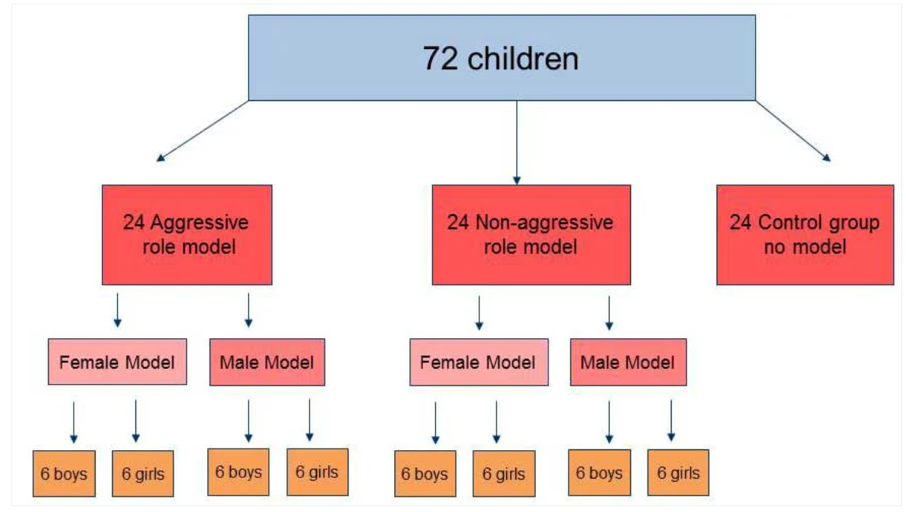
- Participants: 72 children, half boys and half girls, aged 3-4 years old, collected through convince sampling
Method
- Three different experimental conditions:
- 24 children watched a male or female model behaving aggressively towards a bobo doll. The adults attacked it in a distinctive manner (using a hammer, shouting at it)
- Another 24 children were exposed to a non-aggressive model who played in a quiet manner (ignored the bobo doll, played with other toys in the room)
- The final 24 children were used as a control group and weren’t exposed to any model at all
- Stage 2: Mild Aggression arousal. Taking toys of a child.
- Stage 3: leaving each child by themselves in a room with lots of different toys and observed each for 20 minutes through a one way mirror
Results
- Children who observed the aggressive model made far more imitative aggressive responses than those who were in the non-aggressive or control group
- These results support bandura social learning theory that he developed later
- The girls in the aggressive model condition also showed more physical aggressive responses if the model was a male, but more verbal aggression if the model was a female
- Boys were more likely to imitate same sex models than girls. The evidence for girls imitating same sex models is not strong
- Boys imitated more physically aggressive acts than girls. There was little difference in verbal aggression between boys and girls
Limitations
- The study was done in a laboratory setting making the experiment have low validity as it wasn’t a typical real world setting
- Children with the aggressive model may have experienced psychological distress
Application and Evaluation of learning theories in behaviour modification
Systematic Desensitisation as a treatment for phobias
- Phobias tend to originate from a pairing of stimuli through the process of classical conditioning whereby the conditioned response is fear
- Systematic Desensitisation is a form of therapy that is based on the principles of classical conditioning that aim to extinguish the fear response through relaxation techniques and gradual contact with the feared stimulus
Application
- The following steps describe treatment of phobias via systematic desensitisation.
- Together the therapist and client develop a ‘fear hierarchy’ listing scenarios involving the feared stimulus that progress from least distressing to most distressing.
- Client is then taught relaxation techniques to help keep them calm when exposed to their fear
- Clients is then exposed to the feared stimuli that progressively gets more threatening. At the same time the client uses their relaxation techniques to keep them clam
Evaluation
Benefits | Limitations |
|
|
Token Economies
- Token Economy is a behaviour modification technique based on operant condition principles where by symbolic reinforcer is used to encourage as particular behaviour
- Secondary reinforcement: the symbolic tokens used to motivate desired behaviour
- Primary Reinforcement: The tangible reward
Application:
- This technique is widely used by caregivers and teachers to reduce discipline issues and promotes independent behaviours in children
- Examples of secondary reinforces for children: stickers on a reward chart, points, marbles in a jar, tokens, etc.
- Examples of primary reinforces for children: class pizza lunch, movie night, toys
Evaluation
Benefits | Limitations |
|
|