Chapter 4 & 5: Ecology
Ecology
Study of the interactions between organisms and their relationship with their environment.
Ecosystems
Consists of a community of organisms and their environment.
Biosphere
The biosphere is the part of the Earth inhabited by living organisms including land, ocean and the atmosphere in which life can exist.
It is the global ecosystem.
Relationships In The Biosphere
Biosphere is made up of ecosystems
↓
Ecosystems are made up of communities of organism and environment
↓
Communities are made up of populations of different species of organisms.
Habitats
A particular place within the ecosystem where an organism lives and to which it is adapted.
A population is all the members of the same species living in an area.
Communities - Populations of different species of organisms.
Environmental Factors That Affect Organisms
Abiotic - Non-Living Factors
Non-living features of an ecosystem that affect the community.
e.g. temperature, pH, light intensity, altitude, humidity
Biotic - Living Factors
Living features of an ecosystem that affect the other members of the community.
e.g. Plants: food & shelter, Predators, Prey, Parasites & Pathogens, Competitors
Climatic
Elements of climate that influence life and distribution of the organisms that live in a particular environment.
e.g. temperature, rainfall, humidity, wind, day length
Edaphic
Characteristics of soil that influence the community.
e.g. soil type, soil pH, available water, humus
Aquatic Factors
e.g. light penetration, currents, wave action
Energy Flow
The sun is the primary source of energy for our planet.
Energy flow is the pathway of energy transfer from one organism to the next in an ecosystem due to feeding, e.g. along a food chain.
Feeding allows energy to flow from one organism to another in an ecosystem.
Energy Flow in The Ecosystem
Solar Energy
↓
Primary Producers (green plants)
↓
Primary Consumers (herbivores)
↓
Secondary Consumers (carnivores)
↓
Tertiary Consumers (top carnivores)
The Food Chain
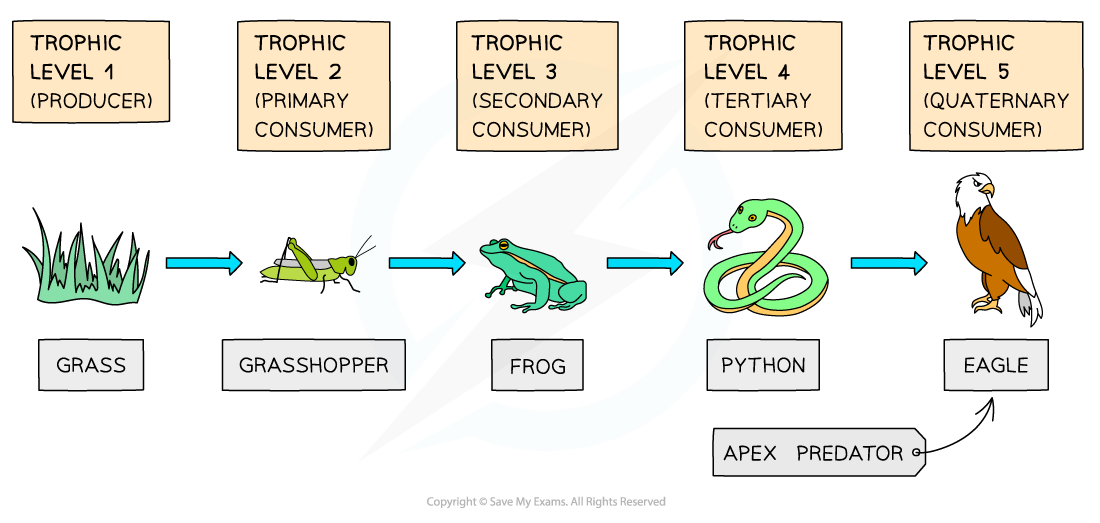
Flow diagram that begins with a plant and shows how food/energy is passed through a series of organisms in a community.
Each organism feeds on the one before it.
A food chain ends when there is not enough energy to support another organism.
Grazing Food Chain
One where the initial plant is living.
Detritus Food Chain
One where the chain begins with dead organic matter and animal waste.
Food Web
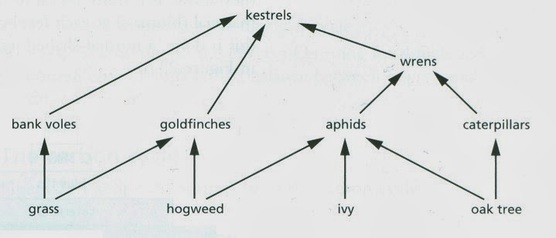
Two or more interlinked food chains which show the feeding connections in a habitat/ecosystem.
Producers
Organisms capable of making their own food by photosynthesis e.g. green plants.
Primary producers are always the first organism on a food chain.
Consumer
Organism that feeds on other organism. It cannot make their own food.
Primary Consumer - feed on producer
Secondary Consumer - feed on primary consumers
Tertiary Consumer - feed on secondary consumer
Trophic Level
Position of an organism in a food chain.
T1 Plants
T2 Herbivores
T3 Carnivores
T4 Top Carnivore
Length of a Food Chain
At each transfer 90% of the energy received by an organism has been lost as heat.
This means there is a decrease in the amount of energy passing from one trophic level to another.
Pyramid of Numbers
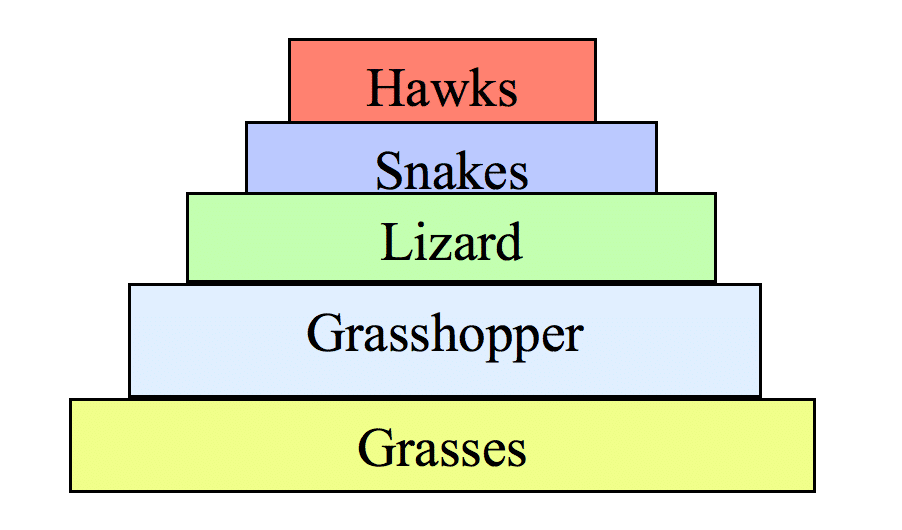
Represents number of organisms at each trophic level in a food chain.
Niche
Functional role of an organism in an ecosystem.
This includes what it eats and how it interacts with organisms and its abiotic factors.
e.g. swallows and thrushes avoid competition by having different niches in the same habitat. Swallows build mud nests on buildings and eats flying insects. Thrushes build nests in trees and eat ground insects and snails.
Two species that have identical niches cannot survive for long in the same habitat.
Nutrient Recyling
Nutrients that make up the bodies of living things are recyled and used time and time again.
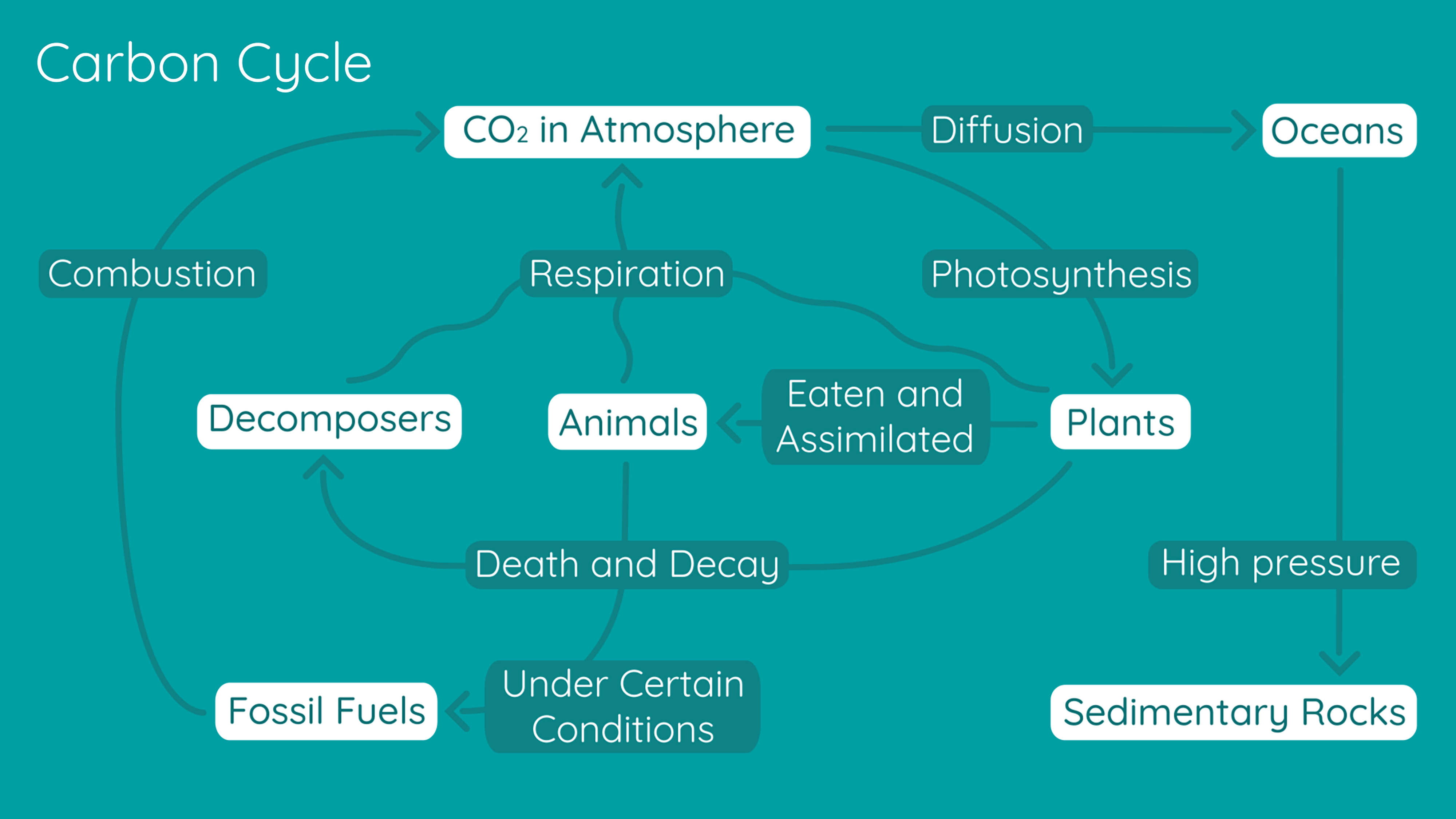
Carbon Cycle
Process by which carbon from the environment is converted into carbon from the enviroment is converted into carbon in living things, which is later released back into the environment.
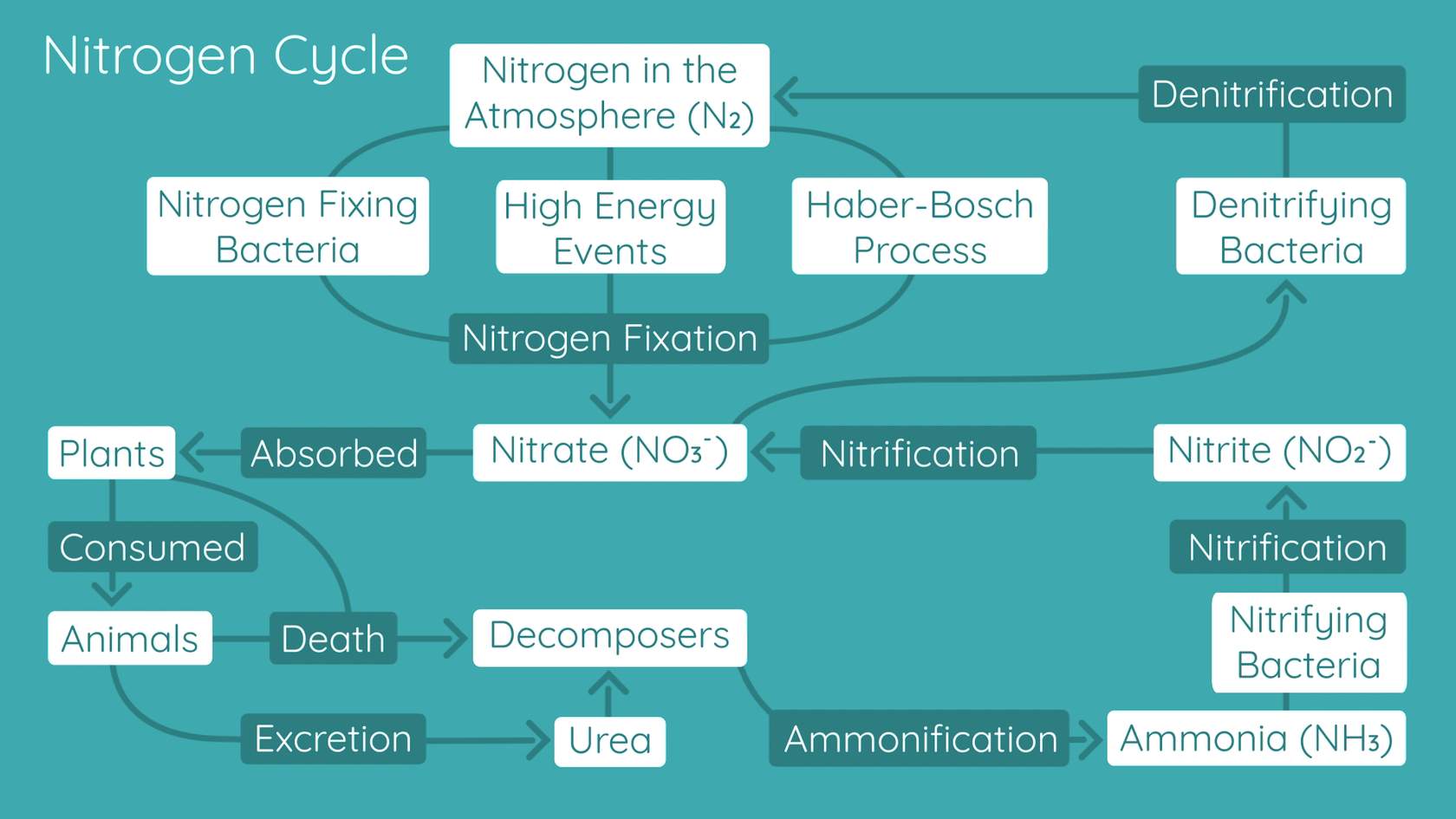
Nitrogen Cycle
Process of taking nitrogen from the air and make it available for use by living things, and then later converted back to nitrogen in the air.
Human Impact on Ecosystems
Pollution
Any harmful addition to the environment.
Chemicals of human origin that harm the environment are called pollutants.
Areas affected:
air, water, sea, soil, land
Types of Pollution:
air pollution
water/river pollution
domestic pollution
agricultural pollution
Effects of A Pollutant on an Area
Area | Pollutant | Source | Effects |
Agricultural | Slurry & Fertiliser | Washed from land | Algal blooms + eutrophication |
Industrial | Sulphur Dioxide | Burning fossil fuels | Acid rain |
Domestic | Plastic Bags | Shopping | Suffocate small animals, litter |
Eutrophication & Algal Bloom
Eutrophication: Where lakes become over-enriched with nutrients, resulting from excess artificial fertiliser washed into rivers and lakes.
Rapid increase of algae (algal bloom) as they use up the nutrients.
When all the nutrients are used up, algae die and are broken down by bacteria, which uses up oxygen in water and results in death of aquatic organisms e.g. fish.
Control of Pollutants
Area | Pollutant | Control Measures |
Agricultural | Slurry & Fertiliser | Avoid spreading on wet, water logged, frozen, or steeply sloping land, or within 1.5m of any watercourse. |
Industrial | Sulphur Dioxide | Fit catalytic scrubbers in factory chimneys |
Domestic | Plastic Bags | Bag levy + reusable bags |
Conservation
Conservation Practices
Area | Conservation Practice |
Agricultural | Mixed farming, crop rotation, biological controls, gene banks |
Fisheries | Fishing net size, quotas, re-stocking |
Forestry | Re-planting, broadleaf/conifer mix |
Fishing Industry
Fishing Net Size
Refers to how large or small the openings or spaces enclosed by the threads of a net are.
Use of small-mesh nets can result in too many young fish being caught.
Using larger meshed nets allows the young to escape, mature and reproduce.
Fishing Quotas
Fixed proportion of the total allowable catch allocated to each fishing nation.
This national quota allocation is further subdivided into quotas for specific areas, seasons, fisheries or organisations.
Helps to prevent extinction of a fish species.
Gradually increases fish stock and helps to re-establish populations.
Attempts to maintain fishing at highest possible levels.
Restocking
Translocation of species into areas where they have not naturally occured is not encouraged.
Achieves permanent increase in sustainable population of a species.
Waste Management
Collection, transport, processing, recycling or disposal of waste materials produced by human activity in an effort to reduce their effect on human health or local aesthetics or amenity.
Waste Management in Agriculture
The main problems are the waste products of farms e.g.:
Slurry
Silage Effluent
Overuse/Incorrect use of chemical fertilisers and animal manures.
Role of Micro-Organisms in Waste Management
Composting is an aerobic process during which micro-organisms decompose organic matter into a stable substance called compost which recycles all the nutrients required for plant growth.
Since it is aerobic, the organic waste mixture must be turned and loosened to allow air into it.
Fungi break down the ‘tougher’ materials in the waste such as lignin and cellulose.
Their filamentous structure penetrates the composting material and helps improve aeration and drainage in the compost heap.
Temperatures within a compost heap can reach 70oC as the bacteria and fungi work to break down the material.
Problems Associated with Waste Disposal
Availability of suitable landfill sites.
The toxic or polluting content of fumes from incineration (CO2, other acidic oxides and dioxins produced from burning plastic)
Decaying waste produces methane gas which contributes to the greenhouse gases.
Harmful substances may leak into groundwater supplies (wells, lakes, reservoir)
Plants and animals in rivers and lakes are killed through direct poisoning or eutrophication.
Waste Minimisation
Reduce: Use less, minimise waste.
Reuse: Use again without changing.
Recycle: Change, recover material and use again.
Pyramid of Numbers
In general, number of organisms declines as you go up the pyramid. This is due to large energy loss between each trophic level.
Means there is less energy available to organisms higher up the pyramid.
Conclusion:
Loss of energy and body size increase as you go up the pyramid.
Uses of the Pyramid of Numbers
Used to compare different communities of the ecosystem by comparing trophic levels.
They attempt to discover and show the energy structure of an ecosystem as a chart by counting the number of individuals at each trophic level.
Limitations of Use
Size of organisms is not considered in a pyramid of numbers. This gives rise to an inverted pyramid of numbers.
Parasitic food chains give rise to partially inverted pyramid of numbers.
Population Control: Factors That Control a Population
Competition
Occurs when organisms struggle for a resource that is in short supply.
Animals: Food, Territory
Plants: Light, Space, Water, Nutrients
Intra-Specific Competition
Occurs between members of the same species.
Inter-Specific Competition
Occurs between members of different species.
Contest Competition
Physical Activity between two organisms
Scramble Competition
All competeing individuals get some of the resource, generally reduces population size.
Predation
Catching, killing and eating of another organism.
Predator: Organism that carries out predation.
Prey: Organism eaten by the predator
Adaptations of Predators
Hawks have excellent eyesight.
Ladybirds have strong mouth parts.
Cheetahs can run at 60 km/h.
Adaptations of Prey
Plants may have thorns, spines or stings.
Nasty taste when eaten.
Faster than their predator.
Staying in herds or flocks.
Camouflage
Parasitism
Occurs when two different species live in close association - where the parasite feed off of the living host and causes harm to the host.
Ecto-parasites live on outside of the host.
Endo-parasites live on inside of the host.
Symbiosis (Mutualism)
Occurs when two organism of different species live in harmony and at least one benefits.
Nitrogen fixing bacteria in the nodules of legums:
Bacteria make nitrogen compounds need by the plant and the plant makes carbohydrates and other food material needed by the bacteria.
Bacteria living in the colon produce vitamin B2 and vitamin K. Body absorbs these vitamins. Bacteria get food and shelter in exchange.
Population Dynamics
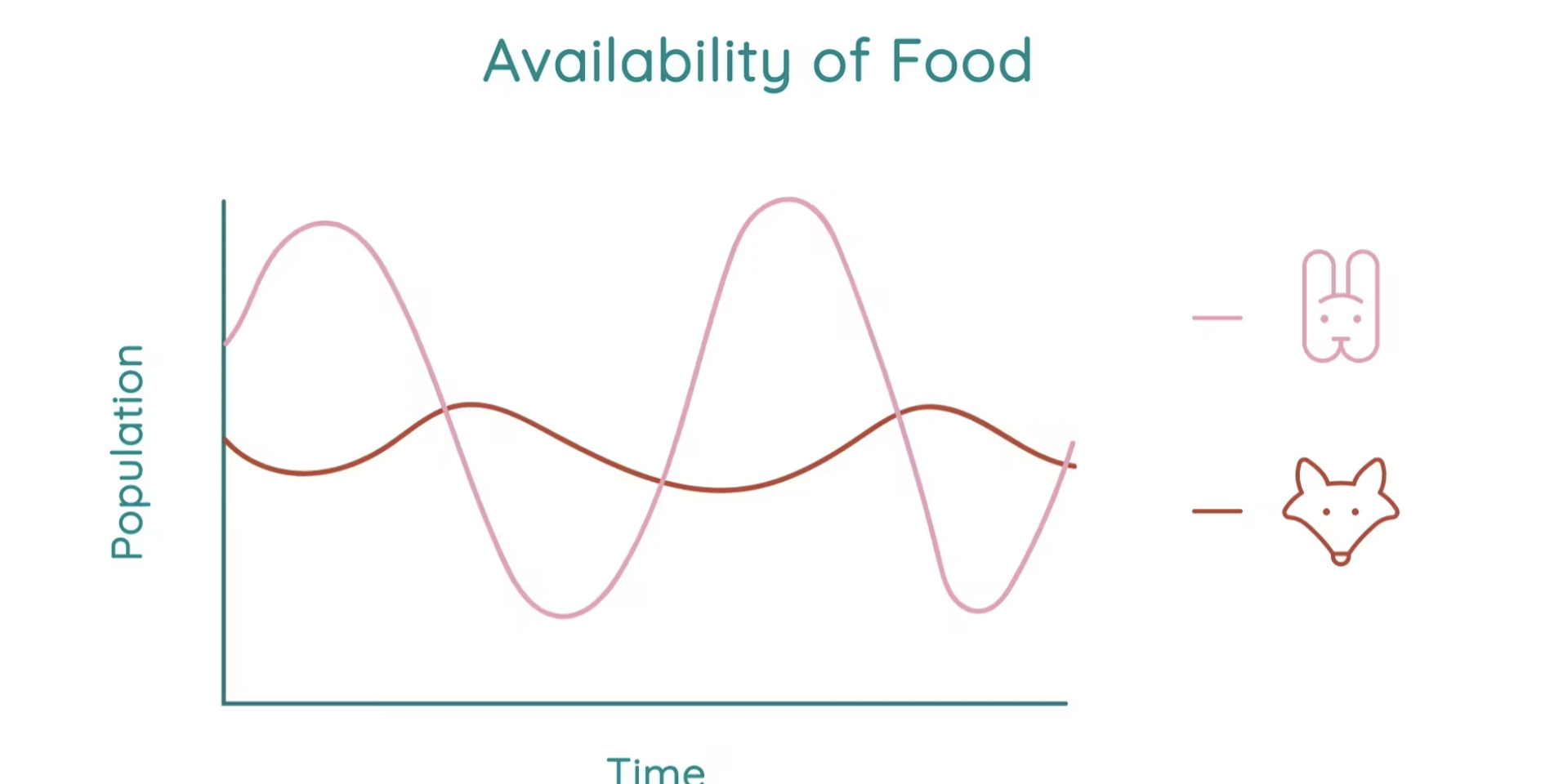
Predator - Prey Dynamics
When prey population increased, the predator population had more food and increased as well.
As the predator population increased, the number of prey being killed increased — resulting in a decline in the prey population.
When the prey population decline, there was less food for the predators and they declined in numbers too.
Leads to increase in prey population.
Factors That Affect Predator - Prey Relationships
Food Supply
Greater food supply, the greater the population increase.
Declining prey numbers due to predation causes a food shortage — as a result predator numbeers decrease.
Concealment
Prey can conceal themselves which allows their numbers to increase again. Prevents extinction.
Movement of Predators
Too few prey will lead to the predators moving out of the area. This allows prey numbers to rise again.
Factors Affecting Human Population Growth
Famine
Greater food supply, the greater population. Famine leads to malnutrition, which leads to death and low birth rates. Advances in agriculture have allowed greater food production matching increase in population.
War
War reduces population numbers. Partners can separate during war reducing birth rates.
Disease
Advances in modern medicine has lead to population increase. Higher life expectancy and lower child mortality.
Contraception
Increased contraception had lead to a decrease in population growth.