P6 reviewer ni paid
PHYSICS - deals with the interaction of matter, force, and energy.
Peter W. Higgs - proposed the existence of the Higgs boson, the carrier particle of the Higgs Field, which gives subatomic particle its mass.
Physics is divided into CLASSICAL and MODERN.
CLASSICAL covers:
Mechanics - deals with motion, force, work, energy, and fluids.
Heat and Thermodynamics - deals with the effects of heat when added to or removed from a system.
Optics - deals with the study of light and It’s properties.
Electricity and Magnetism - deals with phenomena associated with electrical charges, magnetism, and relationship between electricity and magnetism.
Wave Motion and Sound - deals properties, transmission, and perception of different types of waves.
MODERN covers:
Special Relativity - deals with phenomena associated when an object moves with speeds approaching the speed of light in a vacuum.
General Relativity - tells how matter curves space-time and how the curvature of space-time dictates the trajectory of matter and light.
Nuclear Physics - deals with the properties of and the reactions within
the atomic nucleus.
Particle Physics - deals with the building blocks of matter called elementary particles.
Quantum Mechanics - deals with the nature and behavior of matter and energy on the atomic and subatomic levels.
/
Measurement - is the process of comparing something with a standard.
NOTE: The Metric System has two variations the mks and cgs systems. While the English system is otherwise known as fps system.
MKS - stands for meter, kilogram, second
CGS - centimeter, gram, second
The International System of Units - is the modern form of the metric system. It is the system of units that the General Conference on Weights and Measures has agreed upon and is legally enforced in almost all parts of the world.
Fundamental Quantities - are basic quantities that are independent of one another. Examples are length, mass, time , thermodynamic temperature, electric current, luminous intensity, and amount of substance.
Derived Quantities - are combinations of fundamental quantities.
Quantity | Unit | Symbol |
Length | meter | m |
Mass | kilogram | kg |
Time | second | s |
Temperature | kelvin | K |
Electric current | ampere | A |
Luminous intensity | candela | cd |
Amount of substance | mole | mol |
SI PREFIX | SYMBOL | MULTIPLIER | NAME |
yotta | Y | 1024 | septillion |
zetta | Z | 1021 | sextillion |
exa | E | 1018 | quintillion |
peta | P | 1015 | quadrillion |
tera | T | 1012 | trillion |
giga | G | 109 | billion |
mega | M | 106 | million |
kilo | k | 103 | thousand |
hecto | h | 102 | hundred |
deka | da | 101 | ten |
SI PREFIX | SYMBOL | MULTIPLIER | NAME |
yocto | y | 10-24 | septillionth |
zepto | z | 10-21 | sextillionth |
atto | a | 10-18 | quintillionth |
femto | f | 10-15 | quadrillionth |
pico | p | 10-12 | trillionth |
nano | n | 10-9 | billionth |
micro | μ | 10-6 | millionth |
milli | m | 10-3 | thousandth |
centi | c | 10-2 | hundredth |
deci | d | 10-1 | tenth |
Scientific Notation - is a convenient and widely used method of expressing large and small numbers. Nx10^n, where “N” is any number between 1 and 10 and “n” is the appropriate power of 10.
Independent Variable - variable that is changed by an experimenter.
Dependent Variable - the variable that is affected by the change of the independent variable.
Accuracy - refers to the closeness of a measured value to the expected or true value of a physical quantity.
Precision - represents how close or consistent the independent measurements of the same quantity are to one another.
Error - is the deviation of a measured value from the expected or true value. Uncertainty is a way of expressing this error. The equation below shows the relationship of these factors.
Random Errors - result from unpredictable or inevitable changes during data measurement. Random errors affect the precision of the measurements. These errors may be reduced by increasing the number of trials of a measurement and averaging out the results.
Systematic Errors - usually come from the measuring instrument or in the design of the experiment itself.
NOTE: Measurements always have some degree of uncertainty because of unavoidable errors. These errors limit the accuracy of results.
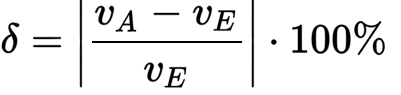
When there is an expected or true value of a quantity, percentage error (or percent error) is usually calculated.
Percent Error - when there is an expected or true value of a quantity.
FORMULA:
δ = percent error
VA = actual value observed
VE = expected value
Percent Difference - is a measure of how far apart the different measured values are from each other, and is therefore an indication of precision.
FORMULA:
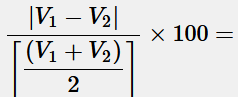
Find the absolute difference between two numbers: |V1 - V2|.
Find the average of those two numbers: (V1 + V2) / 2.
Divide the difference by the average: |V1- V2| / ( (V1 + V2) / 2).
Express the result as percentages by multiplying it by 100.
VARIANCE FORMULA
Find the mean of the given data set. Calculate the average of a given set of values
Now subtract the mean from each value and square them
Find the average of these squared values, that will result in variance
Value X | X – μ | (X – μ)2 |
3 | -5.8 | 33.64 |
8 | -0.8 | 0.64 |
6 | -2.8 | 7.84 |
10 | 1.2 | 1.44 |
12 | 3.2 | 10.24 |
9 | 0.2 | 0.04 |
11 | 2.2 | 4.84 |
10 | 1.2 | 1.44 |
12 | 3.2 | 10.24 |
7 | -1.8 | 3.24 |
3+8+6+10+12+9+11+10+12+7=88/10 Total: 8.8 = mean | 0 | 73.6 73.6/10 = 7.36 7.36 = variance |
Variance - measures the standard deviation of each number in the set from the mean.
Standard Deviation - It is a measure of how diverse or spread out are a set of measurements from their average. Calculate the square root of the variance to get the standard deviation.
ABSOLUTE AND RELATIVE UNCERTAINTIES
Uncertainty - indicates the range of values within which thee measurement is asserted to lie with some level of confidence. The degree of uncertainty may be reported as absolute or relative.
Least Count - the smallest value that can be read from any measuring device.
Absolute Uncertainty - has the same unit as the quantity itself.
Relative Uncertainty - is dimensionless and is obtained by dividing the absolute uncertainty by the numerical or measured value.
FORMULA FOR RELATIVE UNCERTAINTY:
To get the relative uncertainty, divide the absolute uncertainty by the measured value and then multiply it by 100.
Example: The resistance of the wire is (25.00 ± 0.05)Ω.
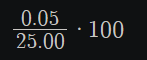
= 0.2
= 25.00 Ω ± 0.2%
NOTE: The quotient is usually expressed as percentage by multiplying it by 100.
VECTORS AND VECTOR ADDITION
Scalar Quantities - are quantities that are fully described by a magnitude (or numerical value) alone.
Vector Quantities - are quantities that are fully described by both a magnitude and a direction.
Arrow - represents a vector quantity.
NOTE: The direction of a vector is the acute angle it makes with the east-west line.
VECTOR ADDITION
Two Important Properties of Vector Addition: Commutative Property and Associative Property
Resultant - the sum of two or more vector quantities.
METHODS OF VECTOR ADDITION
Graphical Method
a.) Parallelogram
b.) Polygon Method
Analytical Method
a.) Using Law of Sines and Cosines
b.) Component Method
Test Questions: