Cognitive Psychology
Memory
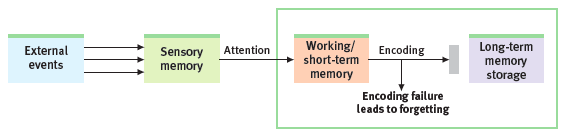
Stages of Memory
Encoding (Process)
Storage (Maintain)
Retrieval (Recall)
Latent Learning: the type of learning that occurs without immediate reinforcement but becomes apparent when there is motivation to demonstrate it.
The Multi-Store Model
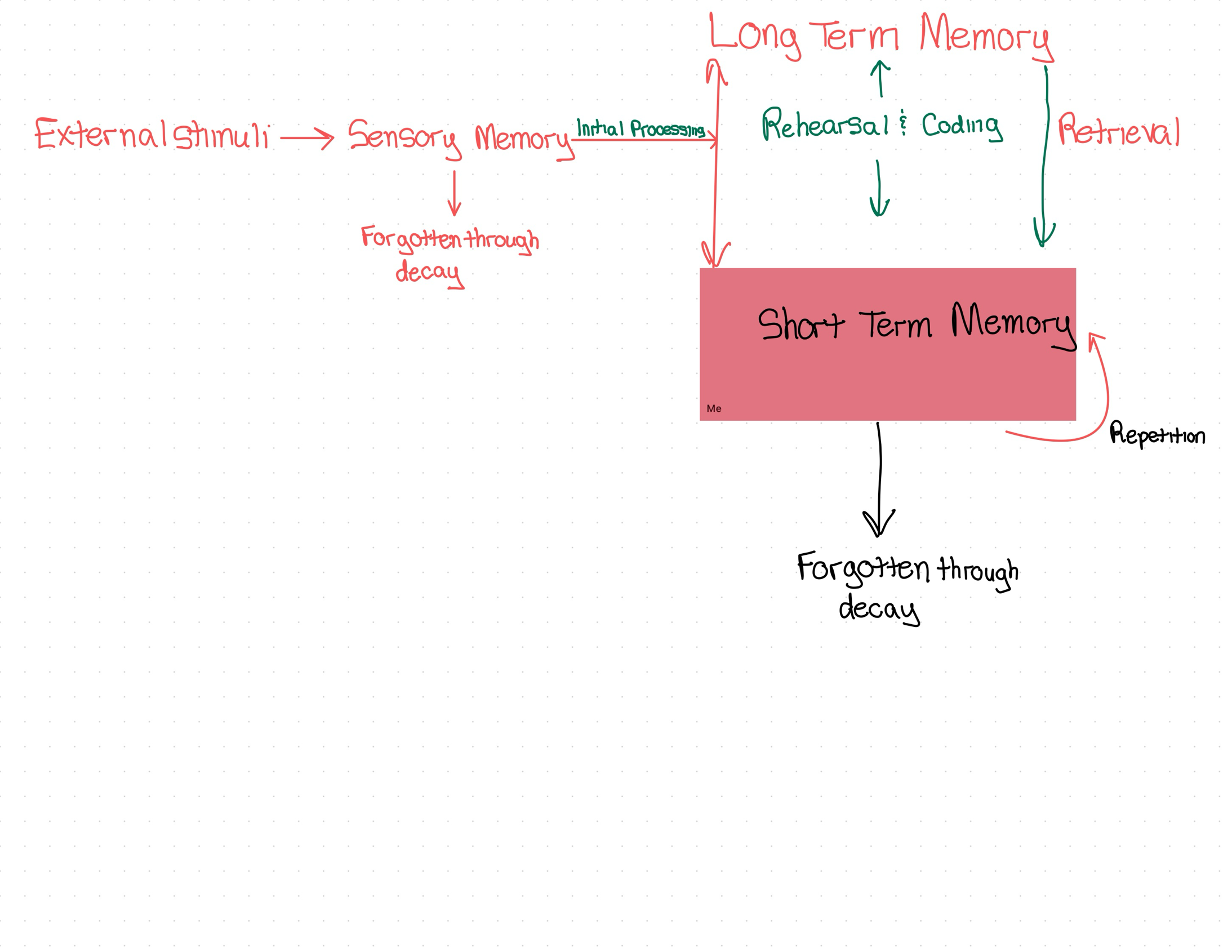
Sensory Memory (SM)
Function: Holds sensory information (sights, sounds, etc.) for a very short time.
Duration: Less than a second for visual information (iconic memory) and 2-4 seconds for auditory information (echoic memory).
Capacity: Very large but only a small amount is passed on.
How it moves to the next store: If attention is paid to the information, it moves to short-term memory (STM).
Short-Term Memory (STM)
Function: Temporarily holds information we are currently thinking about.
Duration: About 18-30 seconds unless rehearsed.
Capacity: Limited (around 7±2 items, according to Miller’s law).
How it moves to the next store: If rehearsed (especially through maintenance rehearsal), it transfers to long-term memory (LTM).
Long-Term Memory (LTM)
Function: Stores information for long periods, potentially indefinitely.
Duration: Can last a lifetime.
Capacity: Unlimited.
Retrieval: Information is retrieved back into STM when needed.
Key Processes in MSM
Encoding: Information is processed in different forms (e.g., visual, auditory, semantic).
Storage: Holding the information in either STM or LTM.
Retrieval: Accessing stored information when needed.
This model is linear, meaning information flows in one direction from SM → STM → LTM. It emphasizes the role of rehearsal in memory transfer but has been criticized for being too simplistic (e.g., it doesn't explain why we remember things without rehearsal).
Sensory Memory
Iconic: Last 1/20th of second
Echoic: Last 3 or 4 seconds
Iconic lasts less because one is likely to grasp on to auditory pro
Working Memory Model
Short-term memory is more complex
Short-term Memory = Working Memory
Visual Spatial Sketchpad (visual and spatial information)
Phonological Loop (spoken and written information)
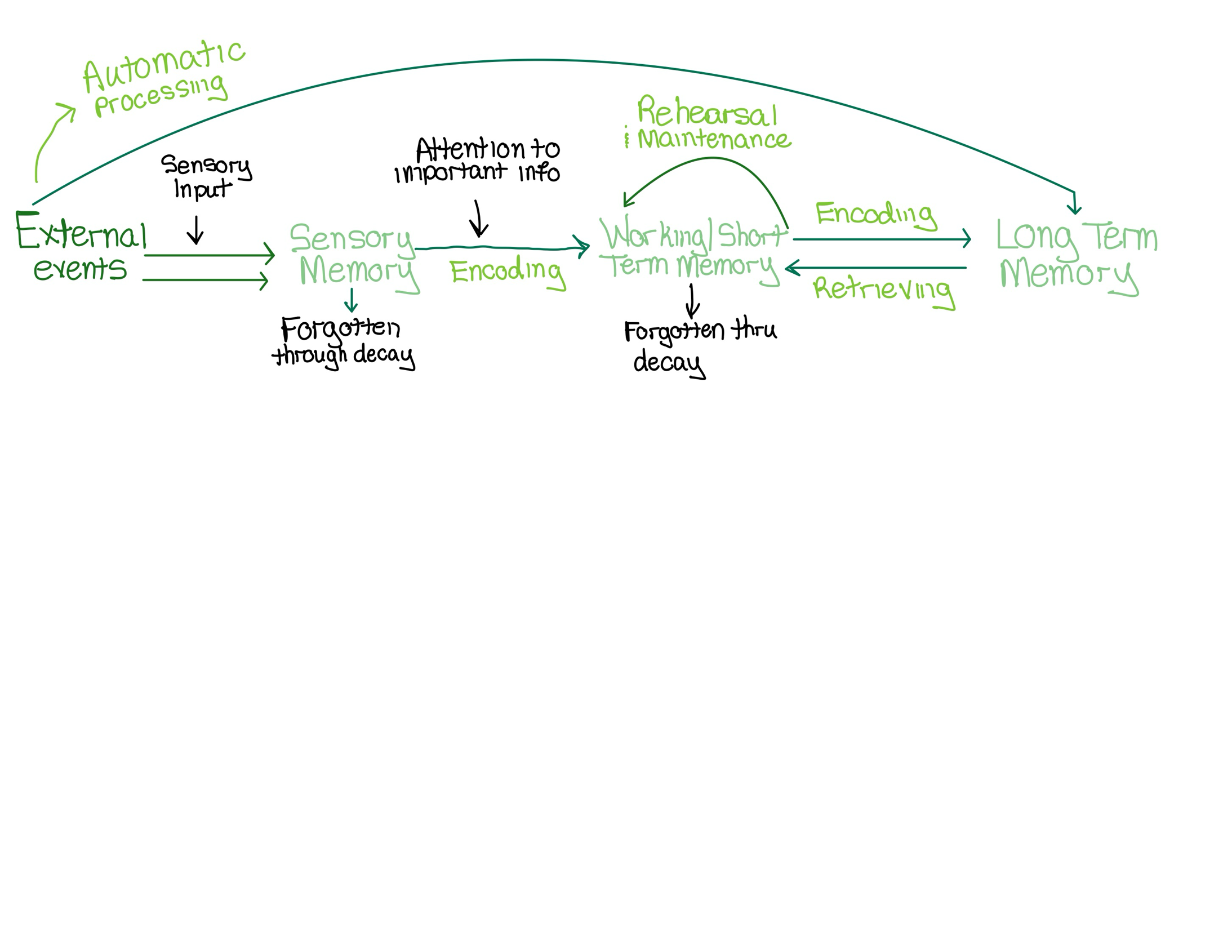
Capacity of Short-Term Memory
15-30 seconds or 7 items (+/-2)
Words
Numbers
Phrases
We can remember more if this is organized!
Biological Process of Memory
Long-term Potentiation: Synaptic connections between neurons become stronger with frequent activation.
Levels of Processing Model
Shallow _____Structural __Phonemic _____Semantic_______Deep
Types of Information Processing
Automatic Processing: Unconscious and effortless encoding of information into memory
EX: brushing teeth, walking, tying shoes
Effortful Processing: Conscious and deliberate encoding of information into memory
EX: studying for a test.
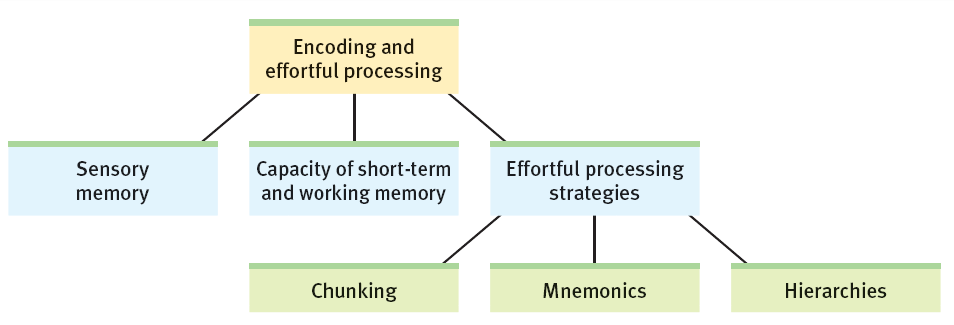
Effortful Processing Strategies to Improve Encoding

Chunking: grouping information together into meaningful chunks or categories
Mnemonic Devices: a strategy that helps one remember by using a word/phrase
Method of Loci: Adding numbers or letters to each part of a room to remember
Spacing Effect
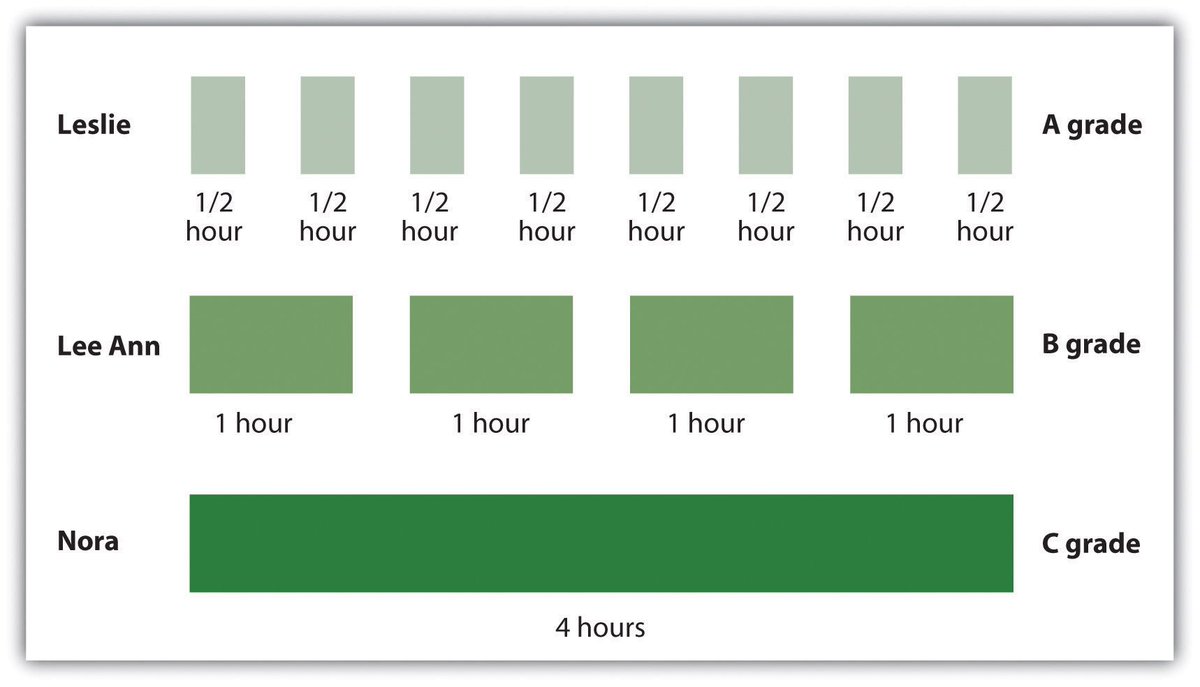
Massed Practice: cramming studies in 4 hours
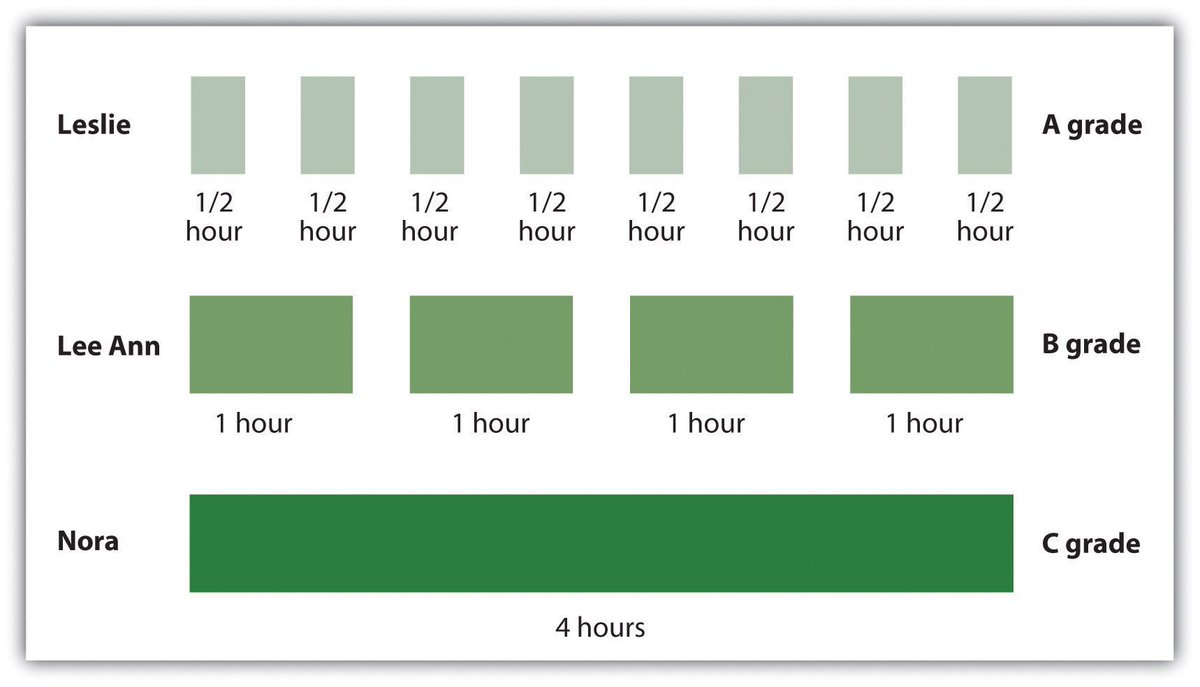
Distributed practice: chunking studying out for 1 hour every day.
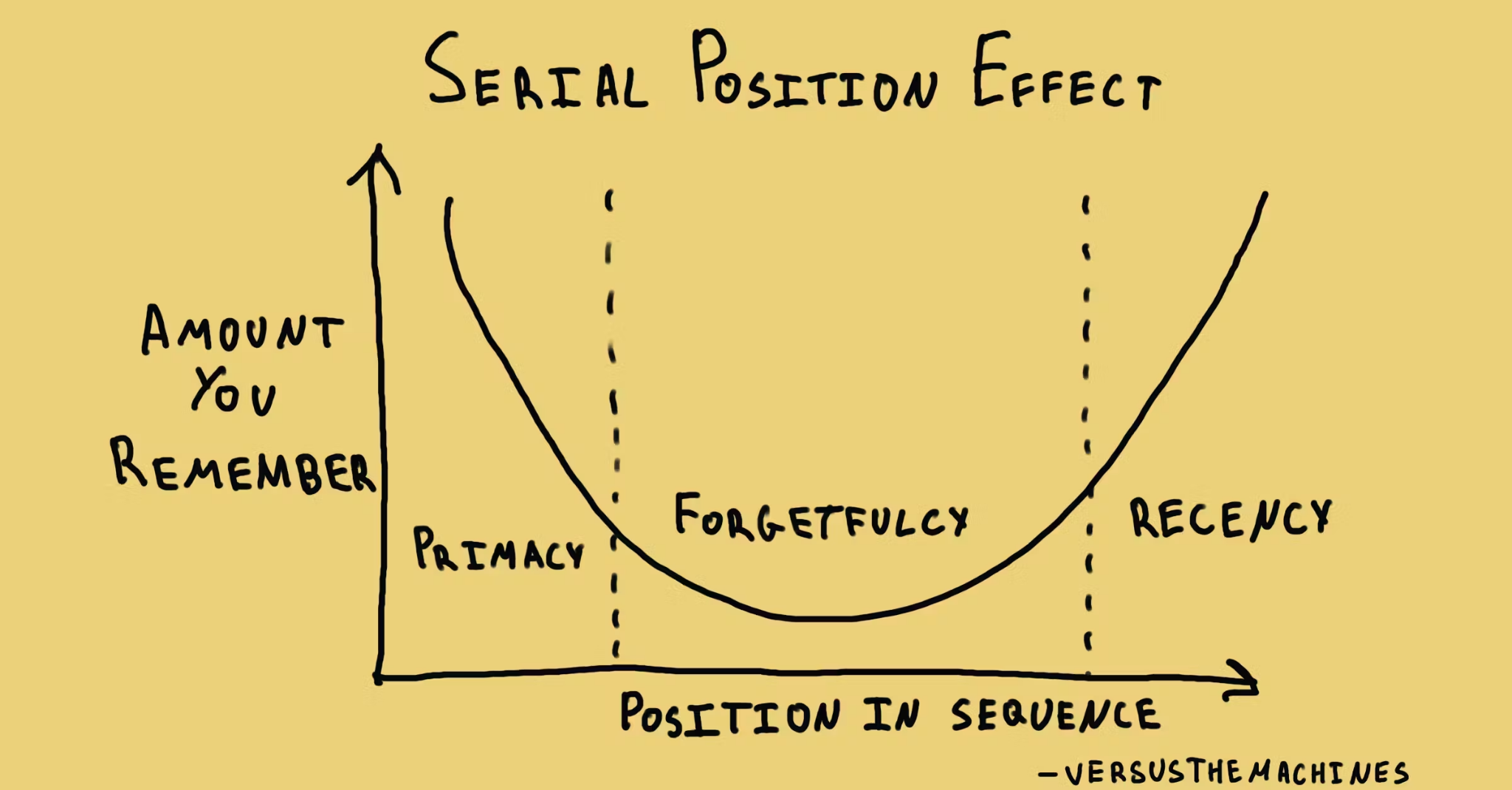
Serial Position Effect: Information presented at the beginning of a list (primacy effect) or the end of a list (recency effect) will be more memorable than information presented in the middle of the list.
Hierarchies: A branching/nested set of categories and subcategories.
Deep or Semantic Processing: When coding information, one is more likely to retain it if one can deeply process even a simple word list by focusing on the semantics (meaning) of the words.
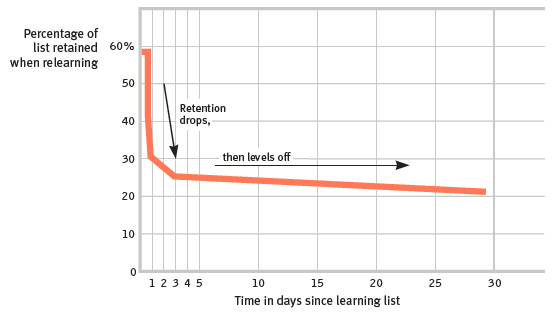
Ebbinghaus’ Retention Curve: The more time spent on learning something, the fewer repetitions were needed to relearn.
Priming: the activation of a particular association in memory.
Memory Storage
Sensory Memory: HIGH capacity, LOW duration
Short-Term Memory: LOW capacity, LOW duration
Long-Term Memory: HIGH capacity, HIGH duration
Rehearsal
Maintenance Rehearsal: Simply repeating information to keep it in short-term memory for a brief period of time
Elaborative Rehearsal: Connects new information to existing knowledge, creating deeper processing and better long-term memory retention
Superior Memory Storage
Autobiographical Memory: Collection of memories of a person’s life
Explains why memories connected to our own lives are more memorable
Suggests that there are biological processes for superior memory storage due to highly superior autobiographical memory
Increased activity in the prefrontal cortex and hippocampus
Storage Impairments
Autograde amnesia: When the hippocampus is damaged, resulting in the inability to “create” long-term memories and forcing a person to always live in the present (50 First Dates, the case of Clive Wearing)
Retrograde amnesia: forgetting events that occurred before an injury or trauma
NO DAMAGE TO HIPPOCAMPUS, loss of episodic memories
Infantile amnesia: implicit memories are retained, but explicit memories only go back to 3 years old for most
This is an encoding failure because the hippocampus has not been developed.
Alzheimer’s Disease: A brain disorder that slowly destroys memory and thinking skills.
Associated with the loss of acetylcholine
Memory Retrieval
Recall: “Fill in the blanks”
Information that is previously learned are retrieved and unconsciously stored
Ex: Recalling celebrities, or names of countries
Recognition: “Multiple Choice”
One identifies which stimuli matches the stored information
Ex: choosing a best answer from a list of possibilities to answer a question
Enhancing Retrieval
Context Dependent Memory: in the same environmental space
Ex: studying in the same classroom you will take the test in
State Dependent Memory: in the same physical and mental space
Ex: chewing gum while learning the info, then chewing gum while taking the test.
Testing Effect: You’re likely to perform better on a test if you do flashcards and practice tests, rather than reading the textbook.
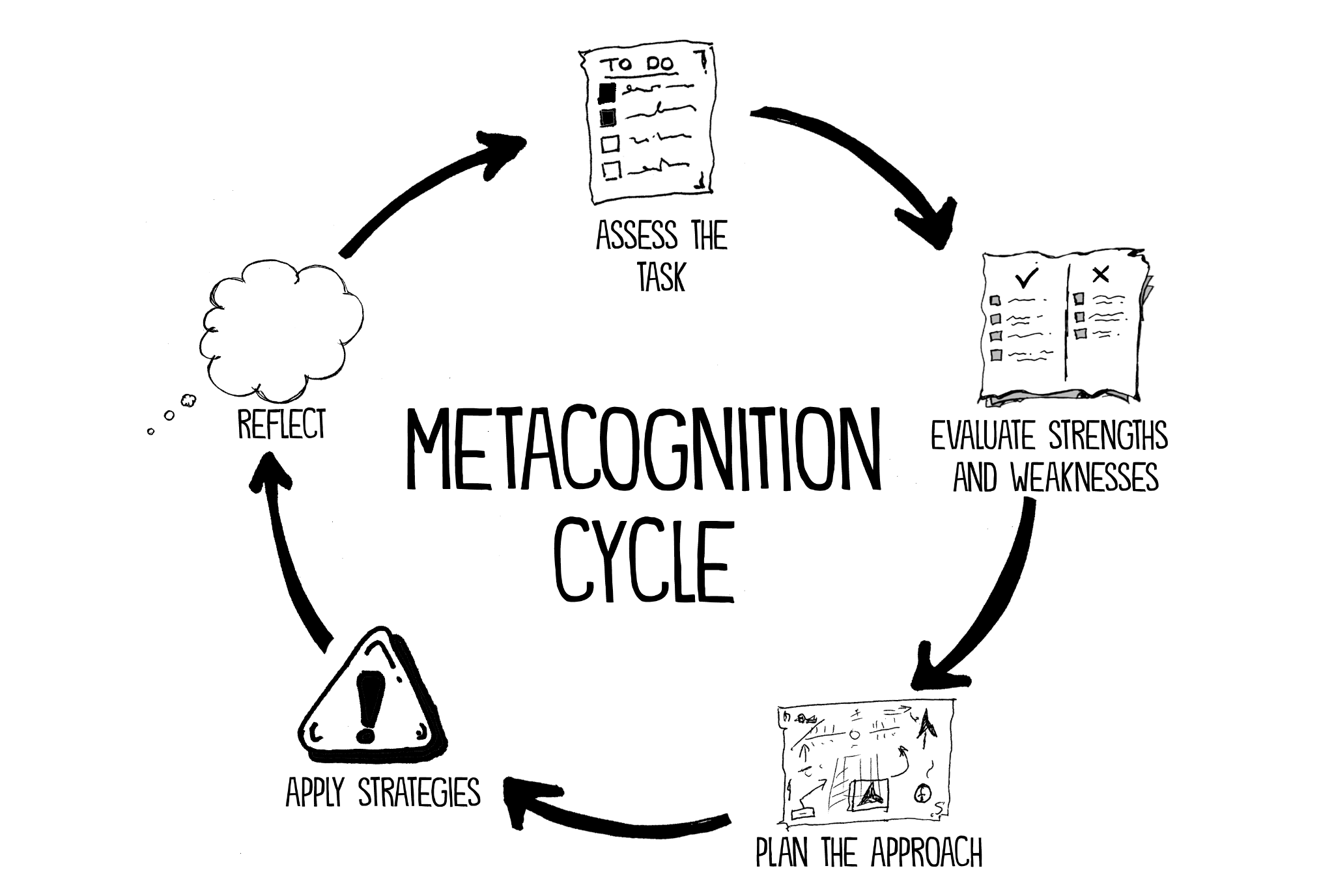
Metacognition: thinking about thinking
Ex: self assessment, goal setting, etc
Memory Failure
Encoding failure: Can not remember what has been encoded. This is mostly age related.
Storage Decay: Memory declines over time if there is no effort to retain the information
80% of what is learned is lost within 24 hours without recitation/review
People typically lose what they learn within 3 months.
Psychodynamic Theory of Forgetting
Created by Sigmund Freud, the theory was known as repression (motivational forgetting)
The pushing out of painful, embarrassing and threatening memories out of consciousness
Retrieval Failure
Retrieval failure: Information is in long term memory but can not be accessed.
Tip of the Tongue: feeling that a memory is available but not quite retrievable. This can be frustrating but normal
This stems from interference:
Proactive Interference: occurs when prior learning interferes with recall of new information
Retroactive interference: occurs when new learning disrupts recall of old information.
Mnemonic: Proactive interferes with Old learning, Retroactive interferes with New learning
Accuracy of Memories
Misinformation Effect: Incorporating misleading information into ones memory of an event.
Constructive Memory: The process of creating and updating memories based on existing knowledge, beliefs and experiences
EX: You witness a car accident. Police ask for the color of the car and you say it was red. You said red because of a car you saw earlier that you saw earlier that day.
Imagination Inflation: Occurs when someone mistakenly believes that an event happened because they imagined it. This contributes to misinformation effect and constructive memory.
Ex: False confessions
Creativity, Thinking and Problem Solving
Creativity: The ability to produce novel and valuable ideas within any discipline, including art, music, architecture, mathematics, science and engineering.
Two kinds of thinking influence creativity:
Convergent thinking: only one correct answer
Multiple choice test questions/intelligence tests
Divergent thinking: can have several or many possible responses
“How many ways can you use a paperclip?”
5 components of creativity
Expertise
Imaginative thinking skills
Adventuresome personality
Intrinsic motivation
A creative environment
Problem solving: the thinking we do to answer a complex question or to figure out how to resolve an unfavorable situation.
Ways to Solve Problems
Trial and error: try out different solutions until one works.
Best when a problem has few solutions
Insight: a sudden understanding about what is required to solve a problem
“Light bulb moment”
Heuristics
Availability heuristic: likelihood of an event based on how much it stands out in our mind
EX: afraid to swim because of seeing “Jaws”
Representative heuristic: when we judge how something represents or matches certain prototypes we have
Obstacles to Problem Solving
Overconfidence: overestimate the accuracy of your beliefs and judgments
FACT: only 50% of people in any particular field can be above average
FACT: about 70% of the people in the U.S. describe themselves as above average
Sunk Fallacy: continuing a course of action once you have committed time, effort and money
EX: finish reading a boring book
Gambler’s Fallacy: the mistaken belief that independent events are interrelated
EX: I have flipped a coin with heads showing up the last 5 flips, tails is bound to be next
Cognitive Bias: ways of thinking that veer us away from natural conclusions.
Framing: the way an issue is posed
EX: You have a 1 in 175 million chance in winning the lottery, but phrases like “One person has to win. It could be you” makes it seem more likely
Confirmation bias: the tendency to search for information that supports our preconceptions
EX: gun control issue
Belief perseverance: holding on to your ideas over time, and actively rejecting information that contradicts your ideas
EX: high school rumor
Fixation: inability to see a problem from a new perspective
Mental Set: the tendency to approach a problem in one way
Functional fixedness: tendency to think of thinks only in terms of their usual functions.
Intelligence
Intelligence: the ability to learn from experience, solve problems, and use the knowledge to adapt to new situations
Ways to Define Intelligence
G factor: general intelligence
Created by Charles Spearman
If people scored high in one factor, they will generally score high on other factors
Most modern psychology tests measure a g factor.
Triarchic Theory of Intelligence
Created by Robert Sternberg, who believed intelligence was composed of three parts:
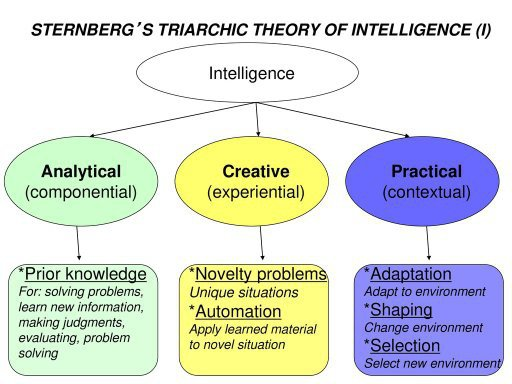
Analytical
Creative
Practical
Savant Syndrome: A person with an intellectual disorder or autism spectrum disorder who demonstrates exceptional cognitive abilities
Howard Gardner’s Multiple Intelligences Theory: Believed the conventional concept of intelligence was too narrow and measures of IQ would miss out on other “intelligences”
Extremes of Intelligence
Gifted: Score over 130
Intellectually disabled: score over 70
How is intelligence measured?
The History of Assessing Intelligence
Created by Sir Francis Galton
Cousin of Darwin
Wanted to use intelligence testing for eugenics (selective reproduction to enhance the capabilities of the human race)
Albert Binet founded the modern intelligence test
Stanford-Binet Scale - Lewis Terman
Mental age: age level at which you function mentally
Intelligence Quotient (IQ): take the mental age provided by the exam divided by the actual age multiplied by 100
Assessment Measures
Assessments: evaluations or tests of ability or other traits
Achievement tests: identify what individuals know and test their skill levels in different areas
Unit or final exams
Upcoming AP exam
Aptitude test: measure ability in certain area, such as numerical, verbal, or mechanical reasoning
Problem solving in work related situations
Modern Intelligence Tests
The Weshsler Tests
Used more widely now than Stanford Binet
David Wechsler believed the Stanford-Binet test did not measure all of a person’s intelligence
Designed to measure intelligence and cognitive ability in adults and other adolescents
WISC( tests for 6-16) to understand whether or not a child is gifted and determine cognitive weaknesses
Psychological Tests MUST be
Standardized
Reliable
Valid
Standardized Scoring
Standardization: “norming a test”
Refers to determining what the “norm” is for typical, randomly selected people taking the test, allowing for the comparison between an individual score to the norm
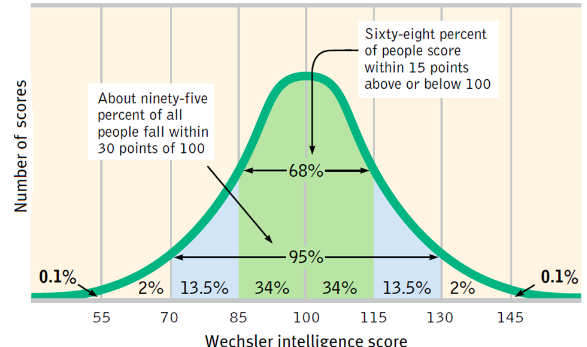
Standard distribution curve looks like this:
Mean of 100
Standard deviation of 15
Restandardization and the “Flynn Effect”
Restandardization: Retesting a sample of the general population to make an updated, accurate comparison group in case people are smarter than the last generation when the test was first made.
The Flynn Effect: Performance on intelligence tests has improved over the years, worldwide.