Acids, bases, chemical stuff
Misc:
The splitting of a substance into ions is called dissociation.
Acids and bases both neutralize each other.
Bases are found in most cleaning products. Acids are found in acidic things like citrus, vinegar, or battery acids.
A neutral pH is 7. Acids < 7, bases > 7.
How do acids and bases produce new substances?
The formula for any acid usually starts with a H (eg. Hcl or H2SO4), while bases usually contain OH (eg. NaOH or KOH).
In an acid-base (or neutralization) reaction, the H+ ions from the acid and the OH- ions from the base react to create water (H2O). Another product of a neutralization reaction is an ionic compound called a salt.
H+ ion = hydrogen ion (acids)
OH- ion = hydroxide ion (bases)
A neutralization reaction is the process where an acid and a base react to form water and a salt; involves the combination of a H+ and an OH- ion to form the water.
How to predict the properties of the substances produced in reactions between acids and bases:
Identify the Reactants: Determine the specific acid and base involved in the reaction.
Determine the Products: In an acid-base reaction, the general products are a salt and water. The reaction follows the general pattern: Acid+Base→Salt+Water
Example: the reaction between hydrochloric acid (HCl) and sodium hydroxide (NaOH) results in sodium chloride (NaCl) and water (H2O)
Write out the balanced chemical equation
Predict the Salt Formed: The salt comprises the cation from the base and the anion from the acid. In the above example, Na+ from NaOH and Cl- from HCl combine to form NaCl.
Difference between acids and bases:
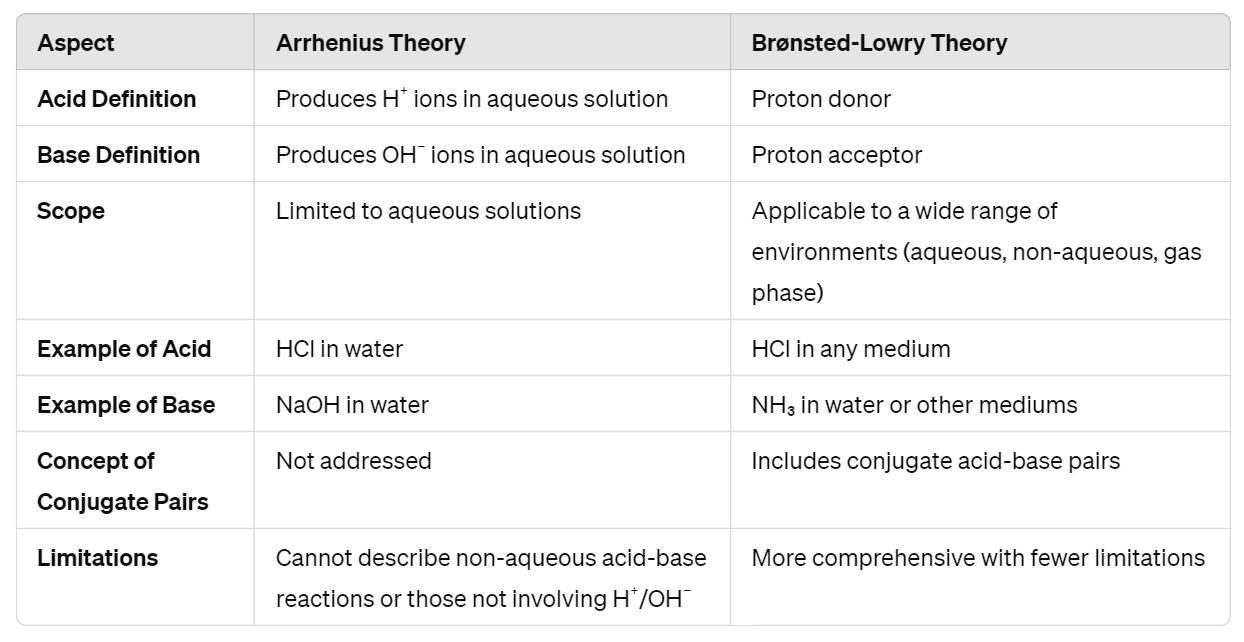
Chemically, the difference is that an acid is a hydrogen donor1 and a base is a hydrogen acceptor2 (Brønsted-Lowry).
Arrhenius's definition:
1an acid is a substance that produces hydrogen ions (H+) in an aqueous solution (when dissolved in water).
E.g. HCl(aq) → H+(aq) + Cl-(aq). 2A base is a substance that produces hydroxide ions (OH-) in an aqueous solution (when dissolved in water).
An aqueous solution is where the solvent is water. A solvent is a substance that dissolves a solute. A solute is a substance that is dissolved in a solution.
E.g. NaOH(aq) → Na+ (aq) +OH-(aq) Limitations:
The Arrhenius definition is limited to aqueous solutions.
It cannot explain acid-base behaviour in non-aqueous solutions or reactions that do not produce H⁺ or OH⁻ ions. For example, it cannot describe ammonia (NH3) as a base without water.
Brønsted-Lowry definition:
Acid: A Brønsted-Lowry acid is a substance that donates a proton (H⁺) to another substance.
Example: HCl→H++Cl−HCl→H++Cl−
Base: A Brønsted-Lowry base is a substance that accepts a proton (H⁺) from another substance.
Example: NH3+H+→NH4+NH3+H+→NH4+
The Brønsted-Lowry definition is more general and can be applied to reactions in aqueous and non-aqueous solutions, as well as gas-phase reactions.
Comparison:
What is the difference between a base and an alkali?
Alkalis are bases that are soluble in water (eg. sodium bicarbonate, sodium hydroxide, sodium carbonate, potassium hydroxide).
The most common bases are alkalis. All alkalis are bases, but not all bases are alkalis.
Hazard symbols:
Toxic/poisonous:
Flammable: 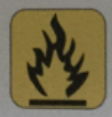 Irritant (with i):
  Corrosive:
Explosion risk:  Non-iodizing radiation:
  Oxidizing:
  Harmful to the environment:
Use of indicators:
All solutions in water are either acidic, alkaline or neutral:
we get an acidic solution when an acid is dissolved in water
we get an alkaline solution when a base is dissolved in water
solutions that are neither acidic nor alkaline are neutral, pure water is neutral, and so is petrol.
Modern universal indicators:
Litmus paper, universal indicator solution, pH probes, pH strips.
What is the difference between strong and weak acids?
A strong acid is an acid that completely dissociates its ions in an aqueous solution.
A weak acid’s ions only partially dissociate in an aqueous solution.
Examples include:
Hydrobromic acid (HBr)
Nitric acid (HNO3)
Hydrochloric acid (HCL)
Sulfuric acid (H2SO4)
Formic acid (HCOOH)
Oxalic acid (C2H2O4)
Hydrofluoric acid (HF)
Nitrous acid (HNO2)
Sulphurous acid (H2SO3)
Phosphoric acid (H3PO4)
Benzoic acid (C6H5COOH)
Perchloric acid (HCL04)
Hydroiodic acid (HI)
Chloric acid (HCL03)
Weak acids:
Acetic/ethanoic acid (CH3COOH)
Formic acid (HCOOH)
Oxalic acid (C2H2O4)
Hydrofluoric acid (HF)
Nitrous acid (HNO2)
Sulphurous acid (H2SO3)
Phosphoric acid (H3PO4)
Benzoic acid (C6H5COOH)
What is the difference between strong and weak bases?
Strong bases are hydroxides and fully ionize in aqueous solutions. Weak bases only partially ionize.
Examples include:
Strong: Potassium hydroxide, sodium hydroxide, calcium hydroxide, lithium hydroxide.
Weak: Ammonia (NH3), aluminium hydroxide (Al(OH)3)
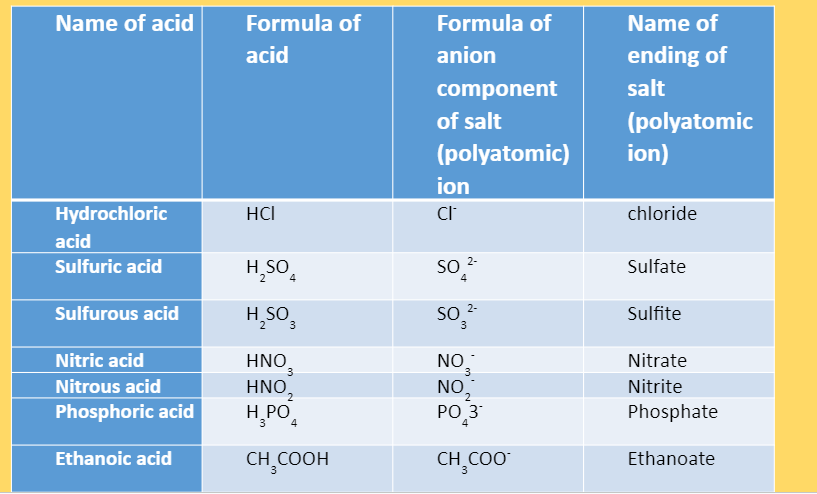
Names and formulas of some common acids:
Acids and salts:
Acids that end in “ic” produce a salt that ends in “ate”. For example, sulfuric acid produces sodium sulfate, nitric acid produces sodium nitrate, and carbonic acid produces sodium carbonate.
Acids that end in “ous” produce salts that end in “ite”. Eg. Sulfurous acid = sodium sulfite, nitrous acid = potassium nitrite.
HCl (hydrochloric acid) is the one exception; it produces sodium chloride.
An ionic equation removes spectators
A substance is neutral when there are an equal number of hydrogen and hydroxide ions. The reaction of a base and and an acid will always produce water and a salt.