Nursing Fundamentals NCLEX
Lab Value Ranges:
Electrolytes
Sodium 136-145 mEq/L
Potassium 3.5-5.0 mEq/L
Total Calcium 9.0-10.5 mg/dL
Magnesium 1.3-2.1 mg/dL
Phosphorus 3.0–4.5 mg/dL
Kidney Function
BUN: 10-20 mg/dL
Creatinine: 0.6 – 1.2 mg/dL males & 0.5 – 1.1 mg/dL females
Labs
HgbA1c: <6.5%
WBC: 5,000-10,000/mm3
RBC: Men 4.7-6.1 million/mm3 & Women 4.2-5.4 million/mm3 Both: 4.2-6.1
Hemoglobin: Men 14-18 g/100 mL & Women 12-16 g/100 mL → Both: 12-18
Hematocrit: Men 42-52% & Women 37-47% → Both: 37-52%
Platelet: 150,000-400,000/mm3
Normal PT = 11-12.5 sec & Normal INR = 0.7-1.8 (Therapeutic INR 2-3)
Assesses how well your blood clots & effectiveness of anticoagulation therapy.
Normal PTT = 30-40 sec (Therapeutic PTT 1.5 – 2 x normal or control values)
Assesses how long your blood takes to clot
Glucose: 70 -105
Medication Therapeutic Ranges
Digoxin: 0.5 to 2.0 ng/mL
Lithium: 0.8 to 1.4 mEq/L
High = constipation
Toxicity = excess salivation
Dilantin: 10-20 mcg/mL
Theophylline: 10 to 20 mcg/mL
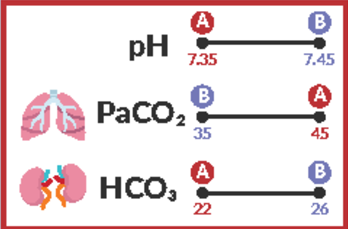
Acid-Base Values
pH: 7.35-7.45
PaC02: 35 to 45 mmHg
HCO3: 22-26 mmol/L
p02: 80-100 mmHg
Latex Allergies:
Note that clients allergic to bananas, apricots, cherries, grapes, kiwis, passion fruit, avocados, chestnuts, tomatoes, and/or peaches may experience latex allergies as well.
Think → “BackpatCPG”
Order of Assessments:
I-inspection
P-palpation
P-percussion
A-auscultation
Except with abdomen it is IAPP-inspect, auscultate, percuss and palpate.
Assistive Devices:
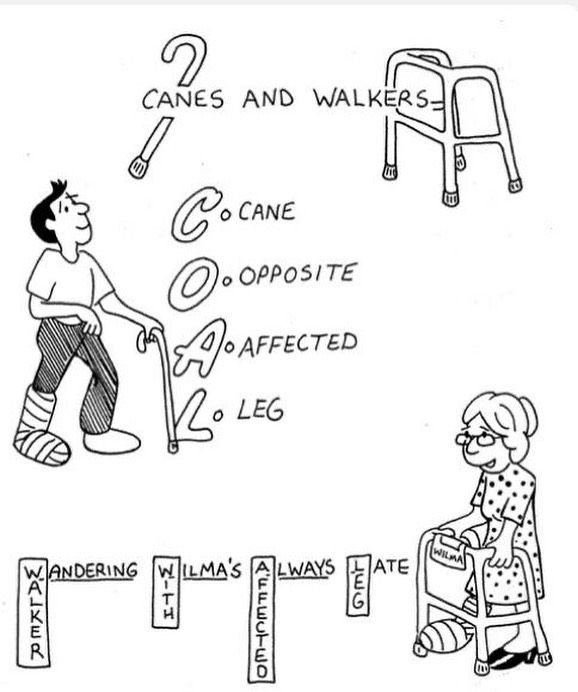
Cane Walking: “COAL”
C-cane
O-opposite
A-affected
L-leg
The cane should be with the good leg to offer support for the weak leg.
Walker: “Wandering Wilma’s Always Late”
Walker with affected leg
Crutch Walking:
Remember the phase “step up” when picturing a person going up stairs with crutches.
Going Upstairs: The good leg goes up first followed by the crutches and the bad leg.
Going Downstairs: The opposite (crutches and bad leg followed by good leg) OR “up to heaven…down to hell”
Delegation:
RNs DO NOT delegate what they can EAT.
E-evaluate
A-assess
T-teach
Isolation Precautions:
AIRBORNE: "My Chicken Hez TB"
-Measles
-Chicken pox
-Herpes zoster
-TB
Management:
Neg. pressure room
Private room
Mask (N-95 for TB)
DROPLET: "SPIDERMAn"
-Sepsis
-Scarlet Fever
-Strep
-Pertussis
-Pneumonia
-Parvovirus
-Influenza
-Diphtheria
-Epiglottitis
-Rubella
-Mumps
-Adenovirus
Management:
Private room
Mask
CONTACT: "MRS WEE"
-MRSA
-VRSA
-RSV
-Skin infections (herpes zoster, cutaneous diphtheria, impetigo, pediculosis, scabies, and staphylococcus)
-Wound infections
-Enteric infections (C. diff)
-Eye infections (conjunctivitis)
Management:
gown
gloves
goggles
private room