B.2.1.1 Introduction to kinematics/linear kinematics
Vector: a measurement that has both direction and magnitude
Scalar: a measurement that only has magnitude
Distance: length of the path a body follows (scalar)
Displacement: how far and in what direction something moves from its starting point to its finishing point (vector)
Speed: the rate at which an object covers distance (scalar)
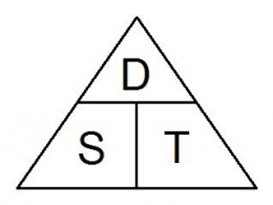
Speed = distance/time (m/s)
Velocity: the rate at which an object changes its position (vector)
Velocity = displacement/time taken (m/s)
Acceleration: rate at which velocity changes with respect to time (vector)
Acceleration = Final velocity - initial velocity/time (m/s^2)
Force: is any interaction that, when unopposed, will change the motion of an object (vector)
Force = mass x acceleration (N)
Momentum: refers to how much motion an object has (vector)
Momentum = mass x velocity (kg/m/s)
Impulse: contact time determines the force applied on the object (vector)
Impulse = force x time (N-s)
Speed distance time triangle: