Ugh
UGH
✨🎀✨coquette🎀 Bio Notes✨🎀✨
⋆。‧˚ʚ🧬ɞ˚‧。⋆
Yellow means Vocab
Any other color means its important
4.1 Chemical Energy and ATP
Carbohydrates and lipids are the most important energy sources in the foods you eat. However, this energy needs to be broken down by chemical reactions.
Carbohydrates = is instant energy; most commonly broken down (glucose yields 36 ATP)
Lipids aka fats and oils = is stored energy; stores 80% of body's energy; takes a longer time to be broken down (fatty acid and glycerol, triglyceride yields 146 ATP)
Proteins = body builders used for skin, blood, body, everything; not energy; least commonly broken down (amino acids)
1g of Carbohydrates = ~17kJ of energy
1g of Proteins = ~17kJ of energy
1g of Lipids = ~37kJ of energy
All cells, including plant cells, use chemical energy carried by ATP.
ATP (adenosine triphosphate) is a molecule that transfers energy from the breakdown of food/carbon-based molecules to cell processes.
ATP is used for building molecules and moving materials by active transport. ATP has 3 phosphate groups but the bond holding the third one is unstable and when its broken one phosphate is released and used as energy which turns the ATP into ADP (adenosine diphosphate)
ADP + 1 phosphate —--> ATP, A-P~P~P (higher energy)
ATP - 1 phosphate —--> ADP, A-P~P (lower energy)
Calories are measures of energy.
Chemosynthesis is a process by which some organisms use chemical energy (no sunlight) to make energy-storing carbon- based molecules
4.2 Overview of Photosynthesis
Plants, bacteria, protists are the producers that are the main sources of chemical energy for most organisms on earth.
Photosynthesis is a process that captures energy from sunlight to make sugars that store chemical energy. Plants absorb visible light for photosynthesis. The energy for all organisms begins as sunlight. Takes place in granum and stroma
Photosynthesis equation :
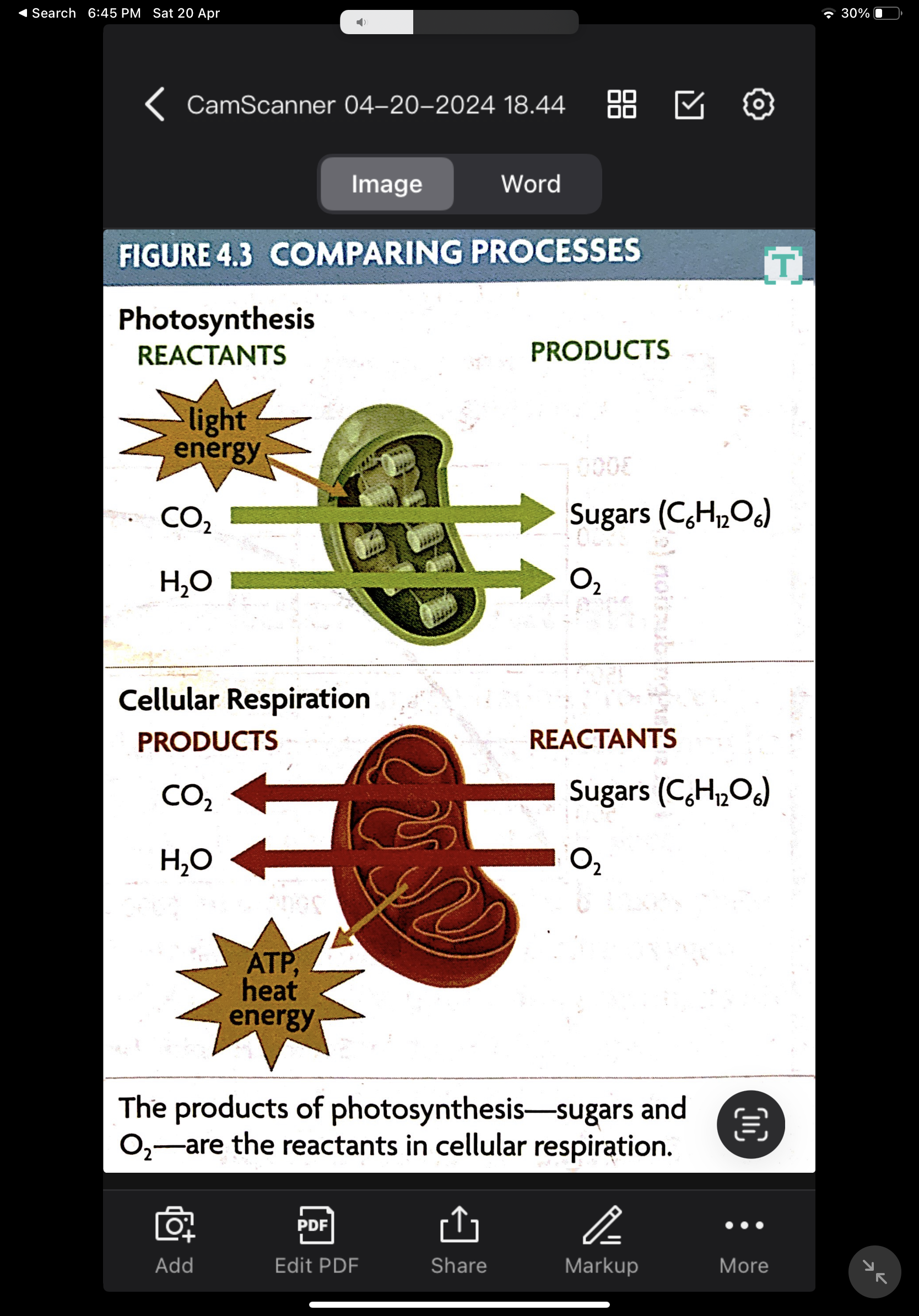
6CO2 + 6H2O —-> C6H12O6 + 6O2
Carbon dioxide + Water yields> Glucose + Oxygen
(which is caused by light energy captured by the chlorophyll)
Chlorophyll is a molecule in the chloroplast (a membrane-bound organelle where photosynthesis takes place in plants) that absorbs some of the energy in visible light. They mostly absorb red and blue wavelengths of light.
Chloroplast Diagram \/
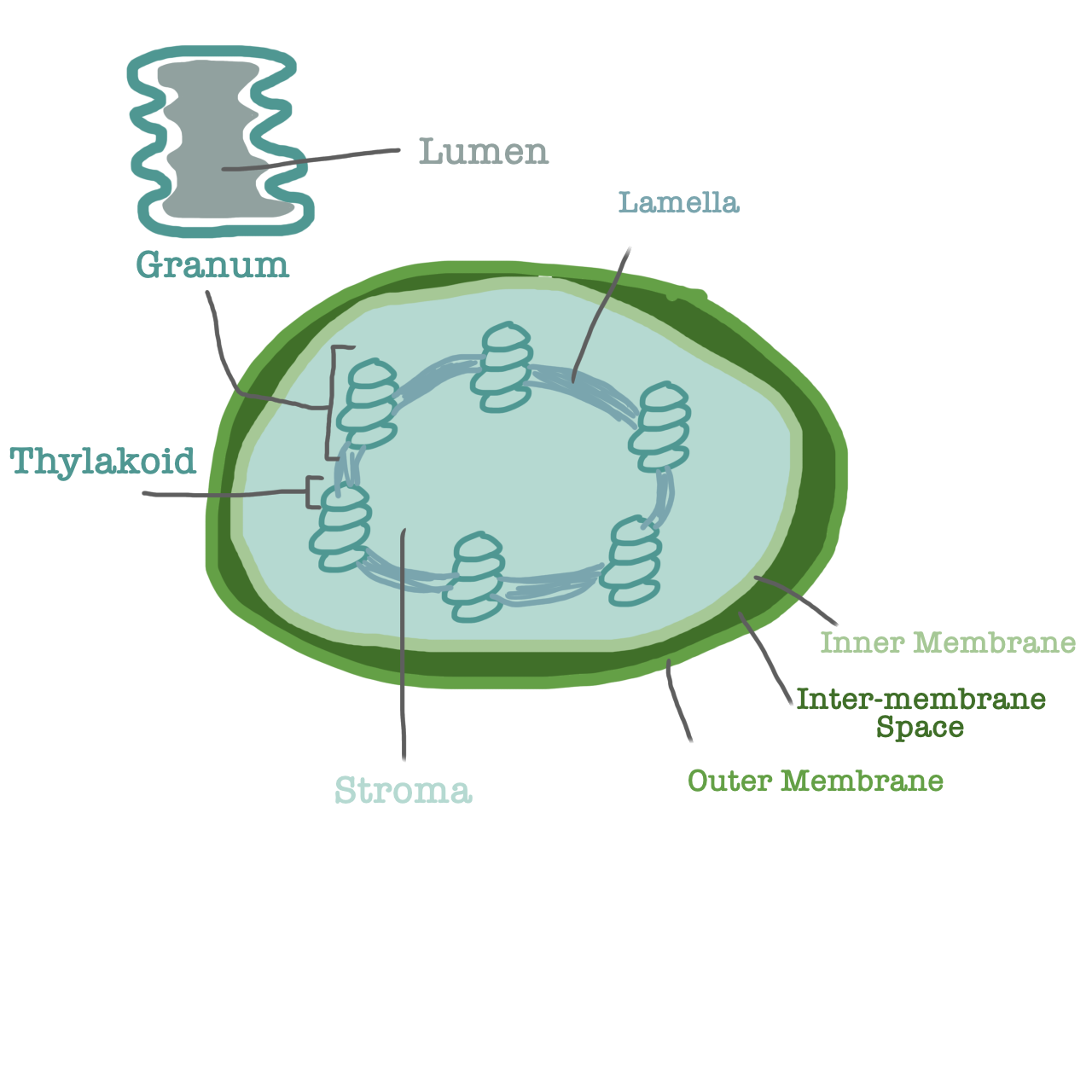
Grana : stacks of coin-shaped, membrane-enclosed compartments (thylakoids)
Stroma : is the fluid that surrounds the grana inside a chloroplast
Thylakoids : pouch like sacs that are bound to a membrane in a chloroplast of a plant cell
Light Dependent Reaction a.k.a. Photolysis (Professor Hill’s Reaction) 2H2O —> 2H2 + O2 | Light Independent Reaction H2 + CO2 —> C6H12O6 |
|---|---|
|
|
Products :
| Products :
|
4.3? Just read this dont need to memorize
Photosystems the 2 groups of molecules that are the functional units of photosynthesis that transfer light energy
PS II happens before PS I
Electron Transport Chain (ETC) is a series of proteins in the thylakoid membrane
Energy carrying molecules :
ATP <— ADP + P + Energy
NADPH <— NADP+ + H²
Occurs in the Light Dependent Reaction
YOU DONT NEED TO KNOW THE PHOSYSTEMS IN DETAIL BUT JUST READ IT (because i spent time summarizing it 👉👈 and its easy, its the LDR process just split into two parts instead of one)
In PS II, Energy from sunlight is used to split H2O by photolysis and hydrogen ions are transported to ETC
In PS I, energy from ETC leave the thylakoid + NADPH is produced by the combination of NADP with the Hydrogen ions in the ETC
Then ATP is produced by ATP synthase, which is a complex enzyme that makes ATP
Final Products of LDR : Hydrogen + Oxygen+ NADPH + ATP
Occurs in the Light Independent Reaction
The Calvin Cycle takes place in the stroma, where CO2 is used to create 3-carbon molecules, by using the energy created in LDR (NADPH and ATP)
Final Products of LIR : Glucose/3-carbon molecules/ triose sugar + NADP + ADP (+ the release of oxygen)
4.4 (+ 4.5) Overview of Respiration
Cellular Respiration is the breakdown of nutrients to release chemical energy, its an Aerobic process as it needs oxygen to take place. Takes place in the mitochondria.
Glucose —> only/main energy source that can be broken down in respiration by cells.
Yeast is one of the few organisms that respire without oxygen
Glycolysis is the first stage of cellular respiration, splits glucose into 2 three-carbon molecules and makes 4 molecules of ATP but 2 ATP molecules are used in the process, its an anaerobic process as it does not require oxygen.
Aerobic | Anaerobic |
|---|---|
|
|
Step 1, Glycolysis in cytoplasm (does not require oxygen)
Glucose —> Glucose Phosphate —> Glucose Bisphosphate —> 2 Pyruvate + 2ATP
Products : 2 Pyruvates/ Triose sugar/ 3-carbon molecule (its all the same thing just a different name) + Gross of 4 ATP but Net Gain of 2 ATP
Mitochondria Diagram \/
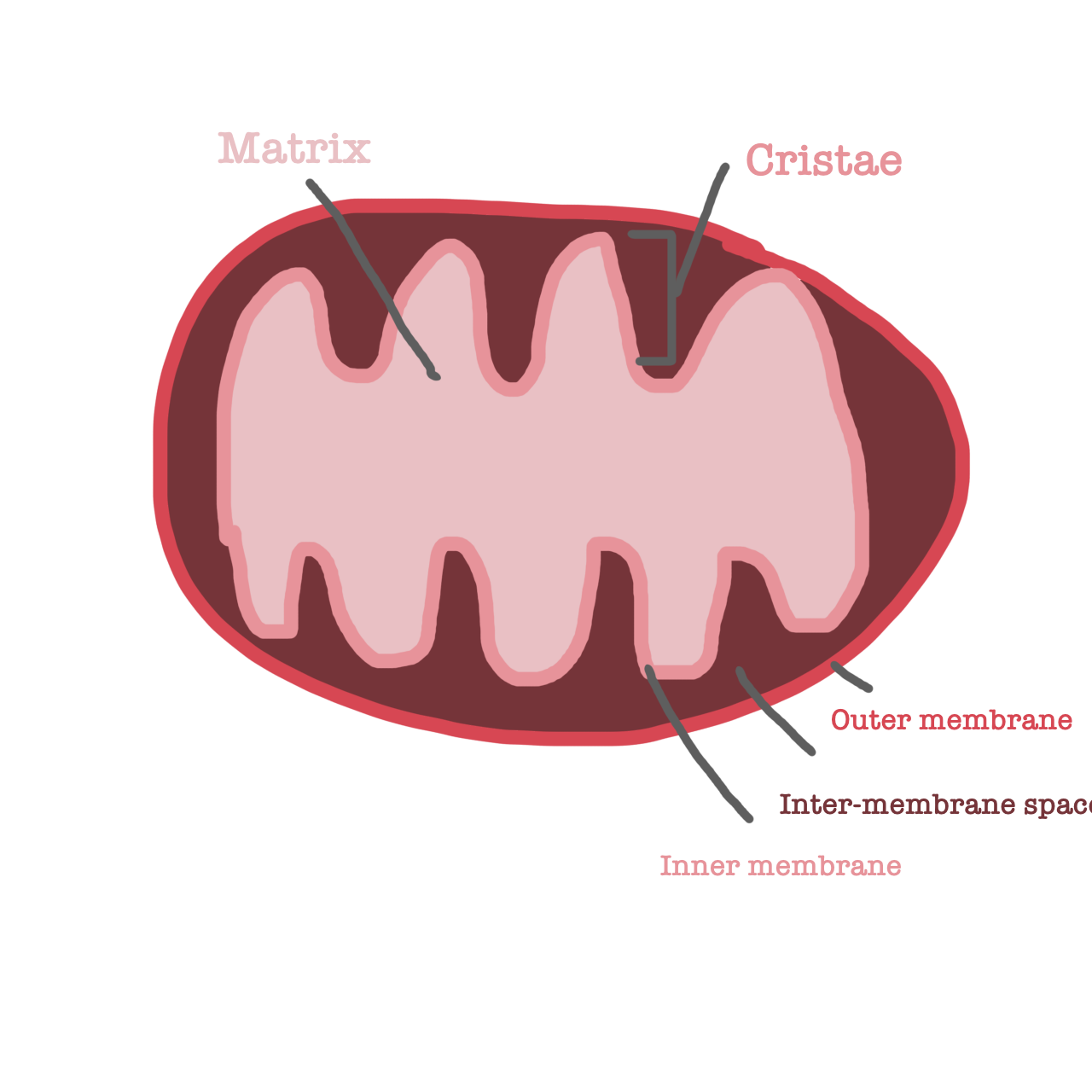
Step 2, Krebs Cycle, takes place in the matrix of the mitochondria ( doesnt require oxygen but will not take place unless oxygen is present)
Products : CO2 + A few ATP (and NADH + FADH but thats not important)
2 positive and negative electrons are then sent to the ETC
Step 3, ETC, takes place in the inner membrane of the mitochondria (requires oxygen)
Oxygen enters here
Products : Water (waste) + 32 ATP (a LOT of ATP)
Products of Cellular Respiration : H2O + CO2 + ATP
Photosynthesis | Cellular Respiration |
|---|---|
|
|
4.6 Fermentation
The cells in your body cannot store a lot of oxygen for cellular respiration.
Fermentation is an anaerobic process that allows glycolysis to continue.
When the oxygen is not present to pick up the high energy electrons, fermentation removes the electrons from NADH and recycles NAD+ to pick up high energy electrons.
Without NAD+, the glycolysis process would stop, with NAD+ the eukaryotic cell can keep breaking down glucose to make small amounts of ATP
Lactic acid fermentation (C3H6O3) occurs in muscle cells, its what causes your muscles to ‘burn’
Alcoholic fermentation occurs in many yeasts and some plants
The fermentation occurs after the glucose is split by glycolysis and u have NADH and 2 Pyruvate and 2 ATP
16.1 Human Population Growth and Natural Resources
Carrying capacity refers to the maximum population size that an environment can consistently support. Earth cannot support an infinite number of people. Technological advances have allowed for continued human population growth
The cause of climate change is overpopulation. Indirectly? Did miss hums say it or is it written?
Renewable resources are natural resources that can be replaced at the rate at which it is used, like solar energy and wind energy. Renewable resources can become nonrenewable if not cared for properly.
Nonrenewable resources are used faster than the rate at which they can be formed, like fossil fuels like oil, natural gas, and coal.
Water is a renewable resource but with pollution and stuff its slowly becoming scarce
Easter Island :
Management of earth's resources affects current and future generations.
The story of Easter Island is a cautionary tale of destruction caused by careless use of resources. When humans first landed on it during 400-700 CE, it was thickly forested, rich soil, and many bird species. It is filled with stone monuments built by humans. They cut down trees without replanting and soon there were no more trees or rich soil or habitat for animals.
No more resources = no more people. This is called unsustainable farming. Only short term benefit with negative long term effects.
Ecological footprint is the amount of land necessary to produce and maintain enough food, water, shelter, energy, (amount and efficiency) of resources, and (amount and toxicity) of waste produced
16.2 Air Quality
Human actions have direct and indirect effects on earth's natural cycles. Each year humans add synthetic chemicals to the Earth.
Pollution is any undesirable factor or pollutant that is added to the air, water, or soil. The effects of pollution add up over time and can disrupt the function of ecosystems.
Smog is a type of air pollution cause by the interaction of sunlight with pollutants produced by fossil fuel emissions such as gas and oil (mixtures of smoke + fog)
The two components of smog :
Particulates are microscopic bits of dust, metal, and unburned fuel, 1-10 microns in size, that are produced by many different industrial processes., they can be inhaled and cause health issues
Ground level ozone ( O3) , in the presence of sunlight NO2 (created by fossil fuels) which gives smog a yellowish color + O2 react to create O3 . But the ozone layer is supposed to act as a shield against uv light.
The ozone layer is also getting destroyed by Chlorofluorocarbons (CFCs) which is released by air conditioners, refrigerators, and aerosols
Acid rain is a type of precipitation produced when pollutants in the water cycle (Nitrogen and sulfur oxides) cause rain pH to drop below normal levels
All rain that falls is slightly acidic (pH 5.6), but when nitrogen oxide and sulfur oxide interact with the oxygen and water the pH drops below 5.6
Acid rain threatens water supplies, species habitat, and causes decline in growth rates, it can also cause trees to become more vulnerable to weather and break
High level of CO2 —> warm climate
Low level of CO2 —> cold climate
Greenhouse effect occurs when CO2, water vapor, and methane molecules absorb energy reradiated by Earth's surface and slow the release of this energy from Earth's atmosphere, they absorb infrared radiation (heat energy) which traps the heat in Earth
Greenhouse gasses : CO2, water vapor, and methane
The short high energy wavelengths emitted from the sun enter the earths atmosphere, then the greenhouse gasses absorb the longer wavelength of infrared radiation
Global warming the trend of increasing global temperatures is created by greenhouse effect
16.3 Water Quality
Eutrophication is the excessive richness of nutrients in a lake or other body of water, frequently due to runoff from the land, which causes a dense growth of plant life and death of animal life from lack of oxygen.
For example if you had a farm which used fertilizers with lots of nitrate in them, the water would runoff into a body of water where the fertilizer would make the algae overpopulate the water which would kill fish populations
Indicator species (bioindicator) is a species that provides a sign or indication of the quality of the ecosystem's environmental conditions.
For example gender-bending fish, frogs,a tern bird,etc
Some pollutants are water soluble so they enter the species then exit with their waste. But some are fat-soluble (pollutants like mercury and PCB have been hurting species)
Biomagnification means that when a pollutant moves up the food chain as predators eat preys, the concentration of the pollutant will increase, so the last organism in the food chain gets affected the most
16.4 Threats to Biodiversity
Biodiversity is the diverse world of living things - the wide array and assortment of species that are found in any ecosystem, it cannot be measured as it is extremely valuable
A decrease in biodiversity will have a ripple effect throughout the rest of the ecosystem, affecting all species
Preserving the rain forests will greatly help to preserve biodiversity
Habitat fragmentation occurs when a barrier forms that prevents an organism from accessing its entire home range
Introduced species is any organism that was brought to an ecosystem as the result of human actions, they can cause economic damage
Invasive species can have a major impact on humans too and cause economic damage, (for example mice were introduced and now people have mouse problems all the time) it can also cause monetary loss when having to deal with the issue
16.5 Conservation
Conservation is protecting and preserving natural resources and the environment
Sustainable development is a practice in which natural resources are used and managed in a way that meets the current needs without harming future generations.
People are using techniques like:
- Fish rotation
- Fishing gear review
- Harvest reduction
- Fishing bans
To conserve fish species
Umbrella species protection means a wide range of other species will also be protected