Chapter 8
Words to consider
As the complexity of life’s demands grows, so does our capacity for handling them. The whole sweep of human development can be thought of as a series of challenges that prompt us to develop new capacities and improve previously acquires ones
Just when we think we have everything handled, the world hands us a new set of challenges, and we rise to the occasion.
Overview

Theories of Development
Developmental Psychology
The study of how humans grow, develop, and change throughout the life span
covers physical, cognitive, and psychosocial domains
Development is seen as continuous or as taking place in stages
Piaget’s Theory of Cognitive Development
Jean Piaget: “The essence of cognitive development is the refinement of schemes”.
Worked to understand children’s reasoning process
Schemes
plans of action to be used in similar circumstances, concepts, understandings, etc
Piaget: We are constantly refining our schemes
Assimilation
process for incorporating new objects, events, experiences, and information into existing schemes
Accommodation
modifying existing schemes and creating new ones to incorporate new experiences and information and develop novel ways to engage
completely new experiences and information and develop novel ways to engage
Leads to cognitive development
Piaget’s Theory of Cognitive Development: Four Stages of Cognitive Development
Sensorimotor Stage (1)
birth to 2 years
infants gain understanding of the world through senses and motor activities
Infants act on objects and events that are directly perceived
Development ofc object permanence
the realization that objects continue to exist when they can no longer be perceived
Preoperational Stage (2)
ages 2-7
Children acquire symbolic function, imagination
understanding that one thing can stand for another
Children exhibit egocentrism
belief that everyone sees what they see, thinks what they think, feels what they feel
perhaps the development of self-awareness
keep in mind the tremendous growth in cognitive activities
Concrete Operațional Stage (3)
ages 7-11/12 years
Children acquire the concept of conservation
quantity of matter stays the same despite rearrangement or change in appearance
begin to understand reversibility
any change in shape, position, or order of matter can be reversed mentally
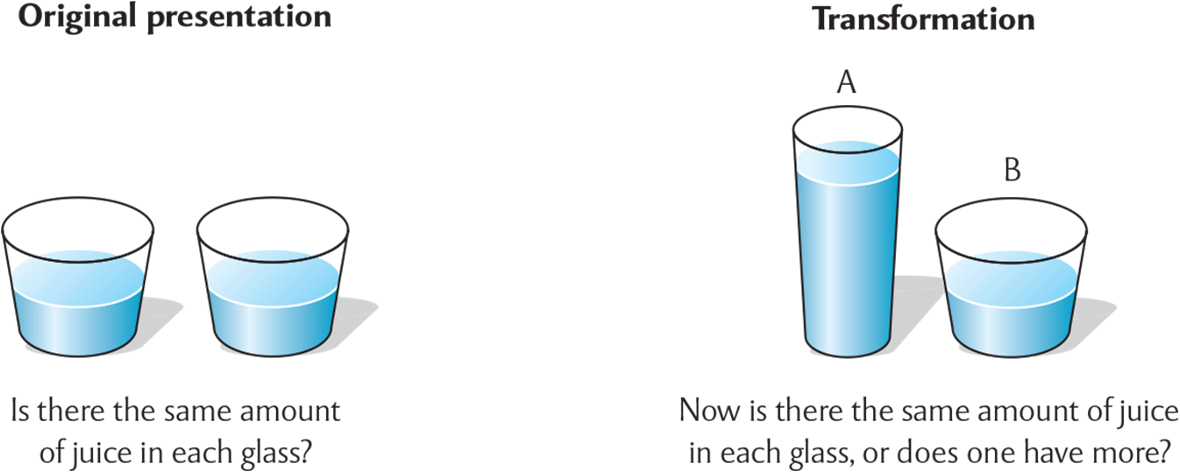
Formal operational Stage
11/12 and beyond
Children acquire the capacity for hypothetic-deductive thinking/reasoning
ability to apply logical thought to abstract and hypothetical situations
Their thinking is becoming more complex and sophisticated
Studies support the validity of Piagent’s cognitive development stages
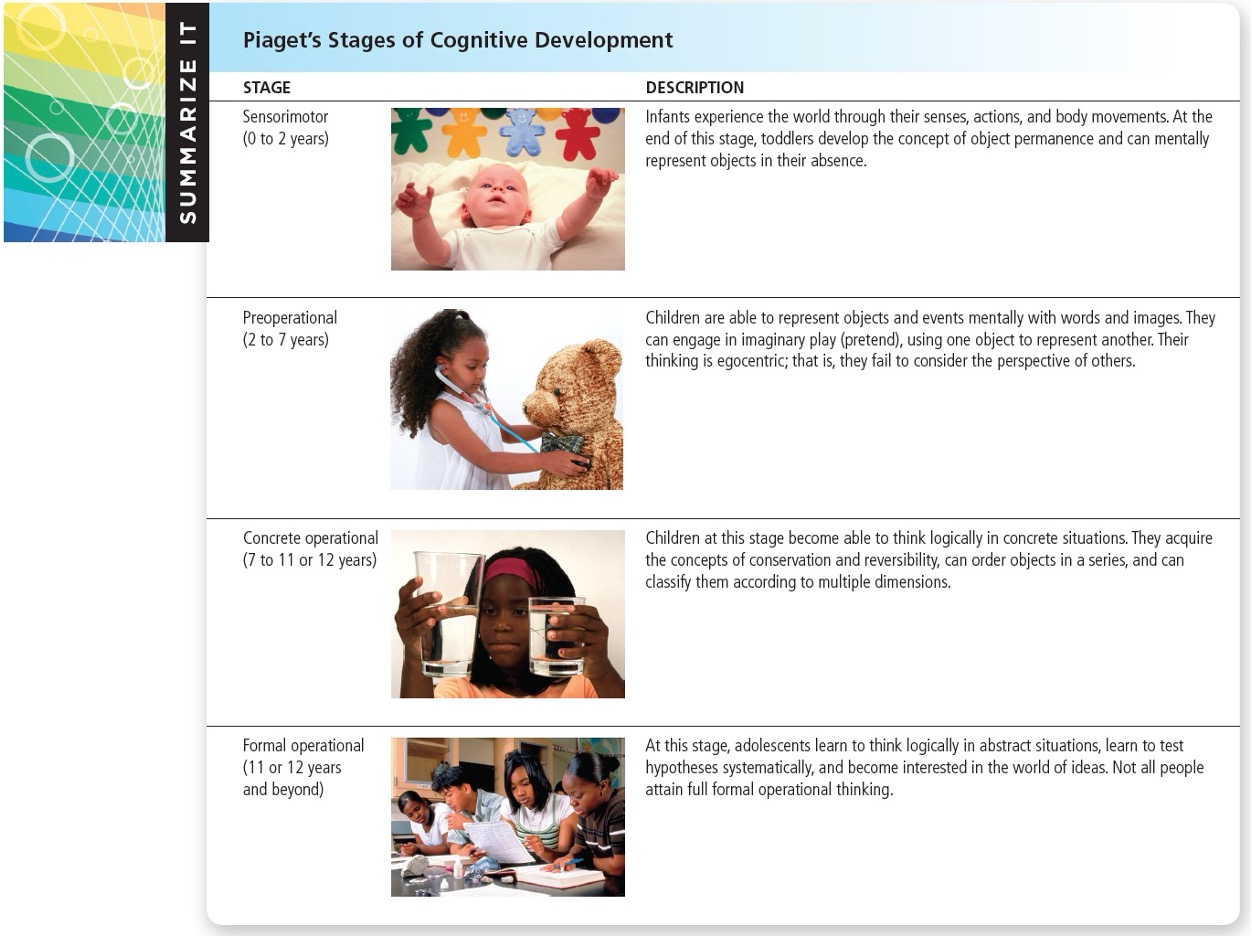
Alternative to Piaget’s Theory: Neo-Piagetian Approach
Some theorists believe that age-related differences in performance are a function of changes in the use of working memory and processing speed
younger children process information more slowly
information less lily to make it to long-term storage
cannot compare original and transformation
Vygotsky’s Sociocultural Approach
Argued that Piaget’s theory placed too much emphasis on forces within the child
Key concepts
Private speech: talking to oneself
Believed that much of cognitive development comes from the child’s internalization of information that is acquired socially though language.
scaffolding/ zone of proximal development
instruction where an adult adjusts the amount of guidance to match a child’s present level of ability
Challenging to improve ability
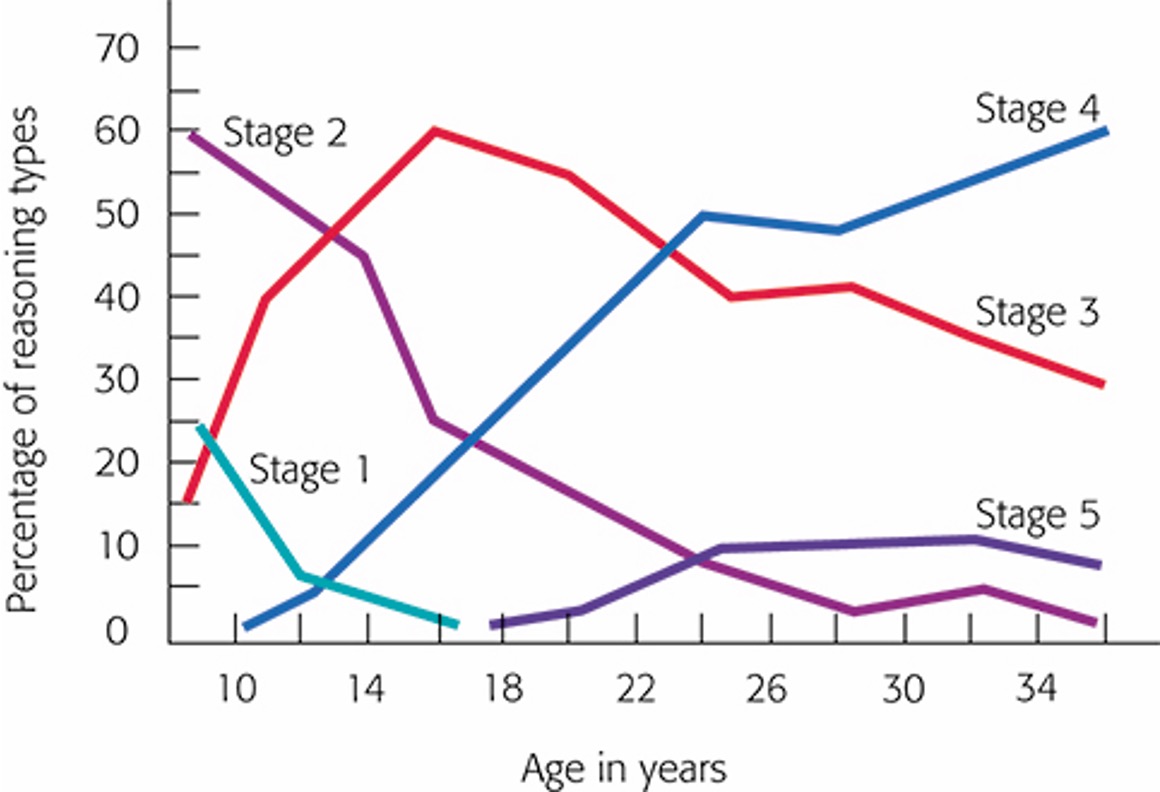
Kohlberg’s Stage Theory of Moral Development
Presented moral dilemmas to participants
analyzed the moral reasoning in their choices
Classified moral reasoning
three levels, two stages at each level
progress through the levels and stages in a fixed order
Each level has a prerequisite stage of cognitive development
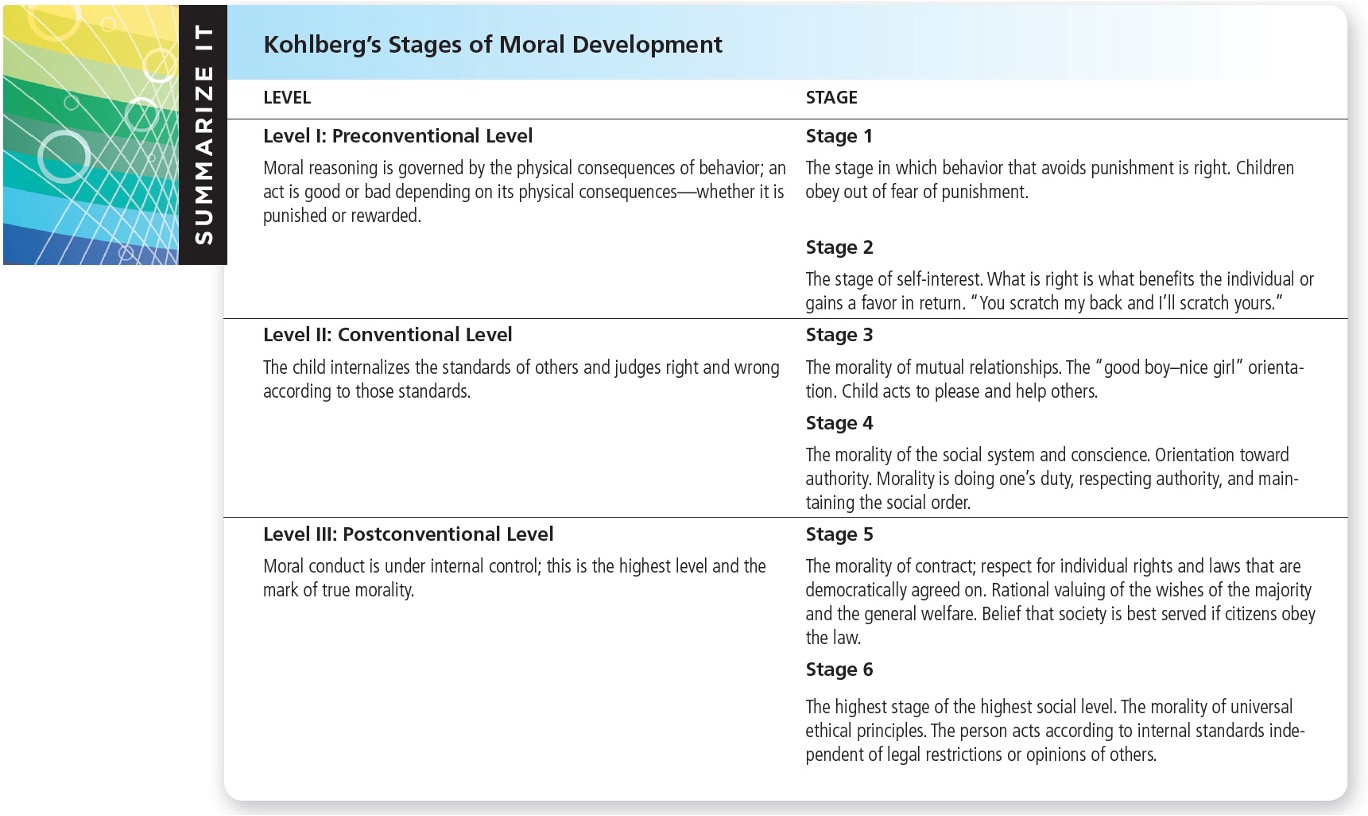
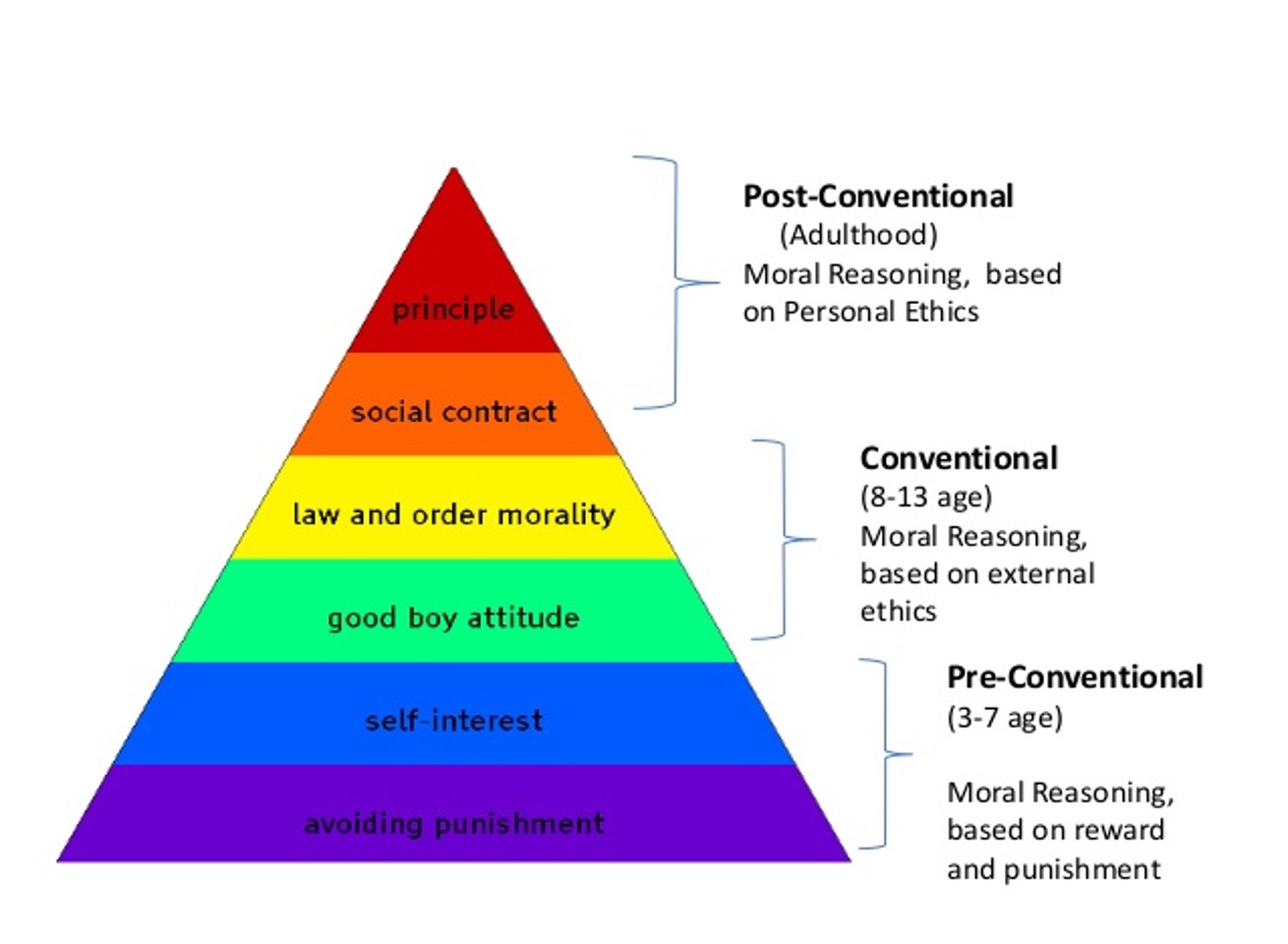
Kolhberg’s Theory
Evidence suggests that the stages occur in all cultures
Stage 5 is present in all middle-class cultures studied but absent in tribal cultures
Assimilation of our sense of morality is lifelong and can be situational
Our sense of morality is probably less rigid than what Kolhberg posited
Criticism to Kolhberg’s Theory
Psychologist Carol Gilligan believed the theory was sex-biased. Argued that “his theory was based on the responses of upper class White men and boys” and that no women were used in Kohlberg’s studies
“Girls exhibit distinct patterns of moral development based on relationships and on feelings of care and responsibility for others”.
not every criminal feels bad for what they did
Kohlberg believed that girls could only reach a certain level
we’re always tweaking our sense of morality
Kohlberg believed that the majority of women remain at S3, whereas most men reach S4 partly due to emotional/care differences
Erik Erikson’s Theory of Psychosocial Development
German-American developmental psychologist (1902-1994)
Raised by his Jewish mother and step-father
Deeply affected by absent biological father
Identify crises
Psychosocial Stages
encompass the entire life span
Each stage is defined by a conflict that must be resolved for healthy personality development to occur
Erik Erikson
*Note: mandatory term paper topic!
Most research has focused on trust in infants, identity formation in adolescents, and generatively in middle-aged adults
Predictions received mixed support in research
Erikson and Identity Formation (IF)
Research shows IF beginning in adolescence but continues well into early adults years
Implications on educational and career concerns
Piaget’s formal operational stage (reasoning) strongly related to IF.
Cognitive ability not yet fully developed until early adulthood
Adolescence: Self Esteem
A person’s overall, individual sense of self, including worth, value, image, importance, confidence, purpose, security, reliance, etc…
Self esteem is constantly being shaped through interaction with environmental/societal forced and the internalization of these factors
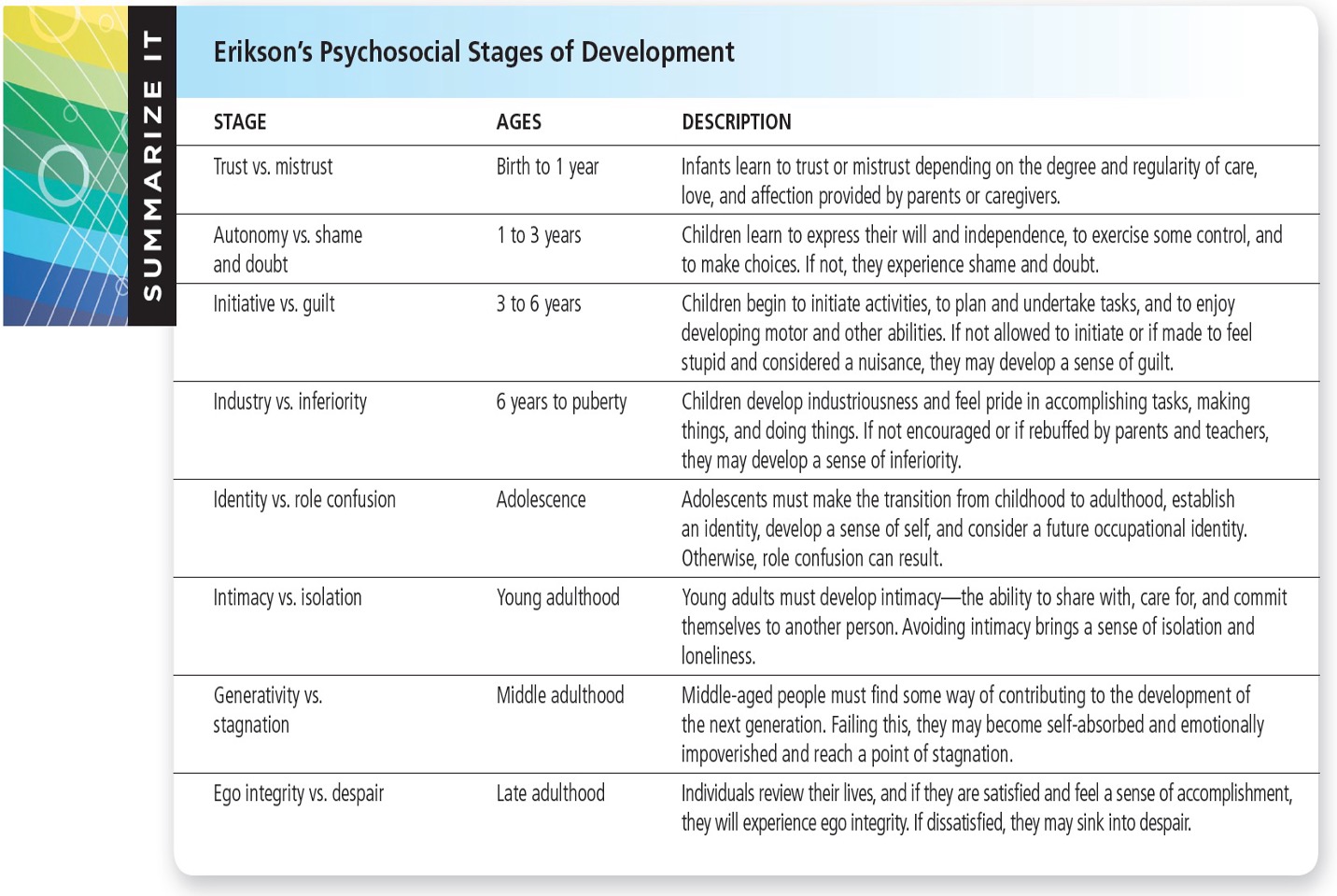
Free to choose whichever stage for the term paper
high incidence of depression in older people who don’t find they have meaning
Human Physical Development
Prenatal Development: Negative Influences on Prenatal Development
teratogens
harmful agents in the prenatal environment
negative impact on prenatal development
can cause birth defects
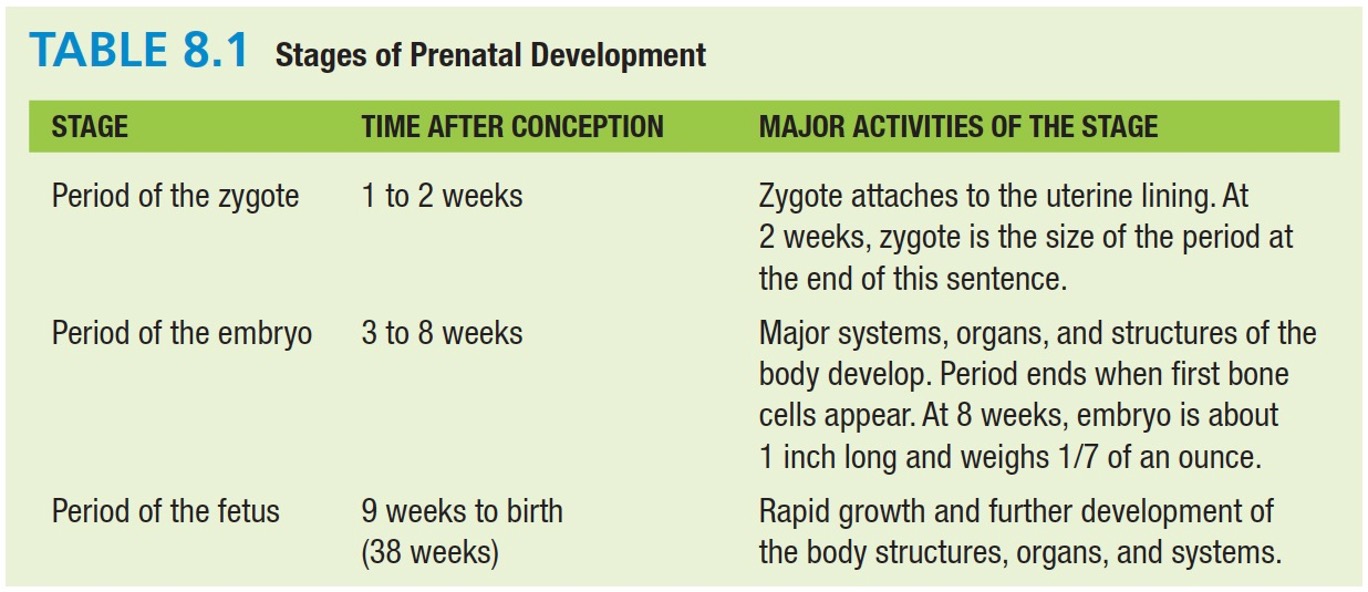
Stages of Parental Development
Critical Period(s)
prenatal period when certain body structures develop
Susceptible to harm, damage
Fetal Alcohol Syndrome: FAS
Mother drinks during pregnancy
Baby is born with mental retardation, small head, facial, organ, and behavioral abnormalities
The Birthing Process
Labor: 3-Stage Process
Stage 1: Uterus contracts; cervix flattens and increases in diameter to 10 centimeters
Stage 2: Fetus makes its way through the vaginal canal and into the world
Stage 3: Uterus expels the placenta
Neonate
Newborn infant up to 1 month old
Development in Infancy: Perceptual and Motor Development
Robert Fantz (1961)
Infants prefer to fixate on some objects over others
Newborn infants can discriminate between objects
prefer faces to black and white abstract patterns
Newborn visual acuity is about 20/600
vision improves rapidly
Reflexes: sucking, swallowing, blinking
Development in Infancy: Temperament
Temperament
behavioral style; characteristic way of responding to the environemnt
influenced by heredity; somewhat predictive of personality later in life
Interaction of temperament (nature) and the environment (nurture) molds our personality
Types of Temperament
easy
pleasant mood, adaptable, approach new situations positivley
difficult
intense emotional reactions, react negatively to new situations
slow to warm up
tend to withdraw, are slow to adapt, somewhat negative in mood
Development and Infancy: Attachment
Attachment
strong affectionate bond a child forms with the mother or primary caregiver
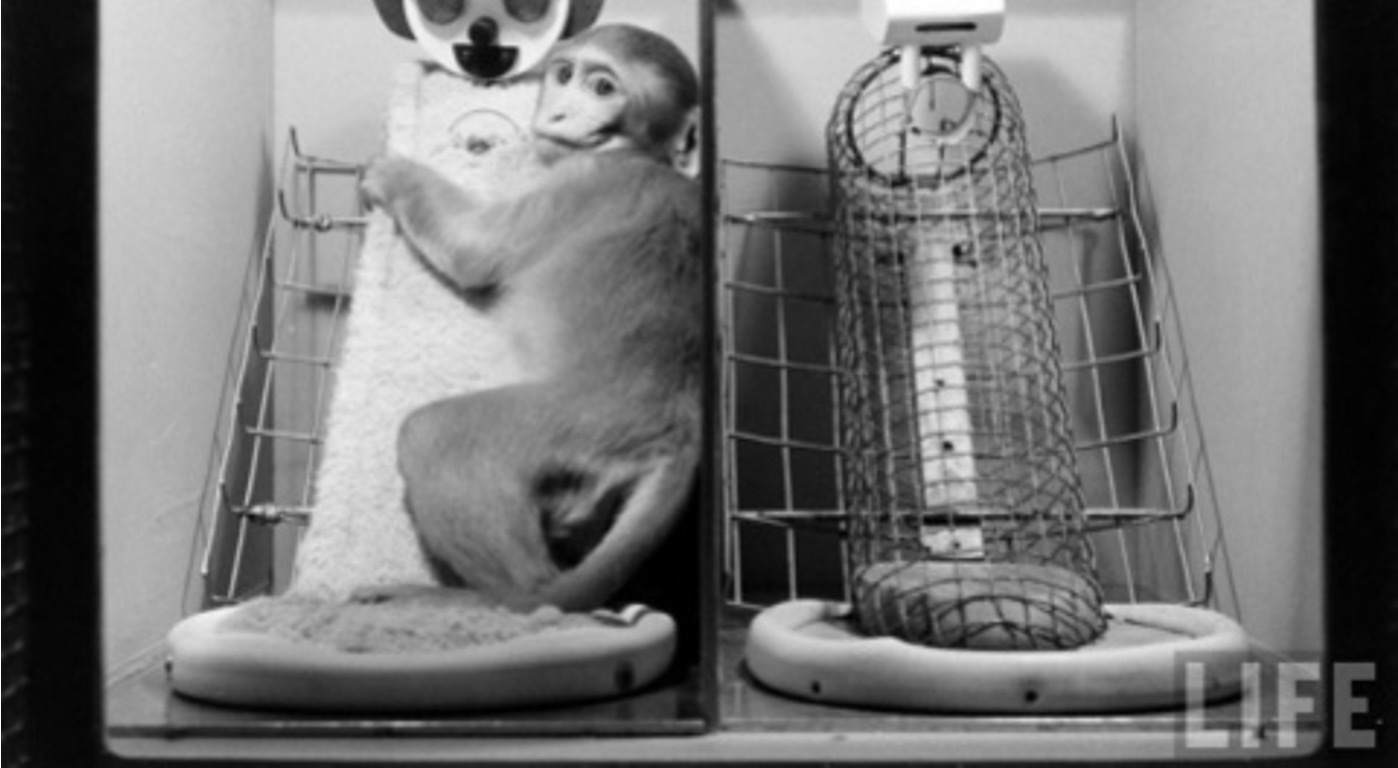
Harry Harlow
Contact comfort (physical comfort with surrogate mother figure) rather than nourishment forms the basis of attachment in rhesus monkeys.
At 6-8 months of age, human infants exhibit:
Separation anxiety
fear and distress shown when parent leaves
Stranger anxiety
fear of strangers
Mary Ainsworth (1973, 1979) studies the quality of mother-child attachment, identified four patterns of attachment.
Attachment Types: Secure
Secure Attachment
about 65 percent of infants
use mother as a secure base for exploring
distressed by separation from caregivers, greet caregivers when they return
display better social skills as preschool children
Attachment Types: Avoidant
Avoidant Attachment
about 20 percent of infants
not responsive to mother or troubled when she leaves
may actively avoid contact with mother after separation
Resistant Attachment
Resistant Attachment
10-15 percent of infants
seek close contact with mother
tend not to branch out and explore
after separation, may display anger toward mother; not easily comforted
Disorganized Attachment
Disorganized/disoriented Attachment
5-10 percent of infants
protest separation
exhibit contradictory and disoriented behavior when reunited
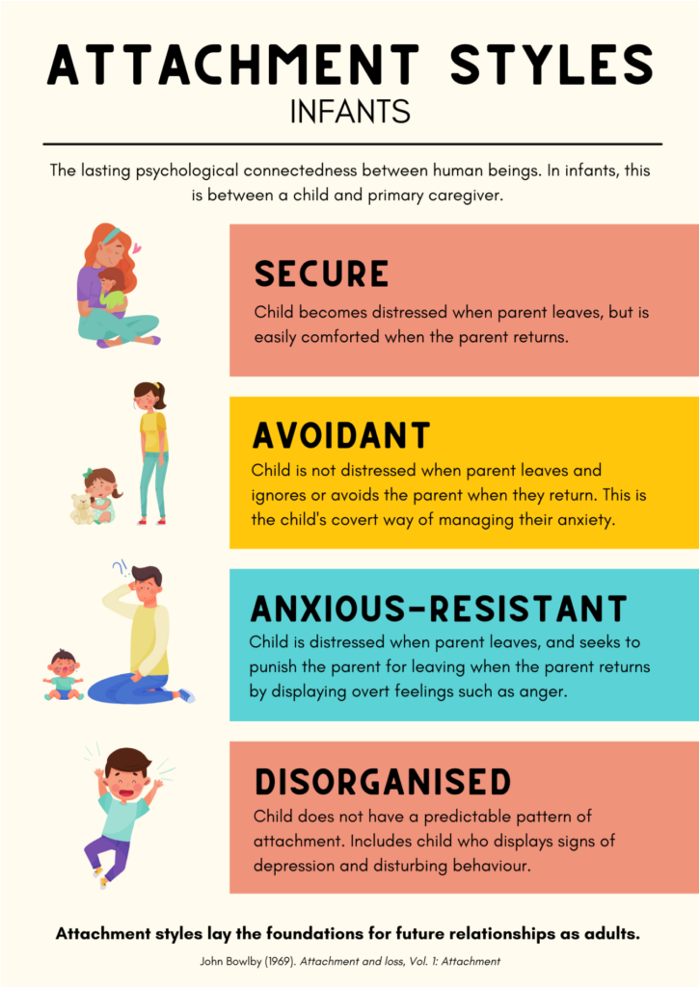
Mary Ainsworth (1973, 1979) studied the quality of mother-child attachment, identified four patterns of attachment
Language Development
Children must acquire language in the first 2 years of life; otherwise their ability to learn it is impaired
Current data however, suggest grammar-learning ability remains strong until age 17-18, at which point it drops
Phases of language development
babbling
Infants babble all the basic speech sounds that occur in all the languages of the world (phonemes)
between 4 and 6 months of age
One-Word Stage
age 1 year
Words represent objects that move or that infants act on
Overextension: basically generalization i.e. all food is “papa” or “chicken”
Underextension: stricter specification than usual
Telegraphic speech
Ages 2-3
Short sentences containing only essential content words
reflects the development of syntax
overregularization
misapplying a grammatical rule
Learning theories
Language is acquired through imitation and reinforcement
imitation and reinforcemnt
Nativist Position
languagely innate
language acquisition device: brain structures involved in acquired language
enables children to acquire language and rules of grammar easily and naturally
can sponge language naturally
Early and Middle Childhood Socialization: Parenting Styles
*Note: mandatory term paper topic
Diane Baumrind re: the continuum of parental control (1971, 1980, 1991)
Authoritarian Parents
arbitrary rules, expect unquestioning obedience, punish misbehavior, ultra strict and inflexible
Value obedience to authority
Authoritative Parents
set high but realistic standards, enforce limits
encourage open communication and independence
Provide structure but are flexible
Permissive Parents
few rules or demands
Children make their own decisions and control their own behavior
Includes indulgent and neglectful
Note: parenting styles are subject to change in time due to parental experience, confidence and familiarity and parental involvement with the child
Paarenting Styles and Child Outcomes
Authoritative Parents
Children raise in a authoritative environment tend to be happier and have higher self-esteem
more self-reliant, socially competent, responsible
Authoritarian Parents
Children raised in an authoritarian environment tend to be withdrawn, anxious, and unhappy
Permissive Parents
Children tend to display immature, impulsive, and dependent behaviors
least see-reliant and self-controlled of three subtypes
poor sense of responsibility
Early and Middle Childhood: Gender Role Development
Biological Theory
prenatal ad sex hormones influence development
Social Learning Theory
environment is more important than biological forces
modeling and reinforcement for gender behavior; gender behaviors are learned through the process of observational learning
Social media’s influence on gender role development
Cognitive Developmental Theory: Kholberg
Development occurs in stages
gender identity
recognizes they are male or female
gender stability
understands their gender is fixed
gender constancy
cosmetic changes does not alter ones sex
Gender Schema Thepry
desire to maintain self-esteem motivates child towards culturally defined gender roles
Adolescence: Puberty and Sexual Behavior
Puberty
period of rapid physical growth and change
culminates in sexual maturity
Early maturation in boys may provide benefits such as
advantages in sports
more success academically
greater aggression and hostility
However in girls is not at advantagous
more self-consciousnes
earlier sexual experiences
unwanted pregnancies
earlier exposure to alcohol and drug use
FORM OF REBELLION
THINK THEY’RE GROWN
form of control
autonomy
Adolescence Sexual Behavior
Sexual activity increases dramatically through the teen years
Factors associated with later onset of sexual activity:
Living with both biological parents plus a harmonious home environment
Higher academic achievement
Involvement in sports
Frequent community involvement
Let’s not forget the importance of developing a healthy sense of self-esteem!!
Adolescence: Social Development
Parenting style affects adolescent behavior
authoritative most effective; permissive least effective
Positive peer group relationships provide adolescents with:
Assistance in identity formation
Standards of comparison
Vehicle for developing social skills
Social Development: Emerging Adulthood
Must addresss developmental tasks in 5 domains
academic, friendship, conduct, work, romantic (similar to Erikson theory)
Emerging adults struggle more with work and romantic tasks
Early and Middle Adulthood: Physical and Cognitive Changes
After age 30, decline in physical/ sensory/ processing capabilities
Menopause
cessation of mentruation
signifies end of reproductive capacity in women
usually occurs between 45 and 55
Gradual decline in testosterone in men
beginning at age 20, continuing until about 60
Early and Middle Adulthood: Changes in Intelligence
Two Types of Intelligence
crystallized intelligence
verbal ability and accumulated knowledge
increases over life span
Fluid intelligence
abstract reasoning and mental flexibility\
peaks in the early 2-s and declines slowly as people age
Early and Middle Adulthood: Social Development
Living arrangements
½ of all US households are headed by a married couple; the other half have different arrangements
Marriage and Divorce
80% of Americans will marry at least once
Marriage is associated with many-physical and psychological benefits (of course if your’e involved in healthy relationship!)
Early and Middle Adulthood: Career Concerns
John Holland: people whose personality matches their job are also more likely to be satisfied with their work
Six personality types and traits
Realistic-aggressive, physical type occupations
Investigative-thinking, planning, organizing
Artistic-asocial, highly individual activities
Social-extraverted, sociable: nursing, education
Enterprising-verbal, leader, persuasive: business
Conventional- requires structure, not very flexible-military, government
Later Adulthood: Physical and Cognitive Changes
General Slowing
reductions in the speed of neural transmission/ processing
leads to slowing pf physical and mental functions
Farsightedness, impaired night vision, hearing loss in higher frequencies
Shrinking cortex due to breakdown of myelin in white matter of brain.
Later Adulthood: Physical and Cognitive Changes
80% of Americans older than 65 have one or more chronic conditions.
hypertension, arthritis, diabetes
Good Cognitive Functioning Predictors:
educational attainment; complexity in work environment; mentally stimulating intimate relationship(s); higher socio-economic status
Later Adulthood: Social Adjustment
60% of 65- to 69-year-olds and 80% of those over 70 have retired from paid employment (Fifers, 2008)
Most do not experience stress adjusting to retirement
Instructor’s note: it’s never too early to plan for retirement with emphasis on sound financial decision. making
Living Arrangements
White Americans place high value on independence
Five percent of elderly women and nine percent of older men live with relatives
Latin-American and Asian cultures
High percentage elderly live with relatives
Much more emphasis on family/ collectivist concerns
Later Adulthood: Successful Aging
Three Components
Good Physical health
Retention of cognitive abilities
Engagement in social and productive activities
Essential to remain physically and mentally active
Achieve ego integrity (Erikson)
Death and Dying: Elizabeth
Identifies 5 stages in coming to terms with death
Denial
Anger
Bargaining
Depression
Acceptance
Instructors note: similar stages in other forms of loss
Critics doubt the universality of stages
reactions to impending death vary widely between individuals and across cultures
Passive euthanasia: with drawing life support, treatment keeping patient alive
Active euthanasia: administration of fatal drug dose by physician or self