Expansion of the Industrial Economy (19th–Early 20th Century)
1. Industrial Expansion: Causes and Key Developments
A. Factors Driving Industrial Growth
● Abundant Natural Resources: Coal, iron ore, oil, timber.
● Technological Innovations:
○ Bessemer process (steel) A revolutionary 19th-century method of the mass production of inexpensive steel from molten pink iron. Developed by Henry Bessemer —> Led to the development of taller buildings, longer bridges, efficient railways and ships this fueled urbanization (1856).
○ Railroads, telegraph, telephone
○ Electricity, mechanized factory systems
● Transportation Networks:
○ Transcontinental railroads: First railroad connecting eastern and western United States. Built by the Central Pacific Union and Union Pacific railroads, it was completed in 1869
○ Steamships and canals: Solved the lack of transportation issues due to land barriers.
● Growing Labor Force:
○ Immigration from Europe and Asia
○ Migration from rural areas to cities
● Capital Investment & Entrepreneurship:
○ Business leaders like Andrew Carnegie, John D. Rockefeller, J.P. Morgan
● Government Policies:
○ Laissez-faire economics: Economic theory that advocates for minimal government intervention in business affairs.
○ High tariffs to protect U.S. industries
○ Land grants to railroads and subsidies
B. Rise of Big Business
● Vertical Integration: Controlling all steps in production (Carnegie Steel).
● Horizontal Integration: Merging with competitors to create monopolies (Standard Oil).
● Corporations & Trusts emerge to consolidate power and eliminate competition.
2. Life in the Industrial Workforce
A. Working Conditions
● Long hours (10–14 hours a day), low wages.
● Dangerous factory conditions; lack of safety regulations.
● Child labor and female laborers exploited due to lower wages.
● Company towns and wage slavery in mining industries.
B. Living Conditions
● Rapid urbanization → overcrowded tenements, poor sanitation, diseases.
● Limited access to clean water, healthcare, and public services.
C. Ideological Responses
● Social Darwinism: Justified wealth inequality; “survival of the fittest.”
● Gospel of Wealth: Carnegie’s belief that the rich should use their wealth for philanthropy.
● Laissez-Faire Capitalism: Little government intervention.
3. Rise of Trade Unionism
A. Why Workers Organized
● To fight low wages, long hours, unsafe conditions
● Lack of individual bargaining power against large corporations
● Child Labor
● Solidarity among workers facing the same injustices
4. The significance of the Triangle Shirtwaist Factory Fire (1911)
● Vulnerability of the workers
Catalyst for reform because of public outrage. 146 girls and women died.
Issues with the building, doors opened in, no sprinklers because they weren’t mandates, etc
Memorial held for the 7 girls’ bodies that couldn’t be idenitifed.)
● Uprising of 20,000
● Efforts by Blanck and Harris to crush union activism at Triangle
● Activism by Clara Lemlich, Emma Goldman, et cetera
● Aftermath of the fire and implications for public policy, push for reform, et al.
B. Early Labor Unions
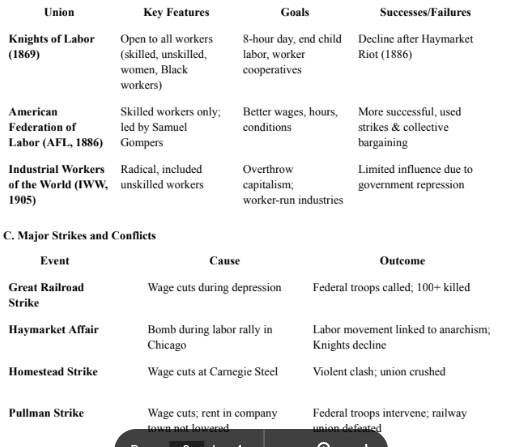
4. Government and Public Response
● Courts often sided with business: Injunctions against strikes; Sherman Antitrust Act: 1890, federal statute that prohibited activities (orga that restricted commerce and competition in the marketplace. Outlaws any contract, conspiracy ,or combination of business interest in restraint of foreign or interstate trade.
(initially used against unions); 14th Amendment; Interstate Commerce Act
● Labor gains slow and uneven
● Public opinion divided: Sympathy for workers vs. fear of socialism, violence
5. Important Terms to Know
● Monopoly, Trust, Capitalism, Collective Bargaining (Collective bargaining is the negotiation process between an employer and a union comprised of workers to create an agreement that will govern the terms and conditions of the workers' employment.).
Strike, Scab, (replacement workers to combat strikes) Lockout
● Tenement, Philanthropy, Child Labor, Sweatshop
● Vertical/Horizontal Integration
● Social Darwinism, Gospel of Wealth, Laissez-faire
● Labor Union, Blacklist, Yellow-dog contract, (An agreement between an employer and an employee in which the employee agrees as a condition of employment, to not be a member of a labor union).
6. The relevance of contemporary examples
● Feast or Famine
● In Building Boom, Immigrant Workers Face Exploitation: vulnerability of workers
● inadequacy of the system
● under-reporting of injuries
● means for evading
accountability
● “independent contractors”
● OSHA: Occupational Safety and Health Administration, is a U.S. government agency within the Department of Labor that sets and enforces standards to ensure safe and healthy working conditions for employees
● similarity to Marcos Che Culchul’s situation
● The Price of Nice Nails
Immigrants face abuse in the work place because of their undocumented status, not being able to speak English, lack of economic mobility so they won’t retaliate or speak out in fear of losing their jobs.
Skillful terracing, the role of the state in facilitating a shift away from concerns of reconstruction to a focus of emergent corporate interests, create hierachy to prevent rebellion, create divid
monetary policy
• tax policy
• support for corporate subsidies
• the role of the Courts
• hostility towards labor
• state sanctioned violence
Challenges for Organized Labor
• disagreements about goals,
methods, structure
• ethnic tension
• racism
• skilled vs. unskilled labor
• public perceptions
Capital Fights Back
• local militia (public and
private)
• replacement workers
(scabs)
• 14th Amendment
• court injunction
• lock-out
• espionage
• weaponizes racism and
nativism
• media
73% of the American agricultural workforce
is comprised of immigrants from Mexico and
Central America.
The majority of undocumented immigrants
working in food production have lived in the
US for more than ten years.
The American dairy industry estimates that
without immigrant labor the retail price for
milk would roughly double.
Clara Lemlich
● Russian immigrant
● Militant activist for labor
and the rights of women
● helped to grow the
International Ladies
Garment Workers Union
● campaigned for
women’s suffrage