Psychology's roots
Psychology is a science
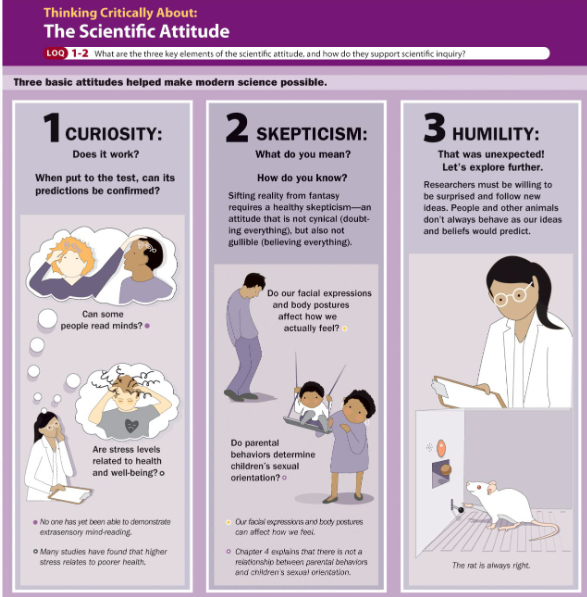
Critical Thinking and the Scientific Attitude
Psychologists scientifically study how people act, think, and feel by applying critical thinking and a scientific approach
Critical thinkers do not blindly accept arguments and conclusions
Science-aided thinkers challenge old beliefs and forge new, fact-related paths
Critical Thinking - thinking that does not automatically accept arguments and conclusions. Rather, it examines assumptions, assesses the source, uncovers hidden values, weighs evidence, and assesses conclusions.
Psychology’s Science birth and Development
Wilhelm Wundt - Established the first psychology lab at University of Leipzig, Germany
Many different Psychologists came from different scientific disciplines
Psychology’s Earliest Explorers: Magellan’s of the Mind
Wilhelm Wundt -
Charles Darwin - British naturalists, research led to evolutionary psychology
Ivan Pavlov - Russian physiologist, studied how we learned
Jean Piaget - Swiss Biologist, studied children’s developing minds
William James - American philosopher, wrote the first psychology textbook
Mary Whiton Calkins - First female president of the American Psychological Association
Margret Floy Washburn - First woman to receive a PhD in Psychology helped found animal biology research
Contemporary Psychology
John B Watson - thought that psychology should be the study of behavior without learning about mental processes
B.F. Skinner - through that psychology should be the study of behavior without learning about mental processes
Sigmund Freud - Austrian Physician, personality theorist and therapist.
Branches of Psychology
Structuralism - focus on structure of the mind
Functionalism - focused on how the mind functions
Behaviorism - the view that psychology (1) should be an objective science that (2) studies behavior without reference to mental processes. Most psychologists today agree with (1) but not with (2).
Humanistic Psychology - an earlier psychological perspective that emphasized human growth potential.
Cognitive Psychology - the study of the mental processes involved in perceiving, learning, remembering, thinking, communicating, and solving problems.
Cognitive Neuroscience - the interdisciplinary study of the brain activity linked with cognition (including perception, thinking, memory, and language).
Unpacking the Definition of Psychology
Psychology - Science of behavior and mental processes
Behavior
Any action that can be observed and recorded
Anything a human or nonhuman animal does
Mental Processes
Internal states that are inferred from behavior
Include thoughts, beliefs, and feelings
Psychology’s current perspectives
Perspective | Focus | Sample Questions | Example of Subfields using this perspective |
Neuroscience | How the body and brain enable emotions, memories, and sensory experiences | How do pain messages travel from the hand to the brain? | Biological, cognitive, clinical |
Evolutionary | How the natural selection of traits passed down from one generation to the next has promoted the survival of genes | How has our evolutionary past influenced our modern-day mating preferences? | Biological, developmental, social |
Behavior Genetics | How our genes and our environment influence our individual differences | To what extent are psychological traits such as intelligence, personality, sexual orientation, and vulnerability to depression products of our genes vs environment? | Personality, developmental, legal/fornesic |
Psychodynamic | How behavior springs from unconscious drives and conflicts | How can someone’s personality traits and disorders be explained in terms of their childhood relationships? | Clinical, counseling, personality |
Behavioral | How we learn observable responses | How do we learn to fear particular objects or situations? | Clinical, counseling, industrial-organizing |
Cognitive | How we encode, process, store, and retrieve information | How do we use information in remembering? Reasoning? Problem solving? | Cognitive neuroscience, clinical, counseling, industrial-organization |
Social-Cultural | How behavior and thinking vary across situations and cultures | How are we affected by the people around us, and by our surrounding culture? | Developmental, social, clinical, counseling |
Psychology Today
Today’s psychologists builds upon the work of many earlier scientists and schools of thought
Psychology is growing and globalizing
Globally more than 1 million psychologists who share a common goal: describing and explaining behavior and the mind underlying it
Psychology influences modern cultures and transforms people
Psychology also relates to many other fields.
Biological psychology - links between brain and mind
Developmental psychology - studying changes from womb to tomb
Cognitive psychology - how we think, perceive and solve problems
Personality psychology - Investigating our persistent traits
Social psychology - How we view and affect one another
Health psychology - the psychological, biological, and behavioral factors that promote or impair our health.
Industrial-organizational psychology - studying and advising on workplace-related behaviors and system and product designs.
Modern Psychology’s Big Idea:
The Biopsychosocial Approach
Culture - the enduring behaviors, ideas, attitudes, values, and traditions shared by a group of people and transmitted from one generation to the next.
Biopsychosocial Approach - an approach that integrates different but complementary views from biological, psychological, and social-cultural viewpoints.
Biopsychosocial Approach
Shared Biologically-rooted human nature
Individual differences in traits, abilities, and identities
Members in a larger social system, a family, an ethnicity, a cultural group
Levels of analysis provide insight into a behavior or mental process; “kin beneath the skin”;
WEIRD research participants
Western, Educated, Industrial, Rich, and Democratic
Sometimes phycologist researchers think that their findings apply to all people rather than the people of the WEIRD cultures
3 Different Levels of Analysis:
Biological
Psychological
Social-cultural
Nature vs Nurture
An age-old controversy over the relative influence of genes and experiences in the development of psychological traits and behaviors
Todays psychological sciences views traits and behaviors arising from the interaction of nature and nurture
In most cases, nurture works on what nature provides
In some instances, epigenetics influences genetic expressions
Nature made Nature-Nurture Experiment
Identical twins have the same genes
This make them ideal participants in studies designed to shed light on hereditary and environmental influences on personality, intelligence, and other traits
Fraternal twins have different genes, but often share a similar environment
Dual Processing With Our Two-Track Minds
Dual Processing - the mind processes information at the same time on separate conscious and unconscious tracks
Example: Vision is a two-track system
A visual perception track enables an individual to think about the world
A visual action track guides an individuals movement to movement actions
Psychology: a science and a profession
Psychology is a helping profession (Clinical Psychology)
Psychology is also a profession that helps people
Counseling Psychology - a branch of psychology that assists people with problems in living (often related to school, work, or relationships) and in achieving greater well-being.
Clinical Psychology - a branch of psychology that studies, assesses, and treats people with psychological disorders.
Psychiatry - a branch of medicine dealing with psychological disorders; practiced by physicians who provide medical (for example, drug) treatments as well as psychological therapy.
Community Psychology - a branch of psychology that studies how people interact with their social environments and how social institutions (such as schools and neighborhoods) affect individuals and groups.
Positive Psychology
Positive Psychology - the scientific study of human flourishing, with the goals of discovering and promoting strengths and virtues that help individuals and communities to thrive
Methods to explore:
Positive Emotions
Positive Character Traits
Positive Institutions
The Need for Psychological Science: Limits of Common Sense
The Limits of Common Sense
Research shows that Thinking, memory, and attitudes operate on conscious and unconscious levels
Most people’s Mental life happens automatically, but intuition can lead them astray
Common Flaws in Commonsense thinking:
Hindsight bias
Overconfidence
Perceiving order in Random Events
Hindsight Bias - the tendency to believe, after learning an outcome, that we could have predicted it. (Also known as the I-knew-it-all-along phenomenon.)
Overconfidence - the tendency to be more confident than correct — to overestimate the accuracy of our beliefs and judgments.
People tend to think they know more than they do
Perceiving Order in Random Events
Humans have innate eagerness to make sense of the world
We have a desire to see patterns in the world
Psychological Sense in a post-truth world
Post-truth occurs when many people’s emotions and personal beliefs tend to override acceptance of objective fats
EX: “The US Crime Rate is Rising” or “Many Immigrants are Criminals”
Political party bias also colors American’s thinking
Extremely liberal and extremely conservative Americans, both with similar self-confidence, view their beliefs as superior
Influences
Identifying Negative Influences
False News
Believe what others say
Repetition
Availability of powerful examples
Group identity and the echo chamber of like-minded
Want to confirm our own beliefs
How to “keep the truth afloat” with Psychology
Slow, deliberate thinking vs gut reaction
Awareness of personal biases
Discussion before dismissal
Debunking
Predebunking - protect people from any future misinformation
Scientific Method
Terms to Consider and learn
Theory - an explanation using principles that organize observations and predict behaviors or events.
Hypothesis - a testable prediction, often implied by a theory.
Operational definition - a carefully worded statement of the exact procedures (operations) used in a research study. For example, researchers may operationally define helping as how many dollars people donate.
Replication - repeating the essence of a research study, usually with different participants in different situations, to determine whether the basic finding can be reproduced.
Preregistration - publicly communicating planned study design, hypotheses, data collection, and analyses.
Features of a Good Theory
Effectively organizes observations
Leads to clear predictions that anyone can use to check the theory or to create practical applications of it
Often stimulates replications and more research that support the theory
Want to get the same results
Leads to a revised theory that better organized and predicts what we observe
Ways to test hypotheses and Refine Theories
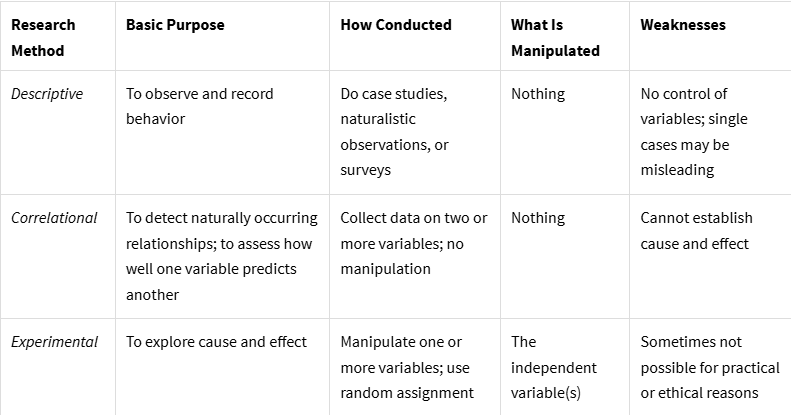
Descriptive Methods
Describe behaviors, often by using case studies, naturalistic observations, or surveys
Describe what is going on. Case studies are helpful when stuff is rare, but it is only one person so results can vary. Naturalistic Observations is when you observe a person in their “natural habitat”
Correlation Methods
Associate Different Factors
Every exam has a bonus question about this
How two things are related
Experimental Methods
Manipulate, or vary, factors to discover their effects
Generally happen in a lab, not in the wild/natural setting
Always try to replicate natural setting though
Case Study - a descriptive technique in which one individual or group is studied in depth in the hope of revealing universal principles
Naturalistic Observation - a descriptive technique of observing and recording behavior in naturally occurring situations without changing or controlling the situation.
Descriptive Technique: Survey
Survey: Descriptive techniques for obtaining self-reported attitudes or behaviors of a group, usually by questioning a representative, random sample
Wording affects
Do not use leading words/questions
(do you enjoy snowboarding → bad question )
Bad questions can prime the brain, which gives bad answers
Bunny story causes people to see a bunny instead of a duck
Random Sample
Survey must be given to a random group in order to get accurate data. Random is better, more generalized is better
BIG SAMPLE GROUP, RANDOMLY PLUCK FROOM THAT
Population
The bigger group that you are plucking from
How do psychologists ask and Answer Questions?
Correlation - a measure of the extent to which two factors vary together, and thus of how well either factor predicts the other
Correlation does not prove causation
EX: Going to class every day does not cause a 100%, other factors are involved.
Correlation =/= causation
Correlation Coefficient
Mathematical expression of the relationship
Ranges from -1.00 to +1.00
0 Indicates no relationship
-1 and +1 are a perfect relation
+1 means both things go up
Class attendance and Grade go up
-1 means one goes up, other goes down
Less sick days, grade goes up
Correlation and Causation
Correlation indicates the possibility of a cause-effect relationship, but it does not prove causation
knowing that two events are associated does not reveal which event causes the other
Experiment
a method in which researchers vary one or more variables (independent variables) to observe the effect on some behavior or mental process (the dependent variable). By random assignment of participants, researchers aim to control other variables that may change the research outcome.
Independent Variable goes Into the experiment,
Dependent variable depends on what happens in the experiment
Random Assignment
Assigning participants to experiment and control groups by chance, thus minimizing any preexisting differences (age, gender) between the groups.
Experimental group - gets the real thing
Control Group - gets placebo
Procedures and the placebo effect
Aids in elimination of Bias
Both the participants and the research staff are ignorant about who has received the treatment or a placebo
Defining Terms
Placebo - fake medication, probably a sugar pill
Placebo Effect - person in control group knows ahead of time that they could end up in control or experiment group, but don’t know which one they are in. Person hopes they benefit from the experiment, and so the person is more positive and this affects the results.
Double-Blind Procedure - The best way to do research. only way to prove causation. Means the researcher and the participants don’t know who has the placebo and who has the real med.
Independent and Dependent Variables
Variables
In an experiment, those variables or elements that are likely to change or vary
Independent Variable
Variable that is manipulated, whose effect is being studies
Confounding Variable
Variable other than the variable being studied that might influence a study’s result (variable outside the study). Always try to limit them, as they can change the result of study
Dependent Variable
Variable that is measured; variable that may change when the independent variable is manipulated
Predicting Everyday Behavior
The Purpose of an experiment is to test theoretical primciples
The resulting principles, rather than the specific findings, help explain everyday behaviors
Psychological Sciences
focus less on specific behaviors
Focus more on revealing general principles that help explain many behaviors
Psychology research Ethics: Studying and Protecting Animals
The study of animals allows phycologists to understand humans better
Animal protection movements protect the use of animals in psychological, biological, and medical research
Use of animals for research is debated among psychologists
is it right to place the well-being of humans above that of other animals?
What safeguards should protect the well-being of animals in research?
British Psychological Society (BPS)
American Psychological Association (APA) - ethics governing body
Even though Animals and humans share DNA, they are not the same, therefore the results might not be the same if the experiment was done on humans
Benefits of animal research for animals
Intervention of handling and stroking methods to reduce stress and ease dog’s move to adoptive home
Improvement of care and management in animals’ natural habitats
Increased empathy and protection for other species
Studying and protecting Humans
The APA and BPS ethics codes urge researchers to:
Obtain participants’ informed consent to participate
Tell participants what the project is doing, possible effects
Protect participants from out of the ordinary harm and discomfort
Keep information about individuals participants confidential
Fully Debrief participants
Tell participants about the experiment and what happened
Ensure Scientific Integrity
Mistakes happen in science, and those are forgivable
Fraud is not acceptable and is unforgivable
Psychology Speaks
In making its historic 1954 school desegregation decision, the US supreme court cited the expert testimony and research of psychologists Mamie Phipps Clark and Kenneth Clark (1947)
studied on race. Able to prove it enough that desegregation was upheld
Psychology research ethics: Values in Psychology
Values impact
Which material is studied
How the material is studied
How results are interpreted
Applied psychology contains hidden values
Psychology has the power to deceive, though its purpose is to enlighten
Outliers skew the data
Use Psychology to become a stronger person and a better student
Use psychology
think, consider, and improve
Incorporating evidence-based suggestions
manage your time to get a full nights sleep
Make space for exercise
Set long term goals, with daily aims
Maintain a growth mindset
Prioritize relationships
Testing Effect - enhanced memory after retrieving, rather than simply rereading, information. Also sometimes referred to as a retrieval practice effect or test-enhanced learning.
Distribute your study time
Learn to think critically
Process class information actively
Overlearn