350 Week 1 Acoustic Phonetics and Sound Wave Mechanics
Fundamentals of Sound Production and Transmission
Sound is created by an audible disturbance, or wave, in a medium caused by a vibrating source.
Primary examples of sound sources include:
Tuning forks
Vocal folds
Sound propagates through physical mediums existing in different states of matter:
Gas
Liquid
Solid
Speech is most usually transmitted through air.
Sound at its fundamental level consists of physical vibrations.
Pure Tones and Simple Harmonic Motion
A pure tone is an acoustic signal that consists of only one single frequency.
Fundamental periodic definitions:
Cycle: A single complete back-and-forth vibration of a wave.
Frequency of vibration: The number of completed cycles within a time period of one second ().
Tuning forks serve as a standard physical example of a pure tone generator executing simple harmonic motion.
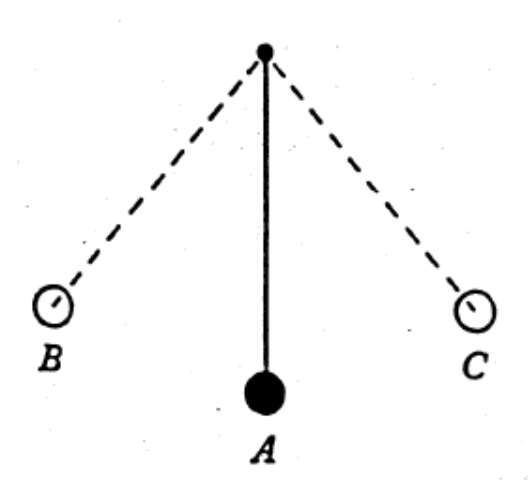
Progression of simple harmonic motion (SHM):
Rest position (): Initial equilibrium state.
Force applied: Induces displacement to position
Elasticity (restoring force): Drives the object back to rest position
Inertia: The physical tendency for motion or lack of motion to continue, which drives the object past rest position to displacement position
Elasticity (restoring force): Drives the object back to rest position
Dynamic physical properties across displacement positions:
Position A: Has maximum velocity: the speed of an object.
Positions B and C: Has zero velocity, maximum displacement, and maximum acceleration: the rate of change in velocity.
Waveform Parameters: Amplitude, Damping, Compression, and Rarefaction
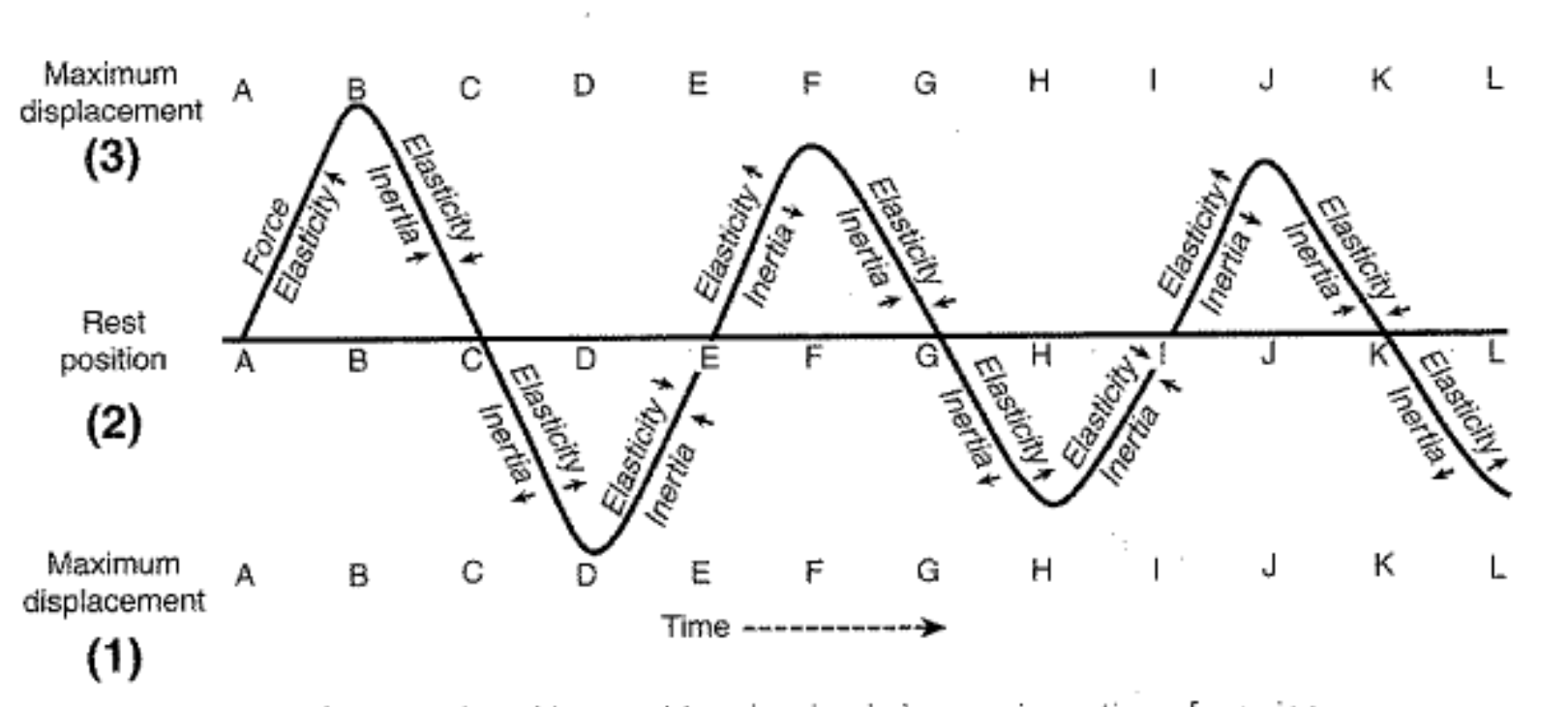
B, D, F, H, J, L: Zero velocity, maximum acceleration
C, E, G, I, K: Maximum velocity
A not included because object starts at rest.
Amplitude and energy reduction:
Amplitude: The absolute extent or magnitude of physical motion of the vibrating body.
Damping: The progressive decrease in the amplitude of displacement over time due to friction or air resistance.
Atmospheric sound wave propagation mechanics:
Compression: A region in an acoustic wave where air molecules are packed closely together, creating high air pressure.
Rarefaction: A region in an acoustic wave where air molecules are spread farther apart, creating low air pressure.
Phase transitions in longitudinal pressure waves:
State at rest Compression phase Rarefaction phase.
Complex Tones and Fourier Frequency Spectra
Principles of complex tones:
A complex tone is a composite sound created by combining two or more pure tone frequencies.
Pure tone component frequency summation example:
Pure tone component 1:
Pure tone component 2:
Pure tone component 3:
The summation of component pure tones produces a complex periodic wave across time ( to ).
Frequency domain representation:
Waveform domain: Displays amplitude variations plotted continuously over time in seconds ().
Spectrum domain: Displays discrete pure tone components by plotting amplitude against frequency in Hertz ().
The spectrum of the sum wave displays discrete vertical lines at each fundamental component frequency, specifically at , , and .