ZOOT 1105 - ANIMAL NUTRITION Introduction to Animal Nutrition
Nutrition
Nutrition - science or study of proper or balance diet to promote health.
- processes of nourishing animals; especially, series of activities by which an animal takes in and assimilates food/feed for promoting growth and replacing worn-out or injured tissues
Nutrition - it involves various chemical reactions and physiological processes which transform foods/feeds into body tissues and activities, such as:
- Food/Feed ingestion
- Digestion of nutrients
- Absorption of nutrients
- Transport of nutrients to body cells
- Removal of unusable elements and wastes products of metabolism
Nutrition
Nutrition - deals with the kind and amount of feeds, their composition of nutrients, the animal performance desired, and digestion and metabolism of nutrients.
Nutrigenomics
- Nutrigenomics - a branch of the science of nutrition.
- Nutrigenomics - the study of the effects of foods and food constituents on gene expression.
Nutrology
- also a branch of the science of nutrition.
- Nutrology - it deals with the prevention of some diseases caused by inappinappropriate feeding/ eating behaviors/practices.
Nutrient
Nutrient - a chemical element or compound that is essential for normal body metabolism.
- A feed/food constituent that aids in the support of life. It may be a single element or it may be large, complex chemical compound composed of many different units.
- A feed constituent in a form and at a level that support life of an animal.
- Any feed constituent or group of feed constituents of the same general composition that aids in the support of animal life.
Feed
Feed - A term given to a particular product that provides nutrients (e.g. rice bran, corn, and rice middling).
- Any material consisting of grains, fodder, or by-products of animal or plant origin which when properly used has nutritional value to animals.
- Edible (can be eaten) materials that are consumed by animals and contribute energy and/or nutrients to the animal’s diet (Usually refers to animals rather than man).
Food
Food - an article used for food or drink for man or other animals.
- Is a substance that provides taste, flavor or nutritive value.
American context - the term food refers principally to articles used for human nutrition.
British context - refers the same term to articles used for animal nutrition.
Feedstuff
Feedstuff - a term which is commonly used when a group or list of feeds is being referred to.
- Similar to a feed or food but is a broader term covering all materials in the diet.
- Any product whether of natural or artificial in origin which when properly used has nutritional value in the diet.
Meal
Meal - a product intended for feeding.
- Applied for products that are used principally for animal feeding. Such products are usually processed or prepared in such a way that it is physically and chemically suitable for animal feeding.
- e.g. A corn grain becomes a corn meal when it is ground and fed with particle size suitable to a particular stage of development of an animal.
Diet
Diet - a number of individual feeds, with corresponding amount or proportion, selected to make a balanced ration or satisfy nutritional requirements of a particular animal.
Ration
Ration - a combination of feeds, perhaps mixed together, which are fed to livestock and poultry to meet the nutrient requirements of an animal.
Balanced ration- quantity of feed that provides an animal all of the nutrients needed in desired proportions.
Ration - Quantity of diet fed per day. The feed allotted to the animal for 24- hour period.
The Nutritive Chemical Elements
- Of the 118 chemical elements, more than 20 enter into the makeup of the essential nutrients.
- From such elements, about 50 or more nutrients can be formed.
- These chemical elements are found in animals’ body (tissues); those with defined biochemical functions are called essential elements and those without are called adventitious elements.•
Semi-essential elements - elements that are present in animals’ body whose function has been demonstrated, in some species.
Basis of Biological Essentiality of Chemical Elements:
- The element must have known or well established biochemical/physiological function(s) in the animal’s body.
- The absence or deficiency of the element will cause health problem(s) specific to that particular element.
- The supplementation/provision of the element in question cures or prevents the health problem(s) or the deficiency symptom(s).
Roles of chemical elements:
- Life is essentially a chemical process.
- The sciences of physiology (study of body functions) and biochemistry (study of the chemistry of life) have greatly aided scientists engaged in animal nutrition research in the discovery of chemical elements necessary for an animals life, particularly with respect to the specific roles and interrelationships of the essential elements.
Antoine Lavoisier
- a French chemist; is the founder of the science of nutrition.
- He established the chemical basis of nutrition.
- Lavoisier established that the nutritive value of feed/food does not reside in a single “aliment” (element).•
General functions of nutrients:
- Structural material for building and maintaining body structures
- Source of energy for heat production, work and or fat deposition
- Regulating body processes or in the formation of body produced regulators.
The main components of animals, plants and food/feed
The main components of animal tissues plants and food/feed are graphically presented below.
- The tissues are divided mainly into water and dry matter.
- The dry matter is divided into organic matter and inorganic matter or ash.
- Organic fraction is made up of carbohydrates lipids, proteins, nucleic acids, organic acids, and vitamins; an inorganic fraction is composed of minerals (macro and micro minerals).
Distribution/Occurrence of Nutrients in Animals and Plants
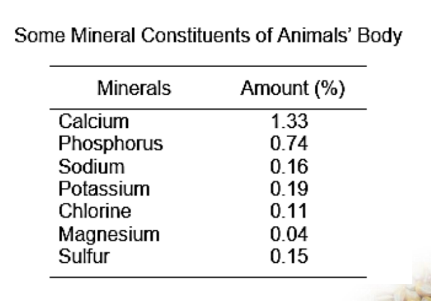
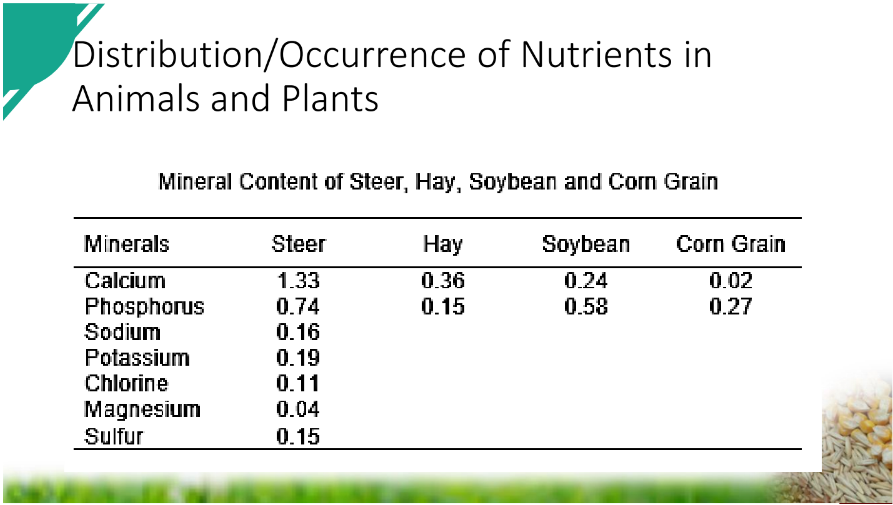
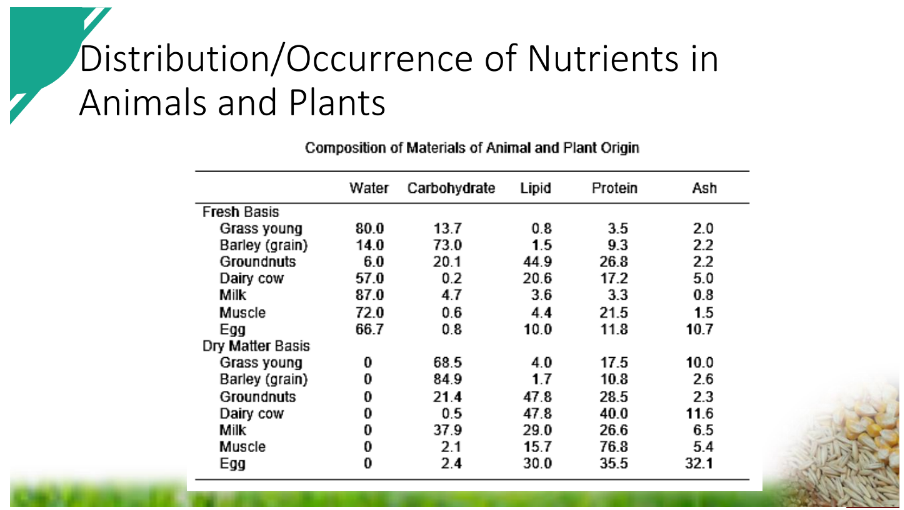
The nutrients are not uniformly distributed in an animal’s body. Some are concentrated in a particular tissue while others are present in minute amounts as indicated below.
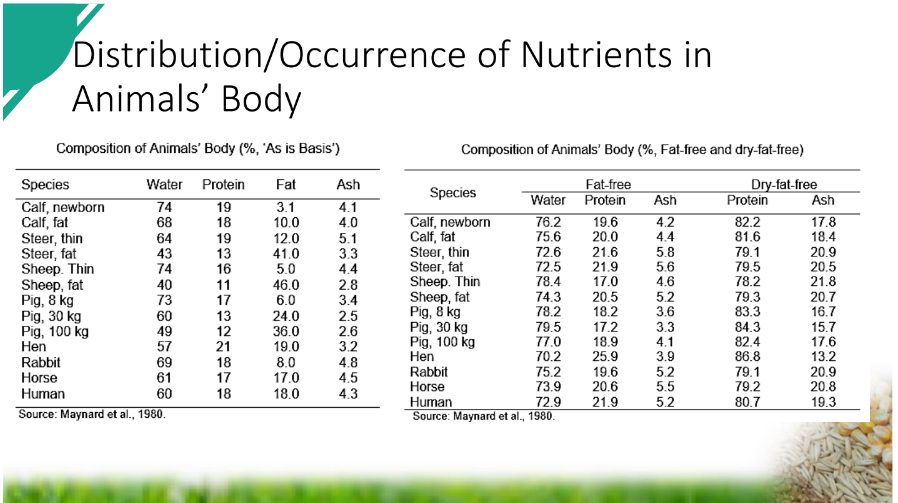
- The chemical composition of animals’ body can be expressed on ‘as is basis’, fat-free-basis or dry-fat-free basis.
- The water content is highest with young animals and lowest with old animals.
- The amount of fat increases with age but is variable, depending on the level of feed intake.
- The protein and ash contents are practically constant on a dry-fat-free basis. The exception is the higher protein values for the pig and hen compared with the other species, reflecting the smaller relative size of their skeleton.
Distribution/Occurrence of Nutrients in Animals and Plants
- Ash fraction is principally made of calcium and phosphorus.
- Calcium and phosphorus exist at a ratio of about 2:1.
- Other minerals are also present in appreciable quantities.