Matter
Kinetic Particle Theory
- It states that matter is made up of tiny particles that are in constant random motion.
- It affects the states of matter, their properties and the changes they undergo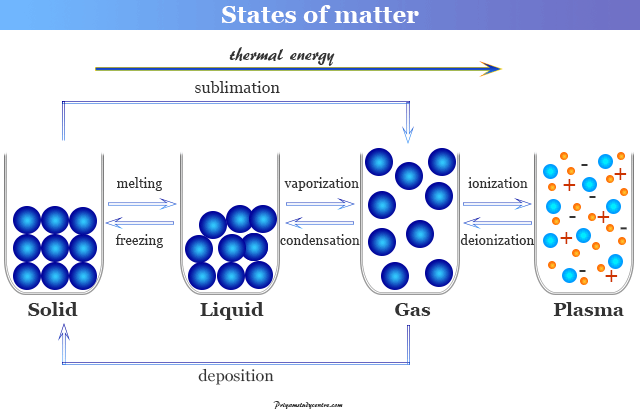
Plasma
- A gaseous state of matter in which a part or all the atoms or molecules are stripped off of electrons forming positive ions & negative electrons
-Most common form of matter in the universe but least common on earth.
Properties of Solid
-Rigid, compact and incompressible
-Has a definite shape & volume
-Doesn’t flow
Types of Solids
Crystalline
-more compact
-arranged orderly
Amorphous
-Easily breaks
-less compact
Properties of Liquids
-Has definite volume but no definite shape
-flows and diffuses slowly
-exerts pressure
-almost incompressible
Surface Tension
-The property of the liquid that makes it resist an external force
-allows objects to float on water
Capillary action
-defined as the movement of water within the spaces of a porous material due to the forces of adhesion, cohesion, and surface tension
Properties of Gas
-No definite shape & volume
-flows & diffuse easily
-compressible
-exerts pressure
Diffusion
-Movement of particles from high to low concentration
Pressure
-The force exerted per unit area
Physical Change
-Matter changes form but not chemical identity
Chemical Change
-A chemical reaction occurs and new products are formed
MATTER IN RELATION TO ENERGY
Exothermic Change
-A process that releases heat to the surroundings
-Liquid water to vapor+heat
Endothermic Change
-A process that absorbs heat from the surroundings
-ice+heat = water liquid
Melting Point
-The temperature at which a solid becomes a liquid is called the melting point
-Substances with high melting points have high forces of attraction between their particles
Boiling point and altitude
-Water boils at different temperatures at different altitudes
-The higher the altitude the lower the boiling point
Element
-It’s a substance that cannot be broken down to simpler substances by chemical change.
-Can be classified as metal, non-metal and matalloid
-It’s only made up of 1 kind of atom
Compound
-Its smallest particle is called a molecule
-It is formed when 2 or more elements combined chemically
-Its represented by a chemical formula
Mixture
-It has variable compositions and its properties may be similar to its components
-Its a combination of 2 or more substances that can be separated by physical methods