AGRI 103: Agronomy - Plant Growth and Development pt. 2/2 lecture 7
AGRI 103: Agronomy - Plant Growth and Development
Growth Habits
Determinant:
Defined as plants with a finite growth period during which a plant reaches a predetermined size or height.
Typically, determinant plants produce all their fruit at once.
Example: Wheat.
Indeterminate:
Refers to plants that experience continuous growth throughout their life cycle.
They may produce fruit and foliage simultaneously.
Example: Lentil.
Semi-determinate:
Represents a growth habit that is intermediary between determinant and indeterminate.
Example: Canola.
Varieties with Mixed Habits:
Many crops or plants possess varieties that may showcase either determinant or indeterminate growth habits.
Examples include: Chickpeas, Tomatoes, Beans.
Specific Crop Growth Habits
Dry Beans Seeding:
Lentil plants exhibit an indeterminate growth habit, continuously flowering until they face stress factors such as:
Lack of moisture
High temperatures
Nutrient deficiency
This information is supported by Saskatchewan Pulse Growers (SaskPulse).
Tomato Types
Determinate Tomatoes:
Grow to a specific (determined) height.
Exhibit bushy growth.
Produce fruit that ripens all at once.
Typically require cage support.
Ideal for large batch cooking or preserves.
Indeterminate Tomatoes:
Grow to an indetermined height.
Have vine growth habits.
Produce fruit that ripens throughout the season.
Require trellis support.
Best for fresh, weekly harvests.
Crop Development and Management
Importance of Crop Stages:
Farmers and agronomists utilize various crop stages to describe crop development, which serves as a guide for applying management treatments. These treatments include:
Application of fertilizers
Application of pesticides
Application of plant growth regulators (PGRs)
Irrigation
Timing of swathing, desiccation, or harvest.
Pesticide Application Considerations:
Certain pesticides must be applied at specific crop development stages to minimize damage to the crop.
Identification of crop susceptibility to pests is critical, as crops are more vulnerable at specific developmental stages, making timely applications essential for effectiveness.
Plant Growth Regulation and Maturity:
Effective application of PGRs is stage-dependent. Plants must reach the proper stage of maturity before termination to maximize yield.
Nutrient Concentration Variability:
Crops display varying nutrient concentrations and requirements (both water and nutrients) contingent on their developmental stage.
Growing Degree Days (GDD)
Definition:
GDD is an index of heat accumulation, also referred to as heat units, over time.
Temperature Influence:
Temperature serves as a primary determinant of the growth rate and development of plants.
Estimation of Crop Development:
GDDs facilitate the estimation of crop development speed, helping predict when specific developmental stages will occur.
Calculation of GDD:
The formula for calculating GDD is as follows:The base temperature varies with each crop; it is the temperature above which growth occurs (for instance, for wheat).
Accumulation of GDD:
GDDs for each day since the start of the season (or since seeding) accumulate to provide a total GDD measure.
GDD Examples
Total GDD accumulation in Moose Jaw from 2019 to 2022 outlines the variability and trends in seasonal temperatures and plant growth.
Early-season varieties of crops will require fewer heat units to reach maturation compared to longer-season varieties.
Different varieties within a crop species showcase unique heat unit requirements for reaching each developmental stage.
Crop Developmental Stages
Identification Systems:
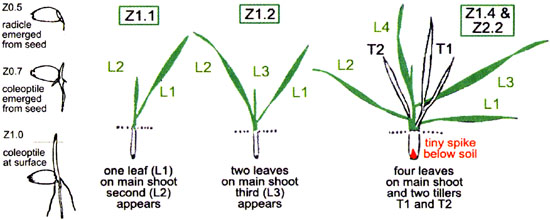
Various systems and scales have been developed to identify specific developmental stages of crops, such as:
Feekes Scale
Zadoks Scale
Haun Scale (for cereals, numerical)
Stage Classification:
Crops, such as soybeans and corn, can be classified into vegetative (V) and reproductive (R) stages.
Reading Assignment Reference:
Students are expected to consult the "Crop Diagnostic Handbook 2022 – SK Ministry of Agriculture, Section 1 General Agronomy – p. 3-18 (Plant Staging)" as this material will be testable.