Animal Science 103 - Exam 2 Study Guide
Equine Management
Cryptorchid horse = Rig, Ridgling, or High Flanker
US Accounts for ~16% of the worlds horses
9 Million Horses in the US - 72% for personal use and 28% for work
Classification of Horses: Draft, Light, Pony (Coldblood, Warmblood, Pony)
Coldbloods or Draft Horses:
Origin = Europe
Hight → 14.2-19 hands; weight → 1400-2000 lbs
Heavy, solid, strong, calm
Purpose = work; pulling loads
Breeds: Shire, Percheron, Belgian, Clydesdale, Suffolk
Warmblood or Light Horses:
Origin = Europe, Asia, North & South America
Hight = 14.2-17.2 hands; weight = 900-1400 lbs
Purpose = Riding, driving, racing ect
Breeds: Quarter horse, Thoroughbred, Standardbred, Paint, Morgan, Appaloosa, Arabian
Ponies:
Origin = europe, asia, south & north america
Hight = <14.2 hands
Weight = 300-900 lbs
Purpose = draft, heavy-harness, or saddle type; riding, driving, racing
Breeds: Shetland, Hackney, Welch, Pony of the Americas
Miniature Ponies:
Height <34-38 inches
Lifespan = 25-35 years
Donkeys:
Long ears; short, upright mane
Male = Jack
Female = Jennet
Purpose = Work animals
World Pop. = 42.8 million
US = 52,000 (0.12%) Donkeys
Horse x Donkey Cross
Stallion X Jennet = Hinny
Mare X Jack = Mule
Characteristics: Horse size/body shape with a shorter, thicker head, longer ears, braying voice & no chestnuts on hind legs
Classification: Draft, pack/work, saddle, driving, jumping, or minis
Horse Management
Water → Twice daily if not constantly available
- Ave. 1000 lb horse will drink 10-12 gallons/day
Housing → Protect from weather, provide ventilation, be clean & dry, Be safe and well maintained
- Have space for exercise
- Barns: If box stalls 12x8 or 10x10
- Flooring- well-drained, solid-footing surface with some give when horses lie down (ex. Clay, sand, rubber mats)
- 3 sided Shed
- Face south away from prevailing wind
- Located on an elevated well-drained site
- Accessible for feeding & manure handling
Manure → Ave 1000 lb horse produces ~50 lb of manure & urine/day (or 9-12 tons of waste & soiled bedding per horse per year)
- Manure should be picked up regularly from the hoses stall (daily) or paddock
Preventative Health Plan → Hoof care, parasite control, dental care, vaccination, biosecurity protocol
- Veterinary care if ill or injured
Digestive Tract:
Herbivore, Monogastric, Hindgut Fermenter
- Stomach is small → 8-15 liters (10% of digestive capacity)
- Cecum & Large Intestines = Digestion/fermentation of Forage
- 60% of the total digestive capacity
- 80% of fiber is digested here
- Small intestines = Digestion and absorption
- 30% of the total digestive capacity
- 60-70% of protein and soluble carbohydrates digested here
Nutrition Management
→ horses evolved using speed as a MAJOR survival mechanism
- use a continuous grazing strategy of consuming small amounts frequently and moving from place to place between grazing
- Grazes up to 20 hrs per day
- minimum of 0.75% - 1% of its body weight daily in roughage on a dry matter basis
- Goal BCS = 5-6
- Don't overfeed
- Horse feed – both hay and grain — should be weighed
- USDA estimates that 90% of horse operations feed some form of grain
- If grain exceeds 1% of the body weight, the grain should be fed in at least 3 equal portions spaced throughout the day
- BCS ranges from 1-9
Teeth: Grow continuously and wear unevenly, creating sharp points on the outside of teeth. Needs to be ground down or floated by a veterinarian
Amount of Pasture/Horse: Rule of thumb = 1-2 acres per horse
- Graze unevenly
- Allow grass to regrow to 8” before allowing grazing
- Supplemental feed = Hay, silage, grain, protein, pelleted, & minerals
Health Management Protocols
- Float teeth - at least yearly
- Hoof trim - farrier visit ever 6-8 weeks
- Groom
- Vaccinate - Annual (spring)
- Deworm - Continuous or strategic
- To limit parasite infections so horses remain healthy
- To control parasite egg shedding
- To avoid further development of anthelmintic resistance
Vaccination:
- No vaccine is 100% effective in preventing disease. Claims granted by the USDA: prevention, control, shedding
- Vaccination without good management will not prevent disease
- Horses within a population vary in degree and duration of protective response after vaccination
- Protection is not immediate
Core Vaccine = Vaccines for diseases where all horses/animals are at risk, public health significance, highly infectious organism that poses a risk of severe disease, high mortality rates &/or no effective treatment, VX demonstrated efficacy and safety, +/- required by law.
- Tetanus
- Eastern & Western Equine Encephalomyelitis
- West Nile Virus
- Rabies
Tetanus (Clostridium tetani)
- Anaerobic bacteria (in soil and manure) enters body through puncture wounds, surgical incisions, or exposed tissues such as the umbilicus of foals and reproductive tract of the postpartum mare
- Bacteria release a neurotoxin that causes spasmodic, tonic contraction of the voluntary muscles by interfering with the release of inhibitory neurotransmitters from presynaptic nerve endings
Clinical Signs:
- Neuromuscular
- Within 10-14 days after the initial wound
- Localized muscle stiffness (jaw, neck, and Hind Leg)
- Rigid raised tail
- Stiff gait
- Generalized stiffness
- Hyperesthesia
- Sawhorse stance
- Prolapsed 3rd eyelid
Treatment: Supportive care, Anti-toxin, antibiotics
West Nile Virus
- Transferred by mosquitoes (horses & humans are dead end hosts)
- Virus causes encephalitis
- 33% of horse cases are fatal
- 40% of survivors have residual effects
Clinical Signs:
- Fever
- 10% of clinical cases WNV crosses the blood-brain barrier to infect the CNS
- Neurologic
- Impaired vision
- Aimless wandering
- Head pressing
- Circling
- Inability to swallow
- Irregular gait
- Weakness
- Paralysis
- Convulsions
- Death
Eastern & Western Equine Encephalomyelitis
- Virus is transferred by mosquitoes from birds and rodents to horses and humans
- Horses & humans are dead end hosts
- Virus cause encephalitis
- 90% of EE cases are fatal
- 20-50% of WEE cases are fatal
- Average of 11 human cases of EEE reported annually in the US
Clinical Signs
- Asymptomatic
- Fever
- Neurologic
- Impaired vision
- Aimless wandering
- Head pressing
- Circling
- Inability to swallow
- Irregular gait
- Weakness
- Paralysis
- Convulsions
- Death
Rabies
- Virus enters through bites … raccoon, fox, skunk or bat
- Virus migrates up nerves (over days to months) to the brain where it causes rapid progressive, fatal encephalitis
- Fatal within 1-5 days after first symptoms
Clinical Signs = Neurologic
Risk Based Vaccines
- Vary regionally, from population to population within an area, or between individual horses within a given population
- Equine Herpesvirus type 1 and 4 (Rhinopneumonitis)
- Equine Influenza
- Botulism
- Strangles
- Potomac Horse Fever
- Equine Viral Arteritis
- Rotaviral Diarrhea
- Anthrax
Equine Infectious Anemia
EIA = Retrovirus transmitted by blood-sucking insects (horse flies, deer flies & mosquitoes) contaminated needles, or in utero from mare to foal
- EIAV reproduces in white blood cells & the horses immune system may attack & destroy the horses red blood cells = anemia
- US = 90-1600 new cases DX per year
- Most infected horses show no symptoms, but they are carriers that remain contagious for life
- No cure or vaccine
- Also known as swamp fever (associated with warm, wet regions)
Clinical Signs
- Fever +/- sweating
- Depression & weakness
- Anorexia & rapid weight loss
- Rapid breathing and heart rate
- Yellow, pale, or spotted mucous membranes
- Edema (swollen legs, lower chest & abdomen)
- Bleeding from nose
- Colic
- Abortion
Diagnosis
- Identify antibodies in the blood
- The agar gel immunodiffusion (AGID) method is the “gold standard” and is commonly known as the coggins test
- Test developed in 1970 by Dr. Leroy Coggins
- Negative coggins = no detectable antibodies at the time of test
- Positive coggins = horse is infected & carrier of the virus
Positive Coggins:
By law EIA is a reportable disease
- All positive cases must be filed with the state veterinarians and the federal Animal and Plant Health Inspection Service of the USDA
State-by-state Requirements
- Many states require proof of a negative Coggins test before a horse can be exhibited at a fair, shown, raced, or evel trail ridden in the company of other horses
- Some states require a negative coggins before a horse can be sold
- A few states require a negative coggins before a horse can be moved within the state from place to place for any purpose
- A few states require that all horses within the state be tested once yearly
Positive Coggins Options:
- Euthanize
- Brand/tattoo and quarantine for life
- In a screened stall 200 yards away from other horses
Conformation
Physical form of an animal (shape and arrangement of parts)
Conformation analysis system = BSMQTT
Balance - equal shoulder area, body, and hindquarters
Structure - Evaluation individual body parts
Muscling - length, thickness, and distribution
Quality - refinement of hair, skin, bones, and joints
Type - breed- or athlete- specific characteristics
Travel - movement balanced within its frame with long ground-covering strides
- Front Legs should have a vertical line from the point of the shoulder through the center of the knee/carpus, cannon bone, pastern & foot, should also be a vertical line from the shoulder through the center of the elbow & foot
- Hind legs and feet should have a vertical line from the point of the buttock through the centers of the hock, cannon, pastern, and foot. Vertical line from the point of the buttock touches the rear edge of the Cannon from the hock to the fetlock and hits the ground behind the heel.
Estrous Cycle
Seasonally polyestrous, long-day breeders
- Fillies enter puberty round their 2nd spring
Range = 12-18 months (avg. 15 months)
Fillies are not usually bred until they are 2-3 yrs
Average cycle length = 21 days (18-24 days)
Follicular phase → estrus → 4-7 days → Dominant hormone is estrogen
- Shorter at peak season (3 days)
- Estrus behavior depends on low progesterone
- Ovulation occurs 2 days before the end of behavioral estrus
Luteal phase → Diestrus → 14-15 days (dominant hormone = progesterone)
Transition: Before & After the breeding season
Spring Transition = Gradual “activation” of HPO axis
Ends: with the 1st ovulation of the year
After fall transition = Winter Anestrus
Estrus Behavior → absent or erratic
15-20% of mares will cycle throughout the year
Ovulation and Fertilization:
- Oocyte is fertilized in the Oviduct
- Embryo stays in oviduct for 5-6 days
- Fertilized embryo enter uterus @5-7 days post-ovulation
Pregnancy Diagnosis:
- Behavior = No return to estrus
- Tease daily starting at days 15-24 post-ovulation
- False (+) → Silent heat, mare with foal, persistent CL
- Flase (-) → Pregnant mare may show heat
- Hormone Assays
- Palpation per Rectum
- Ultrasound per Rectum
Palpitation and Ultrasound
11-14d: First exam (count CLs and look for twins)
16d: repeat twin check is necessary
25d: heartbeat check
58-70d: Fetal sexing - identify the genital tubercle; Filly - hyperechoic (2mm) closer to tail & Colt - hyperechoic closer to umbilicus
Pregnancy
- Length = 335-345 days (340 average)
- Pregnancy may be as short as 305 or as long as 400 days, with the live delivery of the foal
- However, foals born less than 320 days of gestation are classified as premature with a survival rate of 70-75%
- Most mares (>70%) foal between 10 pm and 2AM
Pregnancy Management
- Mild exercise/normal activity through pregnancy
- Proper diet (increased in the last trimester)
- Ideal BCS of 5-6/9
- VX (EHV-1) at 5, 7, and 9 months
- VX booster (EWT, WNV) at 10 months
- Deworm at 10 months
- Caslick’s removed >2 monthsp before foaling
- Shoes removed
- Foaling kit prepared
Preparation for Foaling
- Foaling area = quite, clean, stress-free, well-bedded, and draft free
- Ideally, familiarize the mare with her new area 4-6 wks prior to foaling
- Familiarize yourself with the mare (frequent observation to detect changes with emphasis on the udder, abdomen, trailhead & vulva
Why do we monitor horses so closely?
- The equine placenta detaches readily so foals rarely survive extended labor
- Every foaling should be attended so that help can be given quickly, if needed
Physiologic Changes before Foaling
Clinical Signs:
- Appetite changes
- Body shape
- Ventral and hindlimb edema
- Udder development
- Perineal relaxation
- Engorgement of teat ends
- Waxing
- Vulvar elongation
Physiologic Changes to the mammary glands:
- Edema
- Distention of teats and milk veins
- Waxing (colostrum)
Physiologic Changes to Milk
- Inversion of Na+/K+ ratio
- Ca2+ increases; pH decreases
Stages of Foaling
Stage One: Preparation (30 min→6 hours)
Stage Two: Foal Delivery (<20 minutes)
Stage three: Passage of fetal membranes (<3 hours)
Stage One: Mare Preparation
- Myometrial contractions
- Cervical dilation
- Physical discomfort
- Anxious
- Colicky
- Lifting tail
- Leak colostrum
- Restless
- Sweaty
- Roll
- Frequent urination/defecation
- Up & down
- Posturing
- Pawing at ground
Fetal signal = increased cortisol level
Maternal response = Hormone cascade = increased uterine contractions
Fetal response = adoption of the “birth position”
Ferguson’s Reflex: Fetal pressure on the cervix is detected and relayed to the hypothalamus & posterior pituitary gland via sensory neurons = Oxytocin release
- Fetus is in the birthing position & the mare’s uterus is contracting = rupture of the allantochorion at the cervix
- Stage 1 ends when the water breaks (2-5 gallons of allantoic fluid)... note the time
Stage Two: Foal Birth
- After water breakage, see the foal's forelimbs within 5-10 minutes in the white amniotic sac. Average is 20 minutes
- One foot appears first with the other foot 4-6 inches behind (soles ventral)
- The head follows the feet
- Strong uterine & abdominal contractions
- Ends when foal is delivered
- Tear away the amnion
- Clear fluid from the foal’s nasal passages
- Make sure the foal is breathing & sternal
- Let the mare rest
- DONT break the umbilical cord
- Natural breakage allows vessel spasm for closure
- After breakage, coat the umbilicus in 2-3% iodine or 25% chlorhexidine
- Be aware of the mares attention to the foal
- 1-2-3 rule
- Foal stands within 1 hour from birth
- Foal Nurses within 2 hours from birth
- Mare passes placenta within 3 hours of birth
- Make sure the foal passes meconium
Stage 3: Fetal Membrane Passage
- Typically ~1hr; Mare may appear colicky
- DO NOT manually remove the placenta
- Tie the placenta up
- Placenta is considered retained if it is not passed within 3hrs
- A retained placenta is a medical emergency
- Occurs in `2-10% of mares
- Retained placenta predisposes the mare to metritis, endometritis, laminitis, spesis, & death
Post Foaling Management
Mare:
- Feed for lactation
- Breed her back… when?
- 1st postpartum estrus or FOAL HEAT = 5-12 days
- 1st postpartum ovulation = 6-18 days
- Mares uterus requires 15 days for repair to support another pregnancy
Foal:
- Nurse, the slowly transition to hay and grain (@ 10 days to 3 weeks)
- Reach about 50% of adult weight during the first weight
- Wean foals @4-6 months
- Castrate colts @ 1-2 years of age
Swine Management
Pig between weaning and finishing = Feeder Pig
Pig (240-290 lbs) ready for processing = Market Hog
US Swine Farming Over Time
Then | Now | |
|---|---|---|
Body Condition | Fat | Lean |
Housing | Outside | Confinement |
Diet | Forage (roots, berries, nuts) ear corn and corn-tankage | Corn or Soy (concentrates) |
Pig Farms | Many | Few |
Pig Farm Size | Small | Large |
Breeds | Purebred | >90% of market hogs are crossbred |
Annual Farrowing | 1-2x per year | Continuous |
Litter Size Weaned | 7.5 | 9 to 12 |
Weaning Age | 6-8 weeks | <3 weeks |
Feed Efficiency | 3.5 lb of feed/lb gain | 2.4 lb feed/lb gain |
Global Pork Production
- China
- European Union
- United States
- Brazil
- Russia
Swine is the world's 2nd most dominant meat producing species (pork accounts for 36% of the worlds meat production)
US Swine Industry
- U.S. is one of the world's top five exporters of pork, with exports averaging over 20% of commercial pork production
- U.S. imports pigs/pork from Canada and Denmark
- Consumers surveyed by the National Pork Producers Council:
- Price (58%) was the most important attribute when comparing chicken to pork
- Lipid level (24%) was the 2nd most important attribute, which correlates with tenderness
- Dec 2023 Inventory: 6 million breeding animals + 69 million market hogs
- Most pig production occurs in the midwest due to flat land and proximity to corn and soy production
There is a huge feral swine population in the United States, most prevalent in the south however they are spreading
- Most farms with swine are small however a majority of swine in the US are located in large farms
Trends in US Swine Production
- Most farms (82%) have <100 pigs
- Most pigs (82%) are on farms >5,000 pigs
- Increasing number of large, corporate-owned swine farms
- Increasing vertical integration
- Increasing confinement and automation
- Decreasing pasture use and manual labor
- Increasing individual animal productivity
Feed efficiency, >litters/sow/yr, >piglets weaned/litter
Swine Management Goals
- Optimize productivity and product quality
- Minimize environmental impact (waste and odor)
- Optimize animal welfare and health
- Minimize production costs
Phases of Production
Breeding → Gestation (3 months, 3 weeks, 3 days) → Farrowing (wean @10-15 lbs; 10-21 days) → Nursery (from weaning to 40lbs) → Grower (40-120 lbs) → Finisher (120-290 lbs)
Swine Operations
- Farrow to Wean
- Breeding herd (sows & boars) Produce: Early weaned piglets (10-15 lbs) or Feeder Pigs (35-50 lbs)
- Finishing
- Feeder pigs (range from 30-90 lbs) are purchased and then grown to market weight
- Farrow to Finish
- A breeding herd is maintained to produce piglets that are raised to market weight on the same farm
- Purebred or Seedstock
- Similar to farrow-to-finish except the end product is breeding boars and gilts or show pigs, which may be purebred or controlled crossbreeds
- Produces foundation stock/seed breeders for showing or for cross-breeding systems
- <1% of total hogs raised in the US
- Integrated Corporate Operations
- Vertical integration
- One company (or owners) owns two or more stages of production normally operated by separate companies (or owners)
Flooring Options
- Solid
- Ex. concrete or wood
- Advantage = inexpensive
- Disadvantage = regular cleaning (labor); +/- bedding
- Totally Slotted
- Ex, concrete, steel, aluminum, plastic, wood
- Advantage = Minimizes manure handling
- Disadvantage = Expensive, harder to control temperature, harder on feet/legs
- Partially slotted
Temperature
Newborn = 90-100℉
50-75 lbs = 60-70℉ (65℉)
>180 lbs = 55-70℉ (60℉)
Ventilation Systems
Performs 4 main tasks:
- Provide oxygen
- Removes excess moisture
- Remove dust
- Remove noxious gasses (ammonia, carbon dioxide, hydrogen sulfide, methane, and carbon monoxide)
Ventilation and heating/cooling systems must be well maintained for both animal & human safety
Water
- Water analysis is recommended semi-annually (salinity, pH, turbidity, coliform count, pesticides, heavy metals, hardness)
- Waterers must be the:
- Correct # per group
- Correct height by weight
- Correct flow rate/pressure
Breeding
- Pen Mating: House gilts or sows with an appropriate number of boars in a pen or on pasture
- Remove pregnant sows/gilts
- Rotate boars q day, q 7 days, or q 25 days
- Hand Mating: Heat detect SID or BID, starting at puberty for gilts or 3d post-weaning for sows
- Supervised exposure to a boar (25 min)
- Artificial Insemination: Heat detect & breed
- 67% of all market hogs
- 90% of hogs from farms with >500 sows
Gilts
- 1st estrus: 5-8 months (160-240 days)
- Breed: 2nd or 3rd cycle, 8 months of age, 250-260 lbs
- Non-seasonally polyestrous
- PE - E – DE –
- 21 days = (3-4d)(40-60 h)(14d)
Boars
- Puberty: 5-8 months
- Improves until 18 months then constant until 4 years
- Age matters!
- Young boar - handmate 1x/d, pen breed 8-10 gilts over 4 weeks
- Mature boar - handmate 2x/d, pen breed 10-12 gilts over 4 weeks
- Boars are dangerous
Induction of Puberty (Gilts)
because they can produce more piglets in their production time
- Boar: Olfactory, auditory, and/or visual contact, starting at 150 days of age, will hasten puberty by 40 days
- Breed: Certain breeds (Duroc & yorkshire) reach puberty later than others (landrace)
- Cross-bred gilts reach puberty earlier than purebreds
- Housing: Delay puberty if alone, in small groups (<3), or large groups (>30)
- Pens of 6-12 gilts inside are ideal for puberty at 6 months of age
- Free range housing may favor early puberty
- Climate: Heat, long days, and or poor air quality will inhibit puberty
- Stress: Changing social contacts (mix pens) and transportation will induce puberty
Sows
Pregnant (114d) → Farrow → Nurse/Wean (3-4 weeks)
→ 4-7 days post-weaning = back in estrus… breed (standing reflex, interest in boar, vocalization, swelling/red vulva)
→ Back pressure test = Boars secrete pheromones which elicit the standing reflex in sows and gilts
Management goal = >95% of sows bred within 7d post-weaning to limit nonproductive days
Commercial herds: 5-30% of sows are culled for failure to return to estrus after weaning
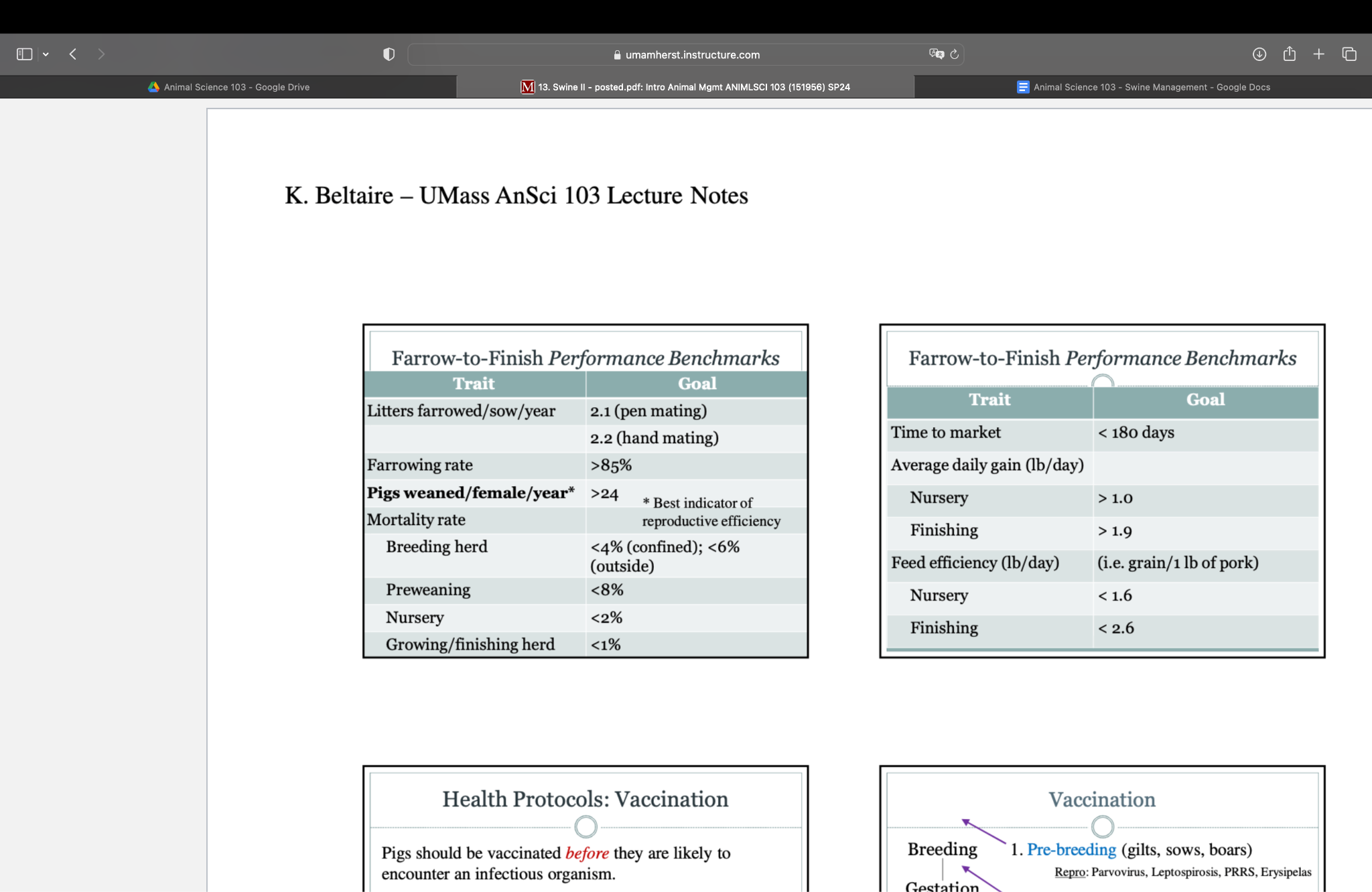
Production Benchmarks
- Deliver 2.2 litters/sow/year (deliver 4 litters before replaced by gilt)
- >85% farrowing percentage = # of females farrowing/# of females bred
- >24 piglets weaned/breeding female/year
Flushing = Increased ovulation rate
Flushing = Increase the amount of feed 10 days before breeding to increase the ovulation rate
Pig Feed
- Feed: 60-70% of the total cost of production
- Ration: Formulated around cereal grains (energy = corn, milo, barley, wheat ect.)
- Ground or pelleted (too fine = ulcers)
- Add protein (soybean meal, meat & bone meal)
- Add vitamins (A, D, E, K, & B)
- Add minerals (Calcium & phosphorus)
Pre-Farrowing Care
Vaccinate: 4-6 weeks & 2 weeks before farrowing
De-worm + De-lice: 2 weeks before farrowing
Wash sows; provide warm, dry, draft free environment
Move to new housing: 1-7 days before farrowing
Housing options:
- Gestation crates
- Free access gestation stalls
- Group housing in pens
- outdoor/pasture
- Farrowing crates: from 7d to 21-28 days after farrowing (~1 month)
Stages of Farrowing
- Preparation
- Piglet delivery
- Uterine and abdominal contractions = piglet by 15 minutes
- Normal interval of 15-20 minutes between piglets (beware of 1 hr between piglets)
- Gilt = 9.5 piglets in 1st litter (increase by 0.5 piglet/litter)
- Sow > 10 piglets per litter
- Normal total litter delivery time = 2-3 hours
- Placenta delivery
- 30 min to 12 hours after last piglet
- Retained if greater than 12 hours
Maternal Recognition of Pregnancy = During the 1st month of pregnancy, each uterine horn must contain at least 2 piglets (total of 4 piglets) to signal the sow that she is pregnant and to prevent regression of the corpus luteum (CL) by prostaglandin
Induce Farrowing
- Allows for close supervision during farrowing
- Groups sows for weaning & rebreeding
- Improves use of labor and facilities
- Allows for cross fostering if necessary
- PGF2a injection to sows on day 112
- 70-80% of sows farrow in 24-36 hours
- +/- oxytocin injection 24 hours after the PGF2a
- Sows farrow within 6 hours
Post Farrowing
- Ensure breathing
- Dip umbilicus
- Ensure nursing & colostrum intake within 4-6 hours
Pre-Weaning Mortality
Roughly ⅓ of pre-weaning deaths occur in the first 72 hours
- Stillbirths: should be <5-7% of total piglets born
- Hypoxia: Premature rupture of umbilical cord
- Chilling: Environmental temperature = 85-100℉ (heat lamp, brooder, creep area)
- Crushing: most common cause of death in the 1st 3rd
- Low birthweight: 30-40% of piglets weighing <2 lb at birth will die during the first 3 wks
- Starvation: Runt piglet or sow lactation failure
- Diarrhea/Scours: Bacteria and Viruses
- Respiratory Diseases
Weaning
Age: Determined by nursing facilities/management
@ 2-5 weeks (most at 3 weeks)
@ 10-12lbs
STRESSFUL!
Loss of maternal antibody protection by ~3 wks
Segregated early weaning (SEW)
- Piglets are weaned at 21-22 days
- Piglets are moved into an isolated, clean nursery then into a finished building (no contact with other groups)
- Temperature for weaned piglets = 85℉ then drop slowly to 70-75℉
Weaning → Nursery
(>12-40 lbs)
Wean → Grower → Finisher
Wean = >12-40 lbs
Grower = 40-120 lbs
Finisher = 120-290 lbs
Housing: group by weight (within 20% of the average)
- 20-50 pigs per pen/pasture
- 1 waterer per 20-25 pigs
- 1 feed space per 4 pigs
- Grower = 60-70 ℉
- Finisher = 60-70 ℉
Feed:
Grower → 16-18% protein
Finisher → 12-14% protein
Feed efficiency <3.5 lbs of weight:1 lb of feed
Feeder Pigs
- Purchased @ 8-9 weeks of age (35-50 lbs)
- Raised to market @275-290 lbs
- Fast turnover in volume of pigs and profit
- Good sanitation and disease control are critical
Slaughter
250 lb hog (on the hoof) → 180 lb dressed (on the rail) → 144 lb retail cuts (in the store)
~28% of weight is lost during slaughter (blood, hide, viscera ect.)
- Carcass is hung on a rail and placed in a cooler for chilling
- 20% of weight is lost during preparation of retail cuts (bone, fat, moisture)
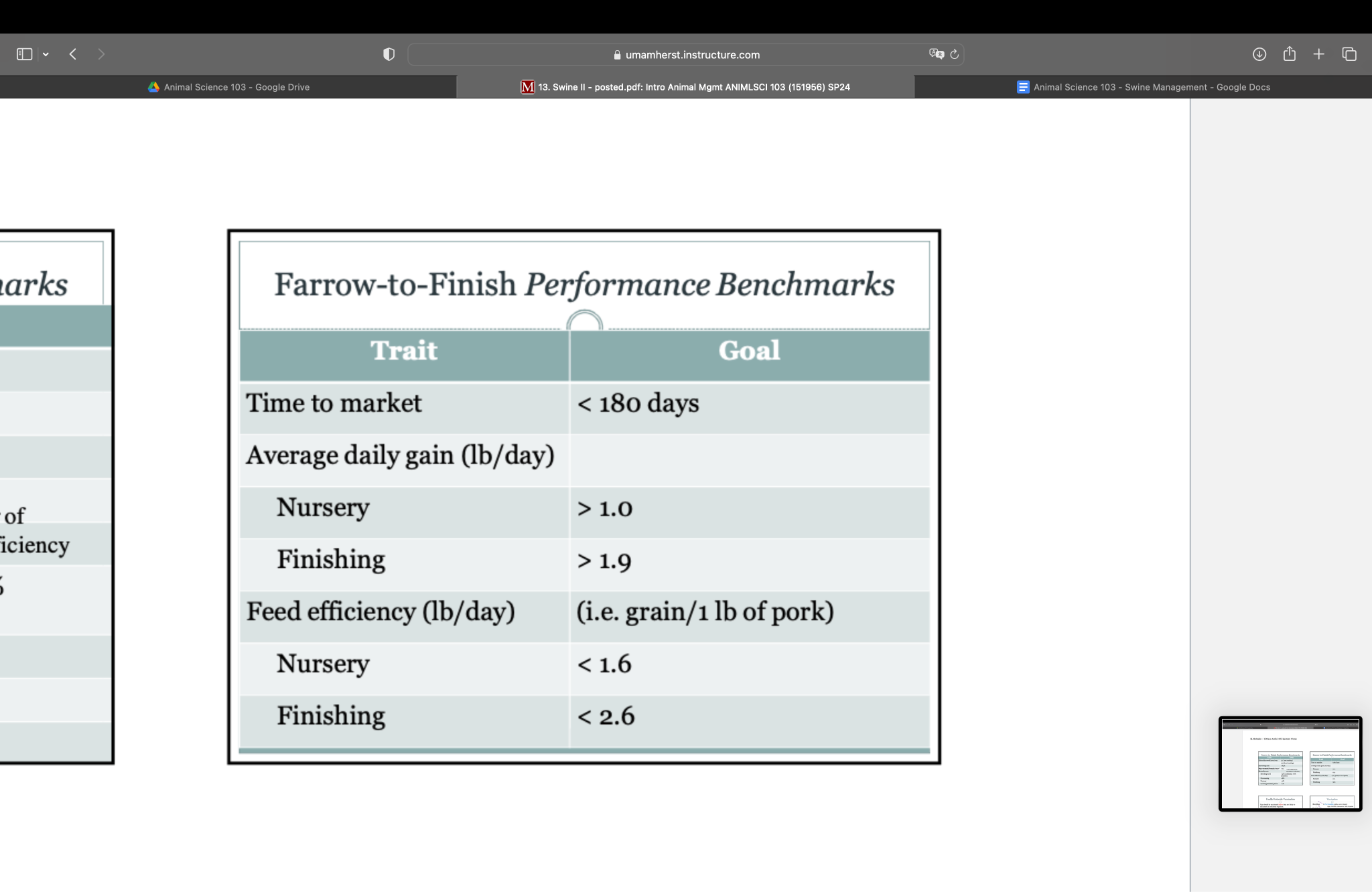
Farrow-to-Finish Performance Benchmarks
Health Protocols
Vaccination
- Pigs should be vaccinated before they are likely to encounter an infectious organism
- It takes 10 to 21 days post-vaccination for a pig to mount a protective immunity response (the exact length of time depends on the pigs age, the Vx, and whether the pig has been vaccinated before)
- Always read and follow the Vx labels
- Vx programs should be tailored to each swine operation
- Pre-breeding (gilts, sows, boars)
- Repro: Parvovirus, Leptospirosis, PRRS, Erysipelas
- Pre-farrowing (gilts and sows)
- Repro, Respir, and gastrointestinal: Erysipelas, Colibacillosis (E. Coli), Clostridium Rotavirus, Transmissible gastroenteritis (TGE), Atrophic rhinitis (AR), Streptococcus, Pseudorabies
- Young pigs (nursing piglets or later + booster)
- Mycoplasma, PRRS, AR, TGE, Pseudorabies
- At weaning (Sows)
- Leptospirosis, Parvovirus
- At weaning (piglets)
- Erysipelas, AR, Haemophilus, PRV, Mycoplasma, APP, Salmonellosis
Parvovirus (PPV)
- Virus – SMEDI (Stillborn, Mummy, Early Embryonic Death, Infertility); endemic in most herds
- Transmission = Ingestion, inhalation, breeding, and transplacentally (in utero)
- <30 d =Embryonic death & reabsorption
- 30-70d = Sequential death; mummies & stillbirth
- >70d = Fetal immune response & some live piglets
- Rarely abortion
Leptospirosis
- Bacterial Spirochete
- Contagious - shed in urine by pigs and other animals (mice, rats, skunks, raccoons)
- Can be present in contaminated water
- Transmission = Spreads via ingestion, penetration through mucous membranes or skin, breeding, and in utero
- Result = sepsis & localization to an organ:
- Uterus = Abortion, stillbirths, mummies, weak piglets & small litters
- Kidneys = Flu-like symptoms & kidney disease
- tx/ctrl = Antibiotics and vaccinate
- Zoonotic
Colibacillous
- E. Coli (in almost everything)
- Causes diarrhea
Erysipelas Bacteria: Erysipelothrix rhusiopathiae
- Subclinical shedder:
- Ingest bacteria or infected through a cut – localize to tonsils – shed in feces & oronasal secretions
- Acute Illness:
- Oronasal exposure – septicemia – localizes
- Fever (104-108)
- Joints = lameness/arthritis
- Skin = diamond shaped skin disease (cyanosis)
- Uterus = abortion (any stage); mummies
- +/- Death (MT = 0-100%)
- Treatment = antibiotics
- Chronic Illness
- Joints = lameness/arthritis
- Heart = endocarditis
- Treatment = antibiotics or euthansia
Parasites
- Dewormer/insecticide
- As need pre-farrowing, at weaning, grower stage
Pot Bellied Pigs (PBP)
- Birthweight = 0.5 lb - 0.75 lb
- Adult weight = 90-220 (rarely up to 300 lbs)
- Lifespan = 10-18 years
- Piglets should be socialized young (<8 weeks of age)
- Diet = Feed an amount of feed equivalent to 2% of their body weight per day
- Similar to dogs, PBP will over-eat
- PBPs have a sweet tooth and prefer foods flavored with sucrose, glucose, & lactose
- Snacks: carrots, celery, and broccoli
- Spay (ovariohysterectomy)
- Based on weight >15 lb (~3-4 months) or based on age (~4-6 months)
- Castrate
- Based on weight 5-10 lbs or based on age (~1-4 months)
Behavior
- Clean, pigs differentiate between sleeping, eating, and toilet areas
- Pigs only have a few sweat glands, so they wallow in water or mud for cooling
- Pigs are herd animals and will fight to establish hierarchy
- Pigs wag their tails and vocalize to express emotions
- Pigs should be provided with environmental enrichment
Maintenance
- Trim hooves
- Clean ears
- Trim tusks/canines
- Bathe
Poultry Management
- Poultry makes up 62 billion $ of gross ag income in the US in 2024
Cash Receipts from Production of poultry:
62% broilers = Meat
21% layers = Eggs
14% turkeys = world's largest producer
3% other (Geese, Ducks, etc.)
Used for:
- Pharmaceutical & vaccine production
- Research
- Products: Paints, varnishes, adhesives, printers ink, photography, book binding, leather tanning
- Cushions, pillows, mattresses, dusters, & insulation material
Trends in Poultry Production
- Consumption of poultry is increasing pretty steadily (so is chicken on its own)
- The feed conversion (lb feed= 1 lb of weight) has greatly decreased, which means chickens can gain significantly more weight with significantly less feed (feed efficiency)
- O{ken consumption has increased but consumption of eggs has decreased
- Since the 1980s total egg production and egg production per hen in the US Has greatly increased
Poultry in the US
Economy of scale = cost advantage obtained with cost per unit of output generally decreasing with size as fixed costs are spread out more over unit of output
- Decreasing total # of farms + increasing individual flock size
Vertical Integration = Coordination (& usually single ownership) of various levels of producing, processing, & distributing poultry
- All stages of production (breeder flocks, hatcheries, feed mills, feed delivery, grow out, processing plants, and delivery to buyers) are owned or contracted by one entity, corporation, or individual
- 99% of broilers are grown under some type of vertical integration contract
Chicken Eggs
Averages 57 grams (1.5-2.5 oz)
25-27 hours for production 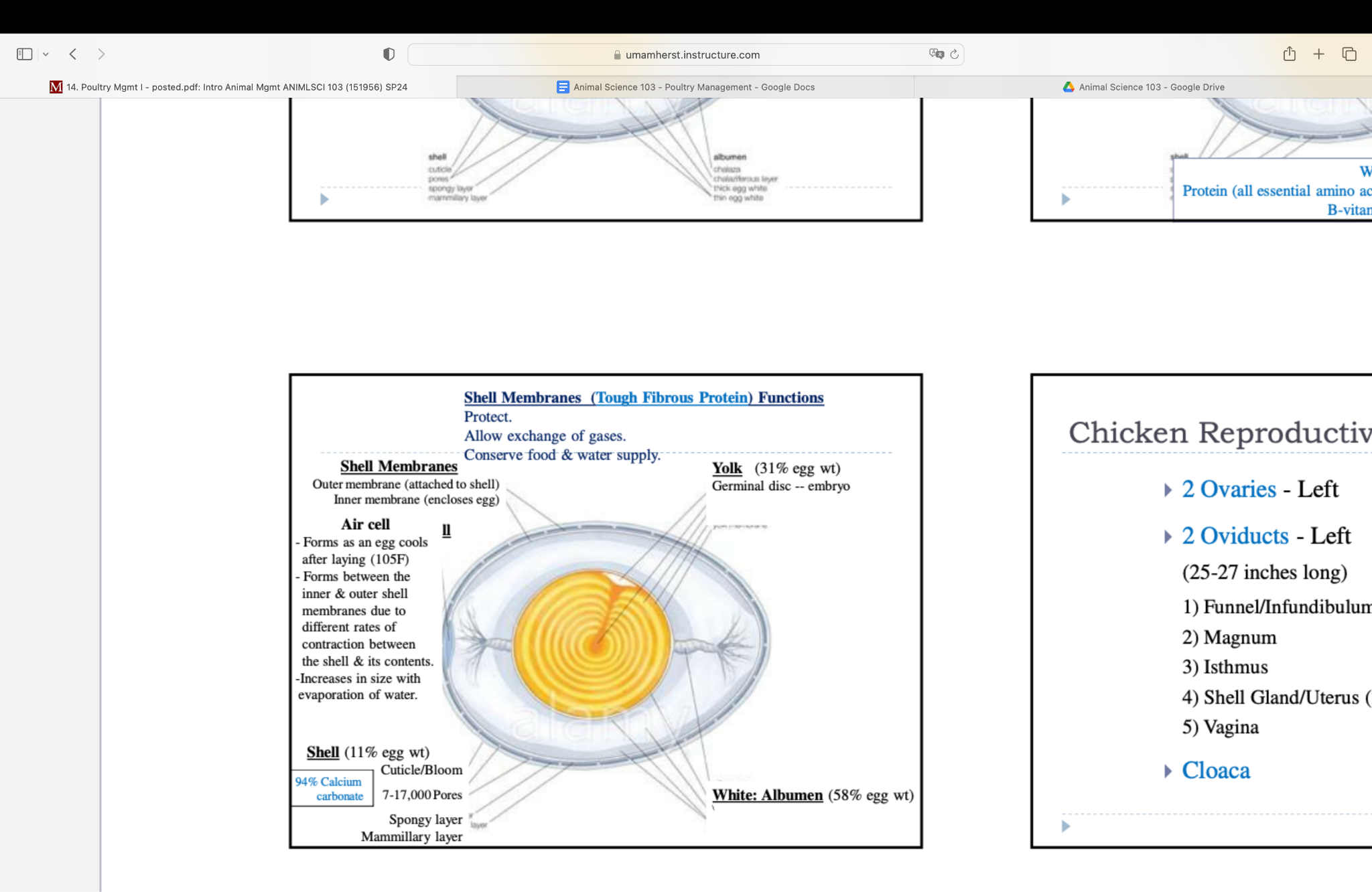
Egg white is made up of water, protein (all essential amino acids), & B-vitamins
- Chalazae anchors yolk
- Chalaziferous layer
- thick layer
- Inner thin layer & outer thin layer
Egg Yolk:
- Has concentric rings of yolk
- Surrounded by a clear vitelline membrane
- Made up of protein, lipids, vitamins (not vit. c), Minerals (Fe, P, S, Cu, K, Na, Mg, Ca, Cl, Mn)
Egg Abnormalities
- Double yolk
- Yolkless
- Blood Spot: Rupture of 1 or more small blood vessels in the yolk follicle at ovulation
- Meat Spot: Tissue sloughed off the hen repro tract or blood spot that changed color
- Soft Shell: Egg is laid early with insufficient time for shell deposition in the uterus
- Thin-shell: dietary deficiency, hereditary, or disease
Chicken Reproductive Anatomy & Physiology =-0
- 2 oviducts - left (25-27 inches long)
- Funnel/Infundibulum
- Magnum
- Isthmus
- Shell gland/Uterus (20h)
- Vagina
- Cloaca
Ovary
- Cluster of Ova (yolks)
- Each yolk is contained within a thin membranous follicle
- Ovum develops as yolk is added
- Color of the yolk comes from fat soluble pigments (xanthophylls)
- Ovulation - occurs 30 minutes after the previous egg was laid
- Only the Left ovary is active
Infundibulum
- 3-4 inches
- Takes approximately 15 minutes
- Engulf the yolk post-ovulation
- Sperm reservoir
- Site of fertilization
Magnum
- Takes 3 hours
- 15 inches in length
- 3 layers of the albumen are formed; chalazae, inner thin layer, thick layer
Isthmus
- 1.25 hours
- 4 inches
- Water & mineral salts added
- 2 shell membranes are formed
Uterus
- 21 hours
- 4 inches
- Outer thin layer of the albumen & minerals pass through the shell membranes
- Shell & shell pigments are added
Vagina
- 4 inches
- Cuticle added
- Muscle to move egg out
USDA Standards
Egg Shell Standards
- Automated computerized detection systems evaluate eggs
- Shell (shape, cleanliness, soundness) → albumen → air cell → yolk
- Eggs are graded into categories of AA, A, B and loss quality standards
Quality | AA | A | B (Breaking stock = liquid eggs/baking) |
|---|---|---|---|
Shell | Clean Unbroken Practically Normal | Clean Unbroken Practically Normal | Clean or slightly stained Unbroken Abnormal |
Air Cell | <⅛ inch in depth Unlimited movement and free or bubbly | <3/16 inch in depth Unlimited movement and free or bubbly | >3/16th inch in depth Unlimited movement Free or Bubbly |
White | Clear | Clear Reasonably Firm | Clear May be weak and watery Small blood or meat spots |
Yolk | Outline: Slightly defined Practically free from debris | Outline: Fairly well defined Practically free from defects | Outline: Plainly visible Enlarged and flattened Clearly visible germ development Other serious defects |
Candling
→ high-density light used to determine the quality of an egg; interior defects & cracks in shell
Hand Candling: Hold a shell egg directly in front of a light where defects become visible and defective eggs are segregated
Automated mass-scanning equipment: Eggs travel along a conveyor belt and pass over mechanical sensors integrated with computerized systems for segregation of defective eggs
→ advanced technology (computerized integrated cameras & sound wave technology) applied for separation of eggs
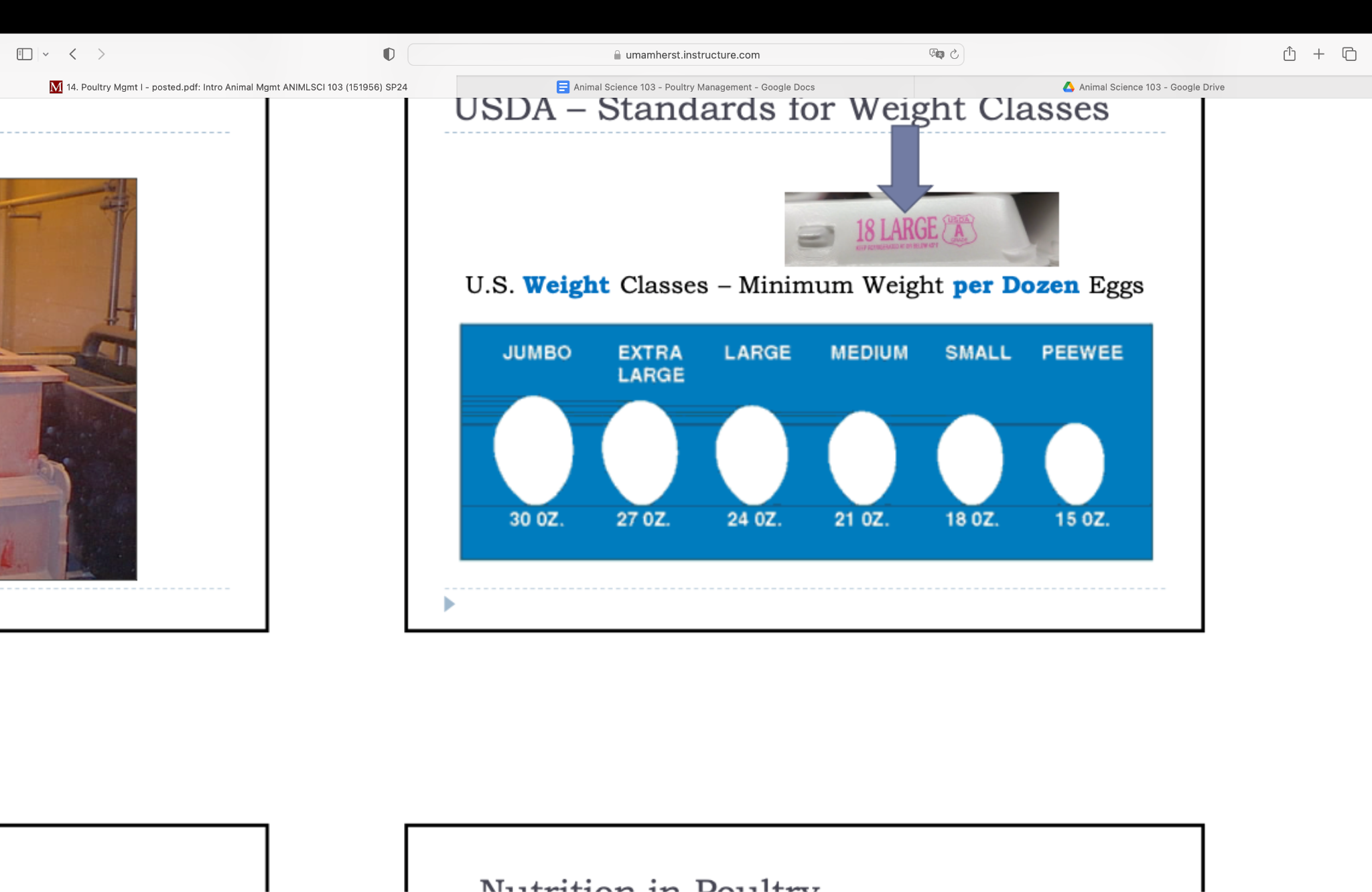
Standards for Weight Class
U.S. Weight classes - minimum weight per dozen eggs
Clutch
The # of eggs a bird lays in one set (eggs/nest)
Clutch = one or more eggs, followed by a rest period then another egg or set of eggs
Clutch size & # of clutches laid in a breeding season vary by species:
Ex. Eagles, Auk, & Vultures; 1 or 2
- Terns and Gulls: 2 or 3
- Shorebirds: 3 or 4
- Hawks and songbirds: 2 to 5
- Chickens and ducks: 7 to 12
- Pheasants and partridges: 8 to 18
Nutrition
- Omnivores
- Poultry are fed almost exclusively complete mixed diets that are offered in mash or pelleted form
- Poultry and swine compete for the same concentrated feeds, such as corn, soybean meal, and by-product feeds
Digestive Tract
- Beak and Mouth
- Secretes saliva/enzymes
- Tongue moves food to pharynx
- Taste buds on roof of mouth and back of tongue
- Esophagus
- Smooth muscle transport
- Crop
- Out-pocketing of the esophagus
- Store food & water \
- When nearly empty, sends signal to the brain to eat more
- Proventriculus
- Glandular stomach
- Hydrochloric acid
- Digestive enzyme
- Gizzard (ventriculus)
- muscular/mechanical stomach
- Grind, crush, and mix feed
- Grit
- Small Intestine
- Duodenum
- Pancreas – digestive enzymes & bicarbonate
- Liver – Gallbladder
- Jejunum
- Meckel's diverticulum: pre-hatching, the yolk sac is drawn into the navel cavity to supply feed and water to the newly hatched chick
- Ileum — nutrient absorption
- Paired Ceca (singular = cecum)
- Blind pouches
- Absorb water
- Ferment coarse materials if fed forage in diet
- Produce eight b vitamins
- Empty contents 2-3x per day
- Large intestines (colon)
- Absorb water
- Rectum
- Cloaca
- Vent
- Color and texture of fecal material indicates the diet & health of the chicken
- White pasty material coating chicken fecal material is uric acid, the avian form of urine
Avian Influenza Virus
Virus = naturally in the intestinal tract of many wild & domestic birds (influenza viruses mutate frequently)
→ LPAI = Low pathogenicity (or subclinical) avian influenza
→ HPAI = High pathogenicity (or clinical) avian influenza
- Influenza Type A viruses are divided into subtypes, based on surface glycoproteins:
Hemagglutinin (H1 to H16) & Neuraminidase (N1 to N9)
Clinical signs:
Contagious virus + rare recovery = Euthanasia/Depopulation
- Lack of appetite and energy
- Swollen head combs, wattles or legs
- Bloody diarrhea
- Drop in egg production
- Trouble walking
- Sudden death
- Nasal discharge, sneezing, or coughing
- Occasionally presents with lesions
Control
- Inclusion and exclusion biosecurity practices
- Vaccination - will not provide absolute protection
- Labor is needed to inject individual birds
- The Vx must be matched to the field HA subtype to confer protection
- Diagnostics and Surveillance
- Elimination of infected animals
- If HPAI infection is confirmed by laboratory testing, all birds within the flock are euthanized
- Educating personnel in HPAI control strategies
Recent Cases
Feb 2022 = HPAI (H5N1) detected by USDA’s APHIS in a commercial turkey flock in Indiana
= No human cases of HPAI viruses detected
By March 2023 = HPAI confirmed in 321 commercial and 478 backyard flocks in 47 states (58.6 million birds affected)
= plus thousands of wild birds (migrating globally)
= WHO: >11 cases of H5N1 in humans, including one person in colorado
March 20, 2024 = HPAI detected in a goat kid in MN
March 25, 2024 = HPAI detected in dairy cattle in TX & KS, sick cows are primarily older animals showing decreased lactation and low appetite, among other clinical signs. On Ave, ~10% of the herd on these premises are affected, with little to no associated death. The dairy farms reported finding dead wild birds
April 1, 2024 = HPAI in a human exposed to the cows (conjunctivitis)
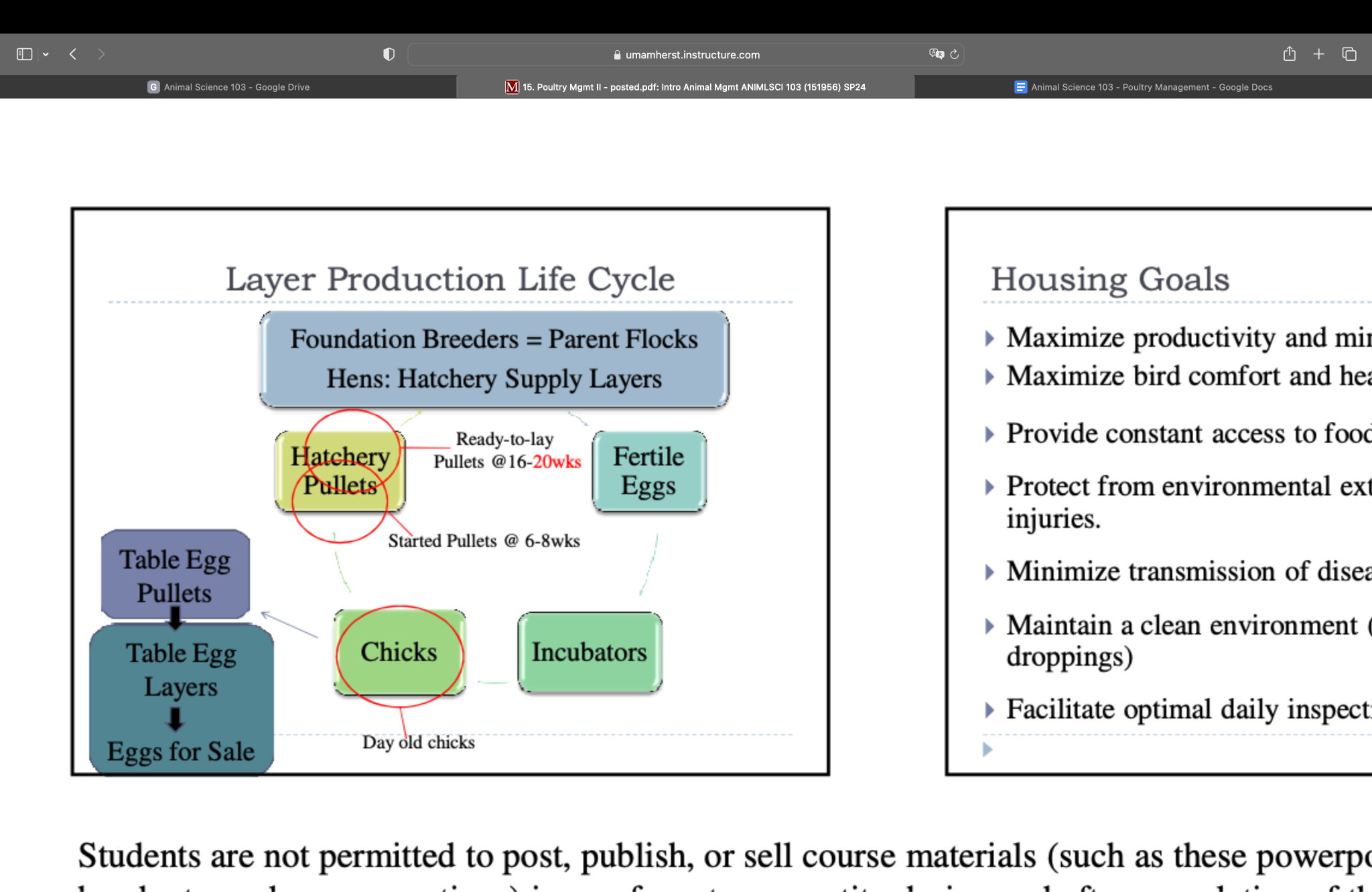
Broiler Production Life Cycle Layer Production Life Cycle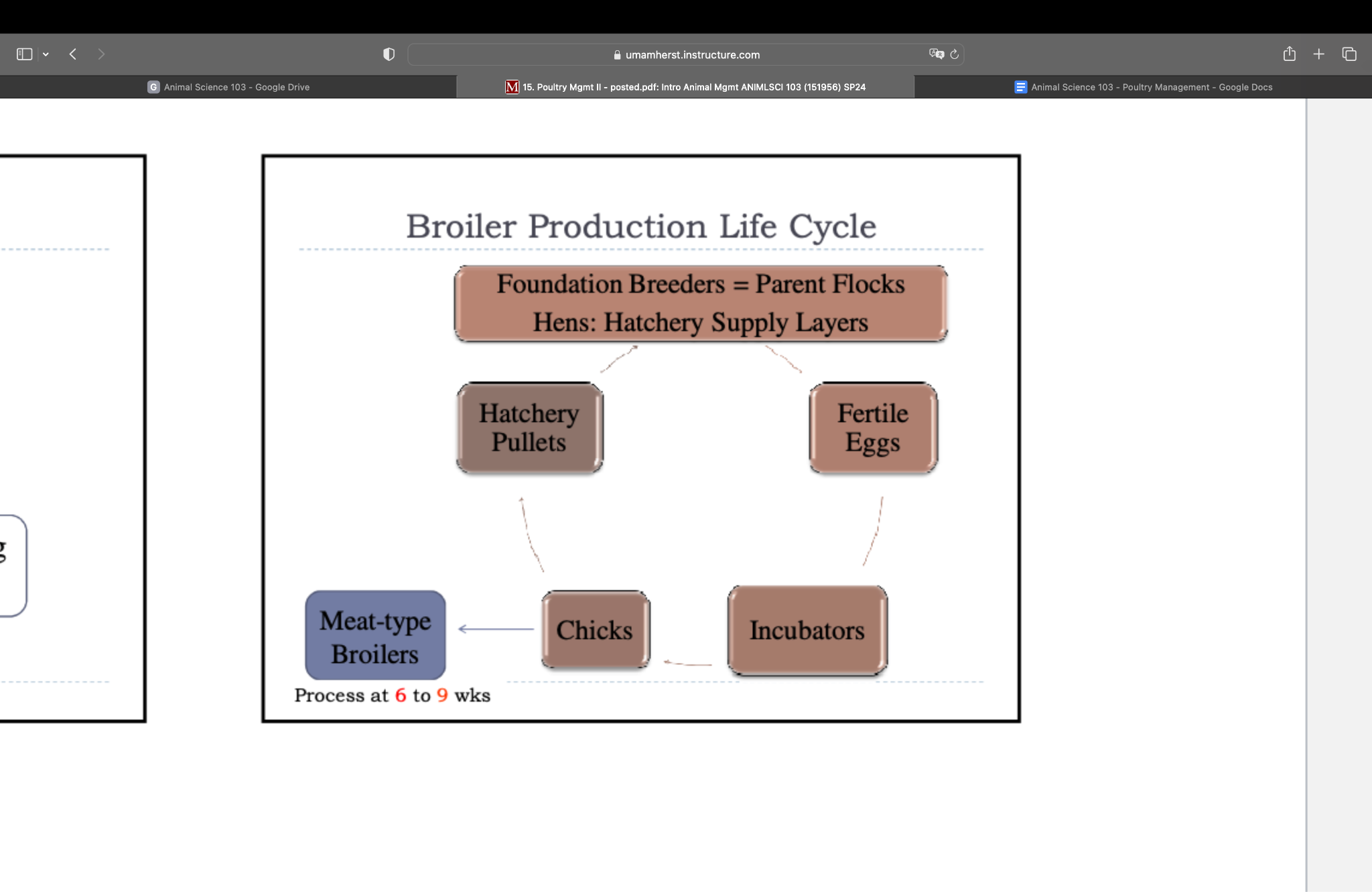
Housing Goals
- Maximize productivity and minimize inputs ($)
- Maximize bird comfort and health
- Provide constant access to food & clean water
- Protect from environmental extremes, predators, and injuries
- Minimize transmission of diseases & parasites
- Maintain a clean environment (minimize contact with droppings)
- Facilitate optimal daily inspection & care
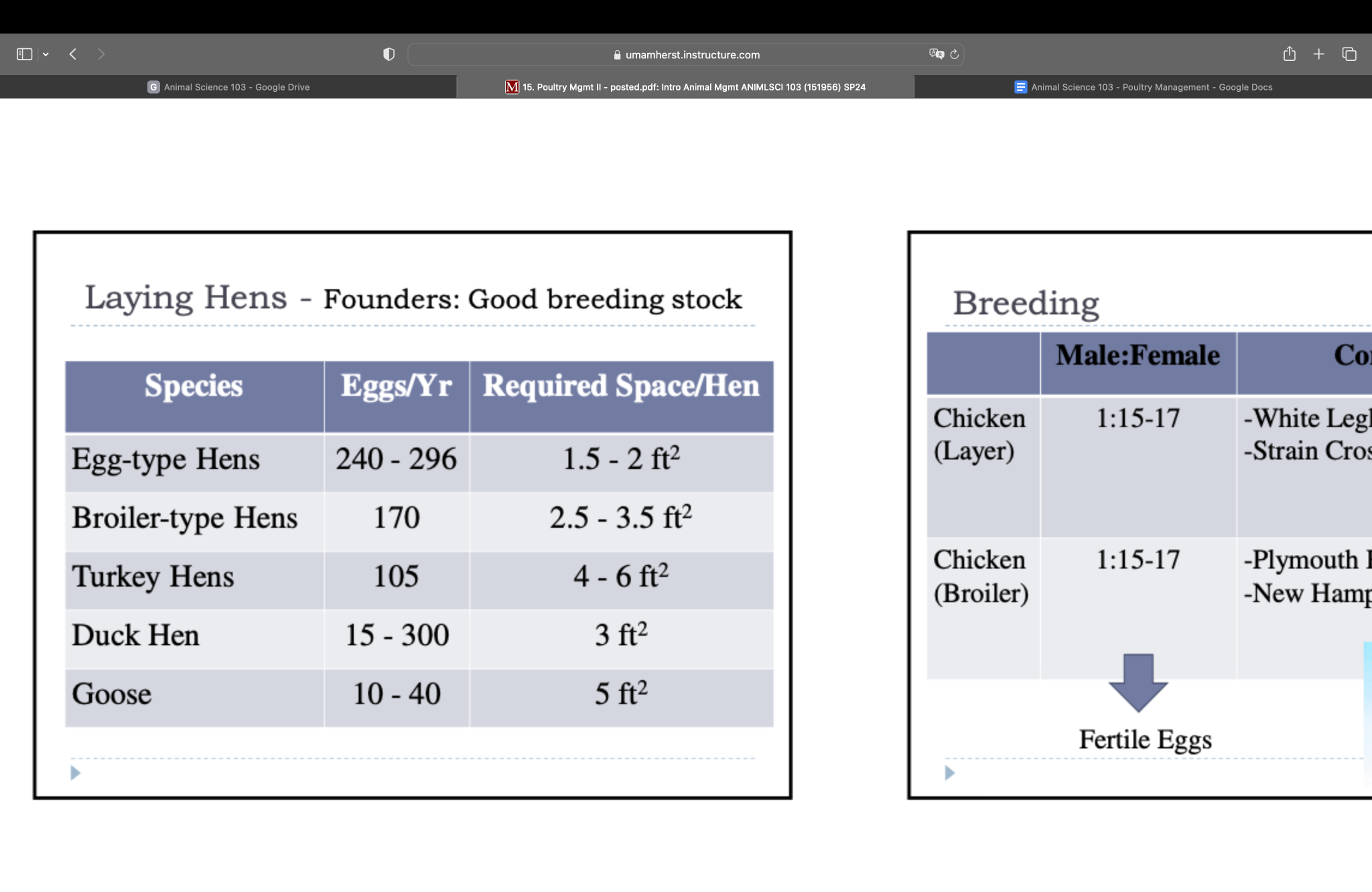
Laying Hens
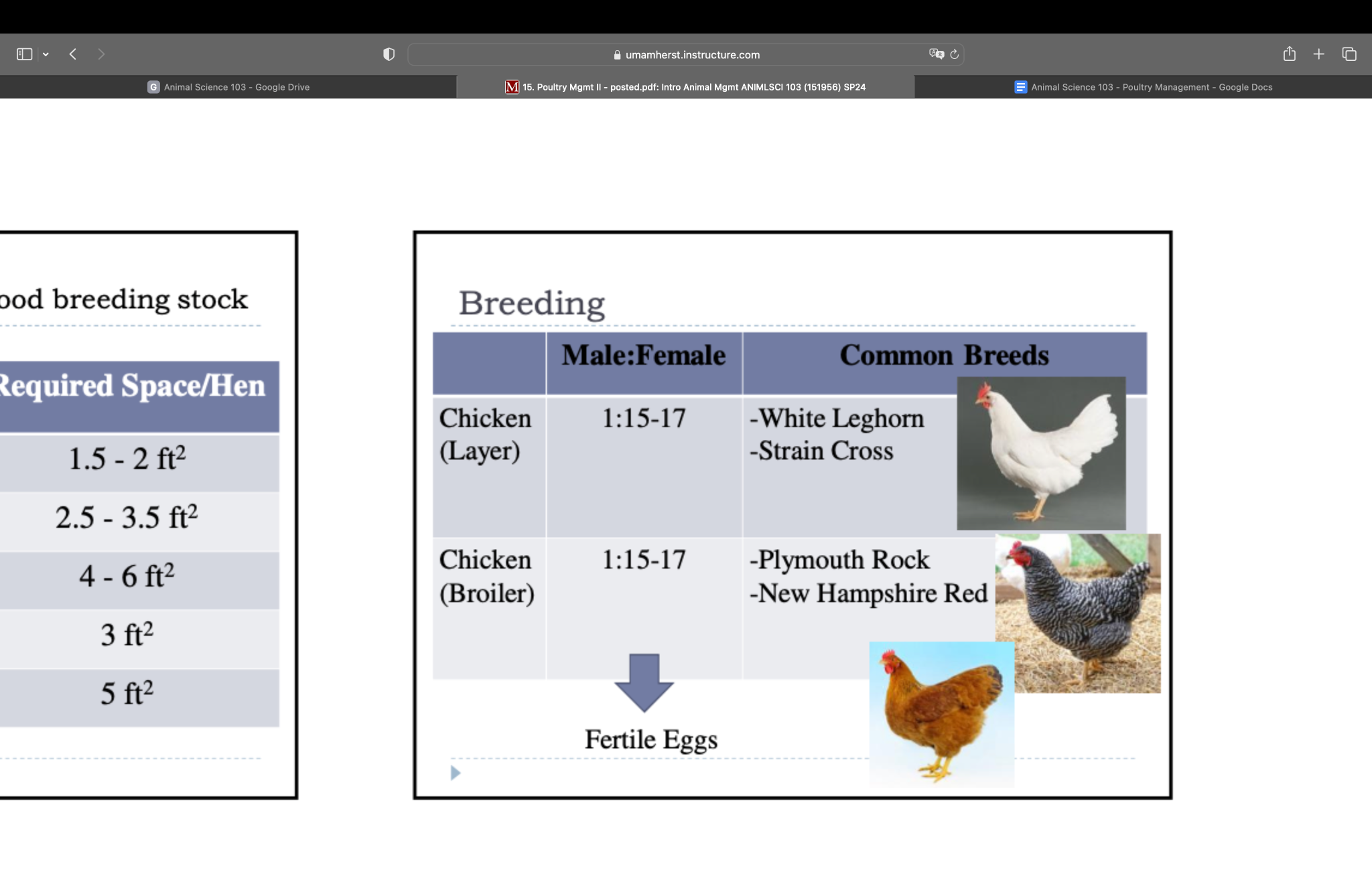
Breeding
Hatchery
0d: collect fertilized eggs ASAP after laying (not too small or large, normal shape, good shell)
0-18d: Eggs are placed in a setter incubator
18-21d: Eggs are moved to a hatcher incubator
Incubators
(forced air/fan systems)
- Temperature
- Hatcher incubator → Switch from embryonic respiration to normal respiration, which generates heat
- Too hot or too cold = Death or Deformation
- At 100 degrees to begin with then cools down to ~98 degrees
- Humidity
- Day 1-18 = 60-65%
- Day 18-21 = 70%
- Turning of eggs (setter)
- Day 1-18 = Large end (air cell) up or horizontal
- Day 18-21 = Horizontal
- Day 1-18 = Frequent (4-6x per day) automatic tilting to prevent an embryo from sticking to the inside of the shell
- Air-exchange
- 21% Oxygen, O2
- Less than 0.5% Carbon Dioxide, CO2
- CO2 greater than 2% = decreased hatchability
- Automated Candling
- 100s to 100,000s of eggs
Incubation Periods
Chicken – 21 days
Turkey – 28 days
Duck – 28 days
Goose – 28-32 days
Hatching
- Pre-hatching the chick’s beak penetrates the air cell for respiration
- Egg tooth (horny point of the beak) opens a small hole = egg is pipped!
- Chick hatches within a few hours
Management Practices
- Beak trimming
- Remove ½-⅓ of the beak
- Minimizes cannibalism, mortality, feather pulling, and stress
- By trained personnel under formal quality control program
- Trim <10 days of age with a clean, precision, automated device, such as infrared
- +/- give Vitamins K and C 2d before trim to enhance clotting and minimize stress/dehydration
- If the beak grows back, 2nd trim at 5-8 weeks
- No stress (no handling, moving, or vaccinating) for 2 weeks after trimming
Chicks ~ Brooding
Floor:
- Dirt, concrete, or asphalt
- Litter (sawdust, wood chips, peat moss, recycled paper)
- 2-4 inches deep over the floor
Water:
- Automatic; suspended
- 1 inch trough-space/chick or
- 0.5 inch pan space/chick
Light:
- Egg: 14hr light + 10hr dark
- Meat: 24 hr light
Brooder House
Temperature:
- 90-95 for day-old chicks
- Drop by 5 every week until 70-75
- Check temp 2x/d - 3 inches off floor
- Check behavior
- Feathered at 4-8 weeks
Feed
Broiler:
1d-6 weeks = starter ration
>23% protein + grit + fat
6-9 weeks = Finishing ration
18-20% protein + fat
Egg Layer:
1d-6 weeks = Starter ration
(18-20% protein + grit)
6-14 weeks = Grower Ration
(15-18% protein)
14-18 weeks = Grower ration
(12-15% protein)
18-20 weeks = Layer mash
(14.5-16% protein)
Pullets @10-20 weeks … growers
Light: 8-9 hours light to delay sexual maturity until 18-20 wks of age
18-20 weeks of age: Pullets are moved to laying barns
Pullets are now called Hens or Layers = Eggs!
Hens
- Lights on for 16 hr/day to simulate summer
- Lights off for 8hr/day so chickens sleep
Table Eggs
- Gather eggs 3x/day
- Handle them carefully & cleanly
- Store @ 65 in 75-80% humidity
- Ship @ 45
- Pack with large end up
Hens: Feeding
- Water: constant (ad libitum) access
- Balanced ration
- 60% grain or grain by-products… energy (ex. Corn, oats, wheat, grain, sorghum, proso millet)
- <10%
- animal or vegetable fats and oils
- Roughage
- Protein
- Minerals
- Vitamins
- Commercial feeds:
- Mash
- Pellets
- Crumbles
Feed Efficiency for Egg layers → lbs of feed required to produce 1 dozen eggs
Goal = 4.3
Cx v
Induced Molting
- Hens = 240-300 eggs in a year
- Commercial laying hens = replaced after 75-80 wks of age (20 months; a little less than 2 years)
- Molt - some (partial molt) or all (full molt) feathers are shed and replaced; varies by species and season
- In Chx: Hens stop producing eggs, lose old feathers, grow new feathers, and rest/repair repro tract
- Induce molt = extend hen’s productive life to 110 weeks (a little more than 2 years)
Methods
- Feed Removal
- Withdraw feed for 5 to 14 days
- Non-feed removal
- Feed deficient levels of nutrients
- Add substances in the feed which inhibit egg production
United Egg Producers Guidelines for Molt Program
- Only non-feed withdrawal molt methods will be permitted after January 1, 2006
- Hens should be provided with a feed source that is suitable for non-producing hens
- Water must be available at all times
- Light period should be reduced to no less than 8h in closed houses, or to natural day length in open houses, for the duration of the rest period
- During the molt period, BW loss should be sufficient so as to not compromise hen welfare in the subsequent laying period
- Total mortality during the molt period should not substantially exceed normal variations in flock mortality
Hen Housing
Cages/Conventional
- Most (62%) of commercial egg production in the US
- Hens should be able to stand up (>67-86 inches per hen)
- Sloped not more than 8 degrees, Flat or tiered laying cages
- Feed trough and Water source (trough, nipple, cup waterer)
- Manure/droppings pit – removed by belts or scrapers
- Temperature - 55-75℉
- Light intensity - 0.5 to 1-foot candle at feeding level w/Light duration > 16 hours per day
Cage Free
Cage Free Label = “the flock was able to freely roam a building, room, or enclosed area with unlimited access to food and fresh water during their production cycle”
- 38% of US layer flock is Cage-Free
- 1.5-2 ft2 per hen for egg-production strains
- 2.5-3.5 per hen for broiler or dual purpose strains
- If there is perching/roosting area over a dropping pit/belt, then >1.2 ft for brown eggs layers and 1.0 ft for white leghorns
- If there are multiple tiers with feeders/waterers on overhead perches/platforms that provide space for <55% of the hens then >1 f^2 of space
- On litter, slatted floors, or wire floors
- Individual or colony nests
- Hens should not travel >26 ft to feed and water
- Superior management is required to minimize mortality
Free Range
Free Range of Free Roaming = Producers must demonstrate that poultry have been allowed access to the outside for over 51% of the animals lives.
- The claim free range can be used on any meat or poultry food product
- To use a Free Range label, producers must provide a brief description of the housing conditions with the label when it is submitted to USDA’s Labeling Program and Delivery Division (LPDD) for approval
- The description is reviewed to ensure there is continuous free access to the outdoors for over 51% of the animals lives, IE through their normal growing cycle
Natural Terminology
- Product contains no artificial ingredients or added colors and is minimally processed
- Minimally processed means that the product was processed in a manner that does not fundamentally alter the product
- Label must include a statement explaining the meaning of the term natural
Organic
- A labeling term; indicates that food/ag products have been produced using methods verified by a USDA accredited certifying agent
- Standards that must be met:
- Organic Food Production Act
- USDA Organic Regulations
- National Organic Program (NOP) Handbook
- NOP Draft Guidance
- The National Organic Program Final rule defines organic production as:
- “A production system that is managed… to respond to site-specific conditions by integrating cultural, biological, and mechanical practices that foster cycling of resources, promote ecological balance, and conserve biodiversity.”
- Detailed records of all feeds, medications, & transactions must be maintained
- To sell organic eggs or poultry meat, birds must be fed and managed organically from the second day after hatching
- All components of the feed ration must be 100% organic
- Prohibited: Growth hormones, antibiotics, genetic engineering, animal cloning, and feed of slaughter by-products
- All production and processing operations, including slaughter plants and egg handling facilities, must be certified organic by USDA-accredited certification agencies
- Year round access to the outdoors, shade, shelter, exercise areas, fresh air, clean water, and direct sunlight, suitable to the species, its stage of life, the climate, and the environment
- Appropriate clean, dry bedding (which must be organic if roughages are used for bedding)
- Shelter designed to allow for
- Natural maintenance, comfort behaviors, and opportunity to exercise
- Temperature levels, ventilation, and air circulation suitable to the species
- Reduction of potential for livestock injury
- An organic operation in violation of the USDA organic regulations is subject to enforcement actions, including financial penalties or suspension/revocation of their organic certification
Strengthening Organic Enforcement (SOE) Final Rule
March 19th, 2024
Why? $$$
- Organic supply chains have become increasingly complex, reducing transparency in the market and leading to cases or organic fraud
Legislation
Nov 2016: 78% of MA voters passed question 3 to: prohibit confinement of pigs/calves/chickens in tight quarters & prohibit sale of meat/eggs from animals that have been confined
Exceptions = Slaughter, Fairs, 4-H events, Medical research, 5 days before a sow’s farrowing date and during nursing, Veterinary exams & tests or treatments, temporary periods for animal husbandry purposes not to exceed 6 hrs in a 24 hr period
2018: CA voters passed proposition 12, a ballot initiative:
- Ban intensive confinement of layer hens, sows & veal calves in CA
- Amended the California Health & Safety Code to Prohibit the sale of eggs, pork, and veal in CA from anywhere using intensive confinement
- Forbids the in-state sale of whole pork meat that comes from breeding pigs (or their immediate offspring) that are “confined in a cruel manner”
- Confinement is “cruel” if it prevents a pig from “laying down, standing up, fully extending its limbs, or turning around freely
- California imports almost all of the pork it consumes, most of Proposition 12’s compliance costs will be borne by out-of-state farms
Difference: CA law would use a 3rd-party certification system to audit compliance, MA would allow either self or 3rd party certification
- Trade associations representing the pork industry and farmers challenged the law as violating the dormant Commerce Clause, which prohibits states from discriminating against interstate commerce or imposing undue burdens on interstate commerce.
Jan 2019: US Supreme Court did not allow other states to sue MA
2023: Q3 rule was put on hold until at least 30 days after the supreme court issues its ruling on California's Proposition 12 lawsuit
May 11, 2023: In a 5-4 ruling the Supreme court affirmed the decision of the US court of appeals and dismissed the challenge of California's Prop 12
Prop 12 and Q3 are currently in effect
BUT … congress is considering the Ending Agricultural Trade Suppression Act or “EATS act”
- The EATS Act would prohibit state governments from imposing conditions on preharvest production occurred in a different state with different standards
- If passed, the EATS Act would affect the enforceability of Prop 12 and Q3
Health Management
- Sanitation
- Good Management
- Vaccination
- Records
Marek’s Disease
- Highly contagious (& environmentally stable) herpesvirus
- Tumors (T Cell Lymphomas) in nerves (lameness or paralysis of limbs), liver, ovaries, testes, muscle, and skin
- Mortality can go to 20%
- Transmission = Virus matures into a fully infective form in the epithelium of the feather follicle and then it contaminates the environment through infected molted fathers and dander
- Birds become infected when they inhale dust containing the virus
- Contaminated dust may remain infectious for several months
- Clinical signs:
- Depression
- Paralysis
- Tumors
- Tx = None….. Prevention is key
- VX = SQ (back of neck) to day old chicks or embryos at 18 days of incubation
- Under typical conditions, vaccine efficacy is usually >90%
- VX prevents the appearance of Marek’s disease tumors and paralysis but it does not prevent birds from becoming infected with and shedding the herpesvirus
Coccidiosis
- Cause = Host-specific protozoal parasite
- 7 Eimeria species are pathogenic to chickens
- Life cycle: Fecal-oral transmission
- Infective oocyst (coccidia egg) eaten by the chicken
- Multiplies over about 7d within the gut of the bird = 1000’s of new oocysts from just one ingested oocyst
- Oocysts are excreted in the droppings and then take 2d to sporulate & become infective to the next host
- Clinical Signs:
- Droopiness
- Huddling
- Loss of appetite
- Weight loss
- Diarrhea +/- blood
- Prevention:
- Keep waterers away from litter
- Minimize stress
- Practice excellent sanitation
- VX @ 5-9 weeks (this is unique no coccidia vaccine for ruminants)
- Feed a coccidiostat (vinegar?)