DYNAMIC EQUILIBRIUM
Concept of Reverse and Forward Reactions
Forward Reaction: This is the process where reactants convert to products. An example can be represented as: .
When more reactants (A and B) are added, the reaction shifts towards the products (C and D) until a new equilibrium is established.
Reverse Reaction: The reverse process where products convert back into reactants can be expressed as: .
Adding more products (C and D) will shift the reaction back towards the reactants (A and B).
Reaction Rate and Dynamic Equilibrium
Reaction Rate: The speed at which reactants are converted to products. It is influenced by concentration, temperature, and catalysts.
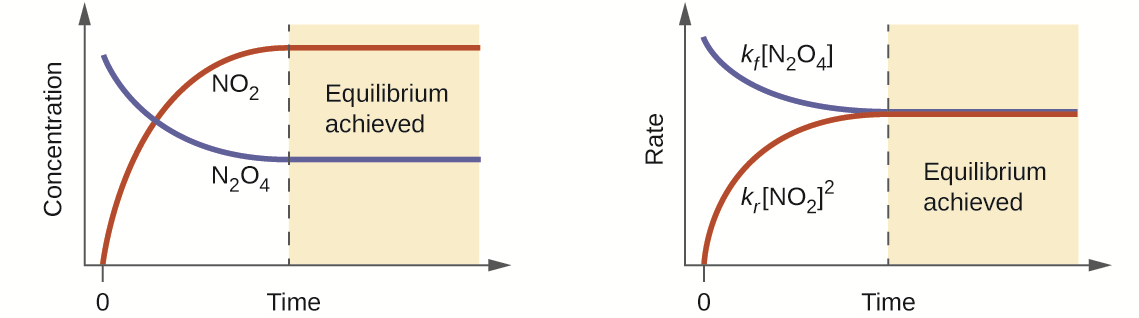
Dynamic Equilibrium: A state where the rate of the forward reaction equals the rate of the reverse reaction. At this stage, the concentrations of reactants and products remain constant, even though the reactions continue at the molecular level.
Equilibrium Constant (K) and Reaction Quotient (Q)
Equilibrium Constant (K): A value that expresses the ratio of the concentrations of products to reactants at equilibrium, considering their stoichiometric coefficients:
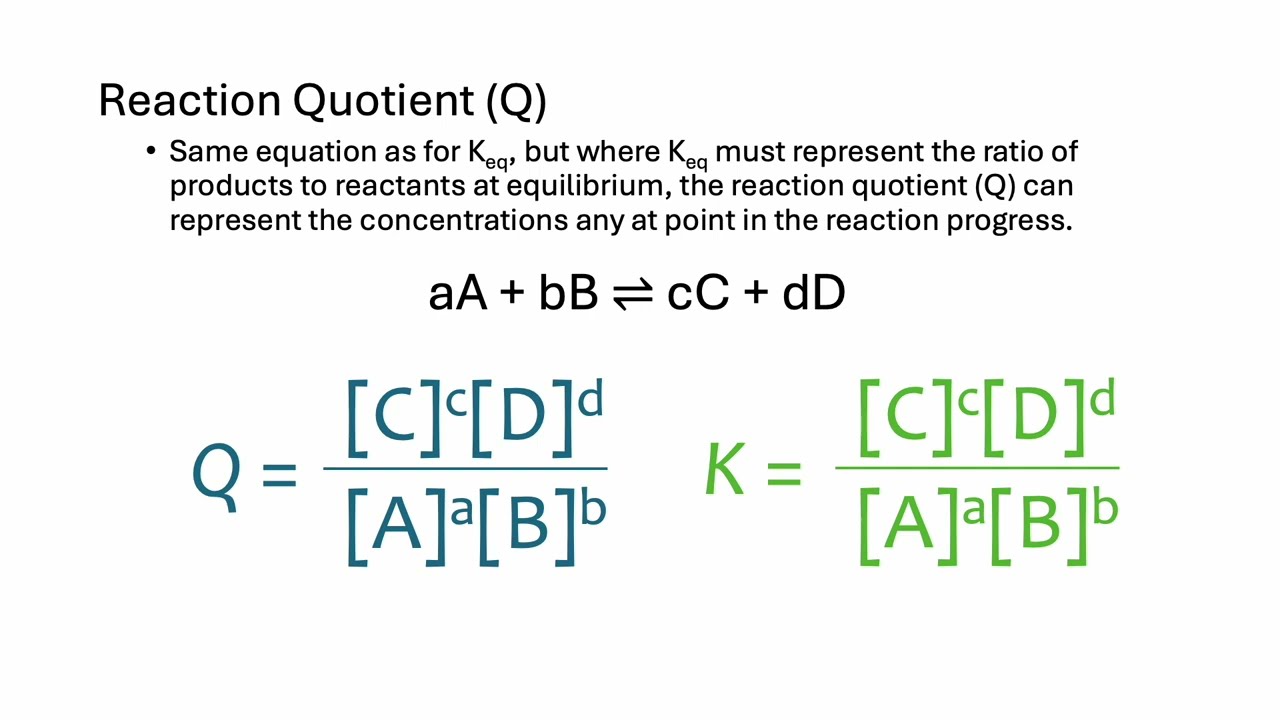
Reaction Quotient (Q): A similar expression to K but for any point in the reaction, not limited to equilibrium. It helps in predicting the direction in which a reaction will proceed.
Predicting Reaction Direction Using Q and K
By comparing Q to K, one can predict the direction of the reaction:
If Q < K: The forward reaction is favored, and the system will shift towards the products.
If Q > K: The reverse reaction is favored, shifting the system back towards the reactants.
If : The system is at equilibrium.
Le Chatelier's Principle and Boyle's Law
Le Chatelier's Principle: States that if an external change (like concentration, pressure, or temperature) is applied to a system at equilibrium, the system will adjust to counteract the change and restore equilibrium.

Boyle's Law: Relates to gas systems and states that pressure is inversely proportional to volume when temperature is constant. This impacts equilibrium in gaseous reactions as changes in volume will affect concentrations of reactants/products and, thus, the position of equilibrium. (P₁V₁ = P₂V₂
Catalyst: A substance that speeds up a chemical reaction without being consumed or a person/thing that provokes significant change or action