Matter
Chemistry - The study of the composition, properties, and changes of matter
Matter - Anything with mass and volume
Mass - measure of the amount of matter in a substance using a calibrated balance
Volume - three-dimensional space occupied by a substance
Matter is composed of Atoms and Molecules
may appear smooth and continuous (isn't)
composed of atoms, sub-microscopic particles
Building blocks of Matter
Molecules - two or more atoms joined to each other in specific geometric arrangements
How to classify
Phase - solid, liquid, gas
Composition - pure substance or mixture
Property - Physical and chemical
Solids
Constituent particles arranged in a regular, three-dimensional array
Alternates positive and negative ions; crystal
Partial Positive and Partial negative atoms for covalent compounds
Have a definite volume and shape
Crystalline Solid - Atoms or molecules are arranged in geometric patterns with long-range, repeating order
Ex. Salt and diamond
Atoms or molecules occupy specific positions to create a well-ordered 3D figure
Amorphous solid - no long-range order
Liquids
particles can move about each other while remaining in contact
have a definite volume, no definite shape
take the shape of a container
Gases
separated from each other by large distances and move about randomly in space
no definite shape or volume
compressible
The change from liquid to gas significantly increases the volume of a substance, by a factor of 1000 or more
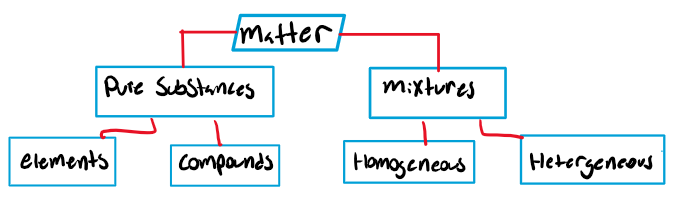
Pure Substances
made up of one type of atom (element) or molecule (compound) that can exist in any phase
EX:
oxygen in a tank
liquid water - H2O
solid diamond - carbon
Mixtures
made up of two or more substances that can be physically separated into their individual components
Ex: Saltwater
Two types of mixtures
Homogeneous
Heterogeneous
Homogenous
Through noncombined, it acts like a single substance
components are the same throughout the mixture
can exist in any phase
Gases - air, anesthetics CN R-and02), natural gas
Liquids - coffee, Saltwater, whiskey
Solids- metal alloys: Brass, cement, plastic
Heterogeneous Mixtures
Has visibly separate component parts
Different amounts of the mixture components depending on sample location
can exist in any phase
Gas - smog and smoke
Liquid - Salad dressing or other shaken liquids
Solid - cookies, dirt, tV set
MSC - fruit in smoothie, cereal in milk
How Matter is Described: Physical and Chemical Properties
Physical properties can be observed or measured without changing the substance being studied
Mass
Volume
Density
melting point
Boiling point
Phase
Color
shape
Includes changes of State:
Vaporizing
Condensing
Melting
Freezing
Deposition
Sublimation
The identity of Substance is unchanged
Chemical properties describe how a substance changes and can only be determined by experimentation. A new substance is formed
Flammability
Ignitability
Reactivity
Matter has a new identity
matter is not created or destroyed
Vaporization - Physical
Burning - Chemical
Law of Conservation of mass
Matter is not created or destroyed in a chemical reaction
During Physical and Chemical Changes, the total amount of matter remains constant