Chapter 9: Cellular Respiration and Fermentation
9.1 Cellular Respiration: An Overview
Chemical Energy and Food
- Food gives living things the energy they need to grow
- Autotrophs make their own food through photosynthesis
- Heterotrophs must eat other living things for food. All living things,
- Food molecules store chemical energy for all living things; that energy is released when they break those food molecules down
- Energy in food can be measured in units called calories
- A calorie is the amount of energy needed to raise the temperature of 1 gram of water 1 degree Celsius
- Cells break down food molecules over time, getting a little bit of chemical energy at key steps
Overview of Cellular Respiration
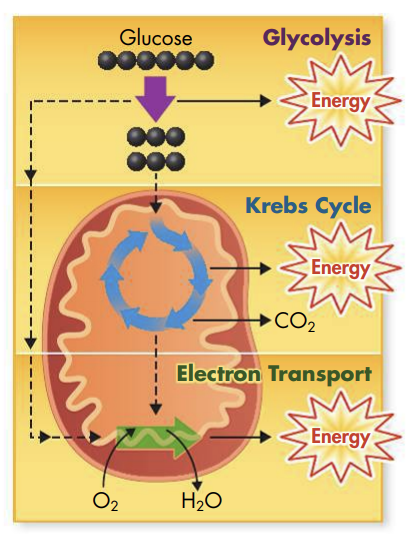
- Cellular respiration is the process that releases energy by breaking down glucose and other food molecules in the presence of oxygen
- Cellular respiration gives off carbon dioxide, water, and energy and the process can be summarized like this:

- @@The first step of cellular respiration is glycolysis@@
- Only a small amount of energy is used to make ATP during this stage; the rest is still locked in the bonds of a molecule called pyruvic acid
- @@The second step of cellular respiration is the Krebs cycle@@
- Pyruvic acid enters the Krebs cycle, where a little more energy is given off
- @@The third step of cellular respiration is the electron transport chain@@
- Most of the energy from cellular respiration comes from the electron transport chain; this stage uses oxygen and reactants from the other two stages to finish the job
- Oxygen is used at the end of the electron transport chain; any time a cell needs more energy, it needs more oxygen, too
- Chemical pathways that need oxygen are called aerobic
- The Krebs cycle and electron transport chain are both aerobic
- A chemical process that does not need oxygen is called anaerobic
- Glycolysis is an anaerobic process
- Mitochondria are the organelles most important in cellular respiration
- The Krebs cycle and electric transport chain take place inside the mitochondria
Comparing Photosynthesis and Cellular Respiration
- Photosynthesis and cellular respiration can be thought of as opposite processes, as the equations for photosynthesis and cellular respiration are the reverse of each other
- Photosynthesis produces food molecules and removes carbon dioxide from the air, and cellular respiration puts it back
- Photosynthesis gives off oxygen, and cellular respiration uses that oxygen to release energy from food
9.2 The Process of Cellular Respiration
Glycolysis
- Glycolysis is the first stage of cellular respiration
- During glycolysis, glucose is broken down into 2 molecules of pyruvic acid' ATP and NADH are also made
- 1 molecule of glucose, which has 6 carbon atoms, is changed into 2 molecules of pyruvic acid, which each have 3 carbon atoms
- One of the steps of glycolysis passes 4 electrons to an electron carrier called NAD+, or nicotinamide adenine dinucleotide
- Glycolysis does not need oxygen, meaning that glycolysis can quickly get chemical energy to cells when there is not any oxygen present
- When oxygen is present, however, the pyruvic acid and NADH made during glycolysis become the materials needed for the other stages of cellular respiration
The Krebs Cycle
- The Krebs cycle takes place within the matrix - the innermost space of the mitochondrion
- During the Krebs cycle, pyruvic acid is broken down into carbon dioxide in a series of steps that release chemical energy
- Step 1: Pyruvic acid from glycolysis enters the mitochondrion’s matrix
- Step 2: Enzymes split CO2 off from pyruvic acid, leaving a 2-carbon molecule, and NADH is produced from NAD
- Step 3: The 2-carbon-atom molecule joins a 4-carbon-atom molecule to become citric acid
- Step 4: More CO2 and NADH are made as citric acid becomes a 4-carbon-atom molecule
- Step 5: More reactions make high-energy molecules of ATP, FADH2, and NADH
- Step 6: The 4-carbon atom molecule can go through the cycle again
- Because glycolysis makes 2 molecules of pyruvic acid from each glucose molecule, the Krebs cycle “turns” twice for each glucose molecule that enters glycolysis
Electron Transport and ATP Synthesis
- Carriers from glycolysis and the Krebs cycle go into the last stage of cellular respiration, the electron transport chain
- The NADH made during glycolysis can enter the mitochondrion to join the NADH and FADH2 made by the Krebs cycle
- Electrons are then passed from all of those carriers to the electron transport chain, which uses them to change ADP into ATP
- @@Together, glycolysis, the Krebs cycle, and the electron transport chain make about 36 molecules of ATP per molecule of glucose@@
- Those 36 ATP molecules represent about 36 percent of the total energy of glucose, meaning that the cell is actually better at using food than a car’s engine is at burning gasoline!
9.3 Fermentation
Fermentation
- @@Fermentation@@ @@is the process by which cells release energy in the absence of oxygen@@
- Fermentation is an aerobic process and takes place in the cytoplasm
- There are two different kinds—alcoholic fermentation and lactic acid fermentation
- @@In alcoholic fermentation, pyruvic acid from glycolysis is changed into alcohol and carbon dioxide@@
- Yeasts and a few other microorganisms use alcoholic fermentation
- A summary of alcoholic fermentation after glycolysis is as follows:

- @@In lactic acid fermentation, pyruvic acid from glycolysis is changed into lactic acid@@
- Most living things carry out fermentation by changing pyruvic acid into lactic acid
- Unlike alcoholic fermentation, lactic acid fermentation does not give off carbon dioxide
- Like alcoholic fermentation, lactic acid fermentation makes NAD+ so that glycolysis can continue
- Lactic acid fermentation after glycolysis can be written as:

Energy and Exercise
- @@You have three main sources of ATP: ATP already in muscles, ATP made by lactic acid fermentation, and ATP made by cellular respiration@@
- At the beginning of a race, the body uses all three sources; however, stored ATP and lactic acid fermentation can give energy only for a short time
- For quick bursts of energy, the body uses ATP already in muscles and ATP from lactic acid fermentation
- For exercise longer than 90 seconds, the body uses cellular respiration