change
change
business change any alteration to a business and/or its work environment
“Change is the law of life. And those who look only to the past or the present are certain to miss the future.”
John F. Kennedy.
- Organisational change involves transforming an existing form into a new one.
- Change is inevitable in all businesses and requires embracing by employees and management.
- Failure to respond to market and consumer pressures can lead to short-term market share loss and profits.
- Continual, ongoing change is necessary for business growth and prosperity.
- Positive change should be reflected in the business's mission and vision statements.
Proactive vs Reactive Change in Business
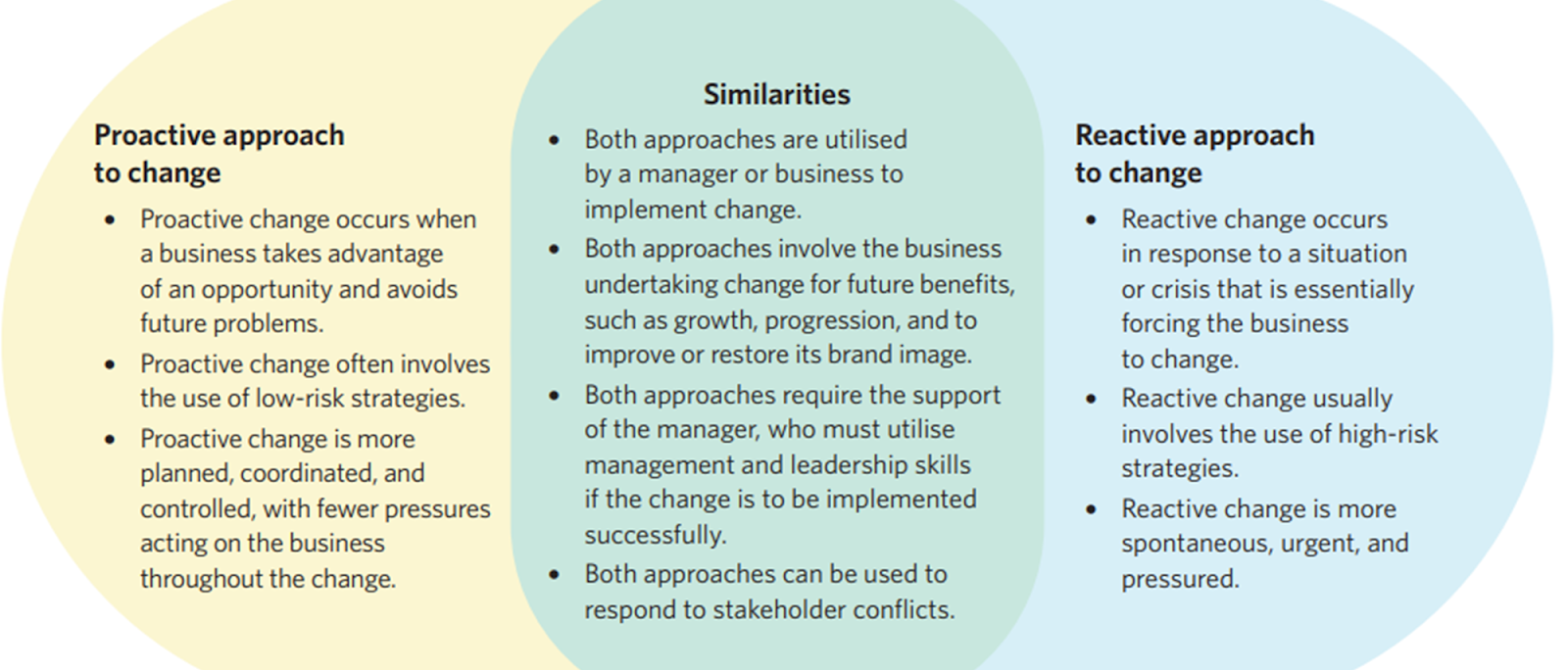
- Proactive change anticipates future business impacts and implements changes to minimise them.
- Reactive change is implemented due to a situation that has already been impacted.
- Incremental change is less traumatic and part of natural business development.
- Transformational change results in major business alterations, often initiated by critical events like a dramatic drop in financial performance.
KPI’s
Key Performance Indicators
- Measure a business's efficiency and effectiveness in achieving objectives.
- Show management areas that are doing well, that could be improved and whether set objectives are being met.
- KPIs should be relevant, reliable, comparable, and measurable.
- Data should come from trustworthy sources and be collected appropriately.
- KPIs should not be anecdotal and should be compared to an objective or time period.
KPIs - efficiency and effectiveness
Business Performance Evaluation
- Managers assess key processes and effectiveness of the business by evaluating the use of resources to achieve objectives.
- Efficiency in converting inputs into outputs is crucial.
- Inefficient goal achievement can lead to financial losses and business failure.
- Key performance indicators provide information on specific business areas.
What information do KPIs provide to the business and management? How can KPIs be analysed?
It is important for you to understand the relationship between the KPIs and different areas of management within the business.
percentage of market share
- Measures a business's sales compared to industry totals.
- Measured by dividing sales by total market sales.
- Increase in market share indicates successful performance and market control.
- It signifies taking market share away from competitors.
Percentage of market share represents the percentage of an industry or market’s total sales that is earned by a particular company over a specified time period. Market share is calculated by taking the company's sales over the period and dividing it by the total sales of the industry over the same period. For example, a company sales of 30,000 units out of a total sales in the industry of 100,000 is 30% market share.
Net Profit Analysis
- Net Profit is the remaining amount after deducting expenses from revenue.
- Expenses are costs incurred from operations.
- Revenue is the sum of all income generated from business activities.
- A business cannot make a profit by increasing sales if expenses also increase.
- A profit indicates successful performance, while a low or negative profit suggests problems like reduced sales, poor customer service, or inadequate expense management.
Rate of productivity growth
- Productivity growth refers to the increase in outputs compared to inputs used over time.
- It involves the ability to produce more goods or services with the same inputs.
- Productivity improves when fewer inputs are used or more output is produced from the same input.
- The rate of productivity growth measures the change in productivity in one year compared to the previous year.
- An example is Susan, a chef who learns to cook faster by attending a cooking school, increasing her human capital and labour productivity.
# of Sales
- Sales refer to the total quantity of goods or services sold by a business over a specific period.
- Measuring sales helps evaluate business performance, especially marketing strategies.
- Rising sales can aid in business planning, budgeting, and product mix adjustments.
- Sales increase doesn't necessarily imply business success; some businesses sacrifice short-term profit to establish market share or improve cash flow.
# of customer complaints
- Number of customers reporting dissatisfaction over time.
- Unhappy customers can negatively affect future sales and profits.
- Complaints may suggest need for staff training, product redesign, or production changes.
Explain what an increase in the number of customer complaints from 10 to 200 per month may indicate and then propose two strategies to respond to this data.
A large increase in customer complaints indicates a large level of customer dissatisfaction with the goods and services currently being produced by the business enough to make them complain directly to the business and may easily translate into future lost sales. Two strategies to resolve this could include; improvements in quality such as improving quality control checks to prevent faulty products reaching the customer and potentially implementing quality assurance or TQM. Another strategy would be to implement staff training to identify and correct faults on the production line through the use of discussion quality circles to prevent errors occurring.
ACCC suing Airbnb over allegations of misleading Aussie customers
Australian Competition and Consumer Commission (ACCC) sues Airbnb for misleading Australians about accommodation prices.
- Allegations: Airbnb falsely represented Australian accommodation prices from January 2018 to August 2021.
- ACCC claims: Prices displayed with only a dollar sign, without specifying the amount related to the US currency.
- ACCC estimates users paid $200 more than planned after being charged in US dollars.
Rates of staff absenteeism
- High absenteeism may indicate low morale.
- Reduced productivity due to absenteeism.
- Low absenteeism indicates job satisfaction.
- Absenteeism is a significant business cost, causing productivity drop or increased costs.
Level of staff turnover Overview
- Measured annually, not including redundancy or downsizing.
- Decrease in turnover indicates satisfaction with work conditions.
- Increased turnover leads to recruitment and training costs, productivity loss, and knowledge loss.
- Healthy staff turnover stimulates innovation and new ideas.
- Major changes or significant turnover are warning signs for a business.
Level of Wastage in Production
- Defines the amount of resources or goods discarded during production.
- Defines avoidable loss of valuable items through underutilization, decay, erosion, or destruction.
- Relates to all resources, including labor, time, and money.
- Measures operational efficiency and reduces production costs.
- Reducing waste may lead to fewer resources used, benefiting the environment.
Website Hits Analysis
- Indicates customer engagement and interest in a business's online presence.
- High hits indicate easy navigation and efficient online presence, potentially increasing sales opportunities.
- Low hits suggest poorly designed platforms or ineffective online purchasing.
- Analytical data can reveal specific products or areas of customer interest.
1.The human resource manager is concerned about the number of employees leaving the organisation?
2.A manager is concerned about the high number of staff sick days compared to last year.
3.Shareholders want to know how the organisation is performing.
4.The marketing manager would like to know about customer satisfaction with the organisation.
5.The operations manager wants to know whether resources are being used properly.
6.The marketing manager would like to check the percentage of company sales in the market place.
7.A manager wishes to gauge how safe the workplace is.
Two KPI’s to measure staff morale.
- Rates of staff absenteeism,
- Level of staff turnover
- Two KPI’s to measure financial performance
- Percentage of market share,
- net profit figures,
- rate of productivity growth,
- number of sales
- Number of website hits
A KPI’s to measure a safe working environment.
- number of workplace accidents
Driving forces
(for change in business)
- Promote and support business change.
- Guide change implementation.
- Successful change occurs when driving forces outweigh restraining forces.
- Stem from internal and external business operations.
- Arise from business objectives and human resources.
Driving force | Explanation |
|---|---|
Owners |
|
Managers |
|
Employees |
|
Pursuit of profit |
|
Reduction of costs |
|
Competitors |
|
Legislation |
|
Globalisation |
|
Technology |
|
Innovation |
|
Societal attitudes |
|
Restraining forces
for change
Managers |
|
|---|---|
Employees | Employee Resistance to Change
|
Time | Time as a Restraining Force:
|
Organisational inertia | "If it’s not broken, Why Fix It?"
|
Legislation |
|
Financial considerations |
|
Force Field Analysis
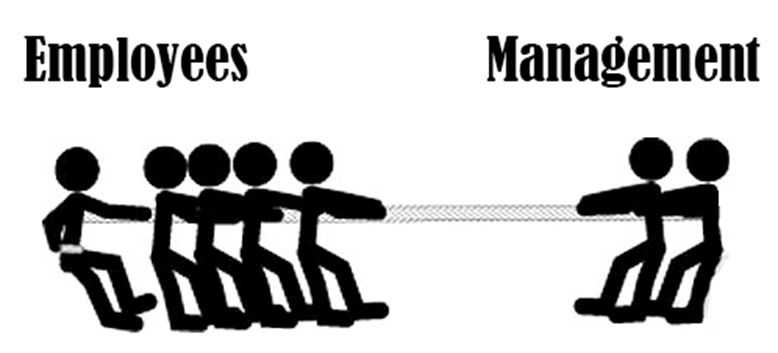
- Management must commit to change for success.
- Change can be challenging and day-to-day tasks can distract from business future.
- Consider the impact of change on stakeholders.
- Plan accordingly to ensure successful change.
- Consider employees, customers, shareholders, and other stakeholders.
Force Field Analysis
Kurt Lewin's Force Field Analysis
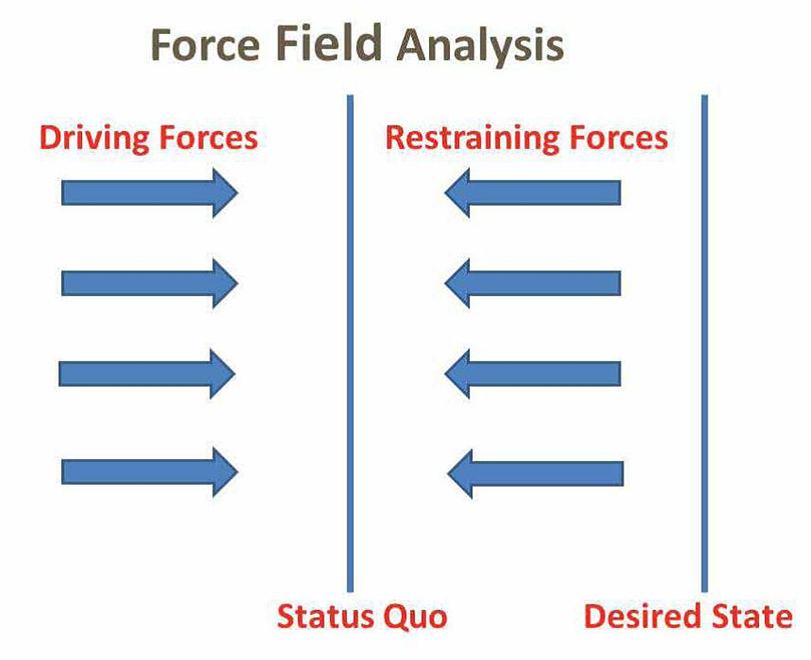
- Examines driving forces and restraining forces in achieving change.
- Driving forces must break through the status quo and restraining forces to achieve desired state.
- Equilibrium between the two forces is necessary for change.
- Driving forces must exceed restraining forces for change to occur.
- Success of change is likely when driving forces are more dominant.
- The theory focuses on the desired business change.
 me
me
the principles
of the force field analysis
Force Field Analysis Overview
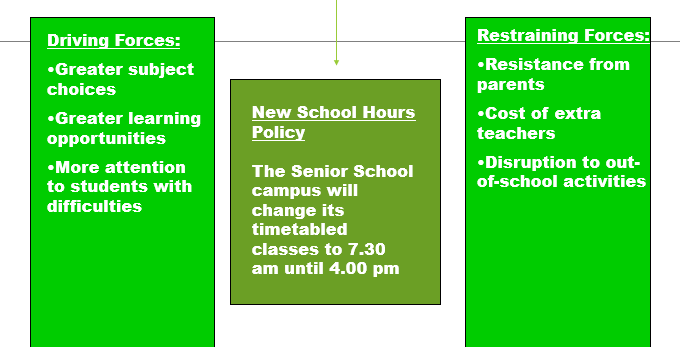
• Helps understand pressures for and against decisions or changes.
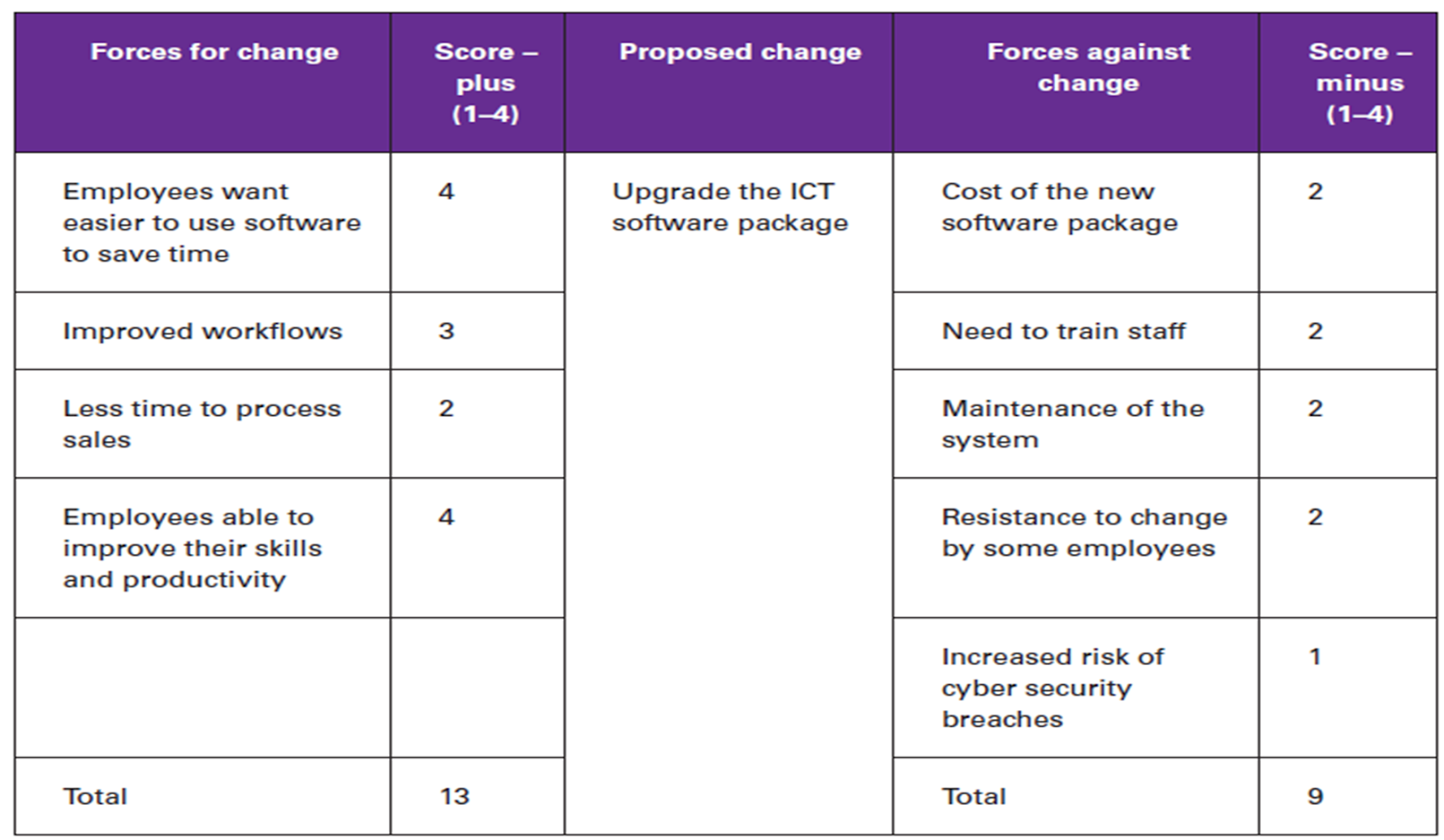
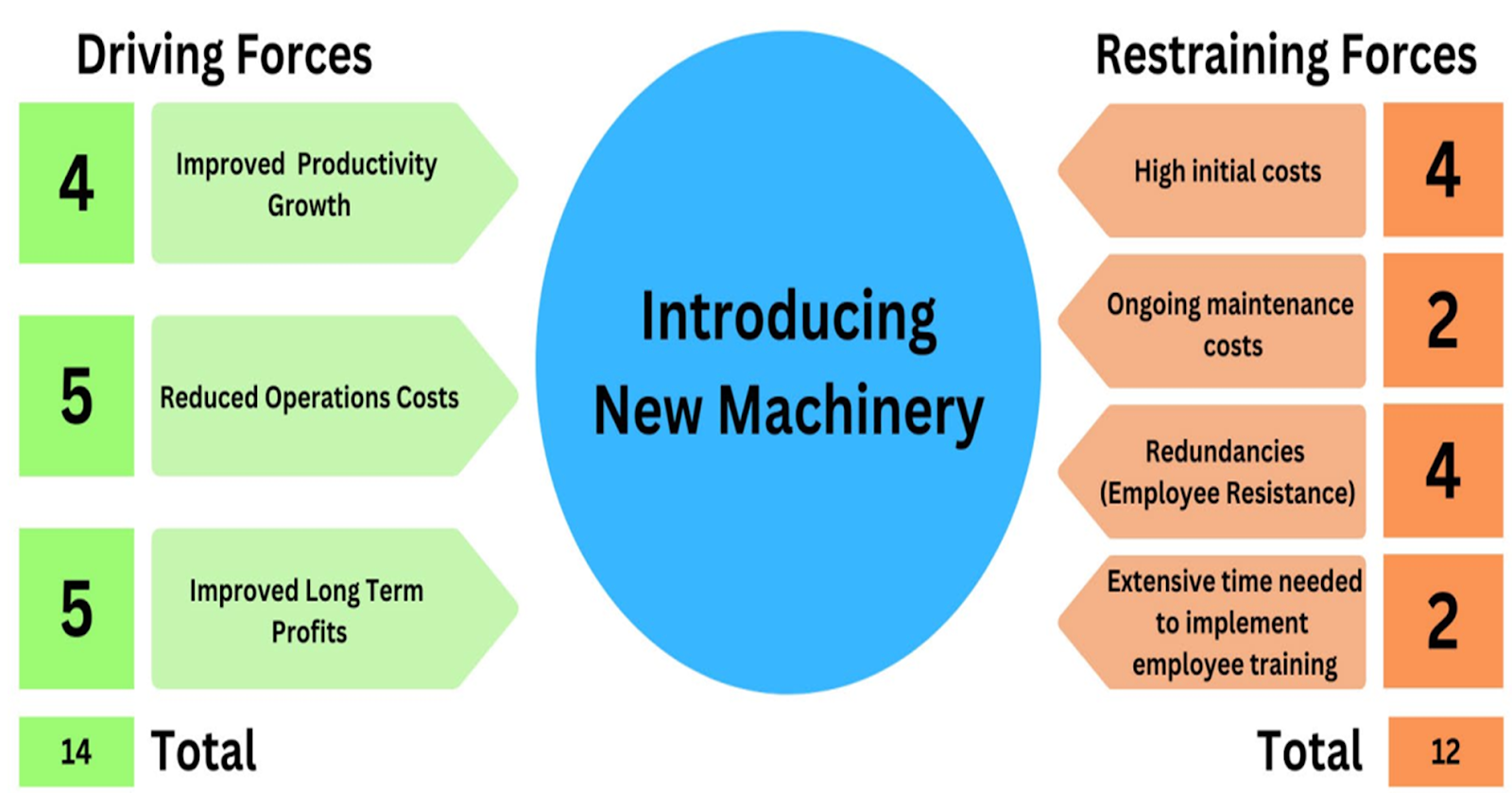
- Weighting process involves scoring and attributing values to driving and restraining forces.
- Identifies driving forces (promoting change) and restraining forces (resisting change).
- Weighting ranges from 1 (low score) to 5 (high score).
- Ranking Process
- Weighing scale assigns values for driving and restraining forces.
- Scores are calculated to determine overall score.
- Ranking arranges forces in order.
- Action required when restraining forces outweigh driving forces.
- Ranking helps identify strengths for driving forces and restraining forces for removal or minimization.
- After Ranking the forces: Businesses should implement a response based on the strength of driving or restraining forces.
- Successful change occurs when driving forces are stronger than restraining forces.
- Action plan:
- Details necessary actions, responsibilities, resources, and deadlines for task completion.
- Outlines strategies to strengthen driving forces and weaken restraining forces.
- evaluating the response is the Final stage involves assessing successful implementation of change.
- Compares actual change to anticipated change.
- Uses KPIs to measure change success.
- Positive change evaluation indicates KPI targets met.
- Negative evaluation may require redo of Force Field Analysis.
- Frequent evaluation of change impact is crucial.
benefits
Force Field Analysis in Change Management
- Early evaluation of 'for's and against' factors in change management.
- Examination of successful implementation of changes.
- Communication of change benefits to employees.
- Identification of future challenges for strengthening supporting forces.
- Time-saving by promoting and limiting main driving forces.
- Cost-effective implementation of change where success is likely.
disadvantages
- Time-consuming, especially for mandatory changes like legislation.
- Requires business resources at business cost.

porter’s generic strategies (1985)
- Explains change management for competitive advantage.
- Contemporary strategic management approach.
Flight Booking Choices: Cheap, No-Frills, Luxury, and Smaller Companies
• No-frills airlines aim to cut costs and pass savings on to customers at lower prices.
• Luxury airlines focus on excellent service, resulting in higher prices.
• Smaller airlines leverage their detailed knowledge of a few routes to offer better or cheaper services.
• Each airline has chosen a different approach to gain a competitive advantage in a crowded marketplace.
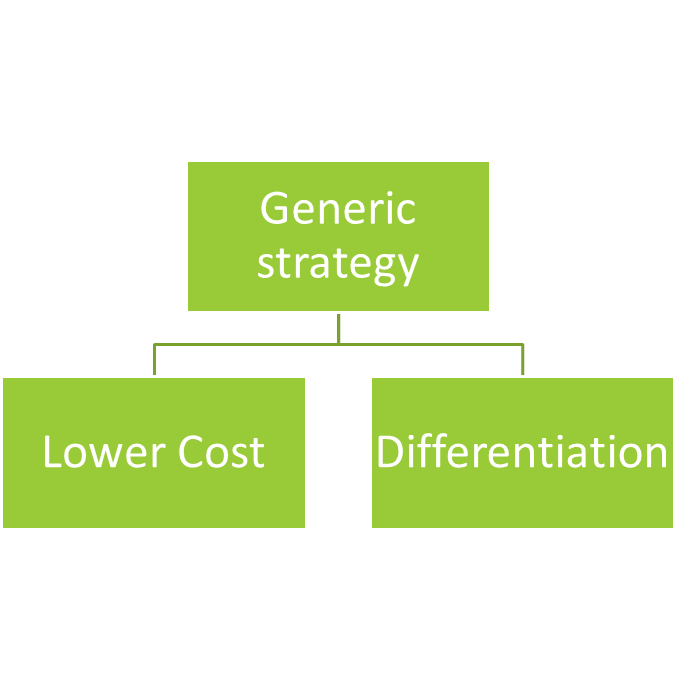
- Porter called the generic strategies “Lower Cost" (no frills) and "Differentiation" (creating uniquely desirable products and services).
Porter's Five Competitive Forces for Businesses
- Entry of New Competitors: Businesses must adapt to attract new competitors to maintain market share.
- Threat of Substitutes: Customers can find similar products or services.
- Bargaining Power of Buyers and Suppliers: Buyers can reduce supplier prices.
- Bargaining Power of Suppliers: Suppliers can raise prices.
- Rivalry among Existing Competitors: The number and capability of competitors.
Lower Cost Strategy
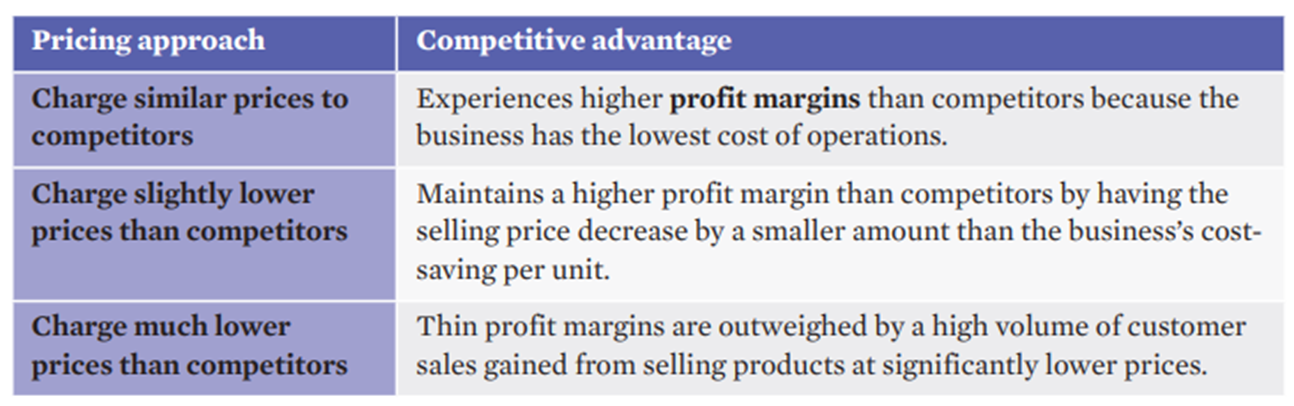
- Aims to gain competitive advantage by minimising product and service delivery costs.
- Customer cost is a separate issue.
- The strategy focuses on being the industry or market leader in cost.
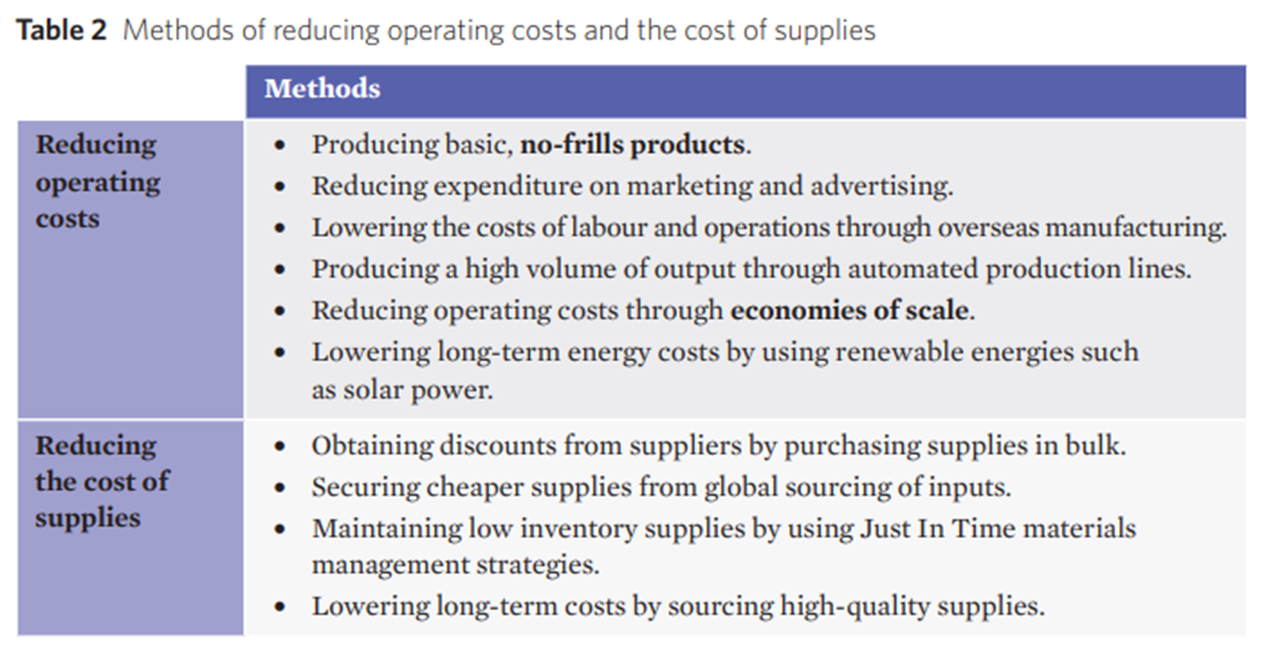
Cost Reduction Implications
• while it aims to reduce costs.
- Potential for reduced consumer value.
- Potential for sales decrease.
- Business detriment.
sum
• Focuses on cost reduction.
• Targets broad market.
• Achieves competitive advantage by reducing costs.
• Beneficial for price-sensitive customers.
• Importance of customer value in cost reduction strategies.
strengths | weaknesses |
|---|---|
|
|
differentiation strategy
- Unique features of products or services that are perceived value to customers.
- Depending on industry and product/service nature.
- Involves features, functionality, durability, support, and brand image.
- Success requires good research, development, innovation, high-quality products/services, and effective sales/marketing.
- Large organisations need agility in new product development to avoid multiple market segment attacks.
Procurement, Patents, and Marketing Overview
- Procurement: Purchasing premium inputs.
- Patents: Protecting product uniqueness.
- Niche Marketing: Effective segment-specific sales campaigns.
- Relationships: Forming high-profile/talented personnel.
- Innovation/Technology: Introducing new processes.
- Training: Enhancing employee skills.
- Distribution: Improving delivery systems.
- Development of unique products or services valued by customers.
- Value added by uniqueness may allow premium pricing.
- Can be based on product image, durability, after-sales, service quality, or additional features.
- Requires flair, research capability, and strong marketing.
strengths | weaknesses |
|---|---|
|
|
sum
Porters generic strategies are
- Lower cost
- Differentiation
• Strength: Provides strategic focus for business competitiveness.
• Weakness: Suggests businesses should focus on one strategy rather than implementing both.
• Warning: Avoids "hedge your bets" by following multiple strategies.
• Cost Leadership: Requires detailed internal focus on processes.
• Differentiation: Requires an outward-facing, creative approach.
Similarities:
- Both aim to gain a competitive advantage
- Both look to maximise profits
Differences:
• Lower cost: Reduces expenses while charging industry average prices.
• Differentiation: Higher expenses passed on to consumers as unique product/service.
• Lower cost: Offers product at industry average price with no frills.