Old Age
Aging
• The population over the age of 60 is growing faster than other age groups
• 53 million people over the age of 65 live in the U.S. In the next decade, that number is projected to grow to 74 million
• Members of this age group have been particularly concerned about maximizing longevity and quality of life
• The prospect of losing memory and independence is among the most feared aspects of aging. More than half of adults over the age of 65 have concerns about their memory
Theories of Socioemotional Development
Erikson’s Theory:
Integrity vs Despair: involves reflecting on the past and either piecing together a positive review or concluding that one’s life has not been well spent
Life review: looking back at one’s life experiences, evaluating them, and interpreting/reinterpreting them
Regrets:
education, careers, marriages, finance/money, family conflict and children’s problems, loss and grief, and health
Making downward social comparisons
Resolving regrets following the death of a loved one
Reminiscence therapy: discussing past activities and experiences with another individual or group
Selective Optimization with Comparison Theory: successful aging is linked to three main factors:
Selection: older adults have a reduced capacity and loss of functioning, which require a reduction in performance in most life domains
Optimization: it is possible to maintain performance in some areas through continued practice and the use of new technologies
Compensation: older adults need to compensate when life tasks require a higher level of capacity
Activity Theory: the more active and involved older adults are, the more likely they are to be satisfied with their lives
Socioemotional selectivity theory: older adults become more selective about their social networks, spending more time with individuals with whom they have had rewarding relationships
Old Age
Cognitive aging
Role in society
Loneliness
Ageism
Cognitive Abilities
Cross-sectional studies suggest that many abilities decline with age
Some abilities are relatively stable in adulthood
Language abilities tend to be better with age
An examination of inequalities across countries shows us what might impact cognitive aging outcomes
Why is this important?
Intact cognitive functioning is related to autonomy, quality of life, and active aging
Cognitive impairment or dementia goes along with increased disability and higher health expenditures (Bonsang et al., 2012)
Determinants of old age cognitive inequalities may provide important information for public health and policymaking efforts
Oliviera et al. (2018)
Global evaluation of ineqaulities and cognitive aging
Significant long-term effects of past educational inequalities on inequalities in old age cognitive functioning observed in the present
Unequal opportunities for education stemming from differences in parental education and gender have important effects on the distribution of old age cognition
Countries that experienced a large gender gap in education are showing higher old age cognitive inequalities
Gender disparity
More woman than men died from dementia in 2016
The age standardized death rates in women were also higher than in men, in line with a higher prevalence in woman than in men, indicating the female predominance wasn’t simply due to the longer lifespan of women
Promoting successful cognitive aging
Krivanek et al. (2021)
Epidemiological evidence suggests that up to 35% of dementia cases may be due to modifiable risk factors, and that healthy lifestyles can offset genetic risk of developing dementia (Livingstone et al., 2020)
What to recommend?
Phsyical exercise
Avoiding traumatic brain injury (safer sports)
Mild alcohol intake
Manage visual and hearing impairments
Good quality sleep
Address sources of stress
No good evidence for: statins, supplements
Personality, the self, and society
Self-esteem tends to decline significantly in the 70s and 80s because of:
Being widowed, institutionalized, or physically impaired
Having a low religious committment
Declining health
Self-esteem decreases during adolescence, increases from 18 through the 20s, levels off in the 30s and 40s, increases during the 50s, decreases from the 70s onwards
Families and social relationships
In late adulthood, new friendships are less likely to be forged and close friends are chosen over new ones
Friendships are more important than family in predicting mental health
Individuals with close ties to friends were less likely to die
Unmarried older adults in a friend-focused network fared better physically and psychologically than other unmarried older adults with little friend contact
Social support
Convoy Model of Social Relations: individuals go through life embedded in a perosnal network of individuals to whom they give and from whom they receive social support
Social integration:
older adults have fewer peripehral social contacts and more emotionally positive contacts with friends and family
Emotional and social loneliness can affect the quality of marriage in older adults
Loneliness
Needs to be considered within the context of an individual’s age
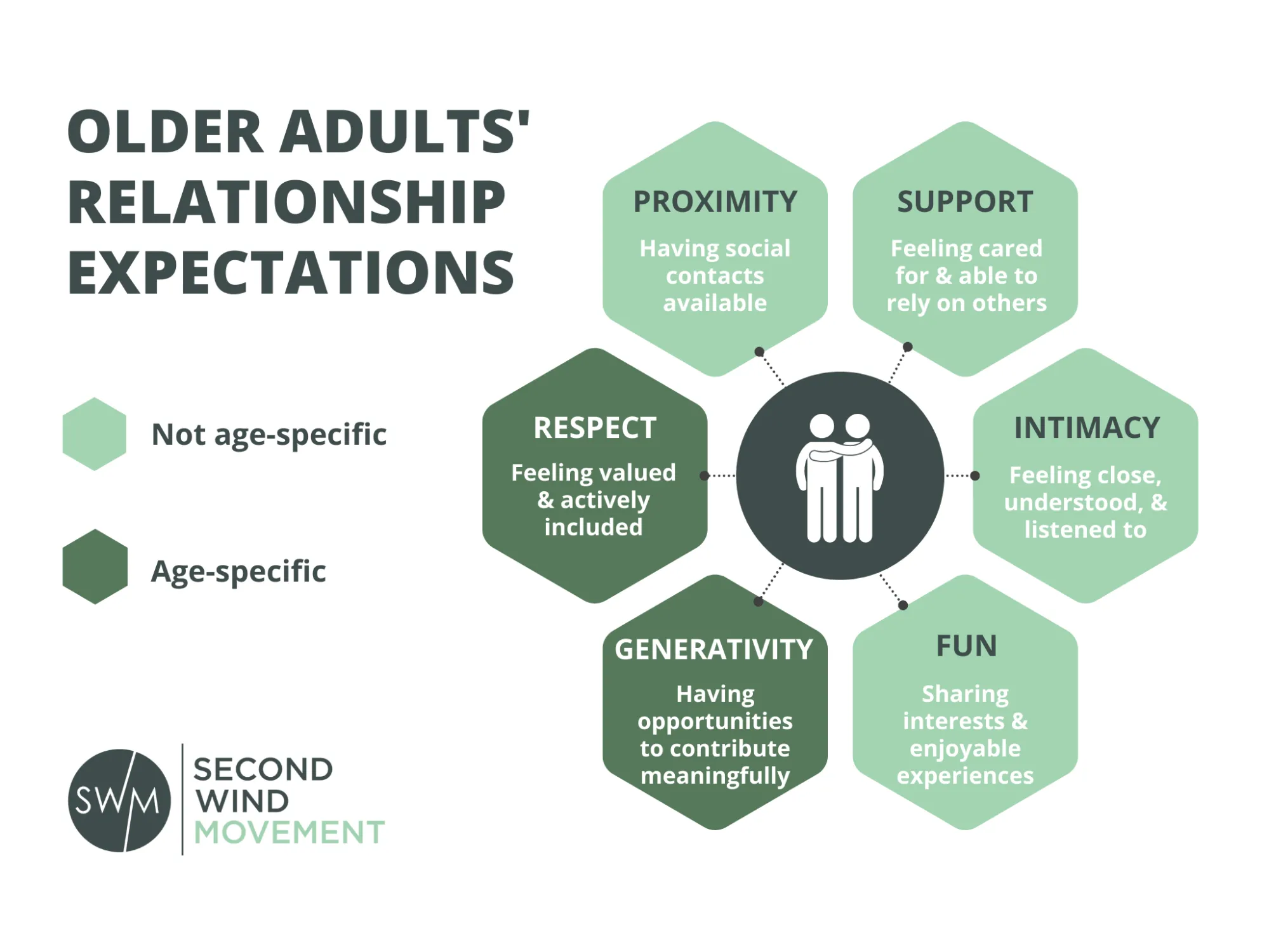
Samia Akhter-Khan’s work has sought to better understand loneliness in old age
This framework is based on research on older-adults reporting on their own feelings and experiences (Akhter-Khan, 2023)
Altruism and volunteerism
Older adults who had persistently low or declining feelings of usefulness to others had an increased risk of earlier death
Volunteering is associated with a number of positive outcomes
Including a reduction of loneliness (Akhter-Khan et al., 2023
Ethnicity
Elderly ethnic minority individuals face both ageism and racism
More likely to become ill but less likely to receive treatment
Many never reach the age of eligibilty for Social Security benefits
Despite stress and discrimination many ethnic minority individuals have developed coping mechanisms that allow them to survive
Successful Aging
Many abilities can be maintained and/or improved in older adults due to:
Proper diet
Active lifestyle
Mental stimulation and flexibility
Positive coping skills
Good social relationships and support
Absence of disease
A sense of self-efficacy
The impact of ageism
• Ageism has been proposed to manifest in at least three forms:
• negative attitudes towards older people, old age and the ageing process;
• discrimination or treating older people unfairly;
• implementing policies and practices that reinforce negative stereotypes of older people (Butler, 1980)
Ageism pervades many institutions and sectors of society, including those providing health and social care, the workplace, the media, and the legal system
Ageism often intersects and interacts with other forms of stereotypes, prejudice and discrimination, including ableism, sexism, and racism
Multiple intersecting forms of bias compound disadvantage and make the effects of ageism on individuals’ health and well being even worse
Lyons et al., (2018) chart the experience of ageism of over 2000 older adults
Clear relationships between subjective experience of ageism and mental health and stress outcomes - these also intersect with gender and sexuality
Changing attitudes
• Negative attItudes toward aging have been found across the lifespan, with much research showing that college students endorse stereotypes of older adults.
• Misconceptons include viewing older adults as inactve, irritable, unproductve, and worth avoiding (Wurtele & Maryuma, 2013)
Levy (2016) suggested two key theore#cal factors for reducing ageism as part of the PEACE (Positve Educaton about Aging and Contact Experiences) model:
• 1) education about aging
• 2) positive intergenerational contact
• Lytle et al (2020) present promising work in College students using ‘instapals’ – exchanging Instagram posts daily for one month
Intergenerational care
Intergenerational care – older adults and nurseries
• Pioneered in Japan from 1970s, gaining in popularity
Murayama et al (2019): intergenerational programs between older citizens and children can enforce neighborhood trust, thus strengthening a community’s intergenerational ties
Kamei et al (2011): In a weekly intergenerational care programme - Quality of life in relation to the me_ntal health of older people improved, while depression scores significantly decreased in the more depressed older people’s subgroup