Cell-The The Unit of Life
Introduction
The fundamental functional and structural unit of life is known as a Cell. Anything less than a complete structure of a cell does not ensure independent living.
Discoveries
- Robert Hooke (1665) discovered hollow cavities (empty boxes) like compartments in a very thin slice of cork (cell wall) with his crude microscope and named them as cellulae or cells. They were actually dead cells.
- Anton Von Leeuwenhoek first saw and described a live cell.
- Robert Brown later discovered and named the nucleus in a cell.
- J. E. Purkinje, used the term protoplasm for the living substance present inside the cell.
Cell Theory
- In 1838, German botanist named Matthias Schleiden observed many different types of plants which contained different types of cells and form tissues.
- Animal cells were studied by Schwann in 1839. He was a British Zoologist and according to studies he reported that cells have an outer layer which is known as Plasma membrane. He later concluded that the presence of the cell wall is uniquely present in plant cells.
- Later, both scientists worked together and formulated the Cell Theory. They both did not explain the origin of the new cell.
- Rudolf Virchow (1855) first explained that cells divide and new cells are formed from pre-existing cells (Omnis cellula-e cellula). He modified the hypothesis of Schleiden and Schwann to give the cell theory a final shape. Cell theory states that–
- All living organisms are composed of cells and products of cells.
- All cells arise from pre-existing cells.
- Membrane bound cell organelles of the protoplasm do not survive along or outside the protoplasm.
- All cells have similar fundamental structure and metabolic reactions.
- Genetic information is stored as DNA in the chromosomes present in the nucleus.
Overview of cell
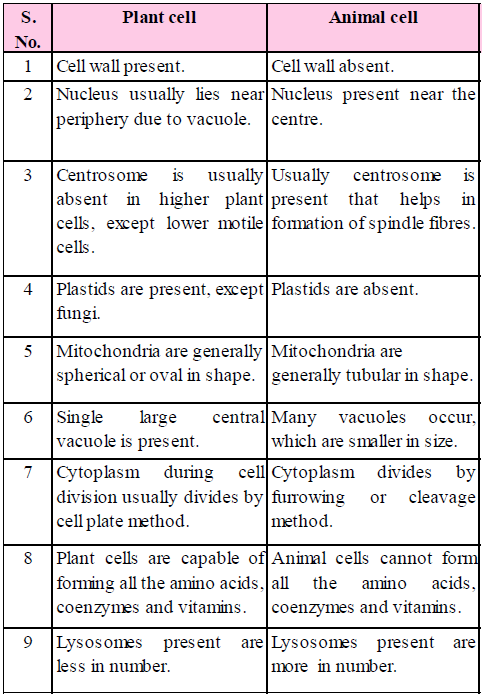
- The plant cells have a cell wall and within it is a cell membrane. The animal cells lack a cell wall and have an outer cell membrane as the delimiting structure of cell.
- Each cell has a dense membrane bound structure called nucleus which contains the chromosomes that in turn contains the genetic material, DNA. Cells that have membrane bound nuclei are called eukaryotic whereas cells that lack a membrane bound nucleus are prokaryotic.
- There is a fluid which makes the volume of the cell and is known as cytoplasm and it is present in both animal and plant cells. It is the main arena of cellular activities in both plants and animals. Chemical reactions occur in it to keep the cell in a living state
- The eukaryotic cells have membrane bound distinct structures called organelles like the endoplasmic reticulum (ER), the Golgi complex, lysosomes, mitochondria, microbodies and vacuoles. The prokaryotic cells lack such membrane bound organelles.
- Ribosomes are NON-MEMBRANE bound organelles found in ALL cells (prokaryotic and eukaryotic). Ribosomes are found in cytoplasm, chloroplasts(in plants), mitochondria and on rough ER.
- Animals contain NON-MEMBRANE organelle called centrosome which helps in cell division.
- Cells differ greatly in size, shape and activities.
Mycoplasmas (smallest cell)- 0.3μm
Bacteria- 3-5μm
RBC’s- 7μm
Largest isolated single cell- Ostrich egg
Longest human cells- Nerve cells
RBC’s: round and biconcave
WBC’s: ameboid
Columnar epithelial cells: long and narrow
Nerve cells: branched and long
Tracheid: elongated
Mesophyll cells: round and oval
Types of Cell
Depending upon the nature of the nucleus, cells are classified into prokaryotic and eukaryotic cells.
Prokaryotic Cells
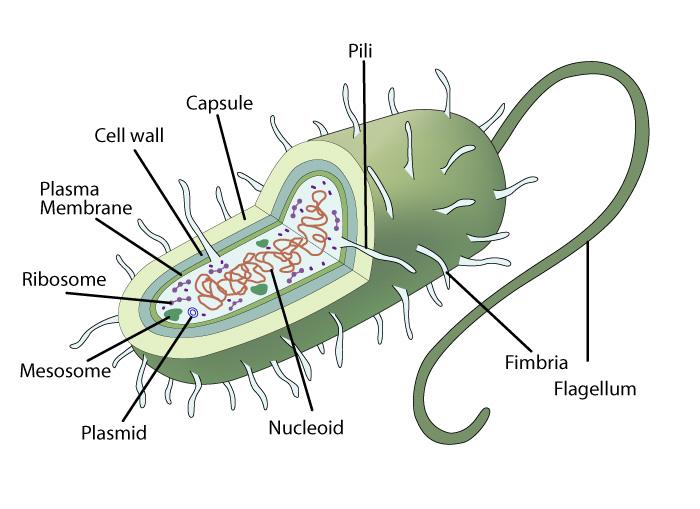
- They are typically unicellular organisms**, e.g., bacteria, blue-green algae, mycoplasma and PPLO (Pleuropneumonia Like Organisms).**
- Smaller and multiply more rapidly than the eukaryotic cells.
- The four basic shapes of bacteria are bacillus (rod like), coccus (spherical), vibrio (comma shaped) and spirillum (spiral).
- All prokaryotes have a cell wall surrounding the cell membrane EXCEPT IN MYCOPLASMA.
- The fluid matrix filling the cell is the cytoplasm.
- The genetic material is naked circular DNA, not enclosed by a nuclear envelope.
- Many bacteria have extra small circular DNA called plasmids that confers certain unique phenotypic characters to such bacteria, e.g., resistance to antibiotics. Plasmid DNA is used to monitor bacterial transformation with foreign DNA.
- Ribosomes are present
- On the plasma membrane, there are some circular coiled bodies called mesosomes which are simply infoldings of the plasma membrane.
1. Cell envelope
- There is a covering on prokaryotic cells which protects them from injuries and shocks. The covering is known as the cell envelope.
- The cell envelope consists of a tightly bound three layered structure i.e., the outermost glycocalyx followed by the cell wall and then the plasma membrane.
- Glycocalyx: The layer could be thick or could be loose. If it is thick and tough, it is called capsule and if it is loose it is called slime layer. Glycocalyx is made up of macromolecules. It provides protection against phagocytosis and antibiotics.
- Cell wall: It lies below glycocalyx and is made up of peptidoglycan. Cell wall provides shape and structural support to the cell and protects bacteria from collapsing or bursting.
- Plasma Membrane: This is the innermost layer and it is semi-permeable. It prevents leakage from the cell and allows the exchange of material inside and outside of the cell.
- Bacteria can be classified into two groups on the basis of the differences in the cell envelope and the manner in which they respond to the staining procedure developed by Gram viz., those that take up the gram stain are Gram positive bacteria (e.g., Streptococcus, Staphylococcus, Bacillus, Mycobacterium, Streptomyces etc.) and the others that do not are called Gram negative bacteria (e.g., Salmonella, Pseudomonas, Escherichia coli, Rhizobium, Helicobacter etc.)
2. Cytoplasm
- It is a semi-fluid structure wherein all the parts of the cell float. It makes up the volume of the cell. There are different types of cell organelles found in the cytoplasm
3. Mesosome
- When plasma membrane extends into the cell in the form of tubules, vesicles and lamellae it is called mesosome. It is a membranous structure. They help the cell in performing various functions like:
- Cell wall formation
- DNA replication and distribution to daughter cells
- Cellular respiration and secretion
- Increases the surface area of the plasma membrane and enzymatic content
4. Chromatophores
- In some prokaryotes like cyanobacteria, there are other membranous extensions into the cytoplasm called chromatophores.
- They contain pigments like chla, β-carotene, myxoxanthophyll, myxoxanthin C- phycocyanin and C-phycoerythrin.
5. Cell extensions
- Motile bacteria have thin filamentous extensions from their cell wall called Flagella.
- Bacterium flagella are composed of three parts- basal body, hook and filament.
Filament is the longest portion and extends from cell surface to outside.
- There are structures which are non-motile and are known as pili and fimbriae.
- Pili are made up of special protein and are elongated tubular structures.
- Fimbriae are bristle-like structures which spike out of the cell. They attach to other bacteria and host tissues as well.
6. Ribosomes
- Small structures which are associated with plasma membrane are called ribosomes.
- 15nm to 20nm in size
- Prokaryotes have 70s ribosomes which are made up of 30s smaller subunits and 50s larger subunits.
- Several ribosomes may attach to a single mRNA and form a chain called polyribosomes. They are the site of protein synthesis.
7. Inclusion bodies
- Reserve materials are stored in the cytoplasm in the form of inclusion bodies.
- Not bound by any membrane and lie free in cytoplasm.
- E.g., phosphate granules, cyanophycean granules and glycogen granules.
- Gas vacuoles are found in blue green and purple and green photosynthetic bacteria.
Eukaryotic Cells
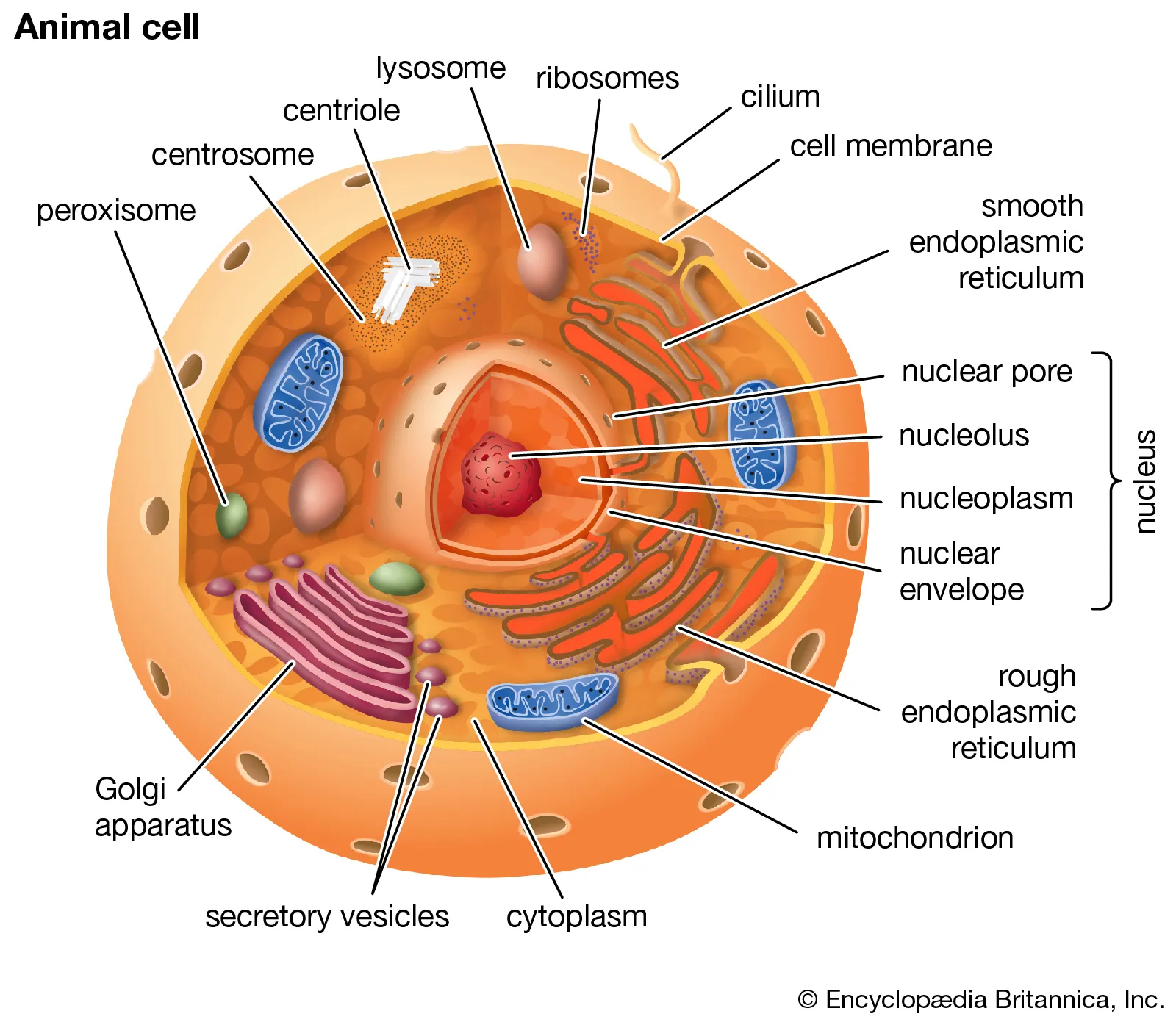
- The eukaryotes include all the protists (unicellular eukaryotes), plants, animals and fungi.
- An organized nucleus is present. It contains hereditary material covered on the outside by nuclear envelope.
- Genetic material is well organized into chromosomes.
- Eukaryotic cells have a variety of locomotory and cytoskeletal structures.
- All eukaryotic cells are not identical, e.g., plant and animal cells.
1. Cell membrane
- Every living cell is externally covered by a thin, elastic, regenerative and selectively permeable membrane called plasma membrane.
- The Plasma Membrane of a cell is made up of a Lipid bilayer with proteins embedded in it, which is composed of lipids. Lipoproteins form the 60% of the cell membrane.
- \