GENBIO (Q4) (COPY)
hi read mo muna ako
- hi ito ung ginigatekeep kong site HAHAHAH parang lng siyang notion x quizlet, pero libre siya
- Notes lahat yung nasa baba
- Pero mas reccomended ko gamitin ung flashcard function, pindutin mo lng ung “View flashcards”
- “View flashcards” > Learn > tpos ayun, pumili ka kung gusto mo may true or false, multiple choice, pero yung go to ko para makapagmemorize is yung “written” lang yung nakacheck
- Pwede lng siya online, notes and yung flashcards, pero kung gusto mo idownload yung notes, idownload mo na lng ung mismong website
Male Reproductive System
- Testes - Ovoid structures about 5 cm long and 3 cm wide.
- 7th or 8th month - The descent of the testes occurs
- Scrotum - Where the testes is located, Sac of skin that hangs outside the abdominopelvic cavity
- Cryptorchidism - is the most common genital problem encountered in pediatrics, It is the failure of the testes to descend into the scrotal sac.
- Inguinal Hernia - If an inguinal canal enlarges or ruptures which a loop of intestine can protrude
- Spermatogonium - Immature sperm cells, develop in the embryonic testes from primordial germ cells that arise from the yolk sac, from sperm stem cells
- Orchiopexy - is a surgery to move and/or permanently fix a testicle into the scrotum
- Scrotum - Sac of skin that hangs outside the abdominopelvic cavity at the root of the penis
- 3*C - Its external positioning keeps the testes ___ lower than core body temperature
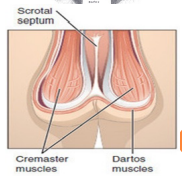
- Wall of the Scrotum - Dartos muscle and the Cremaster Muscle
- Dartos muscle - In the dermis, there is a thin layer of smooth muscle that has contractions of this muscle causes wrinkling of the skin
- Cremaster muscle - is a thicker layer of muscle that lowers and raises the testes based on temperature.
- Scrotal Septum - middle line, divides the scrotum into two sacs \n
- Tunica vaginalis - Each testes is enclosed by this, a continuation of the peritoneum that lines the abdominopelvic cavity.
- Tunica albuginea - A fibrous capsule covers each testis
- Testicle - One of two egg-shaped glands inside the scrotum that produce sperm and male hormones
- Spermatic Cord - Contains the structures running from the testicles to the pelvic cavity.
- Vas Deferens, Nerves, Blood Vessels - Contents of Spermatic Cord
- Epididymis - where the sperm is stored and to transport sperm from the rete testes to the vas deferens
- Seminiferous tubules - Each lobule contains 3 or 4 highly coiled
- Seminal Vesicles - Lie on the posterior wall of the bladder and secrete 60% of the volume of semen
- 60% - secrete ?? of the volume of semen
- Seminal fluid - fluid from the prostate and other sex glands that helps transport sperm out of the man's body during orgasm
- Fructose and Fibrinogen - Two types of seminal fluids
- Fructose - provides energy for the sperm.
- Fibrinogen - helps turn semen into a bolus that can be readily propelled into the vagina.
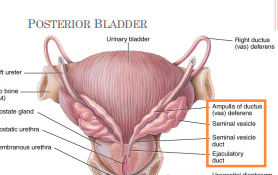
- Prostate Gland - Doughnut-shaped gland that encircles part of the urethra inferior to the bladder, Plays a role in the activation of sperm, Enters the prostatic urethra during ejaculation
- Citrate and Proteolytic enzymes - Prostatic Secretion includes..
- Citrate - is a food source
- Proteolytic enzymes - acts to "decoagulate" the semen that was coagulated by seminal vesicle secretions, which helps the sperm begin their journey once inside the vagina
- Bulbourethral glands - also known as cowper’s glands
- Bulbourethral glands - Pea-sized glands inferior to the prostate
- Alkaline mucus - Bulbourethral glands produces ??? prior to ejaculation that neutralizes traces of acidic urine in the urethra
- Penis - body is found externally, conveys urine and semen
- Corpus Cavernosum and Corpus Spongiosum - two tissue types of erectile tissue surrounded by connective tissue
- Corpus Cavernosum - large spaces
- Corpus Spongiosum - smaller spaces
- Prepuce or Foreskin - Glans penis covered with a loose fold of skin
- Pelvis - root of the penis is attached
- Prostatic Urethra - runs through the prostate, connects to ducts from the prostate and to the ejaculatory duct
- Membranous urethra - between prostate and penis
- Spongy urethra - through the erectile tissue of the penis
- Urethra is a passageway for both urine and male reproductive fluids.
- Epididymis - Storage and maturation area for sperm
- Seminiferous tubules - produces sperm
- Head - contains DNA & the nucleus with ___ highly condensed chromosomes (one chromatid) and has a helmet like acrosome containing hydrolytic enzymes that allow the sperm to penetrate and enter the egg
- Midpiece - contains mitochondria spiraled around the tail filaments
- Tail - a typical flagellum produced by a centriole
- Acrosome - containing hydrolytic enzymes that allow the sperm to penetrate and enter the egg
- Testis > Epididymis > Vas Deferens > Ejaculatory duct > Prostate Gland > Prostatic urethra > Bulbourethral gland > Membranous urethra > penile urethra
- Ectoderm, Mesoderm, Endoderm - Germ layers
- Mesoderm - the germ layers that reproduce
- High glycemic index - Glucose’s index
- Low glycemic index - Fructose’s index
- 23 - chromosomes in sperm
Female Reproductive System
- Ovaries - are solid, ovoid structures, about 2 cm in length and 1 cm in width.
- Uterine tubes, uterus, and vagina - Accessory organs
- Uterine tubes - Receive the ovulated oocyte and provide a site for fertilization
- Isthmus - Empty into the superolateral region of the uterus
- Ampulla - Expand distally around the ovary forming ??
- Fimbriae - The ampulla ends in the funnel-shaped, ciliated infundibulum containing fingerlike projections
- Uterus - Hollow, thick-walled organ located in the pelvis anterior to the rectum and posterosuperior to the bladder
- Body - Major portion of the uterus
- Fundus - Rounded region superior to the entrance of the uterine tubes
- Isthmus - Narrowed region between the body and cervix
- Endometrium - the most active layer and responds to cyclic ovarian hormone changes
- Stratum functionalis - Shed during menstruation
- Stratum basalis - Replaces stratum functionalis each month
- Myometrium - 3 layers of smooth muscle
- Perimetrium - Visceral peritoneum
- Cervix - Narrow lower neck of the uterus which projects into the vagina inferiorly
- Cervical canal - cavity of the cervix that communicates with the vagina and the uterine
- Cervical glands - secrete mucus that covers the external os and blocks sperm entry except during midcycle
- Vagina - Thin-walled tube lying between the bladder and the rectum, extending from the cervix to the exterior of the body
- Hymen - mucosa near the vaginal orifice forms an incomplete partition
- Vulva - is the collective name for the external female genitalia located in the pubic region of the body.
- Mons pubis - fatty pad over the pubic symphysis
- Labia majora & minora - folds of skin encircling vestibule where find urethral and vaginal openings
- Clitoris - small mass of erectile tissue
- Bulb of vestibule - masses of erectile tissue just deep to the labia on either side of the vaginal orifice or urethral orifice.
- Perineum - Area between the vagina and anus
- Bartholin's glands - are located on each side of the vaginal opening, They secrete fluid that helps lubricate the vagina
- Vestibular glands - also known as bartholin's glands
- Bartholin's cyst - Fluid backs up into the gland and causes swelling
- Oogonia - an immature female reproductive cell that gives rise to primary oocytes by mitosis.
- Myometrium - the muscular outer layer of the uterus., it contracts during labor to push the baby out.
- 7 mil eggs - How many eggs does a woman have
- 1 mil eggs - How many eggs that is born
- 300k eggs - How many eggs that will reduce by the time a woman reaches puberty
- 300 to 500 eggs - How many eggs that can be fertilized
Menstrual Cycle
- Menstrual Phase - The uterus sheds its inner lining of soft tissue and blood vessels which exits the body from the vagina in the form of menstrual fluid.
- Day 1 to 5 - The days of the menstrual phase
- 10 ml to 80 ml - How much blood loss is considered normal in menstrual cycle
- Abdominal cramps - caused by the contraction of the uterine and the abdominal muscles to expel the menstrual fluid
- Follicular Phase - it starts with your estrogen hormone telling the lining of your uterus to thicken and develop to prepare for a fertilized egg.
- Day 1 to 13 - The days of the follicular phase
- Pituitary gland - secretes a hormone that stimulates the egg cells in the ovaries to grow.
- Follicle Stimulating Hormone - stimulates your ovarian follicles to grow
- Follicle - One of these egg cells begins to mature in a sac like structure
- 13 days - It takes this duration of time for the egg cell to reach maturity.
- Endometrium - its follicle secretes a hormone that stimulates the uterus to develop a lining of blood vessels and soft tissue
- Ovulation phase - This surge in estrogen triggers a spike in a third hormone
- Day 14 - The days of the ovulation phase
- Luteinizing hormone - is what makes a follicle rupture and release an egg
- Fimbriae - are finger like projections located at the end of the fallopian tube close to the ovaries
- Luteal phase - During ovulation, the egg bursts from its follicle
- Day 15 to 28 - The days of the luteal phase
- Corpus luteum - the follicle transforms into a structure
- Estrogen & Progesterone - Two types of steroid hormone
- Menstruation - The drop in progesterone levels causes the lining of the uterus to fall away
Plant Reproduction
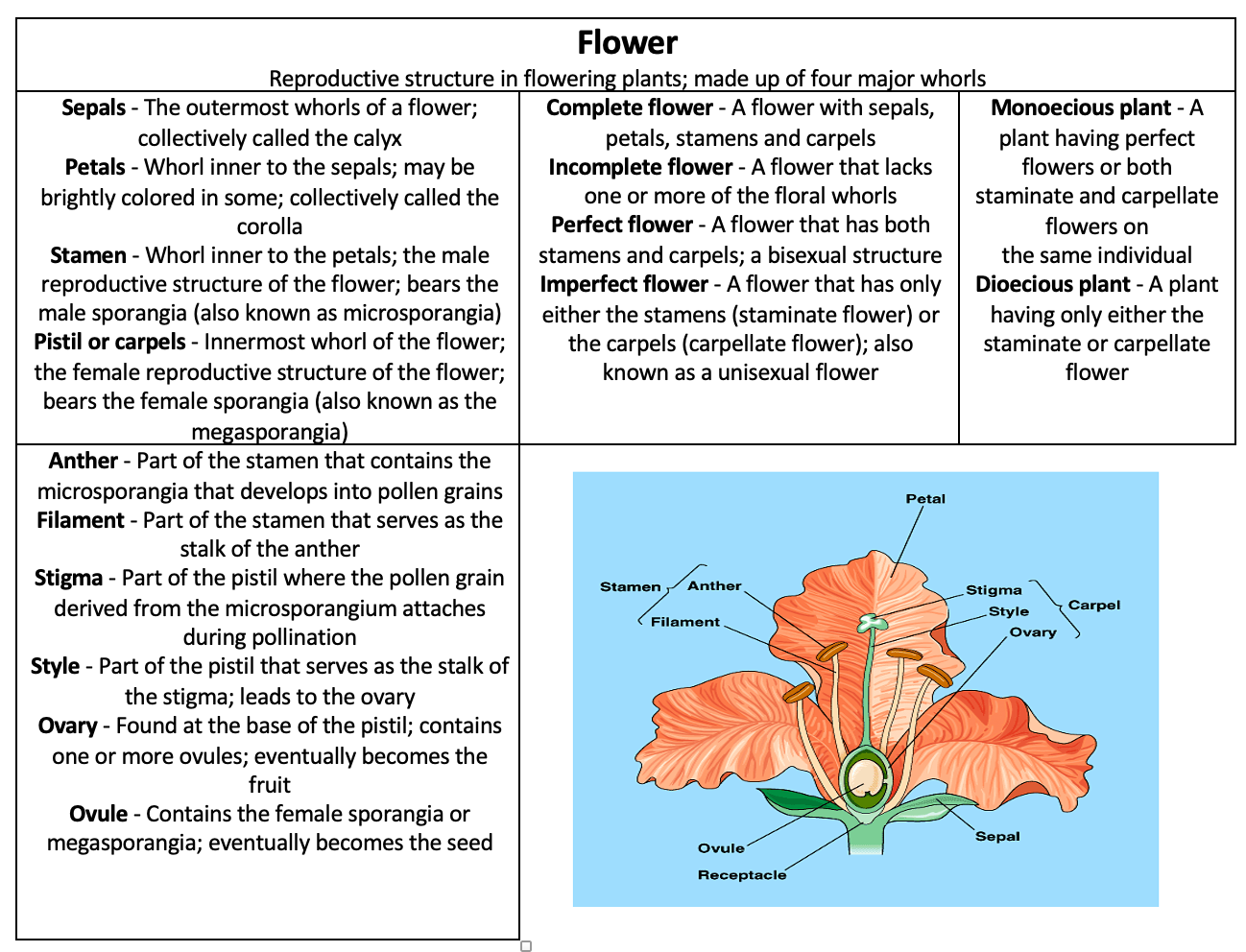
- Flowers - Reproductive structure in flowering plants; made up of four major whorls
- Angiosperms - plants that produce flowers and bear their seeds in fruits. They are the largest and most diverse group within the kingdom Plantae
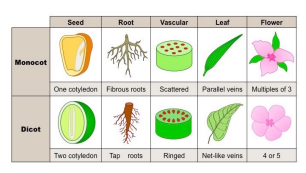
- Monocots - have one seed leaf (cotyledon)
- Dicots - have 2 seed leaves (cotyledons)
- Sepals - Whorl of sterile leaflike structures. Protect other flower parts.
- Petals - Whorl of sterile flower parts. Attract pollinators.
- Stamens - Male reproductive flower structure. produces pollen
- Anther - pollen producing sac.
- Filament - stalk of the stamen
- Carpel - Female reproductive flower structure Produce embryo sac (eggs).
- Stigma – receives the pollen.
- Style – stalk of Carpel
- Ovary – contains the ovules.
- Ovule - A rudimentary seed before fertilization.
- Complete Flowers - have all four whorls.
- Incomplete Flowers – less than all four whorls.
- Perfect Flowers - have stamens and carpels. Bisexual
- Imperfect Flowers - have stamens or carpels Unisexual
- Pollination - The transfer of pollen from a stamen to the stigma.
- Monoecious plant - A plant having perfect flowers or both staminate and carpellate flowers on the same individual
- Dioecious plant - A plant having only either the staminate or carpellate flower
- Microsporangia - male sporangia
- Megasporangia - female sporangia
Asexual vs Sexual Reproduction
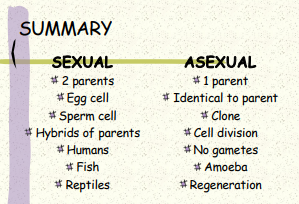
- Asexual reproduction - one organism produces one or more new organisms that are identical to itself and that live independently of it, One parent is involved
- Cell division and asexual reproduction are the same thing in all single-celled organisms
- Binary fission - process by which parent cell splits producing two independent daughter cells that are identical to the parent cell
- Budding - process in which an organism develops tiny buds on its body.
- Budding - it forms a complete or nearly complete new organism that is genetically identical to the parent
- Yeast and hydras - reproduced by budding
- Vegetative Propagation - results in a new plant that is genetically identical to the parent plant (a clone).
- Regeneration - process by which body of parent breaks and produces offspring
- Salamanders - in the larval stage, it can regenerate a limb in thirty to forty days
- Lizards - it has the ability to replace lost limbs or a lost tail. This is important because when a predator such as a hawk captures the tail, it can escape. The new tail lacks the backbone of the original tail.
- Sporulation - Spore formation
- Spores - are produced and each spore develops into offspring which are identical to parent
- Rhizopus - Black bread mold
- Sexual Reproduction - a type of reproduction in which male and female reproductive cells combine to form offspring with genetic material from each parent, two parents involved
- Genetic Diversity - the range of different inherited traits within a species
- Internally - The egg is fertilized by sperm inside the female
- Externally - The egg is fertilized by sperm outside the female, The female lays the eggs and then the male fertilizes them